Showing posts with label soviet union. Show all posts

Tuesday, November 7, 2017

'Land, Peace, Bread' - and Tragedy

'Land, peace and bread.' Sounds great, doesn't it?
Every day, countless people pass by this mural on 26th St. not far from the Universidad Nacional, but I bet few recognize the catastrophic significance of what the dove is advertising.

'Land, peace and bread,' such beautiful sentiments, was the slogan of the 1917 Russian Revolution, which introduced the world to communism and its famines, totalitarianism and mass-murder. Because the Nazis gave right-wing fascism such a bad name, communism's sins are less well known. But The Volokh Conspiracy, a libertarian blog, uses the commonly cited figure of 100 million communist murders, including the Ukranian famines, Mao's Great Leap Forward and Cambodia's Killing Fields.

Nevertheless, the dream lives on, to a greater or lesser extent, in places like the nearby Universidad
The communist 'Voz' magazine celebrates
the Russian Revolution.
Nacional, whose marchers often carry images of Cuban revolutionary Che Guevara. But one doesn't have to look any further than Venezuela to see the impacts of a sort of socialism and a planned economy: People there are hungry, medicines are unavailable, crime has skyrocketed and Venezuela just entered hyperinflation. Meanwhile, its incompetent government is turning more and more authoritarian. Many thousands of Venezuelans have fled to Spain, Florida and Colombia - depriving the country of its most talented and educated young people. (Which why communist nations had a habit of building walls around themselves to keep their people in.)

It also provides a hint of what might have happened here in Colombia if the FARC had somehow obtained power. The mural was commissioned, incidentally, by the government of Bogotá Mayor Gustavo Petro, a one-time leader of the M-19 guerrilla movement.)

The paradoxical thing, of course, is that communism is based on wonderful ideals: equality, cooperation, from each according to his ability, to each according to his need. And on and on. Unfortunately, the tools those governments used to reach those goals - such as totalitarianism and forced collectivization of farms - clashed terribly with human nature.

If only communism were possible, then this would be a much better world. But it isn't, unfortunately.

By Mike Ceaser, of Bogotá Bike Tours

Thursday, November 3, 2011

A Visit to the Leo Tolstoy Cultural Center


Tolstoy, the immortal Russian author,
who died 101 years ago this month. 
The Leon Tolstoy Cultural Center in the middle of La Candelaria sits like an institution out of time and of place. Like the nearby French and American cultural centers, the Tolstoy center teaches culture and language, in its case Russian. But unlike those other institutions, the Tolstoy center is small, neither shiny nor glitzy, evidently surviving on a shoestring budget and is filled with an atmosphere of nostalgia rather than contemporary events.

A look at the center's history explains why. The Centro Cultural Leon Tolstoi was founded in 1944 by the Soviet Union, just as the Allied victory over Nazi Germany and its allies was becoming inevitable, to promote communist ideology here. In conjunction with such cultural centers in Colombia and other nations, the Soviet Union gave scholarships to students from all over the world, who it hoped would return home infused with socialist idealism.

Detail of a mural by Fernando Oramas.
But after the Soviet Union collapsed in 1991 that support disappeared. The Russian state, no longer communist, continues collaborating with the center, but only with occasional visits and donations of books and other items. The Tolstoy cultural center now survives by providing translations and music lessons. Five of the center's officials have been awarded the Lenin Peace Prize, now renamed the Order of Druzhba, the center's cultural director told me.

Today's Russia has a corrupt form of crony capitalism, which has produced a crop of multi-billionares. It is ruled by a few strongmen thru a contolled democracy and intimidated media. But at the Tolstoy Center here in La Candelaria, one might think that the old Soviet Union continued. There are the traditional Russian robes, the heroic mural by the entrance, the busts of Lenin and famous cosmonaut Yuri Gagarin. A plaque on the center's front wall celebrates the Soviets' victory over Nazi fascism, forgetting that the Soviet Union then imposed its own form of fascism on half of Europe.
Lenin still presides here. 

I talked to the center's cultural director, who lamented that the Soviet Union's economic system was ruined by 'ambitious men.' I agreed. Ambition is what makes both communism and capitalism such lousy systems - with the difference that capitalism actually rewards and harnesses that ambition. And, when it works right, that ambition can benefit lots of people, as did the ambitions of American billionare Steve Jobs and Colombian billionare Julio Santo Domingo.
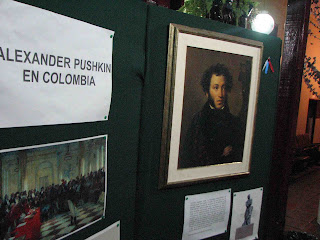
Right now, the center is commemorating
poet Pushkin, a giant of Russian literature.
The director also lamented Colombia's terribly unequal income distribution and its its emphasis on war. Those are two very real problems, but the second does ignore the fact that Colombia's armed conflict responds to violence against the Colombian people by armed guerrillas who espouse a Marxist ideology, altho they don't practice it. The cultural director expressed understandable disappointment with many of Colombia's leftist politicians - Bogotá's current mayor, Samuel Moreno, of the leftist Polo Democratico Party, is in prison on corruption allegations and the previous mayor, from the same party, recently allied himself with conservative ex-President Alvaro Uribe.

Traditional Russian robes. 
But Bogotá's Mayor-elect Gustavo Petro got his start as a leader of the M-19 guerrillas, and has maintained a principled leftist ideology. Perhaps his victory will give the lie to the guerrillas' strategy of armed rebellion. She didn't give me a clear response.

 Most likely, the Tolstoy Center in La Candelaria will maintain its ideology from another era, a sort of museum to a nation which espoused an idealism which failed - and got swept out of history.
The Leo Tolstoy Center is located on Calle 12c between Carreras 3 and 4. Besides teaching music and language, the center also holds cultural events including Russian movies and music events. Find them on Facebook under Centro Cultural Leo Tolstoi in La Candelaria.


Commemoration to the Soviet Union's victory over the Nazis. 

Russian matryoshka dolls. 


By Mike Ceaser, of Bogotá Bike Tours

Wednesday, March 23, 2011

A Glimpse of Historical Tragedy


Sometimes, people with the right knowledge can turn a curiosity into a window on historical tragedy.

This tomb in Bogotá's Central Cemetery stood out because it might be the only one whose text is not in either Spanish or Latin. How did a lone Pole end up in this city with few immigrants? It looked to be one of many stories lost to history. Then a young Polish couple did the bike tour, and opened up a window for me.

The man's title on the tomb told the couple that Mieczysław Chałupczyński had been a member of the Polish government - yet, Bogotá was an unlikely place for a Polish politician to end his career. However, from the tomb's text and the place and date of death, 1946, the Polish couple inferred that his was not just any Polish government. The man had evidently been a member of Poland's government in exile which operated in London during the Nazis' WWII occupation of their country.

A bit of googling told me more: just before World War II, Mieczysław Chałupczyński had been Poland's charge de affaires in Slovakia, were he tried desperately to find allies against the impending invasions by giant neighbors Germany and the Soviet Union. His efforts failed, and Slovakia participated in the German invasion of Poland - only to be itself swallowed up by its totalitarian neighbors.

Chałupczyński presumably escaped to London and joined the government in exile, which called itself Free Poland. He became his government-without-a-state's ambassador to Colombia, which had broken relations with Germany in 1941. Colombia declared war on Germany in 1943.

In 1944, Chałupczyński undoubtedly participated in the creation of the Association of Poles in Colombia

However, after Nazi Germany's defeat, Chałupczyński's hopes for an independent Poland were shattered again. The Soviet Union occupied his homeland and imposed a new type of totalitarianism on the country which had just suffered through five years of war, Nazi occupation and the Holocaust

For Chałupczyński, returning home would have meant suicide. The Soviets tried to stamp out all traces of Polish nationalism, and a patriot like Chałupczyński would have been murdered or shipped off to a Siberian slave labor camp. Then, in December 1945, insult followed injury when Colombia recognized the 'Provisional Government of National Unity' in Poland, a Soviet-created puppet. Two months later, Chałupczyński died, perhaps of a broken heart, an ambassador whose nation had disappeared. He was only 53. 

But the Polish community who buried Chałupczyński so humbly did assert their national pride in one subtle way. The Soviets had removed the crown from the white eagle on Poland's coat of arms, but the eagle on Chałupczyński's tomb still wore it. 

Sadly, sometime during the last 65 years, the coat of arms was stolen, probably by a drug addict who sold the metal for a few pesos. Chałupczyński apparently has been forgotten by the Polish-Colombian community as well. Also, beside Chałupczyński's tomb is an empty one. Was this intended for his wife? Where did she die? That's a mystery which is probably lost to history.

As for the Polish couple, who are from Krakow, they described their nation as divided between younger progressive people and strict religious and cultural conservatives, but independent and moving forward as a member of the European Union. 

Perhaps from somewhere above Chałupczyński is looking on from somewhere above, proud that his nation is finally free and independent. 

A plaque placed in the Central Cemetery in 2012 by the Polish Embassy commemorates an earlier Polish immigrant, who fought for Colombia's independence.  

By Mike Ceaser, of Bogotá Bike Tours
