Showing posts with label newspapers. Show all posts

Thursday, September 25, 2014

What El Tiempo Forgot to Mention

'Successful debut for Aval on the New York Stock Exchange.' Aval's owner, it just so happens, also owns El Tiempo.
If you read yesterday's El Tiempo you learned that Grupo Aval, the huge Colombian banking group, made a successful initial offering on Wall Street - altho it didn't make quite as big a splash as did Alibaba.

'Wall Street welcomes
Grupo Aval's Shares
.'
But Colombia's leading newspaper neglected to mention that Aval and El Tiempo share the same owner, billionaire Luis Carlos Sarmiento. The news wasn't necessarily distorted - Reuters and Fox business news also described the offering as successful. But you could question the huge spread Sarmiento's newspaper gave his bank. Other Colombian media also reported the offering, but made it their second or third story. 
The website La Silla Vacia also pointed out that El Tiempo has given much less coverage to other stock offerings, including even that of EcoPetrol, Colombia's national oil company, in 2008. La Silla Vacia also observed that El Tiempo gave flattering attention to a highway project in which Sarmientos has interests.

El Tiempo has the right to splash whatever it wants across its pages, and readers have the right to judge the paper's credibility. But in the United States and other nations it's basic journalistic ethics to mention possible conflicts of interest in reporting. Take, for example, the Washington Post's coverage of Amazon Corp. and its owner Jeff Bezos, who bought the newspaper last year.

When Sarmiento, Colombia's richest man with a fortune of $17 billion, purchased El Tiempo in 2012 he probably saw it mostly as a trophy. But when he did so, he promised that the paper's coverage would not be biased by his business interests. Now, the more that he uses it to blow his own horn, the less respect it'll bring him. 

For its part, El Tiempo's smaller but older rival El Espectador has belonged since 1997 to Colombia's second-richest family, the Santo Domingos. A glance at El Espectador's coverage of one of the family's other prominent properties, La Cerveceria Bavaria, finds a lot of flattering coverage, including the information that Colombia's beer consumption is still relatively low. 

I'll wait with bated breath for El Tiempo to do an exposé on Grupo Aval or one of its banks, or for El Espectador to uncover corruption inside Bavaria.

Latin American journalism, unfortunately, is known for corruption and favoring special interests. The ownership of Colombia's two most important newspapers by its two richest families is a test for whether journalistic ethics can stand up to economic interests, and the results don't look so encouraging.

By Mike Ceaser, of Bogotá Bike Tours

Tuesday, April 8, 2014

Can an English-Language Paper Survive?


It's not easy starting a newspaper these days, especially when it's a real one - printed on dead trees.

As a veteran of several newspapers - several of them sadly deceased - I'm a real believer in the printed word, as well as the role newspapers play in uncovering graft, telling truth to power, bringing new perspectives on old topics. Other media, such as video, just can't do the job with the same agility and detail.

But, as everybody knows, the traditional newspaper industry is in crisis, mostly due to the Internet, which places limitless information at our fingertips, instantly. Several big papers in the U.S. have folded, others slashed their staff (including stringers like myself). It's not so much because people are reading less, but because the advertising, which is historically the media's main income, has shifted to the Internet. At the same time, the Internet has filled with parasitical publications (read: Huffington Post), which take information generated by others, rework it and republish it as their own.

So, it's admirable to see someone launch The Bogotá Post, a new newspaper that's actually printed on paper.

I've got to hand it to this group. The Post contains real news and real stories by real writers. They evidently interviewed an Irish deputy minister visiting Colombia about Colombia's peace process. (He's optimistic, altho the two countries' conflicts have fundamental differences. And, was the IRA as corrupted as are Colombia's guerrillas by drug trafficking and human rights violations?) Jenny Boyle (it'd be nice to know who she is and how long she's lived in Bogotá and how she commutes) writes an opinion column criticizing the women-only cars in TransMilenio, which for her represent the city's resignation to an ugly element of human nature - men's sexual predation. (Unfortunately, human nature - and particularly male nature - is often ugly, and Bogotá can't easily change that.) The inaugural edition also includes a nice opinion piece by Briton Oli Pritchard about the wonders of bicycling in Bogotá. I'm afraid that Pritchard forgot to mention Bogotá's aggressive drivers and clouds of pollution, but it's still nice to see urban cycling praised - especially in an article that's not surrounded by auto ads.

Then there are some somewhat dated news articles about Gustavo Petro and a few predictable features about Usaquen and the monuments of San Agustin. (I couldn't tell whether the Post is meant to be a weekly, bi-weekly or monthly publication.)

What the Post's inaugural issue conspicuously lacks is much advertising - its only income, since the paper is free. Hopefully, that will come in future editions. But it'll be a challenge in the Internet age.

Sadly, my journalistic career is a trail of deceased and agonizing publications. I started out journalistically with the Florida Flambeau, a spirited, independent daily paper covering Tallahassee, Florida's universities. We published exposés and hard news, as well as sports. But the Flambeau died - beaten by a more commercial paper catering to the sororities and fraternities, according to this Wikipedia article. Several years and newpaper jobs later, I worked for the Bolivian Times, a weekly published in La Paz, Bolivia. The BT struggled along with a colorful and hard-working, but sometimes incompetent and occassionally drugged-out staff, an owner often more interested in flattering his elite friends than doing serious reporting, and Bolivia's dysfunctional economy. Nevertheless, we managed to do some interesting reporting. The BT finally died - perhaps deservedly - after many of us were stiffed of our salaries.

Recent years have not been easy for English language publications across Latin America, as English-language papers have folded not only in Bolivia, but also in Caracas and Mexico City, where the surviving Mexico City News saw its staff slashed a few years ago. Besides the Internet, such newspapers have also fallen victim to changing hiring policies. Foreign companies used to bring down foreign staff, but now tend to hire locals.

The Bogotá Post joins the Colombian capital's only other English-language print publication, The City Paper. I'm not sure how The City Paper, a monthly, has managed to survive the tough times for newspapers despite little advertising. I've enjoyed The City Paper's talented, sometimes magazine-quality photographs and features (detracted, unfortunately, by irregular editing). Both are in competition with the Internet-only, Medellin-based Colombia Reports, which publishes interesting articles, many of which however are recycled from the Spanish-language press.

Good luck to the Post. A new voice is always important. Let's hope this one lasts. 

By Mike Ceaser, of Bogotá Bike Tours

Sunday, August 5, 2012

Colombian History on Paper


The Candelaria's Luis Angel Arango Library, or BLAA, is holding this exhibit about Colombian newspapers' history, which the creators number at the good round number of 223 years.

Colombia, of course, has had a very eventful history, which has been reflected in its newspapers. And the newspapers themselves have been part of that history, for example with the assassination of El Espectador publisher Guillermo Cano (as well as killings and attacks on many others) and the car bombing of the newspaper's printing plant, both planned by Pablo Escobar. For their part, the media-savvy M-19 'invaded' sympathetic newspapers, to give them a justification for publishing the guerrillas' propaganda. Less dramatically, many journalists from all types of media have been forced into silence or exile by threats. 
The Avianca building in flames in 1973.
Perhaps paradoxically, and in contrast to the newspaper industry in developed nations, Colombia's dailies are healthy. Despite Bogotá's high poverty rate and illiteracy problem, the city has a half dozen dailies, ranging from El Tiempo and El Espectador, to sports sheets and sensationalist tabloids given to featuring gruesome crimes and naked women. Newspapers continue to thrive here thanks in part to the nation's strong economy and to low Internet penetration - altho that will inevitably change - and to the fact that the country's two richest families now own the capital's two leading papers.

For all of their weaknesses and errors, newspapers have played a vital role in informing the public and exposing corruption and misdeeds, and lets hope that they can continue doing, whether on paper or in cyberspace.

Crowds pay homage to politician Jorge Eliecer Gaitan after his 1948 assassination. 


A sharp commentary: Uncle Sam stabs
Colombia in the back by stealing Panama. 


Novelist Gabriel Garcia Marquez's Nobel Prize award in 1982.


One of Bogotá's first papers, circulated after the 1785 earthquake. 

To Arms! War with Peru in 1932! (Colombia's one and only foreign war, not counting independence.

Crusading El Espectador publisher Guillermo Cano is assassinated by Pablo Escobar.


A paper reports on the M-19's 1980 takeover of the Dominican Republic's embassy. 

A photo of Bogotá mayor and ex-M-19 guerrilla leader Gustavo Petro. In the background is the old Justice Palace, which the M-19 attacked, disastrously, in 1985.


By Mike Ceaser, of Bogotá Bike Tours

Tuesday, March 20, 2012

Money Mates With Media - Once Again


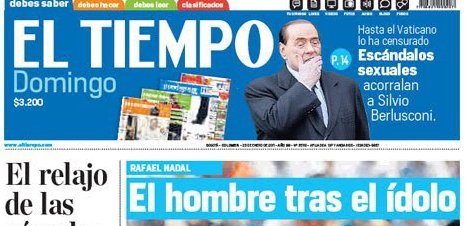
An El Tiempo headline reports about Italian media mogul Silvio Berlusconi. 

Colombia's richest man has purchased Colombia's most important newspaper.

That's good news for those of us who want newspapers to survive in the digital age, but potentially worrisome for those who want them to be independent critics of the powers that be.

Five years ago, some observers worried about how the conservative Spanish-based Planeta media group would change El Tiempo when it purchased the paper in 2007 from the Santos family, its historic owners. But El Tiempo, founded in 1911, has continued covering government scandals and editorializing in favor of drug decriminalization.

Luis Carlos Sarmiento
Now Planeta has sold Colombia's leading paper - perhaps to shore up its books amidst Spain's ongoing economic crisis - to Luis Carlos Sarmiento, Colombia's richest man. El Tiempo did not turn out to be a bad investment for Planeta - El Colombiano reports that Planeta sold its majority share in the paper for $100 million more than it paid. Now, how will El Tiempo cover industries in which Sarmiento holds interests, such as real estate, banking and agriculture, infrastructure, hotels, mining and innumerable other areas?

For a business magnate, a newspaper is much more than a simple investment. It's also a political and economic tool for influencing public opinion and furthering his interests. It's also a sort of a trophy, demonstrating the man's importance. Perhaps Sarmiento, the world's 64th-richest person with a fortune of more than $12 billion, according to Forbes, didn't want to be overshadowed by the Santo Domingo family, which owns El Espectador, Bogotá's other major daily. So, personal honor will hopefully motivate Sarmiento to maintain the paper's reputation in order to protect his own reputation. At age 79, Sarmiento is no youngster and has to be thinking about his own legacy.

El Tiempo amidst Bogotá's colorful press. 
In her El Tiempo opinion column Maria Isabel Rueda argues that the billionare Santo Domingo family, owners of the Bavaria beer company and other industries, has maintained El Espectador's journalistic tradition. I have seen good recent journalism in El Espectador, but also lots of fluff, like headline stories about the IPhone's arrival in Colombia. And, has El Espectador ever investigated, for example, the beer industry?

El Tiempo, of course, has never been free from potential conflicts of interests. Its historic owners, the Santos family, have produced several vice presidents and presidents, including Juan Manuel Santos (and family members continue owning a minority stake in the paper). And some El Tiempo critics have pointed to drug lord Pablo Escobar's bombing of El Espectador's building and his assassination of its editor Guillermo Cano as evidence that El Tiempo was intimidated by the drug cartels' threats.

Sarmiento's intentions sound good. In an interview with El Colombiano, he emphasized newspapers' vital role in a democracy. "They come out every day, watching, criticizing problems, suggesting improvements, trying to fix problems," Sarmiento said.

El Tiempo's historic building on Jimenez Ave. and Carrera 7.
The paper's new headquarters on 26th St. is on
valuable real estate. 
The newspaper industry has suffered severely in recent years, hit particularly hard by the Internet, which has sucked away much of papers' advertising. Some major U.S. newspapers have folded, while others are near bankruptcy. Acquaintances at El Tiempo have told me of lay-offs there, too. But despite all of this, most reporting is still done by newspapers.

By buying El Tiempo, Sarmiento also gets a prime piece of real estate in west Bogotá, television stations and a leading spot in the competition for rights to a third national television network to compete with RCN and Caracol.

Whatever the dangers and advantages of magnates owning media, we'd better get used to it. In the Internet age, with traditional media wobbling, only deep pockets may enable them to survive at all.


By Mike Ceaser, of Bogotá Bike Tours

Friday, February 10, 2012

A Sad Adiós to the Colombian Miami Herald

A past edition of the Miami Herald's international edition.
Last year, a familiar and surprising publication appeared on Bogotá newspaper stands: the international edition of the Miami Herald.

It lasted about one year, and I always wondered how it could survive in a nation in which few people read the news in English, and those who do do it mostly on the Internet. This year, I haven't seen the Herald on newsstands.

In reality, it was mostly New York Times stories below the Herald's masthead. I occasionally purchased the paper, in part because it brought back memories of sitting down with the morning paper back home in the States. And, for all of the speed and convenience of the Internet, I still find reading on paper more satisfying. And, in fact, studies have found that people recall better what they read on paper than what they read on a computer screen. I also have a personal attachment to the Herald, since I contributed a few stories to them years ago, when they and other papers still had freelance budgets.

(Finally, I also have a guilty reason for preferring reading on paper: When you click on some sleazy, superficial headline about Michael Jackson or Britney Spears on the Internet, you know that some computer someplace is taking note and planning more such stories. But, when you read trash like that on paper, nobody else knows.)

Yesterday, Feb. 9, was the Day of the Journalist in Bogotá, designated by the Circle of Journalists of Bogotá.

Selling an international daily paper in English here had to be a challenge from the start when expatriates and tourists can instantly read the New York Times over the Internet. English-language newspapers in Latin America have also declined in recent decades because of changes in corporate hiring policies, as U.S.- and U.K-based companies have tended to hire more locals, who usually receive lower salaries.

The few English dailies remaining in the region include the Buenos Aires Herald, the Tico Times and The News in Mexico City. Of course, online publications have flourished. But most of those mostly copy or rewrite stories from other publications. For about three years around 2000 I wrote for the Bolivian Times. The Times did some bad, even irresponsible journalism, but also contributed a different opinion and informed. It's since folded, and despite my bad memories of being exploited by the paper's owner, the Times' disappearance was probably a loss for Bolivia.

Across the globe, newspapers are having hard times because of the Internet and other forces, as I, an ex-journalist, know well. In Colombia and much of Latin America, in contrast, newspapers are still going strong - thanks in part to a strong regional economy, to the limited Internet penetration and to wealth families who enjoy the status of running newspapers. But as Internet use spreads, Latin American newspapers will inevitably face the same challenges which U.S. and European are now.

Journalist Jineth Bedoya,
attacked for her work.
In recent weeks, Latin papers and other media have also faced threats from governments and illegal organizations. Ecuador's leftist government passed a law prohibiting journalists from reporting on elections - an obvious move to protect the government from press criticisms. An Ecuadorean court also fined two journalists $2 million for "humilliating" Pres. Rafael Correa with their investigative book about alleged corruption by the president's brother. Journalists' organizations have criticized the Ecuadorean government for these and other moves to muzzle the free press.

Meanwhile, Argentina has passed a law regulating paper sales - an obvious move by the government to intimidate the critical El Clarin media group.

In Colombia, meanwhile, the FARC guerrillas reportedly planned to murder a reporter who they believed to be an informant for the U.S. government and another who had written a book about the late FARC leader Mono Jojoy.

Also, Bogotá police prevented journalists from entering a court hearing on the killing by police of a young graffiti painter. Also, the year 2000 kidnapping and gang rape of Jineth Bedoya, a reporter with the El Espectador newspaper, remains unsolved.

In honor of Journalists' Day, the Circle of Journalists of Bogotá gave awards for outstanding journalists and journalism work in print, radio, TV and other 'net. Semana magazine won an award for 'The DAS's Secret Papers,' about the secret police agency's selling of classified documents.  Olga Beher also won an award for her book 'The Clan of the 12 Apostles,' about allegations of connections between paramilitary groups and powerful Colombians.

Those are a few of the reasons why print journalism continues to be so important and relevant.


By Mike Ceaser, of Bogotá Bike Tours

Wednesday, February 9, 2011

Today is Journalists' Day

In Colombia, journalism has historically been a very hazardous profession. According to a 2008 editorial in El Tiempo, Colombian journalists had been murdered at a rate of about ten per year, and about half of those killings were related to their work. The killings, of course, are only a fraction of the number of journalists who are quieted or driven out of their communities or even from Colombia by threats against them or their families.

By that standard, things haven't changed much. Last year, eight journalists were murdered, according to the Colombian Federation of Journalists, and 189 received threats. The federation's president, Eduardo Marquez, says that many of those threats have come from the government or current- or ex-government employees. In addition, he says, the fact that the government is the biggest single buyer of advertising gives it an undue influence.

Clodomiro Castilla Ospino,
murdered during 2010
Historically in Colombia, leftist guerrillas, right-wing paramilitary groups (who have often allied themselves with the government and businesses),  and narcotraffickers have all threatened and sometimes even murdered journalists. Seldom are those killings solved.

Still, Marquez says that the new administration of Pres. Juan Manuel Santos has been much more protective of journalists than was the previous administration of Pres. Alvaro Uribe, who sometimes expressed a somewhat paranoid belief that some journalists were working with guerrilla groups.

World-wide, counts of the number of journalists killed varied, as did calculations of whether the number has risen or declined.

Papers and magazines for sale in dowtown Bogotá.
By Mike Ceaser, of Bogotá Bike Tours