Showing posts with label handicrafts. Show all posts

Friday, May 15, 2015

Where Stones Become Jewels


Working the emeralds.
This afternoon, I visited one of the many emerald workshops around El Rosario Plaza. S mall place in a nondescript building, it turns out stones worth from a few bucks to thousands of dollars. Some of the products of this dark little den may later decorate the bodies of royalty and millionaires.

The most valuable stones from Bogotá's emerald district go to Japan, Hong Kong, New York and Europe. Like Colombia's coffee, the lower-quality stones stay here.

Emerald miner and trader Angel Torres, who showed me the workshop, told me that, even after centuries of exploitation, only a tiny percentage of Colombia's emeralds have been mined (but how can they possibly know?), so the industry has lots of life left in it. Torres also said that one large, foreign-owned mine has tunnels extending 4 or 5 kilometers underground. Talk about claustrophobia!
Rough emeralds, which will be slected, cut and polished.

Cut and polished emeralds.


Down below on Plaza Rosario two men study stones in what is the city's informal, open-air emerald market. 


Because of their pallid color, these stones will never be worth much.
The emerald cutters' building on the east side of Plaza Rosario.
Interested in emeralds? You can visit the workshop and learn about the stones by contacting Angel Torres at 312-752-9544 or angball40 (at) yahoo.es

By Mike Ceaser, of Bogotá Bike Tours

Saturday, June 28, 2014

Born Without Hands, She Needs No Handout


Morales and her niece in her shop near San Victorino Plaza.
Mastering their tightly woven craftwork is a challenge for any young woman of the Zenu indigenous people in Cordoba Department. But Odalis Yaneth Moralez Velásquez had an added obstacle: she was born without arms.

Nevertheless, when she was eight, Morales began learning to make her people's traditional handicrafts: with her toes.

Weaving with her toes.
"I said, 'if I can do other things with my feet, why can't I weave?'" she recalled.

At first, it was difficult: "What a normal person learned in a week," she said, "I learned in two months."

Made by toes, worn on the feet.
But Morales persevered and succeeded.

But then appeared of a terrible force nobody could cope with. In 2009, right-wing paramilitary groups, which roam much of Cordoba, murdered Morales' father and older brother and stole the family's property. She says she has no idea why.

Devastated, Morales fled to Bogotá.

"I had to start from scratch," she says.

A rare sight: Customers in the La Fortaleza mall.
For years, Morales wove and sold her crafts on city sidewalks, where she often drew a crowd. I profiled her several years ago at work on La Septima.

Recently, however, she said police increasingly harassed street vendors, and so, when a mall owner who'd seen her on television offered her a shop rental, she moved in. She now sells her work in the La Fortaleza mini-mall off of San Victorino Plaza, adjoining Ave. Caracas.

Hidden indoors, however, she has much less foot traffic and fewer customers. Morales is a single mother with two children to support and a long commute from south Bogotá.

"This week, I haven't really sold anything," she says with her characteristic smile. Whereas on the sidewalk "there was always someone to buy, someone to help."

Artesanias Odalis: Cra 13A No. 12-13 Local 02. Pasaje Comercial La Fortaleza. 
Cel: 311-414-6865 / 300-715-7060. Land line: 795-5951. E-mail: artesaniasodalis@hotmail.com . 

Related post:

The Armless Weaver of La Septima


Let your fingers do the dialing.


By Mike Ceaser, of Bogotá Bike Tours

Wednesday, April 3, 2013

A Visit to the Escuela Taller de Bogotá


The carpentry workshop. 

Cooking students carry supplies up stairs.
The Escuela-Taller, or School/Workshop of Bogotá, is something this city needs much more of. It provides free courses, lasting about 1 1/2 years, for young people from impoverished and vulnerable backgrounds in cooking, carpentry, woodworking, construction and other areas.

It's located on Calle 9 between Carreras 8 and 9, just around the corner from the Palacio de Nariño and the much better known Escuela de Artes and Oficios Santo Domingo, which is located just around another corner and teaches traditional handicrafts. That school belongs to one of Colombia's richest men, who named it after himself, and charges for its courses.

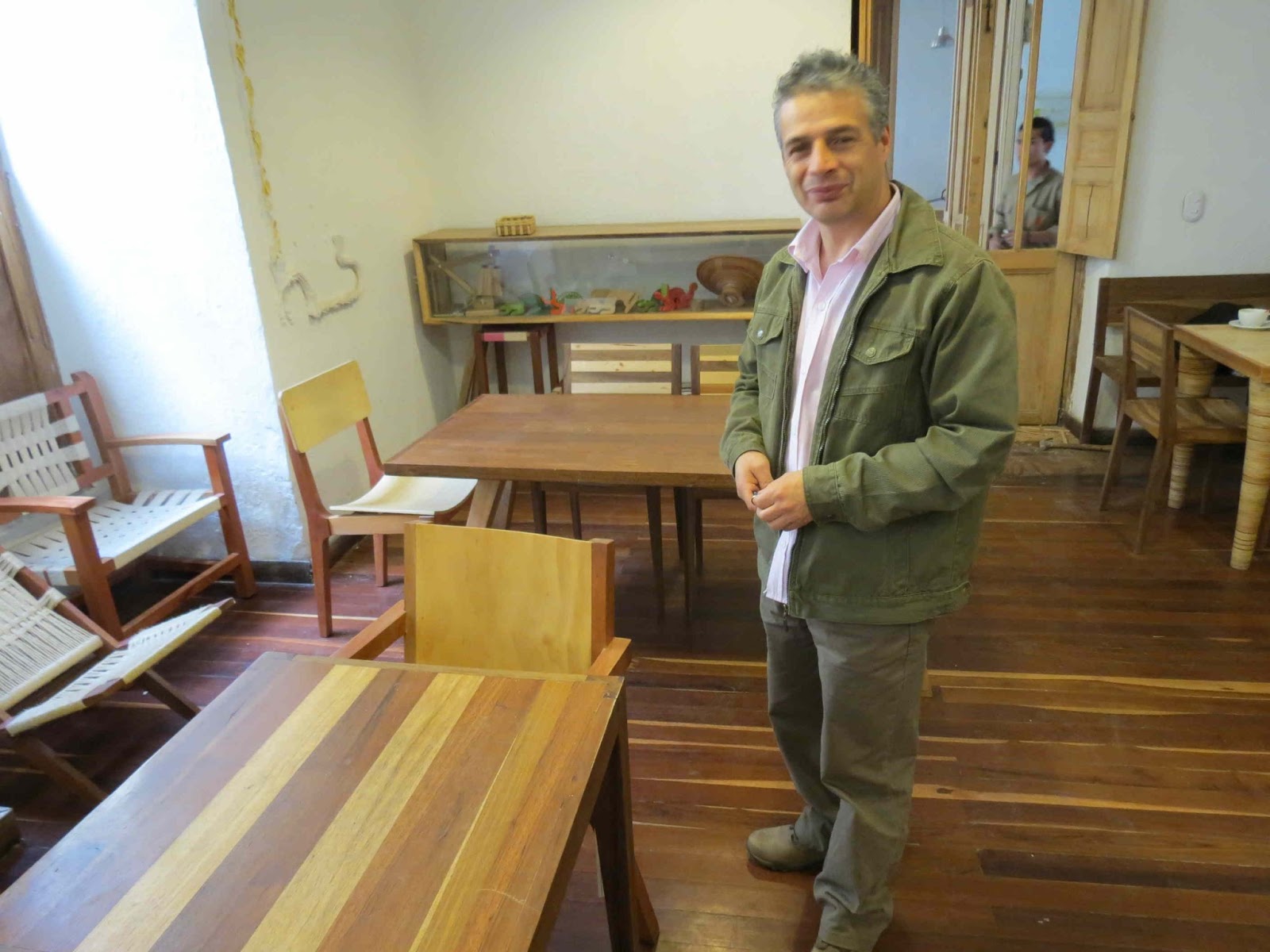
The furniture in the school's cafe are all different styles
because they are the results of student projects. 
In contrast, the Escuela Taller's classes are all free, thanks to support from the governments of Spain, Colombia, the United States and other institutions. In fact, Hillary Clinton visited recently to see the results of U.S. foreign aid.

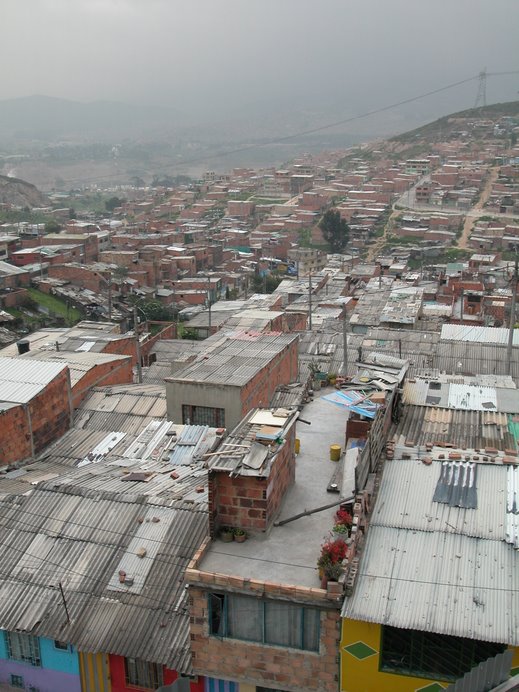
Carlos, one the othe school's outreach and social workers, showed me around. He described the careful background reasearch done on prospective students to make sure they really need the free education and that they will take advantage of it. Many of the students come from Bogotá's poor hillside neighborhoods or from places like Ciudad Bolivar. Even tho classes and materials cost them nothing, the time and bus fares can be a real sacrifice for the youths. And, their families' poverty and sometimes violent neighborhoods mean they have to deal with lots of other issues. Still, about two-thirds of those who enroll complete the courses, Carlos said.
Carlos, one of the school's social workers and my guide.
He said they do careful background checks, including home
visits, to make sure that potential students are both
motivated and genuinely needy. 

The building itself was renovated by the school's students. It had been a convent for nuns belonging to the adjoining Santa Clara Church, now a museum of religious art. The nuns were cloistered, Carlos said, which meant that once inside the convent they never left again. The house had a garden in what's now the patio, and renovators even discovered graves. Carlos wasn't sure whether the remains had been removed, but I heard no reports of ghosts.

For many young people, who don't have the aptitude, interest or the years to devote to a sit-down book-reading higher education, manual skills like those taught at the Escuela-Taller can open the door to a fulfilling and constructive career. The city just needs more places like this.


The building is called the Casa del Venado, altho nobody seems to know why. Perhaps it has to do with the town the builder hailed from back in Spain. Restorers discovered these deer images on the walls of the main family room. 
The cafe/bakery, on Calle 9, is open to the public. 


Projects in the wood turning workshops


The building, once part of a convent, has been thoroughly restored and repaired. 


Restoration continues. 


By Mike Ceaser, of Bogotá Bike Tours

Saturday, February 16, 2013

Craftsmen in La Macarena


Edgar Sandoval has been framing works of art in La Macarena for about 15 years. 
Bogotá's hip La Macarena neighborhood, on the hill above Independence Park and the bullfighting stadium, has filled with art galleries in recent years. But galleries often seem cold and sterile to me. And, usually they're also empty - except for the evenings when they give away food and wine (and even then it seems the visitors come to see each other rather than the art).

So, it often seems to me that art galleries serve to sterilize art and hide it away (which is why street art is so great).

These two La Macarena workshops are colorful, living, active non-deliberate art displays.

A colorful jumble in Sandoval's workshop. 
Edgar Sandoval, who frames artworks in his colorful, jumbled shop, told me about the neighborhood's history, including the artists who've lived here, such as sculptor Edgar Negret. For Sandoval, framing artworks is art itself. Calle 26c No. 4a-11, La Macarena. Tel: 334-5653.

The front wall of Sandoval's shop. 


Sandoval displays a photo of La Macarena from 1946, just before El Bogotazo,
Cesar Giraldo crafts leather works in his shop on Carrera 5.
Cesar Giraldo told makes leather products in his shop on Carrera 5. He says he doesn't know of another leather workshop which has a storefront as well. He makes his own works, as well as fulfilling orders. His works are available here and here. Cesar Giraldo. Carrera 5 No. 26c-18. Tel: 342-8964.


Leather scraps waiting to be made into bags. 


In contrast, here's a minimalist art display in a neighboring 'art' gallery.
Can you see the artwork? Neither can I.
By Mike Ceaser, of Bogotá Bike Tours