Showing posts with label alcohol. Show all posts

Saturday, December 14, 2013

Drunk Driving Out of Prison

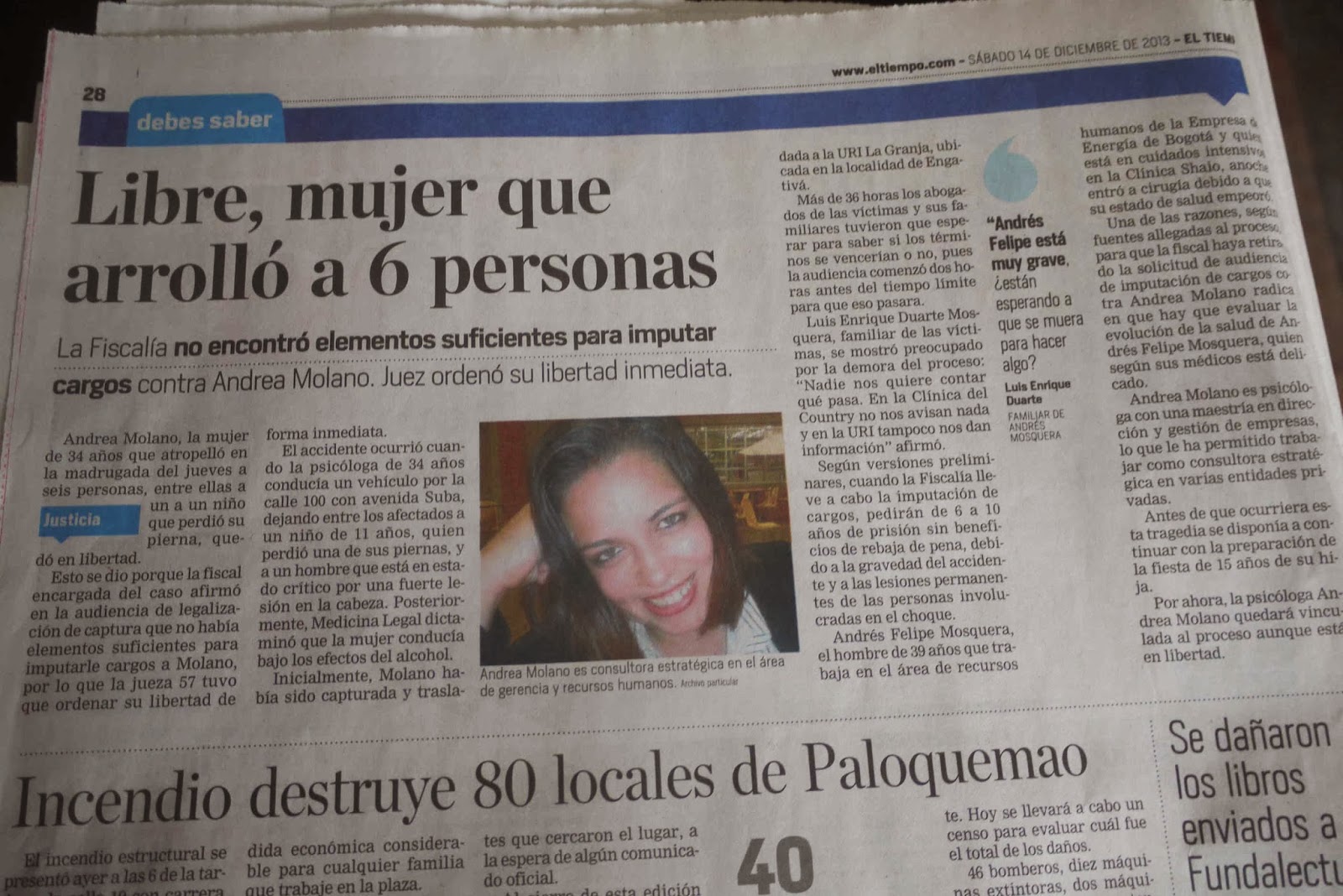
http://www.eltiempo.com/colombia/bogota/legalizan-captura-de-conductora-que-atropello-a-seis-personas_13286102-4
Today's El Tiempo reports that a judge freed a woman who hit six people while driving drunk.

It's like a broken record. Someone gets drunk, hits and maybe kills people. The victims go to the hospital, the driver goes home to relax and recover.

In the most recent case, a woman hit a group of children and adults waiting for a bus to take them to the last day of school. One victim is in critical condition with head injuries, and an 11-year-old boy had to have his leg amputated.

But the driver, a 34-year-old psychologist, was freed and allowed to go home - altho it appears likely that she will ultimately be charged.

It's latest the latest travesty involving a drunk driver.

Fabio Salamanca, a wealthy young man, rear ended a taxi July 12, killing its two women passengers and leaving the taxi driver paralyzed. According to news reports, in late November Salamanca's charges were reduced, opening the possibility of home detention, after his family paid 'compensation' to the victims' families.

Last year, Juan Carlos Varela Bellini. heir to a wealthy Cali family, was drunk driving his Mercedes Benz in La Calera last year and ran over four motorcyclists, killing three and severely injuring a fourth. Varela's family paid the victims and the 27-year-old is serving his sentence in his family mansion.

Altho the victims, who are usually from humble backgrouinds, apparently agreed to these soft sentences, they did so for financial motives, not for justice. Such sentences offer terrible examples and weaken the fear of punishment for those considering getting behind the wheel after a few drinks.

For me, these cases also create an absurd contrast with what happened to an acquaintance who made products like soaps out of marijuana. (I'm sure he smoked the stuff, two.) Riding the bus back to Bogotá after a purchasing trip, police discovered he was carrying several kilos of marijuana. The guy is now serving a seven year prison sentence. (And no home detention for him.)

The case is particularly ironic to me, since marijuana use may actually reduce highway fatalities. That's because driving, while high on pot is certainly dangerous, it's less dangerous than driving after drinking alchohol. And, where pot is easily available, some consumers apparently shift from highly dangerous alcohol to less-dangerous marijuana, making the roads safer.

By Mike Ceaser, of Bogotá Bike Tours

Thursday, September 26, 2013

Wilson of the Red Light District


We often run into Wilson while passing thru Santa Fe, the central red light district, during bike tours. Wilson is killing himself by drinking rubbing alcohol, but he's doing it cheerfully. I have no inkling about what Wilson lives off of, but he generally seems to have bathed and washed his clothing.

And Wilson retains a sense of curiosity. He was delighted to learn the meaning of 'Chicken Hell', the fried chicken place in the heart of Bogotá's low-life red light district.


Chicken Hell, in Bogotá's red light district, is poised to challenge KFC for world dominance.
By Mike Ceaser, of Bogotá Bike Tours

Monday, December 10, 2012

What Investments Does Colombia Want?

Come inside for your aguardiente, tequila and whisky!
Colombia should be careful about what it wishes for in free trade and foreign investment.

I took these snapshots the other day of one of the Mexican Oxxo chain stores which are invading Bogotá.

Junk food, anyone?
This one is located directly - and strategically - right across Ave. Septima from La Javeriana University, where the store advertises several kinds of alcoholic beverages and junk food in its window. Undoubtedly, many more kinds are waiting inside.

Needless to say, in Colombia excessive drinking (and unhealthy diets) among students is a big concern. I had even understood that a law restricted alcohol sales near universities, so I'm not sure why this store is allowed to so brazenly offer intoxicating beverages to students.

Colombia is opening itself to foreign investment like few other countries - for better or worse. Perhaps rather than opening a floodgate it should try to apply a sieve and actually select the investments which really benefit Colombia's economy, its people and its culture.

Then they can ask whether chain stores pushing junk food and alcohol and displacing locally-owned businesses bring many benefits.

This situation also invites reflection on the issue of drug legalization. Alcohol is legal, but few people (besides alcohol makers and vendors) would argue that offering it to stressed university students is a very good idea. And, if drugs like cocaine and marijuana were legalized here, it wouldn't be a good thing for them to be advertised across the street from a university, either.


By Mike Ceaser, of Bogotá Bike Tours

Wednesday, May 23, 2012

Drunk Drivers: Still Almost Invulnerable

The accounts of drunk drivers hitting and even killing people and getting off without jail sentences have become common.

Last week, the issue hit the news again when police pulled over Senator Eduardo Carlos Merlano for apparently driving drunk. 

"Do you know who I am?" the senator demanded of the police officers, and then refused to take the alcohol blood level test.

The scandal was later compounded by a leaked recording in which a police commander criticized the police officer for trying to test the senator. "Out of millions of Colombians, we've selected just a hundred to write out laws," the commander pointed out.

And, apparently, some of those 100 politicians consider themselves above the law. Merlano - who it turned out was also driving without a license - afterwards asserted that he hadn't been drunk and had a right to refuse to take the alcohol test.

Coincidentally, just yesterday a bill which would have required jail time for drunk drivers died in Congress. The bill failed to pass by a single vote. More than 70 senators failed to appear to vote at all, perhaps taking a long lunch lubricated by aguardiente.

Every year,  drunk drivers kill more than 5,000 people in Colombia. 

Poor Sen. Merlano, meanwhile, has been told by his doctor to take a couple of days off of work to relax from all the stress he's suffered.

At last word, Sen. Merlano hadn't expressed an opinion about the anti-drunk driving legislation.

By Mike Ceaser, of Bogotá Bike Tours

Wednesday, July 27, 2011

A New Drug Law For Colombia?

Smoking on a streetcorner: soon to be banned in Colombia?
Colombian legislators have presented a new proposed drug policy law - and then withdrawn it for modification - probably because they realized that it wouldn't work.

The proposed law did not, however, propose courageous changes which might contribute to a shift in drug control strategies.

The proposed law had positives: for example, it would cover both legal and illegal drugs, instead of insisting on the lie that there are two categories of psychoactive substances: those that are legal and good and others which are bad and deserve prohibition.

Just don't breath if you're behind me. 
The law's prohibition against smoking on public streets, plazas and parques would be great - I hate walking down a sidewalk and choking on the second-hand smoke of someone in front of me (who often isn't even smoking his own cigarrette). Holding your breath in Bogotá's thin air, you rush past them - only to have to swallow the smoke of someone else ten feet ahead. But if the legislators really believe that this law's enforceable, they must have been smoking something lots stronger than tobacco.

The proposed law would also have banned alcohol advertising at cultural and sporting events. Inebriation certainly causes lots of damage in Colombia, including sports-related violence - but alcohol also funds lots of activities and plays an important role in Colombian culture. Lots of people enjoy drinking without harming others. Where is the best balance between puritanism, prohibitionism and healthy recreation?

A giant Aguila beer shirt at a football game. Some Colombian teams are in bankruptcy. Would the sport survive without alcohol money?

Fans fight at a football game: much of it is fueled by alcohol. 
On the positive side, the proposal would require coca leaf erradicators to ask for permission before working in indigenous territories. The law would also designate areas for cultivating drug crops for legal consumption - does this mean that Colombia's going to enter into medical marijuana production? Or would it further regulate the legal production of products from coca leaf?

Coca tea and leaves: headed toward more regulation?
Regarding illegal drugs, the law would provide more treatment for drug addicts and create a task force charged with reducing drug use. That's a step forward, since reducing demand has been shown to be much more cost-effective, as well as more humane. But the law also appears to increase regulation on the cultivation of drug crops on indigenous territories. That may be a step backward, if it prevents indigenous people from producing healthy products such as coca tea, crackers and soft drinks, which provide these peoples with alternatives to the illegal drug economy.

But the proposed law did not take even baby steps toward decriminalizing illegal drugs, even tho criminal groups financed by illegal drugs have done more damage to Colombia than perhaps any other nation. Legislators might consider decriminalizing personal use of marijuana or even restate the old personal dosis of drugs. This would surely bring complaints from Republicans in Washington - but would also assert Colombia's independence from U.S. drug policy.

Colombian ex-president Cesar Gaviria has been campaigning for drug decriminalization for a while, and participated in the Latin American Commission on Drugs and Democracy, which also recommended alternatives to prohibitionism. And Pres. Juan Manuel Santos has said that he'd be open to changes on drug policy - if other nations take the lead. He's right. If Colombia did the unthinkable and legalized drugs it could deprive the guerrillas, paramilitaries and cartels of the bulk of their incomes - but would also turn this country into an international pariah.

Colombia has no choice but to wait for Washington to take the lead. But expecting Washington to endorse decriminalization anytime soon is unfortunately reefer madness.

By Mike Ceaser, of Bogotá Bike Tours