Colombia has attracted far fewer European immigrants than have other Latin American nations. Nevertheless, they have made a big impact on the country's arts and culture, as an exhibition on now thru January in the Luis Angel Arango Library shows.
My knowledge of Colombian cultural history is way too thin to evaluate the influence of these men and women. However, their stories, as refugees from European fascism or South American dictatorships, were surely gripping.
A letter by writer Otto de Greiff to Casimiro Eiger offering sympathy for the murders of Eiger's relatives by the Nazis in Poland.
The most detailed drama told in the exhibit is that of Casimiro Eiger, born in Poland in 1909. He traveled to Paris to study, and while there Nazi Germany invaded his homeland. Soon after, the Nazis invaded France as well. Eiger, who was Jewish, fled to Morroco, where he and other refugees boarded a ship that sailed to West Africa, but then returned them to Morocco, then controlled by Vichy France, a Nazi puppet Regime. The refugees then boarded another ship, which sailed along the South American coast seeking a country which would accept them. They were finally allowed to enter Curacao, a Dutch colony in the Caribbean. From there, Eiger emigrated to Colombia. The exhibit includes a brief letter from Colombian poet and journalist Otto de Greiff expressing his sympathies that Eiger's relatives back in Poland had been murdered by the Nazis.
In Colombia, Eiger became an accomplished art critic and promoter of the arts.
Eiger worked in Bogotá with Hans Unger, another refugee from Naziism who had arrived in Colombia
By Robert West.
from Austria in 1938. Unger was one of several German-speaking immigrants who set up literary bookstores which also contained art galleries and became centers of intellectual activity. Unger established his Libreria Central in the Pasaje Santa Fe, just off of Ave. Jimenez. Nearby, an immigrant from Germany and dissenter against Naziism Karl Buchholz opened the Librería Buchholz bookstore/gallery, which soon became another cultural landmark.
A fellow member of the exodus from Hitlerism was Walter Engel, who fled Austria for Colombia in 1948. In Colombia, Engel became an art critic and friend of artist Fernando Botero. In 1965, he moved to Toronto, Canada, where he opened an art gallery which promoted Latin American works.
Clemente Airó also fled fascism, but that of Francisco Franco in Spain. Born in Madrid in 1918, the anti-fascist Airó was interned in a concentration camp and Franco took power. Airó fled to Colombia in 1941 and here founded a monthly arts magazine called Espiral, which also advocated leftist causes. He died in 1957.
Marta Traba (1923 - '83) fled the Peron dictatorship in Argentina and came to Colombia in 1954. She became a noted essayist and art critic. She died in Spain.
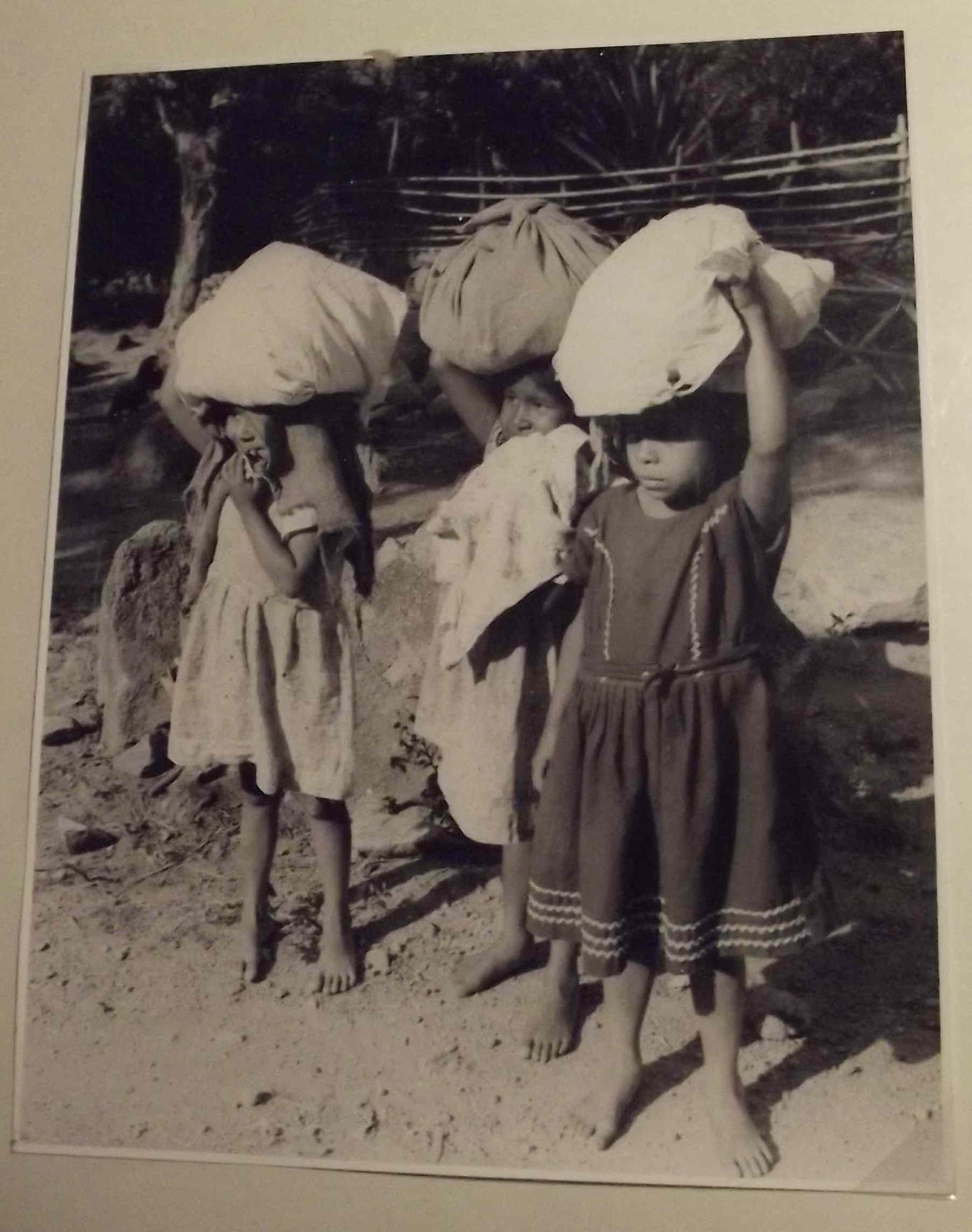
The exhibit also includes the documentary-style photos of Robert West, whose origin is not mentioned. Nearby are photos by anthropologist Gerardo Reichel-Dolmatoff, who left Austria for Colombia right before World War II. Reichel-Dolmatoff, who died in 1995, is remembered as the father of anthropology in Colombia. But recent research revealed that as a young man in Austria he had been a fervent Nazi and apparently assassinated rivals of Hitler. The library's exhibit doesn't mention this dark part of Reichel-Dolmatoff's past.
The Alsina, in which Casimiro Eiger and other refugees fled Nazi Europe.
Karl Buchholz in an interview.
Photos by Anthropologist Gerardo Reichel-Dolmatoff.
Photos by Anthropologist Gerardo Reichel-Dolmatoff.
By Robert West.
Photos by Anthropologist Gerardo Reichel-Dolmatoff.
Photos by Anthropologist Gerardo Reichel-Dolmatoff.
Photos by Anthropologist Gerardo Reichel-Dolmatoff.
Gerardo Reichel-Dolmatoff holds a well-earned place in Colombian academics.
After emigrating here in 1939 he pioneered research on indigenous peoples throughout the country. In 1946, he and his wife Alicia Dussan founded the Ethnological Institute of the Magdalena and in 1963 they founded Colombia's first department of anthropology, at the University of the Andes in Bogotá. Reichel-Dolmatoff was also a member of the Colombian and United States academies of science, received many awards and wrote an astonishing 33 books and hundreds of scientific articles, according to his Wikipedia entry. Reichel-Dolmatoff is, deservedly, called the 'father of Colombian anthropology'.
However, if research by a Colombian academic working for a United States university is accurate, the Austrian-born Reichel-Dolmatoff, who died in 1994, was also hiding a horrific past.
Prof. Oyuela-Caycedo motions to a photo of Nazi
leaders during his talk at the Americanists conference.
(Image from YouTube)
There had previously been hints of links to the Nazis in Reichel-Dolmatoff's youth in Austria, but they were apparently ignored or brushed off as attacks by his enemies. However, in preparation for the 54th International Congress of Americanists, held in July 2012 in Vienna, Austria, University of Florida Associate Prof. of Anthropology Augusto Oyuela-Caycedo began researching the youth of Reichel-Dolmatoff, under whom he had studied. Presumably, the Colombian-born Oyuela-Caycedo expected to fill in some gaps and produce yet another laudatory piece about this 'great man of Colombian academia.'
But, instead, what Oyuela-Caycedo found, with the assistance of researchers in Germany, has threatened the legacy of Reichel-Dolmatoff and perhaps even shaken the foundation of Colombian anthropology.
'The German Revolution,' a dissident Nazi newspaper
which published alleged extracts from
Reichel-Dolmatoff's diary. (Image from YouTube)
Poring thru pre-World War II newspapers, old Bundestag records and even the Nazi Party's own documents, Oyuela-Caycedo and the Geman researchers compiled strong documentary evidence that the Reichel-Dolmatoff who accomplished great things for Colombian science had between the ages of 14 and 25, been a member of the Nazi Party and the SS, murdered Hitler's enemies and trained guards at the notorious Dachau Concentration Camp. Oyuela-Caycedo's talk at the Americanists Conference is here, in Spanish, on YouTube.
In his talk, Oyuela-Caycedo read a chilling account, allegedly copied by dissident Nazis from Reichel-Dolmatoff's own diary, describing Reichel-Dolmatoff gunning down of an old man in 1934 during the 'Night of the Long Knives,' the mass murders of Hitler's opponents in the German government. The next year, Reichel-Dolmatoff worked as a guard and trained other guards in the notorious Dachau Concentration Camp, the model for Hitler's system of mass murder, according to Oyuela-Caycedo.
The current issue of Arcadia
magazine reports the story.
But in 1936 Reichel-Dolmatoff suffered something of a nervous breakdown and was briefly institutionalized, Oyuela-Caycedo found. Soon after, Reichel-Dolmatoff was declared 'inapt' to serve in the SS. The current edition of the magazine Arcadia reports that Reichel-Dolmatoff left the SS complaining of head pains. By 1937, Reichel-Dolmatoff was living and studying in France and working with anti-Nazi organizations, according to Arcadia (but the German researchers found no evidence of such anti-Nazi activities). In 1940, Oyuela-Caycedo found, the Nazi Party expelled and blacklisted Reichel-Dolmatoff.
The story seems incredible. But Oyuela-Caycedo found so many coincidences of time and place between the Reichel-Dolmatoff who was an outstanding anthropologist and the Nazi killer with the same name that his case is solid.
"It hurts me to read this," Oyuela-Caycedo says during his talk, "because I knew Gerardo Reichel."
My lingering doubts about whether this was the same Gerardo Reichel-Dolmatoff were mostly cleared away by one line in the Arcadia article: Reichel-Dolmatoff's family had no response to the findings. That suggests that they have reason to believe the account's truthfulness.
A notice issued by the Nazi party seeking Reichel-Dolmatoff after he had left Germany.
The story invites reflections about human nature: how malleable and changeable and even unprincipled it can be - concepts which perhaps influenced Reichel-Dolmatoff's own anthropology researches. It also makes me ask what drove Reichel-Dolmatoff out of the SS - was it a core of decency, a kind of weakness of will, or an inability to tolerate terrible crimes? Did he invent his headaches to leave the organization? Certainly, his later anti-Nazi activities and even his studies of Colombia's decidedly non-Aryan indigenous peoples were rejections of everything that Naziism stood for.
Did Reichel-Dolmatoff leave his family an autobiography to be released 50 years after his death? We can only hope so. It would be yet another contribution to science and the study of man. But we can also regret that Reichel-Dolmatoff kept this part of his life story secret. Perhaps his turn from darkness to light could have provided answers for resolving Colombia's own conflict.
El Tiempointerviewed two German researchers who are reconstructing the history of Reichel-Dolmatoff and other participants in the Nazi Party. They don't believe that Reichel-Dolmatoff left the movement for ideological or moral reasons, but simply because he came from an elite background and didn't feel comfortable among the Nazi soldiers, who were mostly unsophisticated men. They found no evidence of repentance in his writings or of his reported work for the anti-Nazi resistance.
The researchers don't find Reichel-Dolmatoff's dramatic transformation from apparent Nazi killer to respected humanist at all surprising: they've seen many such cases.
To me, it's yet another indication of the plasticity of human nature. Reichel-Dolmatoff was clearly an intelligent, dynamic person. But he just as easily conformed in a group of vicious murderers as in an elite academic environment.
"We are German historians and are accustomed to cases such as this one and even more jarring ones. We understand that Reichel's history in Germany has caused stupor in Colombia because of his later career. But here it is just one more such case among many," researcher Holger Stoecker told El Tiempo.
A schooner like the Resolute,
which was sunk by a Nazi U-boat.
Seventy years ago today, a Nazi U-boat sank a Colombian schooner, setting Colombia on course to join the Allies in World War II.
The Resolute was a wooden, two-masted civilian vessel flying the Colombian flag and carrying materials to the tiny island of Providencia, part of the San Andres archipelago. There was no mistaking it for a warship, much less one belonging to Holland, United States or Great Britain. But the Nazis, characteristically, didn't care. According to El Tiempo'sreport today, the submarine crew wasn't satisfied with sinking the schooner, but also machine gunned its crew and passengers, killing six people, including a woman and her infant son. Several others were wounded. The survivors, saved perhaps only by the unexpected appearance of a United States airplane, later said that the submarine crew laughed as their victims fell into the ocean.
The next year, a Nazi submarine sank a second Colombian schooner, the Ruby.
A painting of a World War I U-boat sinking a troop transport ship, by Willy Stower.
Colombia responded by first siezing the property of German, Japanese and Italian citizens in Colombia, and later interning them. Undoubtedly, most of those people were industrious residents loyal to their country of residence. Colombia also supported the Allied cause by supplying raw materials and monitoring the approaches to the strategic Panama Canal.
The Caribbean was a forgotten front in history's most terrible war. Some 100 German U-Boats and several Italian submarines roamed the area, attacking Dutch, British, U.S., Canadian, Mexican, Colombian and other ships. Wikipedia's entry on The Battle of the Caribbean doesn't even mention Colombian casualties, suggesting to me that many other vessels from South American and Caribbean nations were sunk but never recorded in the annals of the war.
In fact, this page reports that U-boats sank three civilian vessels from the San Andres, killing 34 people on board.
The victims' relatives and descendants, mixed-race people called Raizales, have not forgotten. In 2001 a group of them filed a lawsuit against Germany demanding compensation. No word about any results.
According to the same web page, the Colombian warship ARC Caldas sank a U-Boat which was attacking a petroleum ship the Caldas was escorting. The report has been disputed, but if true could be Colombia's only violent participation in the Second World War.
Karl Buchholz on left. The other man is probably one of his sons.
While reading about German immigration to Colombia, I discovered the remarkable story of Karl Buchholz, a German bookstore owner who became a minor legend in Bogotá.
The old Buchholz store on
Jimenez Ave.
Before World War II, Bucholz was a success in Europe, where he opened bookstores in his native Germany, Romania and Portugal, as well as an art gallery in New York. Some of his bookstores also included art galleries, which attracted important artists.
But then fascism tightened its grip on Germany. Buchholz's political leanings aren't clear, but he certainly believed in freedom of thought. In the face of the Nazis' totalitarian laws dictating which books could be read and which paintings displayed, Buchholz continued secretly showing work by artists considered 'degenerate' by the Nazi authorities.
If he'd been caught, Buchholz quite possibly could have been sent to a concentration camp and even murdered.
The Buchholz building today. (Background, in center.)
I don't know how Buchholz lived out the war, or if he even stayed in Germany, or why exactly he decided to leave Europe. In one interview shortly before his death, carried out in his book-filled home in north Bogotá, Buchholz said he had feared that communism, which also repressed art and literature, would take over Europe.
After the war, Buchholz emigrated to Bogotá, where he opened a bookstore on Jimenez Ave. and Carrera 8. Eventually, Buchholz and his sons Alberto and Godula opened several stores around the city. His flagship store on Jimenez, which occupied about five stores of the building, also included an art gallery. So, besides courage, give the man credit for persistance and believing in himself.
The area continues to be Bogotá's central bookselling district. Neighboring booksellers remember Buchholz's as being the best bookstore in Bogotá. Today, its building is occupied by a lottery store with offices above it, perhaps a sad commentary on cultural trends.
Bogotá's central book district today.
School texts predominate over literature.
Beginning in 1960, Buchholz also published the arts magazine Eco, which lasted 24 years.
But with Buchholz's death in 1992 at age 91 and his son Alberto's death in an auto accident six years later, the stores closed, ending an important literary chapter in Bogotá.
A sailing ship called a 'goleta,' like Colombia's The Resolute, sunk by a Nazi U-boat in
Today is the 70th anniversary of Japan's 1941 attack on Pearl Harbor, which brought the United States into World War II - and pulled Colombia in in its wake.
Colombia, like most of Latin America, formally backed the Allies during the war, lending use of its territory and natural resources, but did not participate in fighting. Colombia was, however, strategically important because of its nearness to the Panama Canal, which the Allies feared could be attacked by Germany or Japan.
At the war's start, many Colombians still resented the U.S. for its role in turning the province of Panama into an independent country in order to dig a canal across the isthmus. But U.S. Pres. Franklin Delano Roosevelt had improved relations with his Good Neighbor Policy. Also, then-Colombian Pres. Eduardo Santos (the great uncle of current Pres. Juan Manuel Santos) was a Liberal and had studied in France, and so sympathized with the French, who were suffering under Nazi occupation.
After the Pearl Harbor attack, Colombia broke relations with the Axis powers and allowed the U.S. to station troops in the country - a relationship which has continued until today. Colombia had also accepted some Jewish refugees from Europe during the pre-war years, but, like most countries, shut the door in the late 1930s.
Extra! Extra! Read all about it! Colombia declares state of beligerance towards the Axis powers.
In June, 1942, a Nazi U-boat sank the Colombian sailing ship The Resolute, killing six sailors. (Some sources say the Germans sank three Colombian ships.) In response, Colombia declared a state of 'belligerancy' against the Axis powers. In 1944, the Colombia destroyer ARC Caldas, escorting a tanker on its way to Panama, sighted and sank a German U-boat, apparently Colombia's only hostile action during the war.
The Hotel Sabaneta in Fusagasugá, where
several dozen Germans and Italians
were interned during the war.
More troubling, Colombia, like much of Latin America, participated in the U.S.-backed policy of monitoring, expelling and interring Japanese, German and Italian citizens. A group of prominent Japanese and Germans were even put aboard a ship headed toward New Orleans and then the Portuguese colony of Mozambique in Africa, altho it's not clear whether they got there. Many other citizens of German, Italian or Japanese origin had their property confiscated.
Another group of several dozen Japanese and German citizens was interned during the war, under the protection of the Spanish and later the Swiss embassies. They apparently suffered little except for boredom, in a hotel in the tropics.
One colony of Japanese farmers in Cauca province received particularly close observation by Colombian officials, because of fears that they might build an airstrip, from which planes could attack the Panama Canal.
Sometimes, people with the right knowledge can turn a curiosity into a window on historical tragedy.
This tomb in Bogotá's Central Cemetery stood out because it might be the only one whose text is not in either Spanish or Latin. How did a lone Pole end up in this city with few immigrants? It looked to be one of many stories lost to history. Then a young Polish couple did the bike tour, and opened up a window for me.
The man's title on the tomb told the couple that Mieczysław Chałupczyński had been a member of the Polish government - yet, Bogotá was an unlikely place for a Polish politician to end his career. However, from the tomb's text and the place and date of death, 1946, the Polish couple inferred that his was not just any Polish government. The man had evidently been a member of Poland's government in exile which operated in London during the Nazis' WWII occupation of their country.
A bit of googling told me more: just before World War II, Mieczysław Chałupczyński had been Poland's charge de affaires in Slovakia, were he tried desperately to find allies against the impending invasions by giant neighbors Germany and the Soviet Union. His efforts failed, and Slovakia participated in the German invasion of Poland - only to be itself swallowed up by its totalitarian neighbors. Chałupczyński presumably escaped to London and joined the government in exile, which called itself Free Poland. He became his government-without-a-state's ambassador to Colombia, which had broken relations with Germany in 1941. Colombia declared war on Germany in 1943.
In 1944, Chałupczyński undoubtedly participated in the creation of the Association of Poles in Colombia.
However, after Nazi Germany's defeat, Chałupczyński's hopes for an independent Poland were shattered again. The Soviet Union occupied his homeland and imposed a new type of totalitarianism on the country which had just suffered through five years of war, Nazi occupation and the Holocaust.
For Chałupczyński, returning home would have meant suicide. The Soviets tried to stamp out all traces of Polish nationalism, and a patriot like Chałupczyński would have been murdered or shipped off to a Siberian slave labor camp. Then, in December 1945, insult followed injury when Colombia recognized the 'Provisional Government of National Unity' in Poland, a Soviet-created puppet. Two months later, Chałupczyński died, perhaps of a broken heart, an ambassador whose nation had disappeared. He was only 53.
But the Polish community who buried Chałupczyński so humbly did assert their national pride in one subtle way. The Soviets had removed the crown from the white eagle on Poland's coat of arms, but the eagle on Chałupczyński's tomb still wore it.
Sadly, sometime during the last 65 years, the coat of arms was stolen, probably by a drug addict who sold the metal for a few pesos. Chałupczyński apparently has been forgotten by the Polish-Colombian community as well. Also, beside Chałupczyński's tomb is an empty one. Was this intended for his wife? Where did she die? That's a mystery which is probably lost to history. As for the Polish couple, who are from Krakow, they described their nation as divided between younger progressive people and strict religious and cultural conservatives, but independent and moving forward as a member of the European Union. Perhaps from somewhere above Chałupczyński is looking on from somewhere above, proud that his nation is finally free and independent.
A plaque placed in the Central Cemetery in 2012 by the Polish Embassy commemorates an earlier Polish immigrant, who fought for Colombia's independence.
It was probably best for my ability to sleep that I arrived late at a talk today by five Colombian survivors of the Holocaust.
By the time I entered the standing-room-only event at the Bogotá Museum of Modern Art , the accounts of horrific experiences had passed and the survivors were describing the war's end, their migrations to Colombia and whether they could ever forgive, a point they disagreed on.
Faces of many who did not survive.
The four women and one man, speaking still imperfect Spanish with European accents, displayed vigor, spirit and strong memories, a testament to their vitality despite what they suffered: discriminatory laws, being driven from their homes, from their countries, packed in rail cars and seeing friends and relatives taken away to be slaughtered by a civilized nation converted into a machine of mass murderer.
The museum's Shoa exhibition, which fills some three levels, is sophisticated and detailed, with personal experiences, photos, recordings and examinations of Spain's mixed role in the Holocaust (a fascist nation friendly to Hitler, some Spanish diplomats individually risked their lives to save Jews and others). The exhibition also looks at South America's involvement in World War II and Jewish refugees' efforts to flee to Latin America. The information is powerful and moving, as the account of history's most terrible and calculated slaughter must be.
A rally of Nazi fanatics in Barranquilla during WWII
Some other Latin American nations, or their officials, did play either tragic or heroic roles during the war. Cuba notoriously turned the S.S. St. Louis, a ship packed with Jewish refugees, back to Europe, where many were murdered by the Nazis. In contrast, the Dominican Republic agreed to accept 100,000 Jewish refugees, although escaping Europe became so difficult that only 645 people actually made it.George Mantello, an El Salvadoran diplomat stationed in Switzerland distributed El Salvadoran citizenship papers, which saved the lives of thousands of Eastern European Jews and later helped pressure Hungary to resist the Nazis' deportations of Jews to Auschwitz.
After the war, many Jewish survivors, German refugees and Nazi persecutors took refuge in South America, but relatively few came to Colombia, which at the time was suffering a period known as 'La Violencia,' a politically-driven fratricide which at times rivalled Naziism in barbarity.
Five of those Jews who did come to Colombia, mostly because they had relatives already here, spoke on Tuesday at the Modern Art Museum. Now octogenarians, they heard with difficulty, but spoke strongly, with no lack of passion or strong beliefs. A woman whose family managed to send her to England to wait out the war recalled how after Germany's surrender the refugee children received lists of the dead from the Red Cross - "where they found their parents' names."
Max Kirschberg shows the number tattooed on
his arm in Auschwitz.
After telling their stories, the octogenarians reflected on how to prevent another genocide.
"Memory is the best shield so that it doesn't happen again," said one woman. Others spoke out against neonaziism, or the importance of living one's own life in a good way.
The survivors have handled their experiences differently. One decided to forgive. Another said she could not, until she had the permission of "my aunts, uncles, cousins and other relatives" slaughtered by naziism. A woman from Holland has vowed never to step on German soil.
Yet, despite the world's collective memory, genocide has happen multiple times since World War II, in Africa, Serbia, Cambodia, and likely other places - while the rest of the world did little.
Still, the Colombian survivors managed to draw positiveness from tragedy. "There is one God for all of us," said one survivor, to a strong applause from the packed room.
Inge Chaskel hasn't let her WWII experiences ruin her life.
The Holocaust revertebrates particularly strongly in Colombia, because some of the crimes by the country's lefitst guerrilla groups and right-wing paramilitaries almost rival the Nazis' crimes for cruelty and barbarity, although certainly not in scale.
Sadly, at least one Israeli is accused by Colombia of helping train Colombian paramilitaries to commit such crimes.
Like many nations, Colombia also has its own skinheads and neo-Nazis - a bizarre phenomenon in a nation where the great majority of people are of Spanish, Indian or African descent, or of mixed background.
On the other hand, having lived throughout South America, I've seen and heard less racism, anti-Semitism and homophobia here than in other Latin American nations.
There have been at least two famous Jewish Colombians: Actress Fanny Mikey, who organized theatre festivals and founded the National Theatre, and Leo Siegfried Kopp, who founded the Bavaria Beer Company and who has become a kind of saint in Bogotá's Central Cemetery.
The Shoa exhibition ends March 31. The museum is also showing films about the Holocaust.


 Clemente Airó also fled fascism, but that of Francisco Franco in Spain. Born in Madrid in 1918, the anti-fascist Airó was interned in a concentration camp and Franco took power. Airó fled to Colombia in 1941 and here founded a monthly arts magazine called Espiral, which also advocated leftist causes. He died in 1957.




 Posts
Posts