Showing posts with label coca leaf. Show all posts

Saturday, March 3, 2018

Why Coca Erradication is Doomed

Sweaty coca erradicators reduce the supply of the leaf
 - and raise its market value.
How to convince farmers to give up coca leaf for legal, healthy crops?

These days, government officials and newspaper columnists are debating over the best combination of incentives - such as payments and help with new crops - and punishments, such as forced erradication and prison, if farmers don't agree to voluntarily erradicate their drug crops.

At best, the strategy has huge weaknesses: Coca leaf is a good crop economically, because it requires little care, brings reliable income and can be stored and transported easily after harvest. And in many coca-growing regions the government has little presence, whereas the drug cartels, who encourage or even force farmers to plant coca leaf, are very active.

But, give the government the benefit of the doubt: Perhaps this time voluntary erradication WILL work.
Colombia's coca leaf crop
has boomed in recent years.
(Graph from El Tiempo)

The trouble is, it's all futile, anyway.

After all, there are lots of poor people in Colombia, especially poor farmers. Every time a farmer somewhere gives up growing coca leaf, whether voluntarily or not, that reduces the supply and raises the price. In response, you can be sure that some impoverished farmer somewhere else, if not in Colombia, then in Peru, Bolivia, Venezuela or Africa or Asia, will chop down a patch of jungle and plant the leaf.

It's not that coca leaf farmers are bad people, who want to do harm. I've met some of them. To them, cocaine's harm is a distant, vague concept. And, they say reasonably enough, it's the fault of the consumers who decide to drug themselves.

Colombia's coca leaf crop increase has coincided
with a reduction in acres erradicated.
Chart from Adam Isacson.
Meanwhile, the farmers' needs to feed and clothe their children, to buy schoolbooks and medicines, are immediate and urgent. How many of us would act differently?

The more succesful strategy would be to reduce demand, by helping addicts and decriminalizing drugs, which would reduce their damage in every sense and deprive criminals of a huge income.

By Mike Ceaser, of Bogotá Bike Tours

Monday, October 30, 2017

Let Them Plant Coca!

Working a coca leaf plantation in Colombia.
El Tiempo has reported the controversy over a proposed law to reduce the penalty for having a plantation of less than 3.8 hectares of coca leaf, the base ingredient for cocaine, to only 4 years in prison.

It's polemical in particular because sentences of less than four years can be served outside of prison. Since the great majority of family coca plots measure less than 3.8 hectares, this new legislation would in practice make coca growing a non-prison crime.

Of course, in practical terms it's been this way for a long time. Logistically, in terms of prison space and for the sake of rural peace, Colombia could not possibly imprison the more than 100,000 families which survive by cultivating coca leaf.

But there are also economic and legal reasons why decriminalizing coca leaf cultivation is a good idea - no matter what the Trump White House says.

First of all, erradicating coca leaf is futile. The United States has poured well over $10  billion into Colombia, in great part to combat the illegal drug trade. What does Colombia now have? Very possibly a record coca leaf harvest this year!

At the same time, removing a coca-planting family from the business only reduces demand and raises prices enough to make it worthwhile for someone somewhere else to start planting coca leaf.

But there's a third reason: Reducing coca acreage makes little difference in the drug war, because cultivation is clearly not the limiting factor for cocaine production. We know this because most of cocaine's final cost is paying for the danger of producing and transporting it. And campesino coca leaf farmer earns only a tine fraction of cocaine's street price. The tough, and expensive, part of cocaine production is transporting the stuff across international borders and distributing it on U.S. streets.

Even if ALL  of Colombia's surface area were planted with coca leaf, it would make little difference in the drug trade.


By Mike Ceaser, of Bogotá Bike Tours

Friday, October 20, 2017

Trump and Tumaco

A bus burns in Tumaco, where police have clashed with
campesinos resisting coca leaf erradication. (Photo: El Pais)
It's not difficult to draw a line from Donald Trump's more aggressive anti-drug policies to the recent violence in Tumaco, on Colombia's Pacific coast.

Colombia's coca leaf and cocaine production have boomed in recent years, to the dismay of anti-drug officials both here and in Washington. But the boom has not brought the violence of the 1980s drug boom. Some say that's because the cartel wars have shifted to Central America and Mexico; others, that it's because the narcos moved their headquarters from the cities to rural areas, where violence is less noticed. Or, is it due to some tacit understanding between authorities and drug producers to live and let live?

But any such truce was shattered in Tumaco Oct. 5, when six campesinos were killed in clashes with police, under confusing circumstances.

It's not clear who started the confrontations. But tensions were escalated by increased pressure from Washington to erradicate coca fields, the crop which puts food on the table for innumerable rural families but also supplies narcotraffickers.

Cocaine produces untold environmental and human damage here and overseas. But decades of drug fighting, billions of dollars and innumerable deaths haven't eliminated it, and aren't likely to.

The Trump administration's mounting pressure on Colombia to reign in drug production won't eliminate cocaine, but will mean more confrontations like Tumaco's. Non-governmental organizations point to ten more municipalities in the region with the same combustible ingredients: booming drug acreage and violent outlaw organizations which profit from and defend the drug trade.

Meanwhile, the crisis is intensified by the U.S.'s refusal to deal with the FARC, even tho they have demobilized, turned in their weapons and transformed themselves from guerrillas to a political party - yet remain on the U.S.'s list of terrorist organizations.

One of the key selling points of the FARC-government peace agreement was that the FARC would help fight narcotrafficking. But that's difficult as long as Washington refuses to talk to them.

By Mike Ceaser, of Bogotá Bike Tours

Wednesday, August 23, 2017

Beating Our Heads Against a Wall

Coca plants being eradicated in Colombia, near the Ecuadorian border.
For years, Colombia was the model anti-drug fighter for the Washington D.C. conservatives, thanks to military tactics, aggressive erradication and U.S.-supported interdiction programs. Meanwhile, left-wing governments in Bolivia and Ecuador expelled U.S. anti-drug personnel.

The U.S. also sent more than 10 billion dollars  in Plan Colombia aid to battle the guerrillas and erradicate Colombia's drug crops.

Coca leaf acreage has shot up, perhaps to record levels,
during the last several years. (Graphic: Semana magazine)
The result? Today, Colombia's cocaine production has more than doubled over the last several years and more than 90% of cocaine sold on U.S. streets comes from Colombia.

Some analysts argue that the cocaine boom has resulted from a drop in gold prices, which pushed unemployed miners into the drug business, or that as the FARC guerrillas demobilize they have urged campesinos to plant coca leaf in order to obtain a future compensation for erradicating their own crops, or that the suspension of aerial herbicide spraying a few years ago sparked a drug-planting boom.

Any and all of those might play a role, but there will always be incremental factors affecting the drug
92% of cocaine sold in the U.S. comes from Colombia,
according to the DEA, and the rest comes
from Peru and Bolivia. 
economy. And it's interesting that until recently U.S. officials argued that the guerrillas' demobilization would deal a blow against the drug economy. Now suddenly it's the reverse.

In fact, the sustained increase in coca leaf cultivation over the past several years can only be explained one way: More demand has generated more supply. Campesino farmers aren't stupid, and they're only planting coca leaf because they're confident they'll be paid for it.

For way too long, the U.S. has wasted tax money on a futile anti-drug campaign which has only ensured that violent gangs, guerrillas and paramilitaries get rich off of the drug trade.

Albert Einstein once said that the definition of insanity was trying the same thing over and over again and expecting a different result.

Isn't it time to try a new tactic, such as drug decriminalization?

By Mike Ceaser, of Bogotá Bike Tours

Monday, August 14, 2017

Pence (who?) Comes to Colombia?

Yankee go home! Out with Trump/Pence!
United States Vice President Mike Pence visited Bogotá yesterday, causing little polemic - probably because nobody here's heard of him. In contrast to Pence's restraint, U.S. Pres. Trump was meanwhile busy threatening North Korea and Venezuela with military attacks and making news by failing to condemn neo Nazis and white supremecists who staged a violent protest demonstration in the state of Virginia.

Yankee Go Home! (Say the communists)
Pence reportedly talked with Colombian Pres. Santos about the boom in cocaine production and the economic and democratic  in Venezuela, whose violence might spill into Colombia. The U.S. government would like Colombia to resume using aircraft to spray Roundup on coca leaf plantations and to more strongly condemn Venezuela's authoritarian government, which is rewriting its Constitution to its pleasure.

Colombia said that it stopped using the glyphosate herbicide in mid-2015 because of concerns about it causing cancer, although many analysts considered it a conciliatory gesture to the FARC guerrillas, who make a lot of their money off of drug sales. The FARC recently signed a peace deal with the government and are in the process of demobilizing. Whatever the value of aerial spraying, the coca leaf boom was caused by more fundamental factors, such as supply and demand. As for Venezuela, its government is corrupt, incompetent and growing more and more authoritarian. But a military invasion could turn into another Vietnam and would generate tremendous sympathy for the Venezuelan government - and anger toward the U.S. Better to hope that the Maduro government collapses from its own incompetence.

About the only ones criticizing Pence's visit seem to be the communists, who plastered downtown poles with 'Yankee go home!' posters. But the communists are awkward defenders of democracy.

By Mike Ceaser, of Bogotá Bike Tours

Thursday, May 18, 2017

The Wrong-Way Drug War

Erradicating Colombian coca bushes. Less supply increases prices, triggering more plantations elsewhere.
During the Santos-Trump meeting in Washington today, undoubtedly at the top of the agenda was the huge increase in cocaine acreage in Colombia over the last several years.

Colombia's coca leaf crop has more than doubled, reaching record levels.

Conservative politicians and commentators, such as Florida Governor Rick Scott, ex-U.S. ambassador to the OEA Roger Noriega, and a certain right-wing Wall Street Journal columnist, want Colombia to accelerate coca leaf erradication, and in particular restart aerial fumigation with glyphosate.

Coca leaf acreage has spiked in recent years.
(Graphic from Semana magazine.)
Colombia suspended aerial fumigation in mid-2015 following a report which said that glyphosate might cause cancer. Many suspected that the government's real motive was to ingratiate itself with the FARC guerrillas, who late signed a peace deal with the government. Aerial spraying is also controversial because of its impacts on the environment and on food crops. And some analysts say it doesn't produce lasting impact on coca crops, since farmers have found ways to protect their plants, and can quickly replant them, compounding the environmental impact.

But even in the best of scenarios, attacking drug crops is a losing strategy. According to analysts, coca leaf farmers receive barely more than 1% of drug trafficking's profits, meaning that destroying those crops produces little economic impact on the drug economy. Even more importantly, by reducing supply, drug crop erradication raises prices and increases the economic incentive to plant coca. As a result, when they erradicate one farmer's crop, he or another farmer will likely respond by planting someplace else.

Also, drug traffickers' profits rise. Narcos say: 'Thank you Donald Trump!
Florida state Governor Rick Scott send Trump
a letter criticizing Colombian for failing to
erradicate its coca leaf crop.

On the other hand, reducing demand, for example by treating addicts, lowers prices and reduces the economic incentive to plant coca. Yet, Trump has proposed cutting the budget of the Office of National Drug Control Policy by 95%.

Naturally, decriminalizing drugs would reduce many of their negative impacts, but that's not on Washington's policy radar screen.

Afterthought: Santos and Trump also likely agreed to condemn the Venezuelan government for its increasing authoritarianism and many human rights violations. Good enough. So, how does Trump square that with his friendship with Turkish Pres. Erdogan, who is becoming increasingly authoritarian and violates human rights?


By Mike Ceaser, of Bogotá Bike Tours

Saturday, October 17, 2015

Grow a Leaf, Go to a U.S. Prison

FARC leader Timochenko, accused by the U.S. and Colombia
of  'controlling the production, manufacture, and distribution
of hundreds of tons of cocaine to the United States
and the world,' could soon be in Congress.
Alias Timochenko and other leaders of the FARC guerrilla group, which produces and traffics a big chunk of the world's cocaine (as well as committing countless other crimes), likely will receive little more than symbolic punishments, as well as protection from extradition, before moving into politics, under the peace agreement announced recently.


Yet, while the kingpins who earn millions will likely walk free, impoverished campesinos who grow the coca leaf and earn trifles could end up in U.S. prisons.

Coca farmers like these men could soon be
subject to extradition under a U.S. law.
Those are the dirt-poor peasants who plant coca leaf because they see no alternative to feed their families and may have been pushed into the business by threats from narcotraffickers. They are simple people who may have only vague understanding of what happens to the leaves after strangers buy them and haul them away.

This is thanks to the Transnational Drug Trafficking Act of 2015, now making its way thru the U.S. Congress. According to the Congressional Research Service's summary, the act 'Amends the Controlled Substances Import and Export Act to prohibit the manufacture or distribution of a controlled substance...by individuals having reasonable cause to believe that such substance or chemical will be unlawfully imported into the United States.' If the act passes passes and Colombia cooperates, then the peasant farmer who made a pittance from his coca leaves will turn on the TV in a U.S. federal penitentiary and watch the guerrilla leader who earned millions exporting those leaves making a speech in the Colombian Congress.

According to El Tiempo, only a few dozen campesino farmers are imprisoned in Colombia for the single crime of growing coca leaves. However, some 60,000 Colombian campesino families make their living by growing coca leaf, earning little more than a $1,000 per year per household. All of them - or at least the heads of household - would be subject to extradition and traial and imprisonment in the U.S. The would require lots of new U.S. federal prisons.

It hardly seems likely that entombing a few Colombian peasants in a U.S. prison would have any impact on drug production. After all, there are innumerable other hungry and fearful farmers waiting to take their places. And doesn't the U.S. have any better uses for its tax dollars than to fly peasants north, put them on trial and imprison them for decades - such as, perhaps, treating addicts in the U.S.?

Meanwhile, Colombia itself seems to be heading in the opposite direction: decriminalizing coca farming, in favor of encouraging peasants to shift to legal crops.

By Mike Ceaser, of Bogotá Bike Tours

Monday, July 6, 2015

Back to Glyphosate?

'Lost fight against drugs,' headlines Semana magazine.
The news that Colombia's coca leaf acreage leapt 52% in 2014 might have leaders rethinking their decision to stop spraying with glyphosate, the herbicide commonly known as Round-Up.

Colombia recently decided to stop using the broad-spectrum herbicide, justifying its decision using a World Health Organization assessment calling the chemical a 'probable carcinogen.' However, the WHO's evidence seems weak, and many analysts thot that the Colombian government's decision was rather a peace offering to the FARC guerrillas, who have long demanded an end to herbicide spraying.

But now, it turns out, the bulk of the spread of coca leaf plantations took place in areas where spraying is not allowed,

But aerial herbicide spraying, is, at best, just the slowest way to lose the war. Even with aggressive spraying in Colombia, along with manual erradication in Peru and alternative development in Bolivia, cocaine has gotten cheaper in many developed nations.

But Colombia's coca leaf crop may be booming for multiple reasons. Some suggest that campesino farmers are planting more coca in the hope of eventually receiving benefits from the government for eliminating it. Others speculate that economic troubles in rural areas, such as the collapse of pyramid schemes and the drop in the price of gold, might have pushed desperate farmers to plant coca. Or, the guerrillas might be pushing farmers to plant more coca in order to make money before any peace treaty ends their coca business.

But the biggest cause is probably much simpler: The price of coca leaf has leaped recently, making the crop lots more profitable. The price leap is particularly bad news for drug warriors, since it means either that narcotraffickers are either finding better ways to ship their product north, or that demand is rising in consumer nations, particularly as the U.S. and Europe.

There is one sure way to stop losing the War on Drug, which is to declare victory and legalize the industry.


By Mike Ceaser, of Bogotá Bike Tours

Thursday, June 25, 2015

Coca Leaf's Back (It Never Left)


A cure for migraines, diabetes, insomnia? In La Candelaria, a sign on a stand selling coca leaf products boasts of their supposed health benefits.
Relax. Now you can legally consume coca leaf products, again. Well, almost all of them.

In February 2010, the INVIMA, Colombia's food sanitation agency, issued an alert declaring the sale of all products made from coca leaves illegal outside of indigenous territories.

No matter that many coca leaf products, such as teas and balms, have been consumed without incident for decades, if not millenia; No matter that the coca leaf is quite nutritional and, at worst, benign; No matter that every coca leaf made into food, drink or medicine is one which won't end up as cocaine.

Bags of coca leafs for sale.
"The INVIMA calls on the citizens to abstain from consuming or commercializing products such as tea, aromatics, cookies or any other food containing coca leaf among its ingredients," the agency said. "These products lack Sanitary Registry and their medicinal, curative and therapeutic benefits are not authorized or supported by the INVIMA."

Certainly, one should be cautious with any nostrum or other 'health' food - but not paranoid. Potential buyers can look for INVIMA's seal on the package and decide for themselves. They can also decide how much stock they put into the hygiene policies of a government which requires businesses to label the sink 'lavamanos' so that nobody confuses it with a lamp or an oven, but turns a blind eye to air pollution.

Coca tea, and coca rum for sale.
This week, the Council of State annuled the INVIMA ruling, pointing out that coca leaf products have received the approval of entities such as the nation's Ombudsman and the Institute of Anthropology and History.

'The use of coca leaf by part of indigenous communities makes up a fundamental part of their millenial traditions and has great medicinal and nutritional benefits," the council wrote.


Of course, coca leaf products never stopped being available throughout Colombia, both on and off of indigenous territories. Prohibition has never worked.

Try a coca tea.
This is all actually a return to the past. In the late 1800s and early 1900s, before prohibitionist drug laws, coca leaves and cocaine were seen as sorts of miracle drugs, and placed into all sorts of products, including a wine supposedly endorsed by the Pope. (Back then, the colonial powers established coca plantations in far-flung places like Sri Lanka, Taiwan and Java, making me ask why narcotraffickers, who display tremendous in the ways they traffic drugs, don't plant it outside three Andean nations.)

So, consume your coca leaf products if you want to.


By Mike Ceaser, of Bogotá Bike Tours

Monday, May 4, 2015

Let Them Plant Coca Leaf?

A graphic from El Tiempo portrays the recent jump in coca leaf acreage in Colombia. 
The reports that coca leaf acreage in Colombia leaped during 2013 - by between 15% and 39%, depending on whose counting - are a big blow to drug warriors. That's because Colombia has been the model student in the War on Drugs, employing an aggressive United States backed campaign of manual eradication and aerial spraying against the base ingredient of cocaine. 
A plane sprays herbicide
 on jungle coca leaf plots.

The war on cocaine was never a grand success, as the drug's availability on North American city streetcorners attests. However, the fact that acreage has rebounded in Colombia even as the government used aggressive aerial spraying with glyphosate against the crop is a serious sign. 

And, now, the use of glyphosate in Colombia is being challenged because of a World Health Organization report that the herbicide might cause cancer. 
Historic coca leaf production, 2001 - 10.
Colombia's production is in light blue.

Drug eradication doesn't appear to have succeeded ever, anywhere in history, perhaps because it goes against basic laws of supply and demand. As the supply of drugs is cut, prices rise, increasing profits for traffickers and incentives to plant drug crops in other locations. There have been recent reports of coca plant cultivation in Mexico, far from the plant's three traditional sources: Colombia, Peru and Bolivia. 

Replacing drug crops with licit crops would make sense, if only those legal crops were as or more profitable than coca leaf. However, because coca leaves sell for high prices and have advantages of durability and easy transport, many campesinos will always want to produce them.

Perhaps there's a better solution: End futile and expensive eradication programs, which have done much to antagonize Latin Americans against the U.S., decriminalize the drug and concentrate on demand reduction in the consuming nations. According to one RAND report, that's a much more cost-effective way to reduce demand, in any case.

Manual eradication is slower and more dangerous.
World coca flows. (Graphic: UNODC.)

By Mike Ceaser, of Bogotá Bike Tours

Saturday, March 28, 2015

Time to Round Up Glyphosate?

Glyphosate being sprayed over Colombia. (Photo; Wikipedia)
A World Health Organization panel recently labeled glyphosate, the main ingredient in the Round-Up pesticide, as a 'probable carcinogen.'

The evidence is not clear, as this New York Times article points out, and, in contrast, the German government recently ruled that the herbicide was safe. Glyphosate manufacturer Monsanto also insists the herbicide is benign.

But there's enough reason to feel concerned about using glyphosate, the world's most popular herbicide and to wear a mask and gloves while spraying it in the back yard.

Composition of the mixture sprayed over coca fields.
(Photo; U.S. State Department)
Unfortunately, however, that's not an option for many Colombian campesinos potentially exposed to glyphosate, which is sprayed from aircraft in a concentrated form to try to kill coca leaf plantations. Unfortunately, sometimes wind blows the herbicide onto homes, food crops and bodies of water, possibly leading to ingestion by people. Some reports have linked glyphosate to skin problems and miscarriages. And Ecuador worries enough about the impacts of herbicide spraying in border areas to have filed suit in international court against Colombia.

Glyphosate's effects are contested. While glyphosate does kill plants, coca leaf farmers have learned how to deal with it, by spreading a protective coating over their crops' leaves, harvesting the leaves when they see spray helicopters approaching, hiding coca plants between rows of food plants, or replanting quickly after spraying. According to some reports, there is even a 'Round-up ready' variety of coca bush.

A child's drawing shows coca leaf
spray planes killing animals. (Image: Daily Kos)
The loud and prominent coca spraying campaign has also generated lots of resentment against the United States throughout Latin America.

And while glyphosate spraying has been a component of Colombia's aggressive coca eradication campaign, Peru and Bolivia which do not allow spraying have also reported reducing their own coca leaf plantations. Moreover, it's not clear that reductions in coca leaf plantations have affected supplies in the United States and Europe. Cocaine prices are reportedly dropping in the United Kingdom, and higher drug prices in the United States may be due to a crackdown on precursor chemicals. It also appears clear that reducing supply is a much less effective way to combat drug consumption - since it drives up prices - than is reducing demand.

The latest report that glyphosate could be carcinogenic is no reason to ban the chemical. But it does provide yet another reason to consider shelving a dubious anti-drug campaign.

By Mike Ceaser, of Bogotá Bike Tours

Wednesday, September 10, 2014

Coca Leaf Escapes North


A soldier chops down coca bushes in Colombia? Peru? Bolivia?
Actually, it's southern Mexico. (Revista Punto de Vista)
Soldiers used machetes to chop down the coca plants last Thursday, then piled them up and burnt them. Another 1,639 coca plants had been destroyed.

However, this didn't take place in Bolivia, Peru or Colombia, the three countries which have monopolized the production of coca leaf - the base ingredient for cocaine - for the last several decades. Rather, it was in southern Mexico. And these were the first coca plants discovered outside the Andean region of South America during recent decades.
How does your garden grow? Coca plant in Sri Lanka,
possibly mistaken for sandalwood.

It was probably inevitable that coca plantations, which South American nations have tried to eradicate with mixed success for decades, would shift to other regions. And, it's not so novel as it sounds.

Coca plants are native to Andean regions above 1,000 meters. However, the hardy plant can flourish in many regions. Back before coca leaf and cocaine were prohibited, plantations of the bushes were cultivated in Java, India, Jamaica, Sri Lanka, Taiwan, British Guyana and Malaysia. Around the turn of the 20th century Java, a Dutch colony, was the world's main supplier, and Japan later had industrial-scale coca leaf plantations on its then-colony Taiwan.

Today, coca leaf grows as an ornamental plant in Sri Lanka, where it has been mistaken for sandalwood, and I've seen reports of it being planted in Africa.
Coca cultivation areas in the Andes
in 2007 colored in red and yellow.
(Map from TNI.org)

"However, coca is a relatively easy plant to grow," according to the Transnational Institute. "Coca could easily escape the Andes for other tropical regions if enough pressure to eradicate the plant is applied."

Critics of the War on Drugs have long argued that there is a 'balloon effect.' As eradication and interdiction increase in one region, criminal groups shift to other regions.

The economic incentives for planting coca leaf outside of South America and closer to cocaine markets in the United States, Europe, China and Australia are tremendous. After all, virtually all of the final street price of cocaine comes from the costs and risks of transport and the bribes necessary to carry the stuff across borders. The best proof of that is the perpetual poverty of the campesinos who grow coca leaf.

The Mexican coca leaf plantation, in Chiapas State near the Guatemalan border, measured only 15 by 75 meters, and was hidden under banana plants. The coca plants had grown more than 4 meters high, indicating they'd been there for a long time. A week before, Mexican authorities had discovered 180 kilograms of coca leaves and several plants in a house in the city of Tapachula, also in Chiapas.

Will this be the last coca leaf plantation discovered in Mexico or Central America? Don't bet on it.

By Mike Ceaser, of Bogotá Bike Tours

Saturday, May 17, 2014

Not So Fast: No FARC Doesn't Mean No Cocaine

From anti-government fighters to anti-drug fighters?
FARC guerrillas on the march. (Photo: Wikipedia)
In a landmark advance yesterday, government and FARC guerrilla negotiators signed a deal in Havana, Cuba in which the guerrillas agreed to help the government end the illegal drug trade after an eventual peace treaty.

It is potentially great news for Colombia, since, as chief government negotiator Humberto de la Calle said, illegal drugs are the "gasoline" of Colombia's long conflict. Without active guerrillas, Colombia will have a much easier time fighting criminal groups and convincing peasant farmers to abandon drug crops, de la Calle pointed out.

"The goal," he said, "is to liberate Colombia of illegal crops, of coca plantations and cocaine production."

It's an admirable goal, and would be a great thing for Colombia. However, as Sr. de la Calle might observe, guerrilla groups are far from a necessary ingredient for illegal drug production.

Look at Bolivia, which has never had a viable guerrilla force, but is the world's third-largest and a growing producer of coca leaf.

Then there's Peru, which has nearly defeated its own guerrillas, the Shining Path, but recently
Picking coca leaf in Peru: Their guerrillas are almost
gone, but drug production has risen. (Photo: COHA)
surpassed Colombia to become the largest grower of coca leaf.

And then look to Central America and Mexico, which have no guerrilla groups, but are major drug growers (of poppy and marijuana) and distributors to the United States, and have become battlefields for narcotrafficking gangs similar to the cartels which wracked Colombia during the 1980s and '90s.

When there's demand, there will be supply.

Eliminating the FARC guerrillas - if that happens - will hopefully reduce Colombia's violence, expand government control and allow more assistance to peasant farmers. But it's still a long way from eliminating the drug trade.

Still, the agreement is a big step forward. It's the third point the government and guerrilla negotiators have signed onto and shows that the guerrillas really do have an intention of reaching a peace deal. Coming just over a week before the first round of presidential elections, it's a boost for Pres. Santos and seems to indicate that the guerrillas are want him to win - if only because they see the right-wing candidate Zuluaga as a stand in for their arch enemy Alvaro Uribe.

By Mike Ceaser, of Bogotá Bike Tours

Friday, March 15, 2013

Coca Leaves Grow in La Candelaria

Juan and a cabinet of coca leaf products.
Coca leaf products - the legal kind - seem to be proliferating in La Candelaria. I'm not sure whether this is due to more interest, more tourists, or because stores have become less wary about products associated with but totally different from cocaine.

Clean yourself with coca. Here's coca soap.
Already, several local health food restaurants and handicrafts stores carry coca leaf products, which carry a bit of panache and challenge the vision of the-world-according-to-George-Bush-and-Alvaro Uribe.

The most recent addition is the small Nasa Tul Coca Café on Calle 12D just above Carrera 3, where almost everything on sale contains coca leaf. They've got coca leaves, crackers, medicine - even rum and coca leaves with chocolate (another native Colombian product).

The store is run by a young couple, Yudith and Juan, who is indigenous and a native of Cauca Department, which is also the source of the café's coca leaf. They work with Coca Nasa, which Juan said is the oldest and biggest coca leaf product maker in Colombia.

Get drunk on coca rum. 
Coca Nasa has in the past made other products, such as coca wine and a soft drink. But they ran into problems, at least in part due to the leaf's continuing stigmatization. That's despite - or maybe because of - the makers' claims that coca leaf can treat many of your ills, ranging from rheumatism and diabetes to weariness and PMS. I wouldn't count on that. But Andean indigenous people have chewed coca leaves for millenia with no bad effects except yellow teeth and lots of swear swear it helps with altitude sickness.

I've drunk coca tea and chewed leaves quite a few times, with no noticeable effects, either good or bad. But, who can say? Perhaps I'd be worse off if I'd never tried them.

'The coca leaf is culture.'
Coca Nasa waged a long legal battle with the Coca Cola Company for the right to use the word 'coca', Juan said. And - amazingly - Coca Nasa ultimately won, according to Juan. However, soon after that the company encountered obstacles in getting its products into large businesses like supermarkets. Juan blames that on Coca Cola, but I recall a decree being issued prohibiting the selling of coca leaf products outside of indigenous territories. The decree came out, no doubt totally coincidentally, just a few days before U.S. Pres. George W. H. Bush visited Bogotá.

Juan also told me that Coca Nasa was behind the lawsuit which got the annoying, and even slanderous, 'La Mata que Mata,' ad removed from radio and television. The notorious ad featured the cloying voice of a little girl, who implored Colombians not to cultivate coca leaf, 'La mata que mata' - 'The plant that kills.' The ad portrayed all growers of coca leaf, whether they went into tea or cocaine, as killers.

A coca leaf balm. 
Paradoxically, Coca Cola reportedly buys tons of Bolivian coca leaves, which it uses in Coca Cola, after removing the cocaine alkaloid. One of the world's best-known corporations can export coca leaves to the U.S. in contravention of United Nations rules, but Juan said that when Coca Nasa sent boxes of coca tea to Chicago they disappeared in the mail. Figure that one out.

Bogotá's prohibition against coca leaf sales has been enforced only irregularly, as demonstrated by the many shops in La Candelaria and other places selling coca leaf products. Juan said that INVIMA, Colombia's equivalent of the U.S. Food and Drug Administration, has refused to register products made from coca leaves. However, he said they do have indigenous registries, which he said are the legal equivalent.

In any case, Juan pointed out that "all of Colombia is indigenous territory. The Muiscas lived here" in what is now Bogotá (and some still do).

If coca leaf is ever to become an industry, it will have to overcome one big obstacle: The United Nations list of controlled substances, which includes cocaine, marijuana, heroin - and coca leaves.

The Colombian government, tired of the nation being equated with cocaine - even tho Colombia continues to produce most of the world's supply of the drug - perhaps would like to discourage all things coca leaf. But coca leaves and coca leaf products, grown sustainably, could turn into a valuable export for Colombia and the whole Andean region.

Bolivian Pres. Evo Morales, an Aymara Indian and one-time coca leaf farmer who still heads Bolivia's coca-growers' association, recently withdrew his country from the United Nations drug convention in protest, and then reentered after Bolivia was excluded from the coca leaf prohibition. But the prohibition still applies to Colombia, Ecuador, Peru and the rest of the world, even tho coca leaves cannot be equated to cocaine.
Coca crackers in a small shop/cafe a few doors south
of La Plaza del Chorro de Quevedo.

Juan made a parallel between coca leaves and grapes.

"You've eaten lots of grapes, haven't you?" he asked. "Have they ever made you drunk?"

In any case, he said,

"We want to show the positive side of Colombia culture," he said, "the

The coca leaf products industry has also had internal problems. Juan said that one company, despite an indigenous name, does not provide benefits to native people and that its leaves "are of dubious origin." Coca Nasa has sued them, he said.

Nasa Tul Coca Cafe is located at: Calle 12D No. 3-84, in La Candelaria.
Cel: 310-883-2069.

You can also find coca tea and other coca leaf products in La Candelaria at: 

- The cooperative restaurant/grocery/hostel on Calle 15 by the corner of Carrera 3.

- Quinua and Amarantho Restaurant on 11th St. just above Carrera 3.

- The little store/cafe on Carrera 2 a few doors south of La Plaza del Chorro, beside Masaya Hostel.

Related Posts:

The Benefits of Coca Leaves

Taking a Courageous Stand Against...Leaves

Coca Leaves Finally Get a Little Respect

Good Riddance to 'La Mata que Mata!'

By Mike Ceaser, of Bogotá Bike Tours

Friday, October 26, 2012

The Benefits of Coca Leaves

Discussing coca leaves' properties in the San Alejo Sunday flea market. 

As part of the negotiations beginning between the government and FARC guerrillas, the government is demanding that the guerrillas get out of the cocaine business, which has long provided much of their financing.

Coca leaves by the handful.
Which is as good an excuse as any to take a look at the 'good side' of the coca leaf economy. While coca leaves were banned by the United Nations in 1961, along with cocaine, marijuana, heroin and other drugs (but not, strangely, tobacco and alcohol).

Indigenous people in the Andes have chewed coca leaves for thousands of years, without apparent injury, and also used them for religious and medicinal purposes. Bolivian President Evo Morales, an indigenous man who was a coca farmer and is still leader of a coca leaf growers organization, has been lobbying for the U.N. to take the coca leaf off of the prohibited list - so far without success.

Coca and marijuana oils.
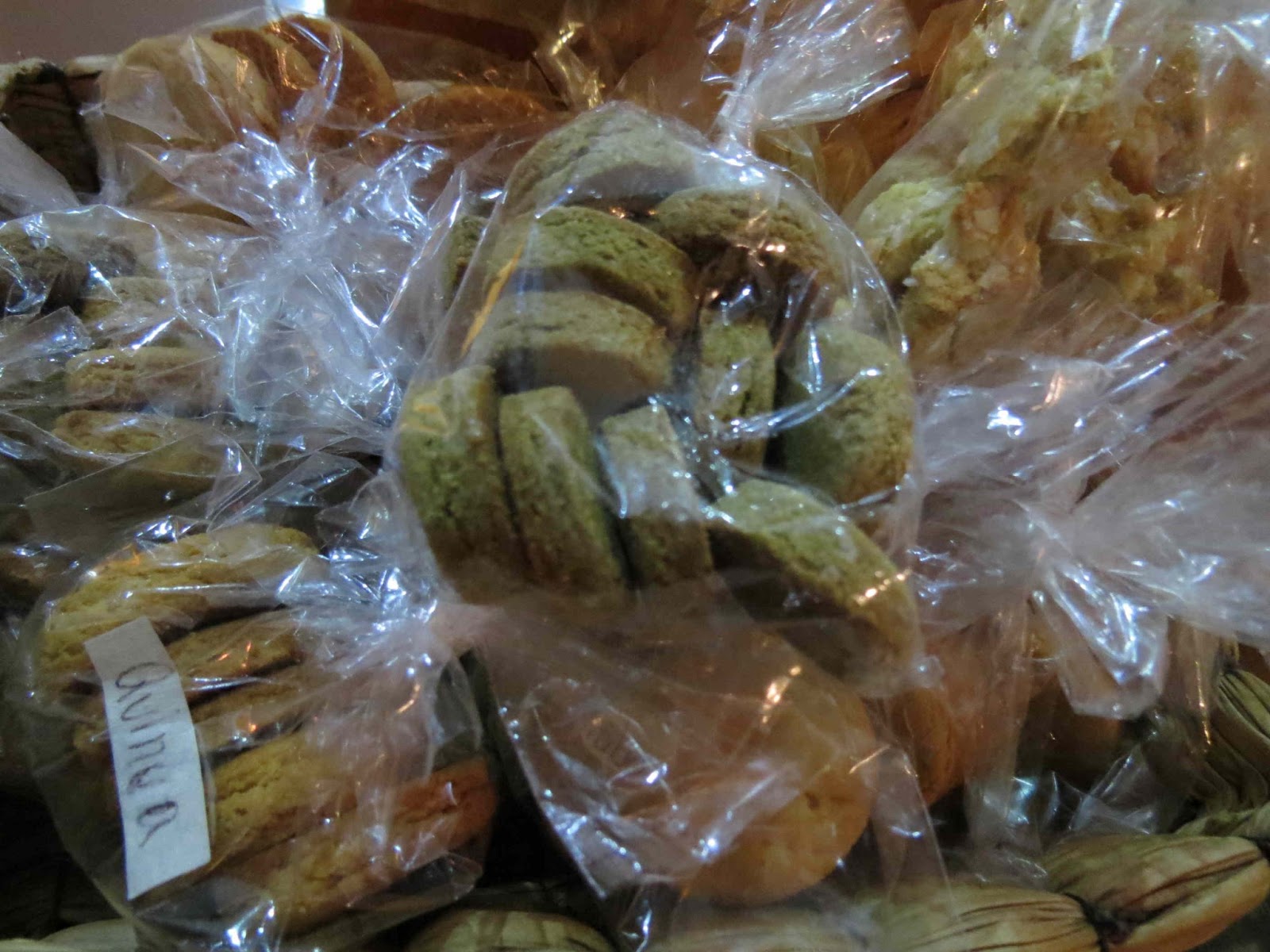
Coca tea and crackers. 
In Colombia, indigenous people are permitted to grow coca leaves on their own lands and use them for traditional purposes. The foods, medicines and other products they make out of coca leaves fall into sort of juridic limbo, as far as I understand: They aren't technically legal, but authorities tolerate them. Like so many other things, the coca leaf prohibitions are absurd. Coca leaves may not cure rheumatism and diabetes, as their sellers claim, but neither are they bad for you. Travelers traditionally sip coca tea to treat altitude sickness, with no ill effects besides a possible stomach ache. And hikers and miners chew the leaves to reduce fatigue. Each leaf sold for one of these healthful uses is a leaf which illegal drug producers can't buy.

Despite coca leaves' benefits for health and the economy of indigenous communities, Colombian anti-drug warriors have tried to demonize the plant, branding it 'La mata que mata,' (The plant that kills) in radio and TV ads, until coca plant growers sued them for defamation and won.
A sign lists coca leaves' supposed health benefits, including losing weight, removing skin blotches, and giving you energy. 
These coca products come from harvests in the Sierra de Santa Marta. 


By Mike Ceaser, of Bogotá Bike Tours