Showing posts with label garbage. Show all posts

Sunday, August 19, 2018

The End of the Trash Museum

Cyclists outside the Trash Museum back in the days of its full glory.
Bogotá's least popular anti-museum is no more.

The Trash Museum asks you what you're doing to the planet.
The Trash Museum, founded decades ago by the son of an upper-middle-class Bogotá family, became a regular stop on our bike tours, as well as a source of discord in its quiet Teusaquillo neighborhood.

As I heard the story, Antonio went to study in paris, where he rebelled against consumerism and wastefulness. He retunred hom, filled his family's house and yard with garbage. The museum became a landmark for bike tourists, but an eyesore for its neighbors, who at least once tried get to get Antonio evicted.

The house's front 'yard' was hidden behind a jumble of paper, plastic, boards and old shoes, decorated
'We are the trash culture!'
with signs denouncing mankind's wastefulness and announcing the planet's environmental collapse. 'How many of these objects came from your house?' asked one hand-scrawled sign. 'This is the way the world is,' announced another.

Passers-by contributed their own pieces of trash and even wrote their own statements. Sometimes, Antonio left his front door wide open, for anybody to enter and experience the museum's trash-packed interior, where he actually hosted friends.

The 'museum' even attained a degree of officialness. It was on Googe Maps and received an award from the Ministry of the Environment for environmental education.

"He was strong; a straight shooter." Antonio's brother gives us the sad news. But I suspect that the neighbors were relieved. 
A daring tourist ventures into the museum.
And Antonio certainly had his admirers, including his brother, who described him as "strong" and "a real straight shooter."

But, as much as I agree with Antonio's ideas - Bogotá's streets, sidewalks and waterways are strewn with paper and plastic from unnecessary packaging left over from mostly unnecessary products, which will either end up rotting in the Doña Juana landfill or float into the ocean, where animals will swallow it and choke to death.

A recognition from
the Ministry of
the Environment.
But Antonio, with his ways of antagonizing people, was not the best messenger. And I´m not sure whether his 'museum' was the product of principle, or just the rationalization of laziness. After all, Antonio spent his time indoors drinking himself to death.

Neither was he a particuarly pleasant person. Once when I stopped in front of the house with a bike
tour, Antonio Emerged from a amidst his trash and greeted us with an 'Heil Hitler.'

Later, we asked him what he did for a living.

"I'm the new Adolph Hitler," he told us.

About ten days ago, Antonio died, most probably from all of his drinking. His brother is clearing out his house and yard - a monumental task - and plans to rent out the property. Check it out soon on air BnB.
Hard at work clearing out the museum.

Ready to cart away the trash.
By Mike Ceaser, of Bogotá Bike Tours

Monday, February 5, 2018

Bogotá's Trash Emergency

Trash piled up in the Santa Fe neighborhood.
Bogotá is even trashier than normal these days due to a strike by folks at the Aguas de Bogotá company, which, a bit absurdly, has been in charge of garbage collection for the past years.

Pedestrians walk past piles of trash near the
Museo de Oro TransMilenio station.
Bogotá's besieged Mayor Enrique Peñalosa will likely pay a political price for this situation. But it is his predecessor Gustavo Petro, now a candidate for president, who set the stage for this fiasco.

Near the beginning of his own term as mayor, Petro, an ex-leader of the M-19 guerrilla group, decided to remove capitalists' dirty hands from the city's trash collection service.

So, Petro took the garbage collection contracts away from those evil private companies which had been doing the work competently for years, and gave it to the city's....water company, Aguas de Bogotá.

Aguas de Bogotá workers protest lay-offs recently.
The water company, besides not possessing the ideal expertise for trash pick-up, also lacked the personnel and the equipment. The water company's workforce was suddenly expanded from a few hundred workers to an unmanageable several thousand. And Bogotá did a rush job of importing dozens of used garbage trucks, most of which did not work, and many of which are still parked and rusting away today, while people fight over who's fault they were.

During that transition back in 2012, Bogotá was also inundated with trash. That trash fiasco eventually led to Petro's being removed from City Hall, and his eventual return.

Today, the water company is still responsible for trash pick-up in 52% of Bogotá.
More trash in Santa Fe.

It is the return to a private trash collection scheme, which has Aguas de Bogotá employees fearing for their jobs, that has triggered the strike and inundated Bogotá with garbage. Bogotá declared itself in a 'sanitary emergency.'

Expect the garbage crisis to continue until at least Feb. 16, when a new collection scheme is to start up.


Many water company employees will likely get jobs with the private companies.
By Mike Ceaser, of Bogotá Bike Tours

Friday, June 30, 2017

The Trash Museum: A Monument to Wastefullness


Bike tourists on a drizzly day outside the 'Garbage Museum' in Teusaquillo.
'Cosmic suicide will awaken us from lethargy.' Thoreau.
Talk about turning a vice into a virtue. The resident of a house on a quiet corner in Teusaquillo evidently liked collecting discarded stuff - but not cleaning up. Over the years, his house and yard filled with the results of his habit, turning the lot into something like a city dump, to the great delight, undoubtedly, of his neighbors.

When you've made a mess of things, it's good to paint it as a matter of principle. Thus, the trash museum has signs pointing out how wasteful and resource-greedy humans are. 'Did some of these objects come from your house?' asks one sign. Another advises 'Think before you buy,' and a third warns of cosmic collapse. He's also got a sophisticated website.

The trash museum, if that's what it is, makes an important point about humanity's wastefullness. And particularly in a city which does little recycling, and, more importantly, makes no effort to reduce the amount of waste produced, in the first place.

A discarded doll inside the house.
The trash museum's trashy entranceway.

'We are the garbage culture.'


N ice flowers!


'Think before you buy.'
'What are you doing?'

The front of the garbage museum, on a corner in Teusaquillo.
By Mike Ceaser, of Bogotá Bike Tours

Monday, May 25, 2015

The Trash Man Cometh


This colorful one-man plaza performance took place today on the Universidad Nacional's Plaza del Ché. Altho when I asked her about its meaning, one person involved shrugged her shoulders, the message carried by this masked man dragging coattails of trash seemed quite evident to me.


Dead in his trash pile.
As for Bogotá, decide for yourself whether Petro's 'Basura Cero' (Zero Trash) program has been anything more than just a slogan. 


Bogotá's paks and sidewalks have become repositories for used tires. They've held meetings about this problem, and that's about it.


By Mike Ceaser, of Bogotá Bike Tours

Monday, December 15, 2014

Bogotá - Still Trash City


Garbage - specifically, the stuff dumped in public spaces - has been Mayor Gustavo Petro's nemesis.

Petro's plan for transforming the city's collection system from private to public resulted in mounds of trash on sidewalks all over the city and eventually got Petro temporarily ousted from office. That was followed by the city's Basuro Cero (Zero Garbage) campaign, which only involved ever-increasing production of garbage - and recycling campaigns, which have produced no noticeable changes in trash disposal habits.

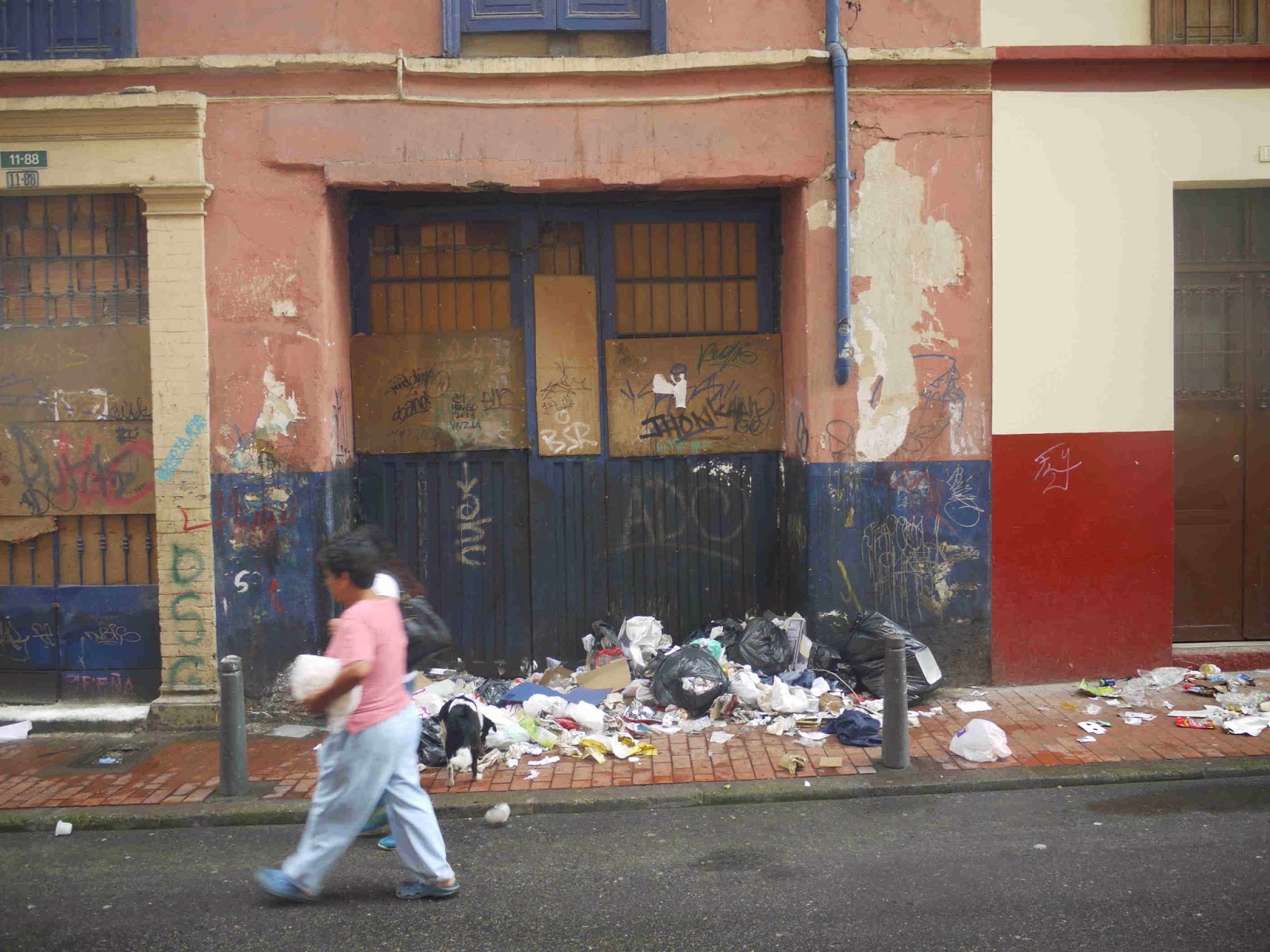
A pedestrian passes a trash-strewn sidewalk in La Candelaria.
Finally, the city issued a law, which went into force about ten days ago, which was supposed to finally and absolutely cure the garbage problem by fining people who did not dispose of their trash at the right time, in the right locations and in the correct-colored bags.

Of course, in a city of millions of people accustomed since forever to tossing their trash willy-nilly onto the sidewalks, where dogs and homeless people tear open the bags and paw thru it for anything they can consume or sell, an unenforceable law changed nothing. If Petro had bothered to ask the opinions of any Bogotanos, they could have saved him the trouble of creating a doomed law.

City 'Zero Garbage' workers sweep up a bit
of the city's tons of garbage.
Recently, Petro lamented to El Tiempo that 'We might have created a revolution.' Yes, he might have, if he had only implemented sensible solid waste policies tested and proven by other cities, such as deposit laws, taxes and other charges to shift the cost of trash disposal onto the businesses which produce and sell the products - thus motivating them to reduce, reuse and recycle their trash.

But Petro, despite being an ex-guerrilla, chose conservative policies obviously doomed to failure. That's nobody's fault but his own.


By Mike Ceaser, of Bogotá Bike Tours

Friday, July 4, 2014

Use it Once and Throw it Out


El Tiempo reports, on the lower left, that Bogotá will host a sustainability conference, and on the upper right that Bogotá is expanding its landfill, named Doña Juana.
Does this make sense? Tossing
garbage into a 'Zero Garbage' truck.
I got a good sarcastic laugh the other day about this coincidence of headlines. On the lower left-hand side, El Tiempo reports that Bogotá is to host the Río + 20 conference on sustainable development. On the upper right: proof that Bogotá is not sustainable: it's expanding its dump, rather than reducing, reusing or recycling its garbage.

Garbage policy has marked Mayo Gustavo Petro's administration. Earlier this year, the procurador got Petro temporarily ousted because the mayor had supposedly endangered public health by mismanaging garbage collection. Now, there are fewer mountains of trash on the sidewalk - but the mountains of trash are piling up in the city's landfill, Doña Juana. Much of that material consists of packaging that was used once, but will fill the landfill for thousands of years. Other stuff could be reused, composted or recycled - but filling the landfill - if only the city bothered.

A Bogotá official boasted that the Rio + 20 conference is proof of the city's green policies.
A 'Zero Garbage' garbage truck, full of garbage.

I'd suggest that once the conference attendees see the city's enormous, smog-spewing traffic jams, they'll ask why the city has not instituted a traffic congestion charge or created high-occupancy vehicle lanes. If they take a whiff of the Rio Bogotá, they might ask why, despite plan after plan and multiple court orders, the river's still an open sewer. And, god forbid visitors should visit the Doña Juana landfill, because then they'd ask why Bogotá lacks an effective recycling program or policies to discourage the use of styrofoam, disposable bottles and other one-use landfill-packing materials.
The Petro administration's main contribution to revolutionizing Bogotá's garbage policy has been to write 'Zero Garbage' on the city's trucks, uniforms and even garbage bags.

According to an interview with a Dutch solid waste official, Holland recycles 80% of its waste and incinerates an additional 18% to generate energy. Bogotá's statistics are almost the opposite: it recycles only 3.9% of its solid waste, according to El Espectador.

The key to Holland's success, says the visiting official, is to make manufacturers and retailers financially responsible for their products' waste material.
A stuffed full 'Zero Garbage' trash bag.
A worker in a 'Zero Garbage' uniform collects garbage on Ave. Septima.

Plastic drink bottles, generally used just once and then thrown away, are filling up the city's landfill. These pop drinks aren't good for us or for the environment, but the city subsidizes their use by doing the manufacturers the favor of carrying them away and disposing them for free.

Why doesn't Bogotá tax their use, as some other cities have? What about a plastic bag tax or even a ban?

How much space will these stacks of plastic bottles occupy in the landfill?
Stacks of styrofoam-packaged lunches for sale in the Universidad Nacional. Tomorrow, the packages will be in the landfill, where they'll stay for a thousand years.
Some cities have prohibited styrofoam packaging, In Bogotá, it's ubiquitous.

Styrofoam packaging spills out of a trash can on La Candelaria's 'Environmental Axis' avenue.
Sacks of organic garbage wait for collection near the Parque Nacional. This stuff could all be composted - but don't expect it to be.
Trash cans by any other name. Labeled recycling bins in Parque de la Independencia.

And here's Bogotá recycling - no thanks to the city.

A man, likely a homeless drug addict, sifts thru trash on Plaza San Victorino for anything that's usable. 
A little while later, the area is cleaner.
This old man works every day along Ave. Septima, collecting cardboard and wood to resell.
He could teach the city father's a lesson.
By Mike Ceaser, of Bogotá Bike Tours