Showing posts with label Bogota. Show all posts

Monday, April 2, 2018

A Beautiful - and Fantastical - Future Bogotá

A hiking trail through Bogotá's Eastern Hills.
Last year, the Museo de Bogotá (located on Carrera 4 and Calle 10, in La Candelaria) put on this exhibit about Bogotá's fantastical future - clearly a vision of the administration of current Mayor Enrique Peñalosa. And it's a nice visition, with a fully developed multi-modal transit system (subway, expanded TransMilenio, cable cars to hillside neighborhoods, and bike lanes), green corridors, high-density neighborhoods and other wonders.
Inside the Museo de Bogotá.
It's a beautiful vision for a city with lots of problems with chaotic development, lack of green space, danger for cyclists and walkers, terrible traffic jams and pollution, and on and on. Naturally, the vision fits technocrat Peñalosa's ideas about low-cost bus rapid transit and the democratizing effects of pleasant public spaces.

'The capital of the bicycle.'
What could possibly go wrong? Unfortunately, human nature. Will the city actually fund such projects, or will the money be stolen by corrupt functionaries or designated for projects which are more populist but have dubious urban impacts, such as highways or sports stadiums. And, while Bogotá debates such projects thru succeeding mayors, with varying priorities, the city will continue growing, legally and illegally, individual residents paying little attention to the mayors' visions. Meanwhile, the number of cars will continue exploding, gridlocking the city's avenues, poisoning its air and increasing pressure to pave over even more land.

A clean, green, sustainable city? A nice fantasy, tragically.


Walking on a map of Bogotá.


Checking out a city map.

A historical map of Bogotá.

Environmental corridors.

The city's 'environmental corridors.'


'Revoke Peñalosa'

Inside the Museo de Bogotá.

Map of the first line of Bogotá's subway.

A bicyclist pedals past the Museo de Bogotá.

Transmicable.

The network of TransMilenio routes.

Transmilenio.
By Mike Ceaser, of Bogotá Bike Tours

Thursday, January 4, 2018

Staycationing in Bogotá

Eating and playing in the street behind the Paloquemao Market.
Bogotá is vacant these days (except for tourists), its streets empty, schools and shops closed and many homes unoccupied. The wealthy and middle classes have mostly cleared out to the coast or their countryside fincas.

But the poorer, working class folks, such as these families of the Los Martyrs neighborhood behind

Paloquemao Market, mostly stay put, either because they have to work or because they can't afford to travel.

But life in an emptied out Bogotá isn't so bad: it's peaceful, relatively unpolluted, and you can play in the street, as this family was doing the other day.

Doesn't that beat crowding onto a dirty beach where you're surrounded by screaming kids and grouching adults, the sun fries your skin and your new shoes get stolen?

By Mike Ceaser, of Bogotá Bike Tours

Sunday, August 27, 2017

Stump City: The Deforestation of Bogotá

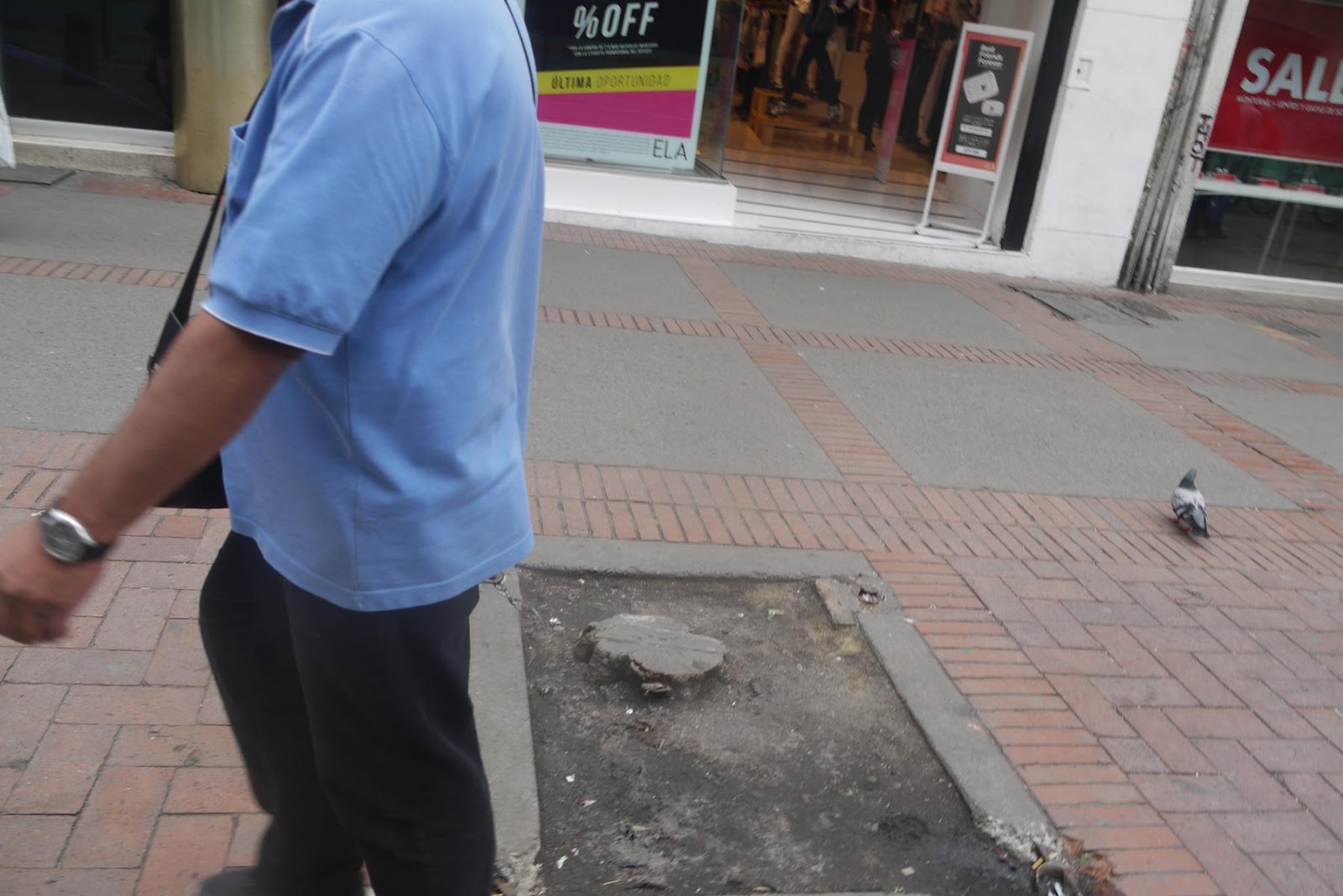
A freshly-cut tree stump on Carrera Septima, in the city center.
Trees cool cities down, reduce pollution, noise and stress, and add beauty to urban areas. They can also provide habitat for bats and birds, which eat pesty insects. But, sadly, anybody walking past the series of stumps along Carrera 7 in downtown could be forgiven for believing that Bogotá's suffering an urban deforestation.

A forlorn tree stump on Las Nieves Plaza.
Urban trees can certainly cause trouble: they fall down, drop branches and leaves, and their roots can break sidewalks and water pipes.

So, when one of those grand old trees becomes a nuisance, the easiest response may be to just cut it down. That solution is not only easiest, but also the most profitable: I understand that the city contractor gets paid for each tree it cuts down (rather than each tree it saves) and also gets to sell the lumber.

With incentives like that, it's a surprise that any tree is still standing.

It wouldn't be so bad if they actually replaced the trees, but the city rarely seems to.

Along Carrera 7, the stumps have it. I didn't see any signs of replanting, either.


In the Parque Nacional, this big tree is leaning over, but otherwise healthy. Will officials cut it or save it?
Manuel can't hold the tree up, but a steel or cement column might. Instead, bet that the tree will be cut down.
Update: The city is doing some sort of work on Carrera Septima, which may be the reason for cutting down all of those trees. Perhaps there's hope yet for the urban environment, if not for the rural one.

By Mike Ceaser, of Bogotá Bike Tours

Thursday, October 6, 2016

Poverty and Peace

Impoverished Colombians are much more likely to have suffered from Colombia's conflict. So, why
did they vote against the peace accord - at least in Bogotá?

Take a look at Bogotá's voting results, as published in El Tiempo. While Usaquen, Chapinero and Teusaquillo all voted SI, while majorities in the poor neighborhoods of Bosa, USME and Ciudad Bolivar, voted NO. On the other hand, many other poor rural areas of the country, such as Chocó, Putumayo and La Guajira, voted heavily SI.
On the one hand, you might expect that victims of violence, such as the tens of thousands of displaced people living in these poor areas, would vote SI to end the conflict. El Tiempo, however, hypothesizes that impoverished Colombians object to the guerrillas, who may have victimized them, receiving government stipends and other support, as agreed to in the peace accord.

Poverty has undoubtedly fueled Colombia's conflict. It may also be blocking an agreement.

Update: Multiple news reports say that evangelical churches, which tend to be strongest in poor neighborhoods, came out strong for the No vote, which might explain both the No winning in poor neighborhoods and the higher turnout there. However, the connection between the peace deal and evangelical issues - mostly LGBT rights - is pretty tenuous.

By Mike Ceaser, of Bogotá Bike Tours

Friday, October 23, 2015

New Labels, Same Smoke


Recently, in its desperation to expand its peso-hemorrhaging SITP bus system, the Petro administration has been slapping 'SITP' stickers on old buses and - like magic! - transforming them into new, modern, efficient, orderly and clean buses.

Except for the fact that they continue stopping in mid-block, running red lights and belching smoke.

Apparently, that sticker doesn't change anything inside the buses.

¿Why haven't any of the mayoral candidates made cleaning the air part of their campaign platforms?


By Mike Ceaser, of Bogotá Bike Tours

Monday, October 5, 2015

Bogotá, Outstanding in Traffic

A massive traffic jam on Calle 26 in central Bogotá.
The traffic app Waze has given Bogotá yet another outstanding rating, but this one is a measure of the
city's urban pain. According to Waze, Bogotá is the worst - yes, the very worst - place to drive of all the cities it evaluates. And Colombia is one of the worst nations in the world.

And the situation is fated to get lots worse, thanks to the boom in private cars. That's unless the government adopts unpopular policies such as hiking the price of gasoline or instituting a congestion charge. But politicians haven't shown the courage for those things.

Interestingly, European nations with high gasoline prices and high rates of bike commuting, such as Belgium and the Netherlands are ranked as good places to drive - showing that policies promoting 'alternative' transit actually benefit car addicts, as well.

Colombia, a bad place for drivers, and Venezuela (where gas is almost free) is even worse.

Would getting more folks onto bicycles mean fewer cars clogging the roads?

By Mike Ceaser, of Bogotá Bike Tours

Tuesday, April 7, 2015

The Evolution of La Candelaria


Residents walk along a cobblestone street in La Candelaria.
 La Candelaria, Bogotá's oldest neighborhood and still the city's heart, has undergone multiple evolutions.

Poor people walk uphill toward the
Egipto neighborhood.
For centuries after the city's founding in 1538, La Candelaria was the home of the city's elite, its power brokers. The wealthy began moving out of the historic center during the 1920s, according to a report by the Universidad Nacional, and the 1948 Bogotazo devastated the city's center, pushign the wealthy north to newer neighborhoods such as Teusaquillo, Chapinero and Usaquen. Meanwhile, amid Colombia's chronic violence, the city's historic center became known for crime, poverty and decay.

However, since the early 2000s, thanks to Colombia's increased stability, lower crime rates and growing economy, La Candelaria has experienced something of a renaissance, with tourism, growing universities and rising property prices.

And now a study by Universidad Nacional students makes it official: La Candelaria is gentrifying.

Dying breed? A neighborhood shop.
According to the university report, monthly apartment rentals in the neighborhood are around a million pesos - a hefty sum in a city which defines an income of more than 200,000 pesos per month as being 'not poor' - and houses can be worth several billion pesos.

As a result, says the study, "the traditional low-income residents are beginning to migrate to other parts of Bogotá, such as the south, which can be noticed by the replacement of shoemakers and bakeries with expensive restaurants."

Today, La Candelaria still feels like a neighborhood. But, as rising rents force out traditional residents, it may lose that and turn into a district of old buildings, quaint cafes and museums.


Universities, such as the Catholic La Salle, have expanded, bringing more students and money to La Candelaria.
Increased police presence has made tourists and residents feel safer, altho crime remains a problem.
However, will La Candelaria ruin itself thru success?

Traffic jams have become chronic in the historical center. But instead of discouraging private car use, officials are allowing the Externado University to build a huge parking garage on the hillside.
A few years ago, someone built this faux-old house on Calle 9.
Whether because of corruption, lack of laws or lack of enforcement, the city keeps permitting constructions which conflict with the neighborhood's historic ambience.
Are those mushrooms behind these houses?
This multi-story apartment building going up on a cobblestone block of Carrera 3 doesn't look very colonial.
Some scenes of La Candelaria?

The Abadia Colonial Hotel was renovated by its Italian owner.
A beggar woman hawks flowers on a La Candelaria doorstep.
A delivery bike in front of a quaint store.
A view down Calle 10.
A theatre and the recently-renovated Muisca Hotel.

Tourists walk near La Plaza del Chorro.
Locals play their daily board game.

A used book store's doorway.

By Mike Ceaser, of Bogotá Bike Tours