Showing posts with label Chicha. Show all posts

Saturday, November 18, 2017

The Bendita Chicha Festival


A few photos from the Bendita bebida festival held yesterday and today on the Plaza del Chorro de Queveda. Chicha and masato are traditional drinks inherited from the Muisca indigenous people, made from fermented corn and rice, respectively.

They're available around the plaza all the time (except during dry law), particularly in the Callejon del Embudo.

Bottles of chicha for sale.


Traditional foods.
By Mike Ceaser, of Bogotá Bike Tours

Saturday, November 29, 2014

La Perseverancia Chicha Festival, 2014


How about some chicha? These folks also had chicha made from quinua.
This weekend the La Perseverancia neighborhood is putting on its annual Chicha Festival. Chicha, usually made from fermented corn, is a traditional drink inherited from the Muisca Indians. La Perseverancia is a hardscrabble, working class neighborhood where families have made chicha for generations.
The 'best' chicha. And they
say so themselves.
The neighborhood, popularly known as 'La Perse', has a reputation for crime and is off limits to tourists and even most Colombians on normal days. But during the festival police abound and the place opens up. 

The area was long known for making chicha. But around the turn of the last century Gustavo Leo Kopp founded the La Bavaria beer brewery down the hill and built a model neighborhood for his employees here. Beer payed taxes, chicha did not. Industry and government allied themselves to denounce chicha consumption as dangerous and unhealthy. But chicha-making persevered, and today many residents brew the drink in homes and stores. And, ironically, fermented foods have today become trendy for the health-conscious. 

We visited La Perseverancia today during a bike tour.

The festival continues thru tomorrow.
Pouring chichas. 
The statue in the background is of Jorge Eliecer Gaitán, a populist politician assassinated in 1948, who was popular in this working-class neighborhood.
'Delicious chicha of corn and honey.'
The chicha festival, with La Perseverancia's church in the background.

'Chicha Doña Leo.' Doña Leo has won several chicha competitions.
Baby birds for sale on the street. 
This boy got a baby chick. 

Don't wander down here. A closed-off street in La Perseverancia.
A La Perseverancia house.

A tourist tastes chicha.
'Chicha creates brutes. Don't consume fermented drinks.' A sign from another era warns against drinking chicha.
By Mike Ceaser, of Bogotá Bike Tours

Sunday, January 6, 2013

La Perseverancia's Chicha-less Festival


During the festival a band played to a crowd seated in front of the church. 
I attended the La Perseverancia neighborhood's annual Chicha Festival this year, only to be  isappointed - there was no chicha for sale. An acquaintance met there explained that the chicha had been sold out to a record crowd on Saturday. That's no too surprising, since the last several weeks have been quite warm, with a blazing sun. I suppose that that's a vote in favor of the festival organizers' decision to move the festival from its historical October date, when it often rained.
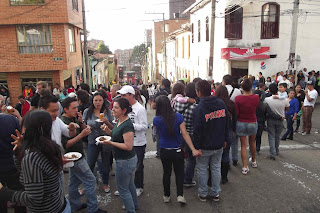

A dancer spins during the chicha festival.
La Perseverancia is a traditional blue-collar neighborhood on the lower reaches of Bogotá's Easter Hills, between La Macarena and the National Park. Originally built by and for the workers of the Bavaria Beer Brewery with the support of the company's far-sighted owner Leo Kopp, it has become known instead for brewing of chicha, a traditional drink made from fermented corn. 

Serving chicha from a plastic bottle.
This was about the only chicha I saw today.
The neighborhood, known affectionately as 'La Perse', grew up in the first decades of the 1900s, when families migrated from the Egipto and Belen neighborhoods to work in the Bavaria Brewery, located down the hill across Ave. Septima from what was then a prison and is now the National Museum. The old Bavaria brewery, with its recognizably German arquitecture, today contains shops and offices. The company, which continues to dominate Colombian beer-making, has a newer brewery in western Bogotá. 

A street fills up - but not with chicha drinkers. 
Bavaria owner Kopp, a Jewish-German immigrant, helped his workers pay for their homes and assisted them in bringing water, electricity and sewerage services to the neighborhood. Many families also built adobe homes with their own hands and sweat. In the spirit of a blue-collar community, the church was named after Christ the Laborer and the plaza featured a 'Monument to Work', which has apparently disappeared. 

The neighborhood became a stronghold of support for fiery leftist politician Jorge Eliecer Gaitan, who was assassinated in the city center in 1948. Today, there's a small statue to the martyred leader, his right arm as always raised up toward the sky.

A crowd in front of the
Church of Christ Laborer.
The chicha festival, which began in 1988, honors a drink which has survived in a hostile world. For decades in the early 1900s the beer and liquor industries and the government propagandized against chicha, claiming that it caused diseases and turned drinkers insane. The anti-chicha lobby's real motives were economic - to sell more of competing alcoholic drinks. The government also wanted to turn the public away from homemade chicha, which didn't pay taxes, to other drinks, which did. 

But chicha has survived, and continues holding an important place in the stomachs and minds of many Bogotanos.

Chicha's survival also happens to be an illustration of another thing - the futility of trying to prohibit mind-altering substances.
Candies for sale. 

A poster celebrates the festival...but where's La chicha?

A man selling pieces of cocoanut fried in sugar cane sugar. 


A statue of working-class hero Jorge Eliecer Gaitan, who was assassinated in central Bogotá in 1948.


A children's band performs traditional music.


An uncommonly warm and sunny day. 


By Mike Ceaser, of Bogotá Bike Tours

Friday, June 3, 2011

Campesinos Take Over Plaza Bolívar!

This woman offers pan de yuca, or yucca bread. 
For the past several years, Bogotá has held mercados campesinos, or campesino markets, on major plazas and other public spaces. Probably the biggest and most prominent of the market locations is Plaza Bolívar, which is also Colombia's seat of government. About once a month, instead of protesters, marching police or musical bands, it fills with stalls selling fruit, breads, drinks, even handicrafts.

The market's goal is to cut out the middleman and enable peasant farmers and other small foodmakers to earn more by selling directly to consumers. The peasants need it: Colombia's rural poverty rate appears to be between 60 and 70 percent, according to the most recent figures I've found, with 20-some percent of rural people suffering extreme poverty. Rural people also suffer the worst impacts of Colombia's armed conflict, driving many into the cities, where they often live in poor, violent neighborhoods. 

Peanuts and other grains for sale.
Jellies and preserves


Buy my masato, a fermented drink made from rice and related to chicha.

Even here, there's a protest - against the proposed Free Trade Agreements, mostly the one with the United States. Peasant farmers fear, probably correctly, that the agreements will flood Colombia with subsidized agricultural products. 
Weighing cocoa powder, to be used to make a chocolate drink.
Try some chicha, a fermented drink, usually made from corn. This woman won first prize in last year's chicha festival in Bogotá's La Perseverancia neighborhood

These guys made chicha from both corn and chontaduro

Another chicha maker.
This group of street artists, named Porno Por Si, performed in exchange for fruit. 


More info about the Mercados Campesinos here: http://www.mercadoscampesinos.tk/

or here: http://twitter.com/prensamercados

By Mike Ceaser, of Bogotá Bike Tours