Showing posts with label drug addiction. Show all posts

Wednesday, November 2, 2016

Indigentes All Over

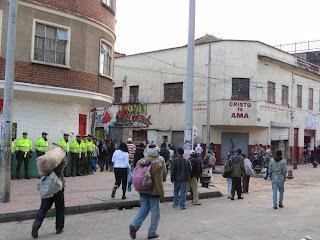
Homeless drug addicts pass the hours away on the median of Carrera 10 south of San Victorino.
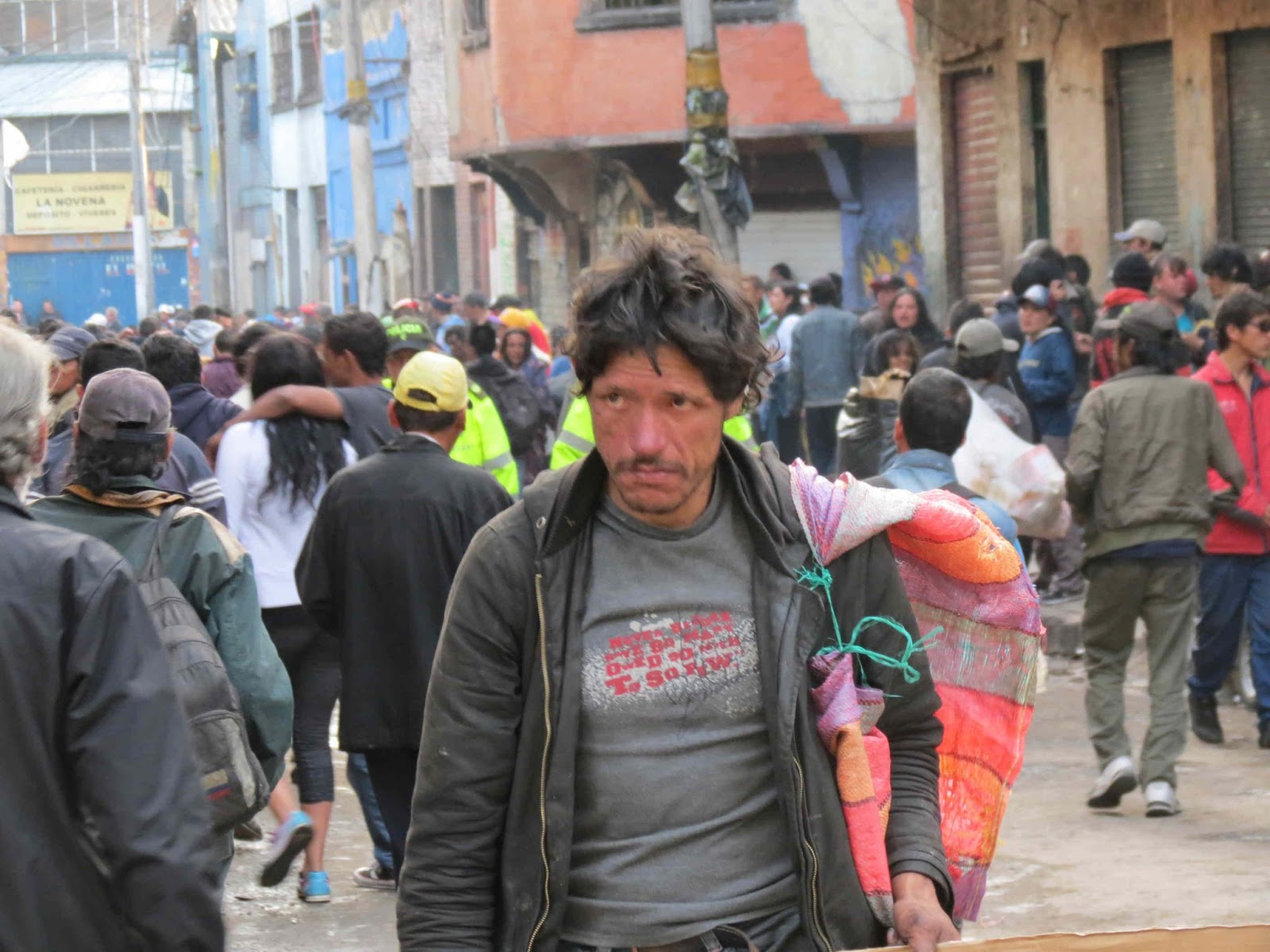
When thousands of police invaded El Bronx this May, they discovered a place of horrors. Crack addicts, child crack addicts, prostitutes of all ages, torture chambers, and even murder victims, buried and forgotten beneath the buildings.

However, what might have been a new life for the addicts and criminals in the bronx, who are also
Residents of El Bronx. (Photo: Semana)
victims, has not come to pass. According to news reports and people who work with addicts, many Bronx residents were bussed to neighboring towns, where they were just dumped on the street, or dropped off on the banks of the Rio Bogotá.

Of course, many addicts reject assistance, so social workers' jobs aren't easy. But now, complain residents of neighborhoods like San Bernardino, located just south of Tercer Milenio Park, the drug addicts camp on their doorsteps. Businesspeople complain about addicts sleeping and defecating in front of their doorways and have marched in protest to Plaza Bolivar.

Permitting a criminal district in the city's center, just a few blocks from City Hall and the presidential palace was intolerable. But now things may be worse, both for the Bronx residents, who lost their homes and community, and neighbors, who now feel as tho they're living in El Bronx.

The 'good' news? Just as before the Bronx there was El Cartucho, sooner or later the same population will settle someplace new and establish a new 'Bronx.'

By Mike Ceaser, of Bogotá Bike Tours

Tuesday, October 21, 2014

To Catch a Thief?


This afternoon in the Teusaquillo neighborhood during a bike tour we came upon this scene, in which two tough-looking men were apprehending this kid, whom they accused of stealing, apparently a car's rear-view mirror.

Scenes like this one aren't rare in Bogotá, where residents frequently take the law into their own hands after crimes - or alleged crimes. In this case, thankfully, the two men didn't beat the kid up, altho that might have been because we witnesses were nearby with cameras, and someone called the police, who showed up quickly. I've seen other incidents in which people beat up an alleged criminal, with the justification that 'the police will just let him go.'

Why is the man in the striped shirt carrying a pistol? Does he really think that two big men need the help of a firearm to detain a small kid? Would he really use it against this kid for supposedly stealing a mirror? And, does he have a license to carry a firearm in the first place?

And, how about the kid? He looked like a homeless drug addict, and very desperate. Had he been kicked out of his home? Beaten or abused? Desperate to eat or more likely to buy bazuco, he tore off a mirror worth a few thousand pesos in El Bronx and started running. He didn't get far this time.

Perhaps he's in a children's home by now and will come out better for the experience. But more likely he's in a cell with other criminals, or back on the cold streets by now.


By Mike Ceaser, of Bogotá Bike Tours

Thursday, September 5, 2013

Memorializing the Beso in El Bronx


This recent created mural on Calle 26 just west of Carrera Decima is becoming a Bogotá icon.

The mural memorializes a scene from El Bronx, the city's open-air drug alley.

On April 1, while Pres. Santos visited El Bronx, an El Tiempo photographer captured a couple in a passionate embrace amidst the street's vice and misery.

The couple were Hernán and Diana, drug addicts and Bronx denizens who survive by making and selling pipes for smoking dope. Both come from 'good' families, and Hernán even got an outstanding score on the ICFES student performance score. Some days the couple manages to scrape together the 8,000 pesos they need to pay rent for a room, some nights they sleep outdoors.

But they appear to be very much in love.


Bynb vMnike Ceaser, of Bnhh}+¿ogotá Bike Tour6

Thursday, May 30, 2013

A Poet of the Bronx: Death, Drugs and Music

Max Heinz and his guitar. 
From Nazi Germany, to Chile to Bogotá's Bronx, the saga of Max Heinz, 'A Poet of the Bronx,' has to make one question human nature - or celebrate it.

Max Heinz's mother fled Germany just before World War II "on the last boat out." She wasn't Jewish, but her father "knew that Germany was going to lose the war" and wanted to rescue his daughter. A man of influence and connections, Max Heinz's grandfather also knew of the Nazis' abuses against Jews and others committed in the notorious Dachau concentration camp. He was able to free a Jewish man from Dachau and help his family escape Germany - but on the condition that they adopted his daughter, Max Heinz's mother. "He put them on the boat, with my mother as their daughter." That's how Max Heinz obtained his Jewish surname Loeb, "although I'm not of Jewish blood."

The family landed in Buenaventura. Eventually, Max Heinz's mother met and married a Chilean man, who took her to his homeland, where Max Heinz was born. The Chilean's own father was from Birmingham, Alabama. His parents spoke to him in English and German, and "I learned Spanish from the drivers and gardeners," Max Heinz recalls. The family returned to Colombia, where Max Heinz's father worked as a translator.

By his home on the edge
of the San Bernardino neighborhood. 
A talented swimmer, Max Heinz participated in national and international competitions, winning many medals, he says. Later, he got into Tae Kwon Do. Being trilingual got him work in universities and language academies. But when his mother died about 20 years ago, Max Heinz's life fell apart. He had dabbled in drugs, he says, but then he lost control.

"I said 'What the fuck! and I went out to the street to drink."

Max Heinz, now 54, lived first in El Cartucho, the notorious neighborhood since bulldozed and replaced by Parque Tercer Milenium, then in El Bronx and now in the equally rough San Bernardino neighborhood just south of Tercer Milenio.

He's witnessed killings committed according to those neighborhoods' pitiless codes of justice. Back in El Cartucho, where he recalls 3, 4 or 5 murders took place every day, the bosses, known as caciques, would hand a man a gun and order him to kill someone.

"If he did it, he'd get twenty bazuco cigarretes, if not he'd get killed himself. He had to do it."

Waiting to sing on a bus on Carrera Decima.
Max Heinz says he was never ordered to kill - thanks to a great degree to his musical ability. Instead, he played his guitar.

In the Bronx, he describes how drug sellers' ruthlessness with debtors. "They'll make the guy sit down, and give him an hour to pay. He can't go anywhere. All he can do is hope that someone who passes by will give him the money. Otherwise, they kill him."

Max Heinz, who seems quite a humanist, accepts this way of doing business.

"The dealers have to do it. Otherwise, the users would all take advantage of them.

"There's a code of honor."

Recently, he witnessed another musician gun a man down in San Bernardino. The corpse was tossed near a road. Nobody said anything. "Everybody is death, dumb and blind," says Max Heinz. The killer "must have had his reason. People don't kill for no reason."

He defends and respects El Bronx, even insisting that prostitution doesn't go on either there or the old Cartucho (against all other accounts I've heard), and that "women, children and animals are respected.

A street in the San Bernardino neighborhood. 
"It's a real paradise," he says of El Bronx, causing me to stare at him. "You can get everything there cheap. I bought a cellphone with television for only 7,000 pesos," he boasts, pulling it out and insisting it wasn't stolen. "Nobody else would buy it. All they want to spend their money on is drugs."

He consumes a cocktail of drugs himself, legal and illegal. But, as he describes it, they serve him as stimulants, keep him awake and enable him to play music. Just a few bits here and there, mixed into something else, he describes. One drug helps him control his consumption of another. He's got his self-maintenance formulas down pat, he says.

That was especially true back when he lived in El Bronx, where "they blasted the music until 6 a.m., shut down for a bit, and then started again."
Teaching English in La Candelaria. 

Still, his almost frenzied grin and rachety movements and speech give away that he's under the influence of something - or needs something.

For the past few months he's taught English in a foundation for poor children in La Candelaria. He credits that experience with helping him reduce the consumption of the one drug which he says was hurting him - vodka.

"I've cut down from two bottles a day to a half a bottle."

Along the way, Max Heinz has been profiled in the now-defunct 'Colombian Post,' which called him 'A Minstrel of Bogotá' and a few years ago in Cromos magazine, which baptized him a 'Poet of the Bronx.' He carries the article proudly in his pocket. Max Heinz says he's lived with six women and fathered nine children.

With students of English. 
Max Heinz seems happy, or at least generally satisfied. He teaches languages, sometimes as a volunteer, with energy and enthusiasm. "Repetition is the key," he explains.

And he earns his bread and butter singing on public buses. He's written 118 songs, but says that evangelical churches have stolen some of them. On buses, only fast ballads will do - he's got only a few minutes for his show, and a bolero would put the passengers to sleep.

"I've got to get on and do my show in two minutes and thirty seconds. I don't beg. I don't talk shit.

"I prefer singing to the poor. They give you coins and shake your hand. The rich just reach out and drop the coins into your hand."

But singing to bus passengers isn't easy: "They're tired. They've had a bad day. And they didn't ask you to sing. You've got to sing well. Otherwise, you make better money just begging."

But Max Heinz declined to sing for me. His guitar strings needed changing, he said.

By Mike Ceaser, of Bogotá Bike Tours

Wednesday, February 20, 2013

Back Into El Bronx


A drug-addicted man walks in El Bronx, in central Bogotá.

A rare sight in El Bronx - a woman laughs at something. 
When I read in this morning's paper that the police had cleared out El Bronx, the notorious street of drugs, prostitution and stolen goods in central Bogotá, I thot: 'Well, another era's over, wonder where they'll go next.' In 2005, the city had razed El Cartucho, a vice- and crime-saturated neighborhood just a few blocks east, and replaced it with Parque Tercer Milenio.

Denizens of El Bronx. 
Whether out of cowardice or wise prudence, I'd never entered El Bronx, but I had heard lots about it: About the open drug dealing within, the crack dens, the child addicts, the prostitution and the selling of stolen goods; But also about the lives and the economy of what is also neighborhood, including small businesses like barbers and restaurants.

Today's papers reported that they'd cleared out El Bronx, which is also known as La Ele and adjoins Los Martires plaza, displacing thousands of people and cleaning out tons of material. Photos showed that what had been a hive of junk, shacks and human activity was transformed into an empty street which could have been anyplace.

I went down to see it. Instead, I found lines of riot-equipped police keeping people blocks away from El Bronx. "We don't want the people to go back," one told me.
Before the street was reopened, a boy pulls a
cart past a line of police. 

Instead, El Bronx's denizens were sleeping on sidewalks and gathered in a crowd of hundreds in Los Martires Plaza. In the plaza, while I talked to some police officers, human wrecks from El Bronx limped past us. Nobody knew what would happen. Several cops had told me that El Bronx's residents had resettled a few blocks west. "They'll have to go somewhere," I predicted.

Suddenly and without warning, the police line moved aside and, yelling with excitement, the crowd of dirty, ragged, drug-addicted men and women raced to El Bronx's entrance. They limped and hobbled, dragging ragged, dirty clothing, and pushing carts filled with their worldly belongings. I followed.

Beside and across from El Bronx's entrance stood lines of riot police. For once, El Bronx's residents ignored this gringo as he stood among them taking pictures. When I've passed by in the past and tried snapping a few shots of the melee of humanity in the street frantically buying and selling, the drug pushers in the entrance hobble out either offering their products or threatening violent punishment for photo taking. So, with cops all around and the El Bronx's residents distracted by the need for that next hit, I snapped away.

The background (According to news reports): Early Tuesday morning city employees arrived in El Bronx offering medical check-ups and food. Hundreds of Bronx residents got into their vans, and city workers cleared out the remaining people. While the street was unoccupied, the bulldozers entered and leveled everything, including shacks, workshops, small businesses, etc. Many Bronx residents lost the few belongings they had. Afterwards, the street was clean, but its structures were gone.

Police patrol a street in the Los Martires district. 
While El Bronx is off limits, homeless
drug addicts sit on a street-corner. 
I've never been anyplace else like El Bronx, and the mass of depravityand human degeneration reminded me of one of those accounts of human sinks you read about far away and long ago. But here they were, men, women and children completely given up to addiction, who paid for their habits by stealing, trash-picking or any other way.

A cop approached me. "Where are you from." "The United States," I told him, "but I live here."

...and sleep on a sidewalk. 
"And you're on bazuco?" he asked. That's the cheap and dirty form of cocaine which most street people are addicted to. He couldn't think of any other reason a person would come down here.

"No, just taking pictures," I said.

Another cop, who was also photographing, told me that El Bronx would not be the same. "They can come here and do their drugs, he said, but they can't rebuild their shacks. Instead, there'll be a half-dozen rehabilitation centers for them. Little by little, we'll reform them"

and wait...
Hopefully that'll happen, altho it seems to me that most Bronx residents are beyond recovery. The administration of Mayor Gustavo Petro, a leftist who has tried to treat drug use as a health and social problem instead of a crime, has tried setting up treatment clinics near El Bronx and other addicts' havens, but they haven't received much acceptance. In any case, other cops predicted that El Bronx wouldn't change.

A pedicab passes a handsome older building in
Los Martires, once a wealthy neighborhood. 
I entered only a few yards into the street, and then only with cops around. Several Bronx informed me that I'd soon lose my camera, so I retreated nearer the police line.

A middle-aged couple limped out. Despite being  drug-worn, they still looked friendly and warmhearted. They were Yudy and Cesar, and they'd frequented El Bronx since its beginning about seven years ago and said it was imported to have a drug 'tolerance area.'

"There are terrible things here, but also beautiful ones," they told me.

"What's a beautiful thing about El Bronx?" I asked.

For one thing, they said, bazuco addicts like themselves could feel a self respect in El Bronx, where everybody was accepted. "One doesn't feel denigrated."

And El Bronx is a place of life and death.

"Children are born and grow up in El Bronx," they told me, altho many of them are addicts from childhood.

"And you can buy anthing here, even brand-name clothing, for cheaper than you can outside."

A homeless man on Los Martires Plaza, where hundreds of Bronx residents waited. 
I pointed out that most of these items were undoubtedly stolen. But Cesar and Yudy didn't see much wrong with that.

"A fool who gets robbed deserves it." 
On Los Martires Plaza, Bronx residents wait
for the street of vice to be reopened. 

"And the terrible things?" I asked, altho I'd read many accounts. 

"The executions," they said, using the word ajusticiamientos, which suggests that the killers are doing justice. "They execute people for stealing, out here on the plaza."

I observed that killing someone for stealing seemed harsh. But they considered it justified.

"If one person steals, then others follow him," they pointed out. While much of what's bought and sold in El Bronx is stolen, those who control the street know that theft here will scare away customers. 

Yudy and Cesar, long-time Bronx visitors, say the street has postive aspects. 
The city had provided a medical van,
but it got few visitors. 
Then, the couple described a kind of torture performed on miscreants inside El Bronx. As best I could understand it, the offender was made to sit in a bucket of water, and then an electrical cable was dropped into the water. 

"Some survive, some don't," they said. 

The couple also knew El Cartucho, El Bronx's predecessor, and they say El Cartucho was much worse. 
The plaza's neglected monument to the nation's martyrs. 
As for Judy and Cesar, they work helping out in a nearby skid-row hotel. They'd like to get off of bazuco, and feel they are "80% of the way there."

That makes them exceptional in El Bronx, where most residents are beyond repair. Their employment has given them hope.

Storekeepers watch the action b
y Martires Plaza. 
"It helps to have responsibility," they told me. 

El Bronx sounds like a horrific place, altho also a sadly human one. Perhaps the city will clean it out, out of embarrasment of having this vice den so close to the city center and the historically important Plaza de los Martires. But then El Bronx's residents, who will always exist, will just move someplace else. 


On Los Martires Plaza young men pass the time waiting by pretending to fight. 

Race into hell: After the police opened their line, Bronx residents run back into the street. 

Racing back into El Bronx - and toward that next drug fix. 

Running back into the Bronx, some pull hand carts. 


This man stood at El Bronx's entrance, like a master of ceremonies. 
'Christ Loves You.'
The master of ceremonies gets photographed.
A man dressed in a burlap bag. 


A man pushes a snack cart into El Bronx. Things are returning to normal. 

The police search those heading toward El Bronx. 
The street's weathered buildings. The people here are poor, but satellite TV is essential. 
Afterward, Los Martires Plaza is covered with litter. 
The little-used medical van's windows reflect the plaza. 
Related Post: Battle in El Bronx

Free Drugs for Addicts?

By Mike Ceaser, of Bogotá Bike Tours