Showing posts with label arquitecture. Show all posts

Friday, October 20, 2017

A Look Back at Rogelio Salmona

The Torres del Parque, in the La Macarena neighborhood, above the Plaza de Toros Santamaria.
If you've lived in or even just visited Bogotá, you've seen the work of architect Rogelio Salmona - or at least his influence.

A stilt walker in the Gabriel Garcia Marquéz Cultural Center
in La Candelaria, designed by Salmona and financed by
the Mexican government.
Born in France in 1939 to a Jewish family, Salmona's family emigrated to Colombia in 1931. In 1948, in the wake of the Bogotazo riots, Rogelio moved to Paris and spent a decade working with famed architect Lecorbusier. He returned to Colombia in 1958.

Salmona died on Oct. 3, 2007, a decade ago this month.

Salmona, Colombia's most famous architect, loved to work with brick and incorporated lots of curves into his buildings. In a socially striated nation where many are paranoid about crime, Salmona integrated his apartment
Rogelio Salmona
complexes into their surroundings, rather than walling them off. Salmona also designed the Virgilio Barco Library in north Bogotá, the graduate studies humanities building on the Universidad Nacional campush, and the Nueva Santa Fe apartments and the neighboring Archivo General de la Nación, both just south of La Candelaria, as well as many others.

Walking thru many of Salmona's works, with their curving lines and stepped pools of water, gives one a sensation of a visit to an Arab desert oasis. And in fact, Salmona spent time in northern Africa.
An interior hallway of the Gabriel Garcia Marquéz
Cultural Center.

Unicyclists pedal on Jimenez Ave. in central Bogota. 
The Nueva Santa Fe apartments, just south of La Candelaria.

Entrance to the National Archive, also just south of La Candelaria.
The National Archive.


By Mike Ceaser, of Bogotá Bike Tours

Monday, May 15, 2017

Religion, Terror and Luxury: La Calle del Sol

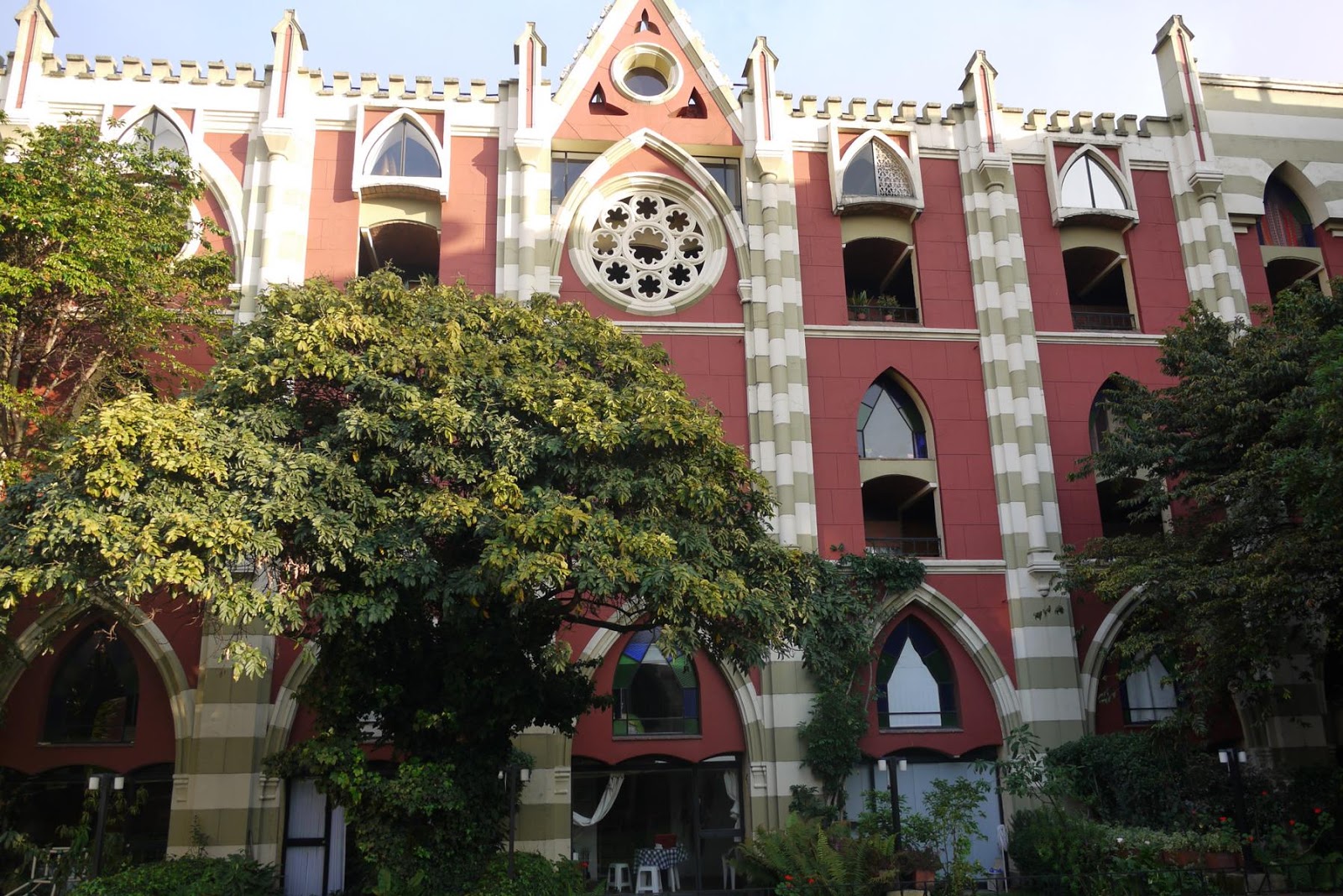
The Calle del Sol building on Carrera 3 in La Candelaria. A seminary, monastery, secret police headquarters, and now apartments.
An old-style lamp on
the building's corner.
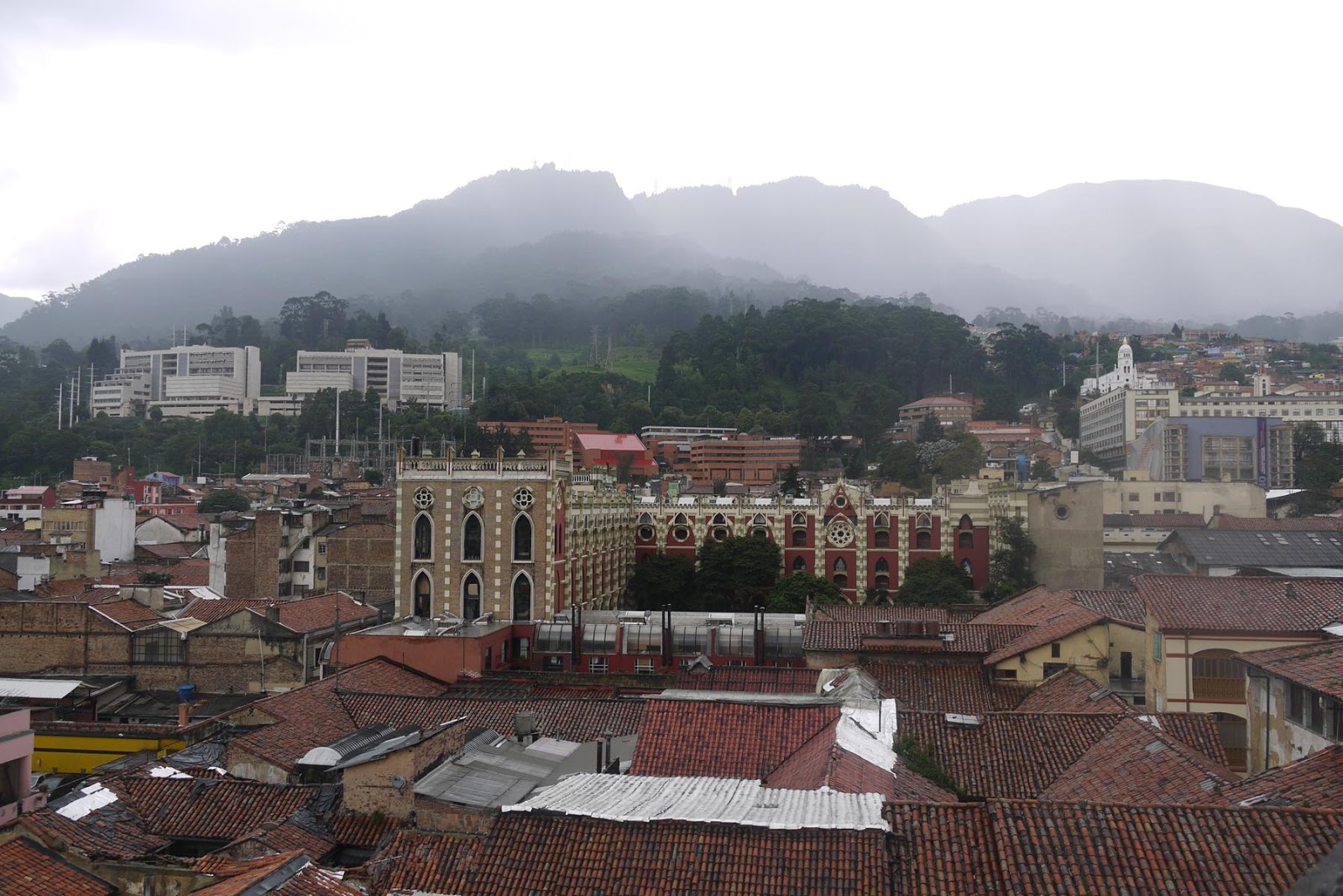
The Calle del Sol apartments are perhaps the most majestic and sought after residences in La Candelaria. Located on Carrera 3 between 11th and 12th streets, the building's neogothic arches make it look look like a monastery - which in fact it was in the early 1900s.

Built around 1917 to be a Catholic seminary, the Calle de Sol was later a monastery and then, in the '50s, '60s and '70s, headquarters for the feared DAS - Colombia's secret police. During the mid-1950s, Colombia was ruled by dictator Rojas Pinilla, who allegedly had communists and union members tortured and killed in the building's dungeon. One of those allegedly murdered there was the original Manuel Marulanda Vélez, a union leader from whom the legendary FARC guerrilla leader took his nom de guerre. Even today, residents and security guards sometimes report hearing ghostly wails of those unfortunates.

Today, on the building's 12th Street side, in the DAS's old prison, is a classy restaurant named La
The Calle del Sol's
entranceway.
Bruja, or the witch. Supposedly, a woman who believed that her son was being held prisoner in the DAS's dungeon, implored the guards to allow her to visit him. They refused. So she prepared delicious dishes for the guards, 'bewitching' them with her coooking and, decades later, giving the restaurant its name.

After the secret police departed, the building was neglected for years, until a group of Colombian and foreign investors purchased, expanded and renovated the old monastery and turned it into apartments, which opened around the year 2000. Today, Calle del Sol contains some 74 apartments of different sizes, surrounding an inner lawn.

View from an internal window.

A hallway.

The building has a marvelous internal lawn: a piece of tranquility in the midst of central Bogotá.


A great view from the Calle del Sol's roof.


The new BD Bacata skyscraper seen from the Calle del Sol.


A skyline at sunset.


A view of the Calle del Sol and Bogotá's Eastern Hills from the BLAA library.
By Mike Ceaser, of Bogotá Bike Tours

Monday, November 26, 2012

Is Central Bogotá Falling and Burning Down?


A few weeks ago this old home in La Candelaria simply collapsed one day. Since then, it's been cleaned out and boarded up. But will it be rebuilt?


A few months ago, this once-handsome building in the San Victorino shopping area burned down. I don't believe that anybody was killed or seriously injured, but dozens of shops were destroyed.

The owners have started demolishing the building, which is more than has happened in other cases.


This historic building burned about 25 years ago, a neighbor told me. Because of its historic status, repairing or replacing it is complicated. So, the owner has just left the burnt shell there.


And this building below, also in La Candelaria, was gutted by fire about four years ago. Since then, it's been covered with metal and plastic - and left to decay further.


By Mike Ceaser, of Bogotá Bike Tours

Sunday, November 18, 2012

Bogotá's Elegant New Pedestrian Bridges

Bridges frame the church atop Monserrate.

As part of the eternally-unfinished TransMillenio extention to the airport, the city built several of these elegant pedestrian bridges over 26th Street/Carrera 3a above Parque de la Independencia, near the Universidad Jorge Tadeo. (The area has no distinct name).

Anyway, the bridges strike me as elegant additions to the neighborhood, even if they don't seem to be heavily used - yet.

Meanwhile, the TransMilenio line, already more than two years behind schedule, is still far from completed. The replacement of Carrera Septima's bridge over 26th St. received lots of attention and was completed efficiently months ago. But the expansion of the Carrear Quarta bridge has received much less attention and seems to be dragging. That job is necessary to extend the 26th St. TransMilenio line to La Candelaria.

Meanwhile, construction has not even started on the last two kilometers of the line to the airport. That piece is supposed to be completed next year, altho a connector shuttle is running.


A bridge points toward the Colpatria Tower, Colombia's tallest building.

Expansion work on the bridge over Carrera 3, necessary to extend the TM line to La Candelaria.


By Mike Ceaser, of Bogotá Bike Tours

Tuesday, February 28, 2012

Bogotá's Forgotten Bridges

The Puente Boyaca, visible along the Eje Ambiental.
Have you seen them?
Bogotá's Rivers. 
We've heard lots recently about the demolition and planned replacement of Seventh Ave.'s bridge over 26th St., which has meant pedestrianization of part of Seventh Ave. as well as huge traffic jams in central Bogotá.

Along the Eje Ambiental,
pools represent the Rio San Francisco
which flows in a pipeline below ground. 
But Bogotá also has a historical patrimony of bridges, altho almost all of them are now buried underground.

When the Spanish first arrived in Bogotá the city was predominantly seasonal wetlands, with rivers flowing down from the Eastern Hills and spreading out across the savannah.

The Rio San Francisco, visible
behind the Quinta de Bolivar. 
Over the centuries, the Spanish and later the Colombians built bridges across those rivers. Today, with most of those rivers buried under cement and asphalt, those bridges have disappeared as well. About the only old bridge visible today is the Puente Boyaca, (renamed from Las Aguas in 1905) and now partially uncovered on the Eje Ambiental, near the Las Aguas Church (and the Spanish-Colombian Cultural Center, whose construction never gets going).

A map near the Puente Boyaca
shows locations of historic
bridges, now buried under asphalt.
Today, the Rio San Francisco is alsopaved over except for its upper reaches, and represented by a string of pools down the avenue's center.

But, once the river had 18 major bridges, a map says, across which Bogotanos traveled between La Candelaria - then most of the city - and the city's north.

Last year, during construction of the new TransMilenio line along Carrera 10, workers uncovered walls belonging to an old bridge which spanned the Rio San Agustin near the avenue's intersection with 6th St. The old bridges are considered historical and architectural landmarks, despite their invisbility, and so the TransMilenio designs were altered so as not to disturb the old brickwork. I visited the site, where the Bicentenario Station and a ramp interchange are being built, and could see no sign of the old bridge. The men working on the project knew nothing about it either.
A homeless person's campsite
alongside the Rio San Francisco. 

One of the few rivers still exposed, albeit in a canal, is the Rio Arzobispo, which runs thru the Parque Nacional and the Teusaquillo neighborhood. Like the other rivers, tho, the Arzobispo (said to be named for an archbishop who committed suicide by leaping over one of its waterfalls during the 1800s) reeks from pollution drained into it by illegal hillside homes and homeless people who live under its bridges.

The Bicentenario TransMilenio station. Workers doing excavations here found walls from an old bridge spanning the Rio San Agustin. 

Rivers still flow down from Bogotá's eastern hills - but now flow underground. 

The Rio Arzobispo runs in a canal, but at least you can see it. 

Women cover their noses while crossing a bridge over the Rio Arzobispo. Notice the signs on the bridge prohibiting defecation and urination. 


By Mike Ceaser, of Bogotá Bike Tours