Showing posts with label metro. Show all posts

Tuesday, October 14, 2014

Higher Train, Lower Price Tag

A ride with a view from Medellin's metro. Why pay more to bury a train line underground? (Photo: Colombia Travel)
Bogotá underworld is a crowded place: power lines, natural gas pipes, sewers, building foundations and lot and lots of loose earth, because Bogotá was built on top of a wetland.

That's a very, very inconvenient place to try to build a train line.

But above Bogotá, there's a lot of....empty space.

Urban trauma: Subway construction in Toronto, Canada.
(Photo: UrbanToronto.ca)
As many analysts have pointed out, the most expensive and slowest place to put a train line is exactly where Bogotá plans to: Underground. Ex-Mayor Enrique Peñalosa says so in a long essay in today's El Tiempo. And the other day an official from Medellin, whose own train line is partially underground, said it clearly: "It's not viable at all...Building an underground subway line is crazy."

An elevated train costs lots less to build and to maintain than does an underground line. (And a ground level train is even cheaper.) That's a fundamental factor for Bogotá, which can't figure out where it'll find the estimated $7.5 billion dollar price tag of the first underground subway line. (The cost is equivalent to the city's whole annual budget.)

A ride in an elevated train line is also lots more pleasant. I grew up mostly in the San Francisco,
Riding in the sun. A BART train pulls into a station. (Photo: NBC Bay Area)
California Bay Area, which has a regional train system called BART. Various BART segments run underground, on the surface and on elevated tracks, and I can tell you that when a train emerges from a tunnel it's like a breath of fresh air: Sunlight replaces fluorescent lights and views of the city and mountains replace gloomy black tunnel walls. Cellphone reception improves, too.

So, more people will ride an elevated train - and enjoy it a lot more.

And it's no secret that one of Bogota's big drivers for building a subway line is status. That's why city leaders keep repeating that Bogotá's the only big Latin American city without a metro, and one of only a couple of cities its size in the world without one. Peer pressure is a bad reason to do anything. But, if what Bogotá wants is status, then building a shiny, visible above-ground train line will do lots more for the city's image than would burying that train under ground.

By Mike Ceaser, of Bogotá Bike Tours

Putting the Metro into Context


Cars block TransMilenio buses on Calle 13 y Carrera 10 today. The cop doesn't seem to care.
A massive traffic jam on Carrera 30.
 The ongoing mania about building a metro system - undoubtedly the salvation of the city! - might make us forget there's lots more important and immediate steps city leaders could take tomorrow to make Bogotá liveable. The subway's first line alone is projected to take 10 years to build and cost $7.5 billion - approximately the city's annual budget - and that's before the inevitable delays and cost overruns.

Meanwhile, is there anything the city could do to make transit sane?

I'll leave it to you to decide whether fining drivers who stop in the middle of intersections and discouraging private car use (read: a congestion charge) would get traffic moving.

Remember that if they do build the planned subway system, by the time the first line's finished a decade from now, the number of private cars in the city will have more than doubled, and many other transit projects will have been postponed or cancelled in order to provide funds for the subway.
By Mike Ceaser, of Bogotá Bike Tours

Tuesday, May 8, 2012

Marquez in the Moscow Metro


In a strange case of ideological intersections with perhaps a bit of time warp mixed in, the city of Moscow's metro has decorated its 'Poetry Car' with Gabriel Garcia's Marquez's poetry.
Colombia's ambassador to Russia Rafael
Amador amidst a crowd of Gabo fans.

Marquez only a little bit of poetry (mostly sappy romantic stuff) - just enough to decorate a single car, evidently.

The Leo Tolstoy Cultural Center in La Candelaria has a small photographic display about the rolling exhibition. It's appropriate, since the Cultural Center is something of a throw-back to the old Soviet Union, with its busts of communist icons and tomes and talk about socialism's victories. Appropriately, too, Marquez is a leftist and buddy of Fidel Castro, and the subway system construction was begun by Josef Stalin, albeit before most of the world had realized what a monstrer he was.

Today, of course, the Soviet Union is gone, as is communism, replaced by a savage capitalism. But the dream lives on in a few places, including the Leo Tolstoy Cultural Center.

Lenin in Moscow's metro. 
The subway exhibition provides an excuse to reflect on Bogotá's own plans to build a subway, which are now experiencing yet another resurgence.

With 12 lines, 306 kilometers of rails and 185 stations, Moscow's metro is a colossal achievement - and some of its stations, which are built like palaces, show that. I read that the Soviets' philosophy was to make it a sort of palace for the common people, in the place of the old Czarist palaces which the revolution had overthrown. That's good enough. Decorations aside, the Moscow Metro is also said to be the world's most densely-used metro.
A Moscow Metro station - an underground palace. 


But despite all of this, Moscow is a chaotic city full of traffic jams, as you can see here:


Moscow, with about 11 million people, isn't much bigger than Bogotá, altho they do have lots more money. Thos who believe that a subway would be a magic bullet for Bogotá's transit problems ought to look at Moscow and think again.

Stained glass in Moscow's Metro. 
If Bogotá does go ahead with subway construction, the first trains probably won't be rolling for another decade, at least, and then it'll be only a single line, measuring perhaps a dozen kilometers - a few percent of Moscow's system. But in the meantime, millions more cars will have flooded into the city.

Can anybody believe that, without strong measures to discourage car use, the traffic congestion and pollution above ground won't be many times worse?

Here's good advice from one of the video's commentators: "I say tax cars at every intersection and use the monies to build public transport systems."

By Mike Ceaser, of Bogotá Bike Tours

Tuesday, November 15, 2011

A Bogota Subway...For Your Grandchildren?

Petro and the Metro. 
It's a fundamental part of Bogotá's election cycle: A new mayor gets elected, and he promises the city a subway system.

Altho during the campaign Mayor-elect Gustavo Petro was uncommital on subway plans, now that he's won he sounds like he wants to build one - except that he's not sure where. Petro's subway line will run north-south, but maybe also east-west, to cover a lot of the city.

Lima's new metro: Ready to roll soon?
If Bogotá goes ahead, let's hope it does better than Lima, Peru, which is just about to inaugurate a new metro line - after only 30 years of waiting. Construction on Lima Peru's electric train began during Alan Garcia's first presidency, in the late '80s. Garcia's administration finished a line of 9 kilometers - but it was useless, since it didn't reach the city center. Then came years of corruption, terrorism, economic chaos and political turmoil. Neighbors converted the unused subway line into an urban art canvas. In 2009, Garcia, back in power, started work up again and Lima expects the line to open to the public....pretty soon. This first train line will measure 21.5 kms and have 16 stations. The new work also cost more than a half-billion dollars, $43 million per km, about $100 million more than budgeted, .

The lessons from Lima: Don't count on things going smoothly. In an era of global economic turmoil, in a Colombia with an armed insurgency, lots of things could happen to halt subway construction for years or even decades.

Once it really got to work, Lima did progress at good speed - but Lima's is an above-ground train line. By most accounts, Bogotá's line would be mostly underground, complicating construction and meaning more urban trauma.

A Bogotá metro inauguration in 2036?
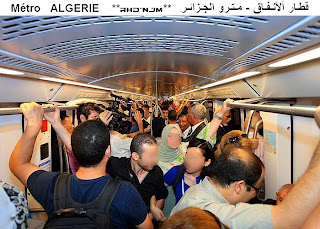
Riding the rails in Algiers.
Similarly, just this month Algiers, Algeria inaugurated a metro line - just 28 years after construction started.  Like Lima's metro, oil-rich Algeria's project was delayed by a civil war and economic troubles. There's also concern there that the cost of the fare, equal to about five loaves of bread, is too much for Algerians' budgets. The 9 km subway line cost about $1.5 billion, or $160 million per km. A similar line in Bogotá would only carry you from the city center to Chapinero.

The lesson from Algeria: To build a subway, plan on no economic turmoil or domestic unrest. Of course, none of that happens in Colombia.

A mini-metro for Bogotá in 2039?

Wrapped up and ready to roll:
a Bangalore, India metro train.
Finally, a sort-of success story from India. India's hi-tech capital Bangalore recently opened a 9 km metro line, about five years after construction began. Sounds good - relatively speaking.

Yet, compare that to Bogotá's TransMilenio, which in about 12 years has constructed 84 kms of lines. Even its overdue and corruption-plagued Phase 3, which is supposed to start operating early next year after more than two years of construction, will add about 18 kms of lines (to be extended to 20). That's double the distance Bangalore built in five years, and almost what Lima built in three decades.

Keep in mind, too, that, while subways do move lots of people quickly and cleanly, they cost a fortune and do little to resolve traffic congestion.

Yes, a subway system would be a boost for Bogotá - but will any of us live to see one?

A TransMilenio bus in La Candelaria. A good deal, despite its problems?


By Mike Ceaser, of Bogotá Bike Tours

Saturday, November 12, 2011

Petro Gets on the Train

Heading to Bogota?
Mayor-elect Gustavo Petro, like Samuel Moreno and many another mayor before, wants to build a subway. And not just any subway - the line along Bogotá's eastern border which various technical studies have recommended - but instead one that goes both north and south AND east and west.

Possible map of Bogota metro....

That would be great - if it were to happen affordably, and within our lifetimes. Other Latin American cities, like Medellin and Lima, Peru, have taken decades to build even basic subway lines. Do we have reason to believe that Bogotá would be particularly more efficient than them - particularly when we've all seen that basic road work and TM expansion projects drag on for years?

But every mayor dreams of leaving some great concrete-and-steel accomplishment behind him, and Petro's no different.

On other transit issues, however, Petro's ideas seem more sensible.

and another proposed metro route.
He wants to build a streetcar line in north Bogota. That has several advantages: streetcars (also known as surface light rail) are much cheaper than subways to build and less expensive to maintain than bus lines, as well as less polluting. (But they're also less flexible). Another strong point in favor of a streetcar line in the north is that, for cultural reasons, many upper class people who won't lower themselves to get onto a bus, will ride trains - perhaps because that makes them feel European.

Samuel also promised a subway. (Photo: La Cariñosa)


Another proposal with support is a regional commuter train line along the existing rail line extending north from central Bogotá. This corridor, which now carries only a weekend tourist train, is terribly underused. However, a high-speed train, which would require protective fences along the lines, would create a barrier dividing the city. And, such a train could promote sprawl along its route.

The little-used rail line could carry commuters - but would require lots of investment.


A crowded TransMilenio bus...but if all these people were in private cars, the city would strangle. 
TransMilenio moves, while other vehicles wait. 
Petro also said in a post-election interview that private car users will subsidize mass transit. That's good economics, as well as social justice, since private car owners are wealthier and consume an inordinate quantity of public resources, such as space, air and everybody's peace of mind.

Onto the list of Bogotá transit fantasies, we can add this proposal in today's El Tiempo: to permit only low-emission vehicles in parts of Bogotá, most likely Ave. Septima. Septima is, some may recall, the same dirty, chaotic, congested avenue which municipal fantasizers say they'll transform into a 'green corridor.'

Until this miracle happens, however, those same officials are managing to ignore the city's tremendous pollution, which a World Bank study of a few years ago concluded cost society more than did the country's armed conflict.

Smoke rises from a fire near Palo Quemao. Nobody pays attention. 


By Mike Ceaser, of Bogotá Bike Tours

Wednesday, May 5, 2010

The Mayor and the Metro

Samuel Moreno was elected mayor to a great extent on his promise to build a subway system.

That system has not been built or even contracted yet - but it's already being questioned. Two university studies suggested the soil was sufficiently stable for digging tunnels, that the construction could damage buildings overhead, that the trains might not be be fast enough to justify the system, that construction will impact natural areas and that passenger flows will overwhelm some stations.


But the most fundamental question is whether the city has the money to pay for this megaproject.

I can promise you right now that metro construction will go tremendously over-budget and cost way more than expected. Just look at what's happening with the Transmilenio system's expansion: one line was supposed to be finished this November, but is now going to take until mid-2011 - at least. And building a metro system is hugely more complex and expensive.


Bogotá desperately needs to keep expanding its public transit system and phase out the existing chaotic and polluting old private buses. But do Bogotanos really want to live amidst rubble, blocked roads and noise - for many years, maybe even decades?


Is a subway system really a practical, realistic solution, or a boondoggle intended to boost the mayor's legacy and make Bogotanos feel like they've got a world-class city?

I suspect the second. Bogotá should continue to expand the Transmilenio, consider light rail and institute a congestion tax like London's.


This blog written by Mike Ceaser of Bogota Bike Tours