Showing posts with label guns. Show all posts

Monday, October 1, 2018

How U.S. Policy Drives Latin America's Homicides

The United States is hurting instead of helping.
The Washington Post published this interesting editorial yesterday about Latin America's homicide plague: It is the planet's most homicidal region, a problem which the author blames on poor governance.

The editorial board is half correct. When parties in dispute lack confidence in the legal system, or
A homicide scene in Mexico, where much of
the violence is driven by the illegal drug trade.
(Photo: The Economist)
when the legal system doesn't fulfill its role of punishing criminals, then its more likely for people to turn to violence.

But the people in dispute also need a motive to turn to violence, and the commentry left out that part. After all, large parts of Africa and Asia also lack rule of law and functioning legal systems, but generally don't suffer from the same levels of violence as Latin America. What's the difference?

The difference is that Latin America is ground zero for much of the world's illegal drug trade. Narcotraffickers by nature cannot use the legal system, so they often turn to violence. Needless to say, if buying and selling cocaine and marijuana were not illegal, then they'd be traded by legal companies, which would sue each other instead of shooting.

Add in the fact that Latin American criminal groups have relatively easy access to firearms purchased in the United States and you have a lethal mix.

Before trying to help Latin America, the United States could stop hurting the region.

By Mike Ceaser, of Bogotá Bike Tours

Wednesday, November 8, 2017

Crack Down on Guns!


'Popeye,' one of Pablo Escobar's killers, shows off a tool of his trade.
Years ago, working on a construction site in Texas, I met a tall Texan in his 50s who had just gotten out after ten years in prison. He was a good-natured man who I doubt would have stolen a wallet if he'd found it on a park bench. Rather, he'd gone to prison for killing a stranger.

Homicides in Colombia by guns
(light blue) and knives (dark blue).
Altho knives are much more common,
guns kill many more people.
(Source: El Tiempo
He told me that he and his father had pulled into a gas station somewhere in Texas and started filling their tank. Unbeknowest to them, the rule was 'pay before you pump,' and another man was in the office paying for the gasoline that my acquaintance and his father were pumping.

The other man, believing that these two were stealing his few dollars worth of fuel, did what Texans do: He pulled out his gun and ran toward them. My acquaintance, seeing the stranger coming at him with pistol pointed, pulled out his own gun and shot the other man dead.

One man died and another did ten years in prison - at huge cost to society - because of a misunderstanding over a few gallons of gasoline. If they had not been armed, they would have argued briefly and resolved the situation with a handshake.

Those sorts of routine, deadly confrontations - even more than mass shootings like the recent ones in Texas and Las Vegas - are why Colombia is right to tighten its gun control laws.

The correlation is clear: Number of guns and number of
gun massacres, the U.S. is in a class by itself.
(Source: New York Times)
According to a recent study by the Fiscalia, reported by El Tiempo, 7 out of 10 homicides in Colombia are committed by firearms.

"Firearms have a preponderant role in lethal violence in Colombia," the report said.

Bogotá can add one more fatality with the death this week of Daniela, a university student shot in the head by a mugger on her way home in April. She lingered in a coma for seven months while her family and friends agonized. The killer has not been caught.

Firearms are smuggled illegaly into Colombia from the United States, Central America and Europe. But others are purchased here legally, only to be used criminally. Of the almost 86,000 firearms seized by authorities between 2014 and '16, almost 20% had been purchased legally in Colombia but made their way to criminals.

What's more, the proportion of firearms confiscated from members of criminal organizations captured or killed has plummeted in recent years, from 94 guns for every 100 members of such organizations in 2010, to only 19 per hundred in 2015. That might mean that the organizations are getting better at hiding their guns, switching to other weapons, such as knives, or that corrupt police are confiscating but not reporting weapons in order to sell them on the black market - and back to criminals.

And that happens frequently. I once covered the crime beat for a small town newspaper in Mississippi. One of the most frequent items stolen in home burglaries were guns - perhaps legally purchased, but now in criminal hands.

As in the U.S., the large number of firearms in private hands in Colombia turns minor confrontations deadly. In the city of Cali, 42% of homicides result from such confrontations rather than contract killings. In Bogotá, the proportion is 21%, in Medellin, 14%, according to El Tiempo.

To tighten up access to firearms, the Fiscalia offers the example of Japan, which has only a tiny number of gun homicides. There, in order to obtain a permit to own a gun, a person must pass a written test, a gun handling test and a psychological examination.

In Colombia, a person must, among other things, show the results of a psycho-physical evaluation and explain why he or she needs the weapon for protection from threats.

Related: 

The Axis of Killing


A Gun Sale Gone Wrong


By Mike Ceaser, of Bogotá Bike Tours

Sunday, June 14, 2015

Disarm Yourself?


'Disarm Yourself,' say the police.
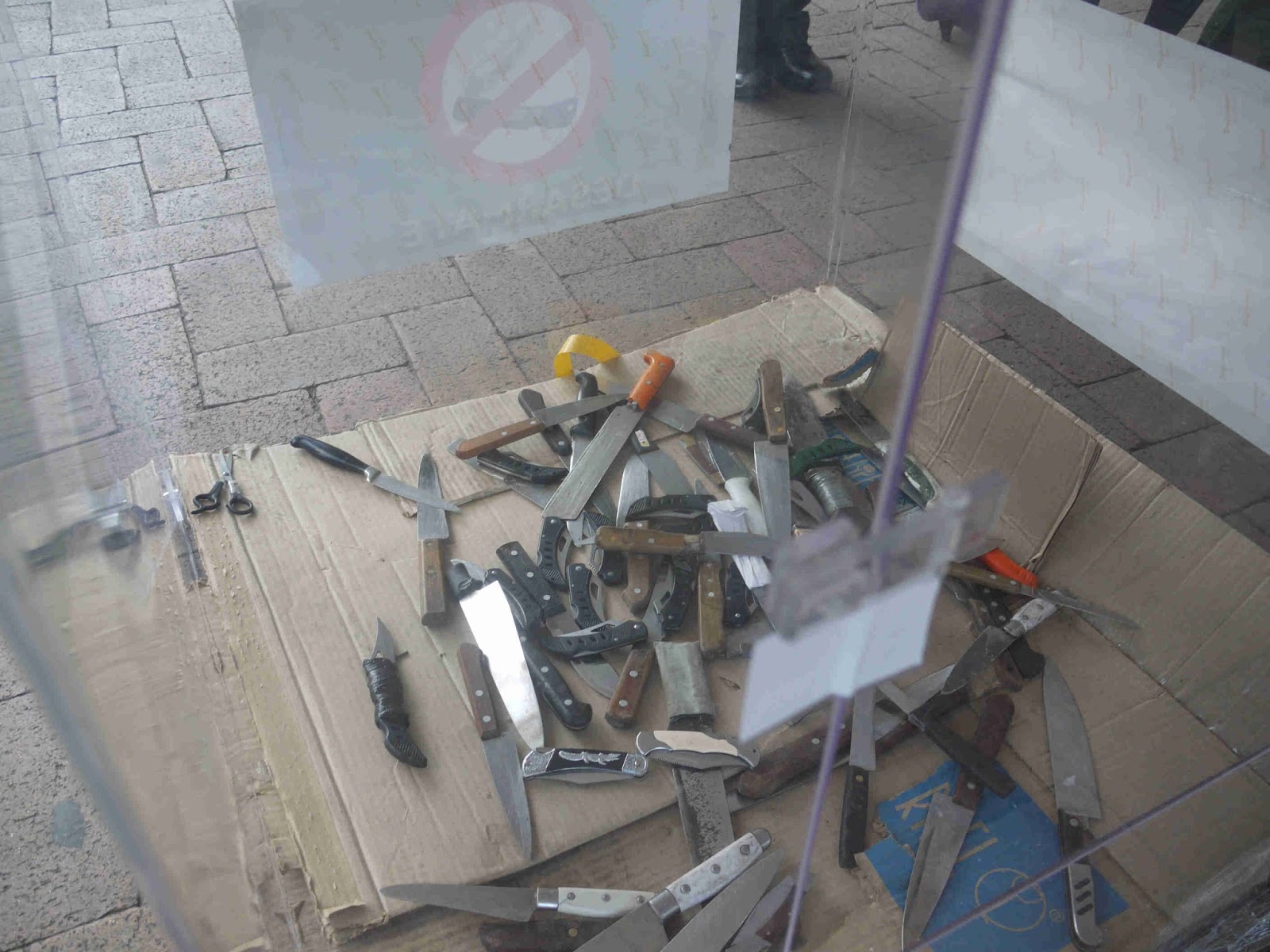
Confiscated knives on display.
The other evening, I was buying an electric shaver in one of the Sanandresitos along Calle 13, an area known for fencing stolen cellphones and money laundering. The shop also had a display of pocket knives - instruments not known for cutting bread and cheese.

As I was leaving, a tough-looking fellow crossed the dark street, purchased a knife and departed with it under his coat. He wasn't heading off to prepare his dinner.

Bogotá has just prohibited the carrying of 'armas blancas,' which include knives and other sharp weapons. It's potentially a positive move, since almost nobody carries knives to defend themselves, whereas criminals routinely do to threaten others.

A jackknife. Tool or weapon?
The trouble is enforcing the law, since knives, stilettos and other such weapons are easy to hide. And, how do you distinguish between someone carrying a knife to commit crime, and someone carrying one for work or carrying home new-bought knives to prepare dinner?

When I was a kid growing up in California, we carried jackknives or pocket knives to be cool and manly, but not to cut anybody.

Regulating the market is even more difficult, since there are legitimate uses for those weapon-like knives, such as camping, hunting and fishing. And, unlike a gun, you can make a knife at home.

All those grey areas leave the armas blancas law open to abuse. Still, for those of us who don't want to be mugged by a drugged out addict, as has happened to me, see the law's advantages.

On the other hand, a week ago I was going home late at night in La Candelaria when two cops stopped and searched me, even tho they had no reason to think I was up to any crime - which I wasn't. Perhaps frustrated by not finding any reefers in my pockets, they confiscated the pepper spray I usually carry, as I have been mugged on my way home at night.

"Where's your permit for carrying this," they asked me.

In fact, no permit is required for carrying a pepper spray.

Prohibited?
I've since talked to several police officers, who agree that what those two cops did was rob me. The cops did not deposit my pepper spray in the police station. Perhaps they threw it away or sold it.

For whatever reason, criminals don't use pepper spray to commit crimes, but the spray seems to have saved me from several muggings.

Do the police really want more crime victims?

Congress is now considering requiring a permit to carry such personal protection. That might be reasonable. But disarming law-abiding people of this non-deadly protection device would just make criminals' work easier.

On the other hand, prohibiting pepper spray and similar devices will compel some people to resort to guns, replacing a non-deadly, non-injuring weapon with a deadly one.

By Mike Ceaser, of Bogotá Bike Tours

Tuesday, October 21, 2014

To Catch a Thief?


This afternoon in the Teusaquillo neighborhood during a bike tour we came upon this scene, in which two tough-looking men were apprehending this kid, whom they accused of stealing, apparently a car's rear-view mirror.

Scenes like this one aren't rare in Bogotá, where residents frequently take the law into their own hands after crimes - or alleged crimes. In this case, thankfully, the two men didn't beat the kid up, altho that might have been because we witnesses were nearby with cameras, and someone called the police, who showed up quickly. I've seen other incidents in which people beat up an alleged criminal, with the justification that 'the police will just let him go.'

Why is the man in the striped shirt carrying a pistol? Does he really think that two big men need the help of a firearm to detain a small kid? Would he really use it against this kid for supposedly stealing a mirror? And, does he have a license to carry a firearm in the first place?

And, how about the kid? He looked like a homeless drug addict, and very desperate. Had he been kicked out of his home? Beaten or abused? Desperate to eat or more likely to buy bazuco, he tore off a mirror worth a few thousand pesos in El Bronx and started running. He didn't get far this time.

Perhaps he's in a children's home by now and will come out better for the experience. But more likely he's in a cell with other criminals, or back on the cold streets by now.


By Mike Ceaser, of Bogotá Bike Tours

Tuesday, July 29, 2014

A Shocking Proposal: Tasers for Colombian Cops


Cops on patrol today on San Victorino Plaza in Bogotá. They appeared to be carrying regular pistols.
Colombian media are asking whether the 'electric pistols', commonly known as tasers, are dangerous. Colombian police use some of the devices and may buy more of them.
Israel Hernandez, a Colombian-American
who died last August after being
tasered by police in Miami Beach.

The answer obviously is 'yes,' but that's the wrong question. Nothing is perfectly safe, particularly a device designed to incapacitate violent criminals by causing them pain.

And police will use some dangerous device, whether billy clubs, tasers or regular guns. The right question to ask is whether tasers are better than the alternative.

Tasers have a bad image here, and perhaps rightly so, because last August Israel Hernandez, an 18 year-old Colombian-American graffiti artist was killed in Miami Beach by a police taser charge.

A taser.
Hernandez's death was a tragedy. However, in August 2011 another young Colombian grafitero, Diego Felipe Becerra, died in Bogotá after police chased and shot him with a real gun. Becerra would probably be alive today if those cops had been using a taser.

According to Amnesty International since 2001 500 people in the United States have been killed by electric stun guns. Every one of those deaths is a tragedy. But every year tens of thousands of people in the U.S. are killed by firearms. If those were replaced by tasers, almost all of those people would have survived.

Bogotá graffiti artist Diego Felipe Becerra, 
shot to death in 2011 by police firearms. 
Any weapon can be deadly. I'm sure that many people have been killed with billy clubs. But tasers will more likely be used in place of real guns. For all the dangers of tasers, real guns are much more dangerous, not only to the suspect, but also to bystanders. A bullet can kill or injure someone hundreds of meters away. Miss with a taser charge and nothing happens.

According to a police study cited by Wikipedia, taser use reduced police deaths by 75%. The Taser company's website claims that their products have saved 128,000 lives and counting. I wonder how they came up with that number. However, if I were a youth being chased, rightly or wrongly, by police, I'd much prefer they carried electric pistols than ones with bullets in them.

Bogotá cops: better off with firearms,
electric pistols, or both?
And, if I were a cop, I'm sure I'd prefer an electric pistol to a real gun except in extreme situations. Say you're called to a tavern where a drunk construction worker is throwing chairs at the walls. You can't get close enough to club or tackle him. You could try to shooting him in the arm, but you might miss and kill him or another patron. And shooting a suspect would surely mean an investigation and newspaper headlines. So, you pull out your electric pistol and immobilize the guy, at minimal risk to other bar patrons.

Another danger of real guns was highlighted by the ongoing scandal over the importation of thousands of Sig Sauer pistols, apparently in violation of German law. Some of those pistols were stolen before police even received them - meaning that criminals are likely using them today to rape, robbery or even murder. I'd much rather that those criminals get their hands on tasers - which fire only one to three times and which the bad guys probably wouldn't even know how to use - than real guns.

It's amazing to me, too, how the potentially illegal purchase of tens of thousands of deadly real guns and the theft of some of them, produced little news, while the purchase of a few hundred electric stun guns has generated a firestorm. It's a testament to how blasé society has become about the proliferation of firearms.

By Mike Ceaser, of Bogotá Bike Tours

Sunday, July 13, 2014

A Gun Sale Gone Wrong

A Sig Sauer model S P2022 pistol. (Photo from Sig Sauer website)
It seemed to be yet another routine United States arms sale to Colombia: 64,485 Sig Sauer model S P2022 pistols, with a price tag of $28.6 million.

But this sale went wrong - in two different ways.

A military equipment shop in central
Bogotá advertises Sig Sauer products.
Several months ago, the German newspaper Süddeutsche Zeitung reported that German-made Sig Sauer pistols, part of a lot shipped here between 2007 and 2012, were in the hands of Colombian security forces. That meant a violation of German law, since Germany has not authorized the sale of such arms to Colombia out of concerns about human rights violations and Colombia's internal conflict.

The sale put the U.S. government into hot water with the Germans because the U.S. had apparently promised the Germans not to resell the arms to a third country. Ironically, the U.S. government could have legally sold Sig Sauer pistols to Colombia - if they were made in Sig Sauer's plant in New Hampshire. However, the pistols shipped to Colombia were reportedly a mix of U.S.- and German-made arms.

German officials told Semana magazine that the case was "very grave," but that it required more investigation.

Whatever the human rights challenges of Colombian security forces, this apparently illegal sale underlines the importance of regulating and monitoring international light weapons sales, as the United Nations Arms Trade Treaty, which is awaiting ratification, would do.

Perhaps the U.S. and German governments are monitoring these weapons to determine whether Colombian security forces employ them in human rights violations. However, they will not be able to monitor all of the pistols, because last November 100 of them were stolen from the police even before their importation process was complete.

Authorities reported recovering 36 of the pistols and arresting six people, including pawnshop owners, who'd participated in the robbery and black marketing of the guns, reports El Tiempo. A police official had sold the guns for 500,000 pesos, about US $260.00. each. But the other 64 guns are out there, likely in the hands of criminals, who may use them to rob, rape or murder civilians - or even to kill the police the guns were intended for.

By all accounts, Sig Sauers are well-made, long-lasting guns. So, Colombians will have reason to fear these weapons for many years to come.

By Mike Ceaser, of Bogotá Bike Tours

Saturday, March 30, 2013

The Axis of Killing

South American homicide rates:
The region has some of the
world's highest murder rates. 
At the risk of being associated with a United States president of limited intellectual and moral capacity, it's hard not to call the triumvirate of tyrranies which blocked the United Nations Arms Treaty yesterday evil, evil, evil.

North Korea, a totalitarian dictatorship which has millions of its own people in concentration camps and threatens nuclear war to get attention; Syria, who dictator is massacring his own people; and Iran, which has also threatened to annihilate at least one of its neighbors, have blocked an arms treaty which could cut the ongoing slaughter of civilians around the world.

The arms treaty would, finally, impose some common-sense rules on the international traffic in weapons ranging from handguns to surface-to-air missiles. The treaty would, among other things, try to keep weapons out of the hands of murderous dictatorships. Maybe that's why these three regimes oppose the treaty.

The question shouldn't be whether or not to approve this treaty, but why such common-sense rules weren't created many years, civil wars and massacres ago.

Homicides on headstones. (Photo from IPS news)
The treaty is strongly supported by both Mexico and Colombia - nations which have been scourged by firearms violence fed by the globe's unrestricted weapons trade.

Fortunately, the treaty could still become international law thru a vote by the General Assembly, where support appears to be overwhelming. Then, however, it will have to be signed by individual nations. Nations such as Russia and China, which have sold weapons to authoritarian regimes, will probably resist
Assault rifles and bullets: Subjects for free trade?
signing, as will nationsl like Pakistan, which wants to weapons to threaten India, at the expense of its own children's food and education. For its own part, the U.S.'s powerful and paranoid gun lobby opposes the treaty because, it says, it could restrict private ownership of guns - even tho both the treaty's authors and independent analysts say that won't happen.

Ironically, the treaty would actually benefit the wealthy arms exporters in North America and Western Europe which already apply strict controls to their arms sales. That certainly doesn't make it right to hawk weapons to nations which lack money for food and schoolbooks, but it's a little bit less evil.

Ironically, one of gun rights' fundamentalists' strongest arguments is the supposed need for citizens to protect themselves against a tyrranical government. So, it's ironic that gun rights defenders are allying themselves with and defending the interests of exactly such dictatorial regimes, which obviously are not worried by a free trade in arms.
By Mike Ceaser, of Bogotá Bike Tours

Wednesday, January 2, 2013

Massacres and Money Making

Demonstrating a shirt's bullet-stopping capacity.
United States massacres may turn into a business opportunity for a Colombian company.

Miguel Caballero makes children's vests, backpacks, t-shirts and other wearable things that are (supposedly) bulletproof. Remember how mom sent you off to elementary school with the admonition 'Keep your jacket on so you won't catch cold,' or 'Wear your raincoat so you don't get wet'? Well, now moms can add a third warning: 'Keep your bulletproof gear in case a madman with a high-powered gun bursts into your school (or house of worship, or shopping mall, etc) and starts blowing holes in people'.

It's only practical good sense, after all.

Armor your kids today!
Of course, the danger from shootings has been wildly exaggerated by the massive media coverage of the recent massacre in a school in Connecticut. I'd be willing to bet that children stand in far more danger from a traffic accident on their way to or from school than they do of getting shot. But, nevertheless, I'm sure that some psychologically vulnerable, overprotective parents will take money away from their children's schoolbooks and computer funds to buy V-Bags, Puffer Kids, T-Shirt Kids and Safety Vests which will make their kids feel embarassed and uncomfortable and little safer.

But the totally insane thing here is that, unlike cold and rain, this is a danger which shouldn't exist at all. It only exists because in the United States high-powered rifles are sold so freely violent mentally ill people can and do buy or steal them and then start killing.

I suppose there's nothing wrong with Caballero manufacturing wearable bulletproof accesories for children - except that it makes totally unnecesarry threat seem normal and acceptable, when instead society should be addressing the cause - too many guns. The social hysteria reminds me of the Cold War paranoia, when many people, including schoolchildren, lived in constant dread of nuclear annihilation from the Soviet Union. But the U.S.'s gun threat is a completely home-made danger.

The U.S.'s gun lobby is already very powerful, and thrives economically on these massacres, which cause booms in gun sales. (I just wonder whether, in their hearts of hearts, gun company executives felt a secret thrill when this latest massacre happened, because they knew it'd mean huge new Christmas sales). But a gun protection industry will create an even stronger lobby. I'm waiting for bulletproof pews for worshippers to take cover behind, bulletproof store windows in malls, and on and on, until everyday life is lived in a paranoid fortress and a multi-billion firearm-industrial complex has grown up which will defend to its last dollar of profit the right to commercialize high-powered murder machines.

During the 1980s and '90s feature stories about Colombians using bulletproof business suits were regular fare for the international media, and deepened the country's image as one big free-fire zone. Altho it still has a serious homicide problem, Colombia has changed profoundly since the Pablo Escobar days. Interestingly, according to news reports, the company now sells 95% of its products outside of Colombia.

Now, the paranoia has shifted north, to the U.S. But, unlike the case of Colombia, which has long been victimized by global drug trafficking and drug prohibition policies, the U.S.'s mass murder problem is completely domestically-created.

Interesting Addendum:

The Canadian government made an awkwardly-timed announcement the other week celebrating "new market opportunities for its gun makers in the form of exports of assault weapons - which are banned in Canada - to Colombia. The announcement came the day before the assault rifle massacre in Newtown, Connecticut. Those "new market opportunities" for Canadian companies are evidently a result of the recent Canada-Colombia Free Trade Agreement.

Since assault weapons are, thankfully, not available on store shelves here in Colombia, I assume that any "market opportunities" would be sales to the military or police. But those organizations have had serious human rights issues.

By Mike Ceaser, of Bogotá Bike Tours
Monday, July 16, 2012

The UN's Vital Arms Control Treaty!

You probably haven't heard of it, but at the United Nations headquarters in New York they're discussing a treaty on arms traffic which could someday make Colombia a much safer place.

Unfortunately, a few confused fanatics in the United States make the treaty's passage unlikely anytime soon.

A Swedish-made AT4 anti-tank missle launcher
like those sold to Venezuela and then transferred to
the FARC guerrillas.
Incredibly, no international treaty exists on arms trade, despite the fact that small arms such as handguns and automatic rifles kill a half million people every year, while they together with heavy weapons can destabilize governments and carry out wholesale repression and massacres of civilians, as we've seen in places like Syria, Sub-Saharan Africa, Mexico and Colombia.

Regulating the trade in weapons, which cause so much havoc and killing, seems like a no-brainer. And it would help Colombia, not only by keeping weapons out of the hands of illegal groups, but also to reduce Colombia's extremely high homicide rate.

The treaty under discussion would, according to ArmsControl.org, prohibit international arms transfers when they would cause:

  • The undermining of global, regional, local, or internal peace and security;
  • Violations of international humanitarian law or human rights law;
  • Involvement in genocide, crimes against humanity, or war crimes;
  • Risk of diversion to organized criminals or terrorists;
  • Impairment of socio-economic development;
  • Risk of unauthorized re-export from the recipient state.


It's predictable that authoritarian governments which want weapons to repress and kill their own people would oppose this treaty, as would the governments which earn billions of dollars selling arms to human rights trampling dictatorships. (Recent sales and attempted sales of weapons by China to Zimbabwe and Russia to Syria come to mind.)

Illegal arms seized by Colombia's military. 
Colombia has helped write the new treaty. But neighbor Venezuela, which has made huge weapons purchases and is building an AK-47 factory, abstained from a vote on the issue, as did China and Russia, two big arms exporters. The U.S. voted against the proposed treaty, altho the Obama administration has expressed support for it.

Undoubtedly, the most powerful opponents of this treaty are the United States' fanatical domestic organizations - even tho they actually have nothing to fear from this treaty (altho I wish they would). The evidence, from both common sense and scientific research, is overwhelming that more guns in circulation usually mean more crime and violence, and the drop in homicides following Bogotá's recent ban on carrying weapons is even more evidence of that. U.S. organizations like the notorious NRA choose to ignore the evidence because of their paranoia that any sort of arms registration will end up taking away their handguns. That's ridiculous. Nevertheless, for the time being, they appear to have won their war in Washington. But the proposed treaty says explicitly that it wouldn't affect nations' domestic gun laws, but regulate only international transfers. In addition, the U.S.'s controls on weapons exports are already quite strong, meaning that treaty's impacts would be small. 


The U.S., as the world's largest arms exporter, is critical to this treaty. But ratification by the U.S. would require a two-thirds vote by the Senate, and far more than one third of the U.S. senators live in fear of the NRA.


Standing in the way of sane gun laws in the U.S. is bad enough. But gun-rights fanatics should be ashamed of themselves for blocking a treaty a treaty which could save millions of lives and stabilize nations around the world. By taking this position, the NRA and its allies make themselves passive accomplices to mass murder on a global scale. 

By Mike Ceaser, of Bogotá Bike Tours

Monday, April 9, 2012

Disarmament Looks Like It's Working

'Amar no Matar' 'Love Instead of Killing' says a banner in today's March for the Victims. 
Today is the 'Day of the Victims' in Colombia. That refers primarily to victims of political violence, but victims of everyday violence are no less important.

So, the reports that homicides are down significantly in Bogotá is encouraging.

The drop isn't huge: 17% in febrero and 6% in March compared against 2011. But those are 65 fewer lives lost, 65 fewer families wracked by tragedy, 65 fewer agonizing parents or fatherless (or motherless) children, 65 fewer lovers left alone, 65 fewer dreams disappeared.

Many reports tie the drop in homicides to recent restrictions on the carrying of firearms. Other factors, such as restrictions on liquor sales, more police on the street and a growing economy may also be factors.

But the fact that some other types of violence and street crime have increased argues strongly that the firearms restrictions have saved lives. This year, police have confisticated nearly one thousand firearms. Since most fatal shootings occur during gang disputes or common street fights, fewer guns on the street mean less likelihood that those altercations will turn fatal.

Related posts:


Lay Down Your Arms


By Mike Ceaser, of Bogotá Bike Tours

Monday, January 2, 2012

Lay Down Your Arms

A bad omen: An 11-year-old boy plays with a toy gun in Bogotá's Santa Fe neighborhood. 
Just-inaugurated Bogotá Mayor Gustavo Petro's most surprising announcement yesterday was that he'd promote a law banning the carrying of firearms in public. 

The wild west? El Mio tabloid
says so, reporting on a shooting death.
The idea is very imperfect, but worth trying, and a glance at today's El Tiempo shows why. Colombians celebrating the New Year by firing guns into the air injured at least five children and killed a six-year-old girl in Medellin. In Nariño Province, a mayor elect was assassinated by gunmen even before he could take office. And, in Argentina, the governor of Rio Negro province was killed by a gunshot in the face, apparently because of a domestic accident.

Guns make it much easier
for people to kill people. 
Obviously, if carrying guns is outlawed, only outlaws will carry guns. But, with fewer guns in circulation and a clearer law, police should be able to more easily identify the bad guys. More importantly, the no-carry law will prevent many good people from turning into bad ones thru stupidity, such as pulling out a gun and shooting someone during a drunken brawl. And, guns in good, law-abiding folks' hands get lost or stolen and end up in the hands of criminals.

'To love or to arms?' Asks this poster
hung on City Hall on Plaza Bolivar.
Back in the U.S., I once met a victim of such a stupid tragedy. I worked construction with a man in his mid-40s who had just completed a ten-year prison sentence. A decade before, this man had driven into a gas station in Texas and begun filling his tank. What he did not know was that the station required customers to pay before pumping, and it turned out that someone else was in the office paying for the gasoline which my acquaintance was pumping. The other customer thot my acquaintance was stealing his gas, and, being a Texan, he pulled out his gun to resolve the situation. My acquaintance then drew his own gun and shot the other man. The misunderstanding over a few dollars worth of gasoline killed one man and stole ten years from the life of another.

If they had not been armed, it would have all ended with a few sharp words. 


No guns allowed: On the
side of an OAS vehicle. 
At 38 per 100,000 people in 2010, Colombia has an inexcusably-high intentional homicide rate. And, in 2005, firearms caused 81% of those killings. Firearm accidents weren't even counted. (Look at the bloodiest nations on Wikipedia's list, incidentally, and you'll see a list of the countries which Colombia's cocaine is trafficked thru to the U.S., which may mean also something.)

In Bogotá, incidentally, the murder rate has dropped to a lower-but-still-way-too-high 21.5 per 100,000 people, and hopefully will continue dropping.

Non-deadly defenses.
Gun rights advocates will claim that no-carry laws leave them defenseless. But lots of other, non-fatal self-defense tools are available, such as stun guns, mace, tasers, pepper spray, electrocuting brass nuckles, and lots more. I carry around a pepper spray and have pulled it out several times in threatening situations, but never had to use it. The bad guys see the thing, think twice, and go away.

But if I did use it - perhaps mistakenly - I wouldn't be a killer.

In 1989, Petro and the rest of the M-19 guerrilla group lay down their guns and began participating in Colombian politics. The demobilization was a success. But today Petro may have a tougher time getting many thousands of armed Bogotanos to lay down their own guns.

Petro's plan to give away a free stipend of water to lower-income Bogotanos isn't so positive. The intention is good, but giving anything away promotes waste. Instead, the city could distribute low-cost water-saving devices such as low-flow shower heads and low-flush toilets. That way, they'd save both money and water.

By Mike Ceaser, of Bogotá Bike Tours

Sunday, November 13, 2011

Arms, The Man and Uncle Sam

Bout: Locked up. 
In his United States prison cell, Viktor Bout probably doesn't want to hear anything about Colombia.

Bout, a Russian nicknamed 'The Merchant of Death,' had been the world's most successful smuggler of arms, altho he also traded in drugs and legal products, including even humanitarian supplies.

But Bout tried for one deal too far - an arms sale to Colombia's FARC rebels, for which Bout left the safety of Russia for Thailand to seal the deal. But the supposed FARC representatives were actually informants working for the U.S. Drug Enforcement Administration, who got Bout arested and eventually deported to the United States for trial.

And perhaps it was appropriate that Bout was tried and convicted in the U.S., even tho his weapons killed mostly Africans, because it was the U.S. which, in lots of ways, created Bout. 

A Soviet soldier uses a surface-to-
air missile. With the Soviet
Union's collapse, its weapons
flooded the world. 
Bout flourished in the free-wheeling, uncontrolled illicit arms market, shipping mostly small arms to different warring groups, primarily in Africa. Bout cared only about money. In some conflicts, he sold weapons to both dictators and insurgents fighting them, single-handedly creating arms races. But Bout also shipped humanitarian and other supplies, and was even hired by the U.S. government to supply U.S. forces in Iraq.

Bout's planes also reportedly carried Colombian cocaine north.

Bout's business was successful, in part, because of the U.S. government's traditionally strong opposition to an international treaty regulating the trade in small arms. Those are the weapons which kill about 2,000 people every day, including many Colombians, in insurrections, gang battles and street crimes. Colombians, for example, murder each other at a rate more than double that of war-torn Mexico. The U.S.'s position has shifted somewhat during the Obama administration, but not enough.

The Merchant of Death may be locked up, but, like the drug trade, where there's money to be made, other merchants will appear to make it. And, even more than illegal drugs, weapons should be regulated and controlled. 

FARC fighters carry
black-market weapons. 
Bout had offered the supposed FARC representatives an arsenal of weapons including 100 surface-to-air missiles, armor-piercing rockets and even helicopters. The U.S. indictment focuses on harm to the U.S. and its citizens. But, if the FARC had actually gotten ahold of those weapons, they would have caused lots of carnage against both Colombian soldiers and civilians, even downing passenger planes. 

After Bout's conviction, campaigners called for a U.N. treaty controlling the arms trade. But the U.S.'s National Rifle Association, a paranoid gun-rights lobby which seems to have U.S. presidents terrorized, says that "In most cases, agendas for the elimination of private ownership of firearms are disguised as calls for international arms control to stem the flow of illicit military weapons." I'd like to see how a treaty blocking an African dictator or a Colombian terrorist group from buying a surface-to-air missile is going to take away a rifle from a deer hunter in Montana, but the NRA has apparently convinced itself of it.

And that's fundamental, because Bout is a small fish in the pond. The United States is the world's biggest arms merchant. And a recent U.S. sting operation showed that guns smuggled across borders go directly into criminal hands - including Colombian hands.

And while weapons (along with drugs) remain unregulated, terrorist groups will continue arming themselves and conflicts in Africa, Colombia and elsewhere will drag murderously on.

By Mike Ceaser, of Bogotá Bike Tours

Wednesday, July 20, 2011

Gunning Fast and Furiously to Colombia

Smuggled guns: Headed toward Colombia?
Fast and Furious was a United States anti-gun-smuggling operation intended to uncover gun smuggling routes into Mexico. But it went terribly wrong when some 1,400 weapons apparently went missing, according to CNN, and several appeared at the scene of the murder of a U.S. Border Patrol agent.

And now, several of the operation's weapons have reportedly surfaced in Colombia, in the hands of the violent drug-smuggling operation known as the Oficina de Envigado.

U.S. authorities messed this operation up badly. However, it still shows how far illegal guns go - all the way from the U.S. border to Colombia, where they just keep on killing.

Rational control of gun sales in the U.S. would not only save lives in the States, but also in Mexico, Colombia and many other nations.

By Mike Ceaser, of Bogotá Bike Tours

Saturday, January 8, 2011

Lost Bullets Found!

Or, whatever goes up must come down....


It happens every new year: People in Colombia (and many other nations) celebrate New Year's by firing guns upwards, at the moon and stars. They forget that those bullets are gonna fall back down someplace or other, and that someone might be standing there.


In Colombia, such bullets are called 'balas perdidas,' or 'lost bullets.' And, unfortunately, in recent weeks, a few of them have found homes - inside of people who were standing under them. This year, several people were killed by such bullets and others injured, causing authorities to hold a meeting about how to deal with the problem. Reportedly, over the past decade a thousand Colombians have been killed by 'lost bullets,' although that total includes people caught in gang-gang and gang-police shoot-outs.


Celebrating this way is almost as insane as flying over a city firing a gun randomly down at the city, something which only a psychopath would do.


Somebody was under this bullet.
Unfortunately, however, as the U.S. has learned, there's no way to make firearms available to stable, law-abiding people without letting them get into the hands of drunks, crazies and criminals.

Here's a terrifying article about gun sales and use in Bogotá, including the fact that there are many illegal rent-a-gun outfits.

Colombia has strict gun control laws ( in order to get a gun license, you're supposed to prove that you're under a real threat) and has tried gun buy-back programs, but not enough enforcement. However, lots of bad guys still have illegal guns, and police complain that prosecuting for illegal gun possession is very difficult.

'I shot a bullet in the air,
It came back down I knew not where,
Until one day I found, 
The man it fell on came around.'


By Mike Ceaser, of Bogotá Bike Tours
