Showing posts with label waste. Show all posts

Sunday, July 2, 2017

Plastic Everywhere, and No Solution in Sight

Before the plastic bag tax: Carrying plastic bags (probably full of more plastic bags) home from the supermarket.
After the bag tax: the more things change, the more they stay the same: Carrying plastic bags (probably full of more plastic bags) home from the supermarket.

Sackss of plastic bags and other trash in the Plaza San Victorino.
Nobody doubts that plastic bags are a problem. They little streets, plazas and parks, trash up rivers and clog sewers. And a lot of them end up in the ocean, where animals swallow them and choke to death. And then there are all the petroleum resources used to manufacture the bags, and the pollution generated during the process. All to make something which is often used just once, for a short time, and then discarded.

So, give Bogotá officials credit for recognizing the problem. If only they would try an effective solution.

First came 'educational' measures for stores. Some neighborhood stores put up signs encouraging customers to bring their own bags - which almost everybody ignored.

Worth something?
Then, on July 1 a bag tax kicked in - of 20 pesos -  or 6/10 of one U.S. penny. Nobody bothers to pick a 20 peso coin up off the street, nor do people carry them, making this tax meaningless. So, unless the same customer uses five bags, he likely won't get charged at all. At the same time, I don't see any practical way the DIAN can monitor how many plastic bags a store uses. (Expect a black market in plastic bags). So, stores will simply pass on to all of their customers the tax bill for the bags they report using, eliminating the tax's incentive quality.
The tax didn't discourage this shopper from packing her
shopping cart with bags filled with more bags.

All of this makes about as much sense as Colombia's policy to reduce carbon generation, in which the country simultaeneously taxes carbon to discourage its use, and also subsidizes fuel consumption and encourages oil and coal production.

It's no wonder that plastic bag habits are tough to change. Not only are plastic bags convenient, but a friend points out that giving them out has become a 'social gesture.' I couldn't count the number of times that a seller has chased after me or literally cried out in protest when I rejected his or her offer of a completely useless plastic bag to carry home a single apple, a candy bar or a box of aspirin. But the bag came from somebody's heart.

Taxes have effectively reduced plastic bag use in Ireland, some U.S. cities, and other localesbcxi. But those places have stronger legal systems and lower rates of corruption and black markets.

Perhaps a bag tax would work here if the government either enforced it using sting operations, or actually taxed the newly-manufactured bags.

'Please bring your own bag.' This sign, in a shop in La Candelaria, was removed once employees realized that the pllastic bag decree wouldn't be enforced.

A sign in a shop implores customers to save the planet by bringing their own bags.
Notice the woman's hand giving a customer a bag.
City workers hand out reuseable bags in La Candelaria. They gave the bags to anybody willing to sign for them, whether they needed them or not.
A proud woman with her free bags.

This older woman scored two bags. But will she ever use them? Could she actually carry one full of stuff?
The La Panamericana stores seem to have taken real measures. Here, a sign at the checkout counter saying they no longer will give out bags smaller than 30 by 30 cms.

Canvas bags for sale in La Panamericana.
The bag rule doesn't apply to neighborhood corner shops and traditional markets like this one.

By Mike Ceaser, of Bogotá Bike Tours

Monday, August 11, 2014

The Used Tire Tsunami

Trash and tires. Looks like a homeless person will burn these tires, turning them into toxic air pollution.
They're everywhere: Discarded on sidewalks, abandoned in empty lots, tossed onto median strips, rolled into rivers....Old, used and useless tires are becoming part of Bogotá's landscape. The proliferation of car and truck tires is yet another example of how cars privatize benefits while passing their costs, including noise, pollution and congestion, onto society.

A tire decorates a sidewalk.
Expect the Petro administration to make some pronouncements and posters urging Bogotano car owners to do the right thing by spending time and money to properly dispose of old tires. But Petro's fantasies about people being altruistic and civic minded are, sadly, mostly fantasies. Instead, many people and businesses find it cheaper and easier to dump old tires in the nearest empty public space - where they collect water and breed mosquitoes and can catch fire, pouring thick, oily smoke into the air. Even when the tires are trucked off to a dump, they cause the same problems.

Bogotá generates some 2.5 million used tires per year, according to the Secretaria de Ambiente, 30% of which end up dumped in parks, rivers and fields. In 2010, the city issued a resolution requiring tire sellers to accept used tires free of charge. But either that doesn't happen, or the sellers just toss those same tires back out onto public space.

Will this guy use these tires - or dump them?
The only real solution here are measures which Petro doesn't believe in - legal penalties and economic sanctions. Tire manufacturers and importers should be charged a tax on each tire. That money would be used to pay a deposit for each tire turned in and properly discarded. If used tires do not disappear from the landscape, then the tax would increase. The tire industry would also have to pay to develop a system to reuse or recycle the tires, perhaps by turning them into paving material.

But don't expect any real solutions from Petro, who seems to fear most hurting the interests of big business.

This tire shop tosses its discard tires by its own doorstep.
Used tires piled up outside a tire shop. Will they be tossed in a river tonight?
By Mike Ceaser, of Bogotá Bike Tours

Wednesday, July 10, 2013

Better Late than Never for Doña Juana Victims

Victims of the Doña Juana mine disaster wait to register for compensation outside the Placio de Justicia today.
On September 26, 1997 Bogotá's landfill, Doña Juana, exploded and collapsed, exposing toxic materials and pumping noxious fumes into the air. Some 1.2 tons of trash slid downhill, blocking the adjoining Tunjuelo River.

The Doña Juana landfill. 
Landfill neighbors and the hundreds of trash pickers who lived off of the dump sued, and late last year the Consejo de Bogotá finally awarded 227 million pesos to some 2,000 victims, for their medical problems, including respiratory problems, allergies, skin infections and vomiting. Many were also compensated for lost work time. (The stench spread widely across Bogotá.)

The landfill had been badly managed, allowing toxic gases and liquids to accumulate until the structure collapsed. The exposed material included chemicals and organic wastes from nearby leather tanning works, which rotted quickly after being exposed.
A long wait keeps getting longer. 

Today, 15 years after the disaster, dozens of people lined up outside the Justice Palace on Plaza Bolivar to register for compensation.

The landfill now seems to be better managed. Waste pickers are no longer allowed to work there. But

the landfill has a new problem - it's predicted to reach capacity this year, and the city has arranged no alternative. Meanwhile, City Hall's 'Basura Cero' (Zero Trash) slogan doesn't seem to have changed anything - 800 garbage trucks continue dumping their loads into Doña Juana every day.

And this website claims that neighbors are still bothered and sickened by the landfill.


By Mike Ceaser, of Bogotá Bike Tours

Wednesday, December 19, 2012

Garbage City

A man pulls flourescent light bulbs out of a mound of trash near Palo Quemao.
It's unfortunate that the trash isn't all white, or else Colombia's capital city could be expecting a white Christmas. 

Bagging trash in the National Park.
That's thanks to the huge piles of garbage piling up on sidewalks and median strips and spilling into streets and parks. 

City officials say this is only a temporary problem resulting from the city's transition from one trash collection system to a new one. Let's hope that's true. But, it already seems clear that the optimistic goal of separating and recycling large amounts of Bogotá's trash isn't going to happen anytime soon. 

The recycling plan looks doomed to failure, not only because bogotanos just aren't used to separating their trash and aren't used to following government instructions. But there's also a huge contrast to many developed world neighborhoods where recycling has been implemented: There, each house puts out its own trash can, and the city knows who's separating their trash and who isn't. In contrast, in much of Bogotá whole streets just pile their trash anonymously on the corner. So, there's no way to know who is not separating their refuse - except that, so far, almost nobody at all is. 

Too little, too late? Here comes the cleanup army!
The city government has made a list of a half dozen cities across the world which have succesfully introduced recycling. But all but two of those cities are in wealthy, developed nations, where levels of education and rule-following are much higher. One example is the city of Pune, India. But, from what I read, in contrast to Bogotá it sounds like all of Pune's garbage is collected together and then separated in large facilities. A small number of households do separate out their recyclables. But these households have personal relationships with the scavengers, or trash pickers, who go door-to-door collecting the useable material. 

The other developing-world example, La Pintana, Chile, is only a communa, or district in Santiago. And there they're collecting only organic waste. 
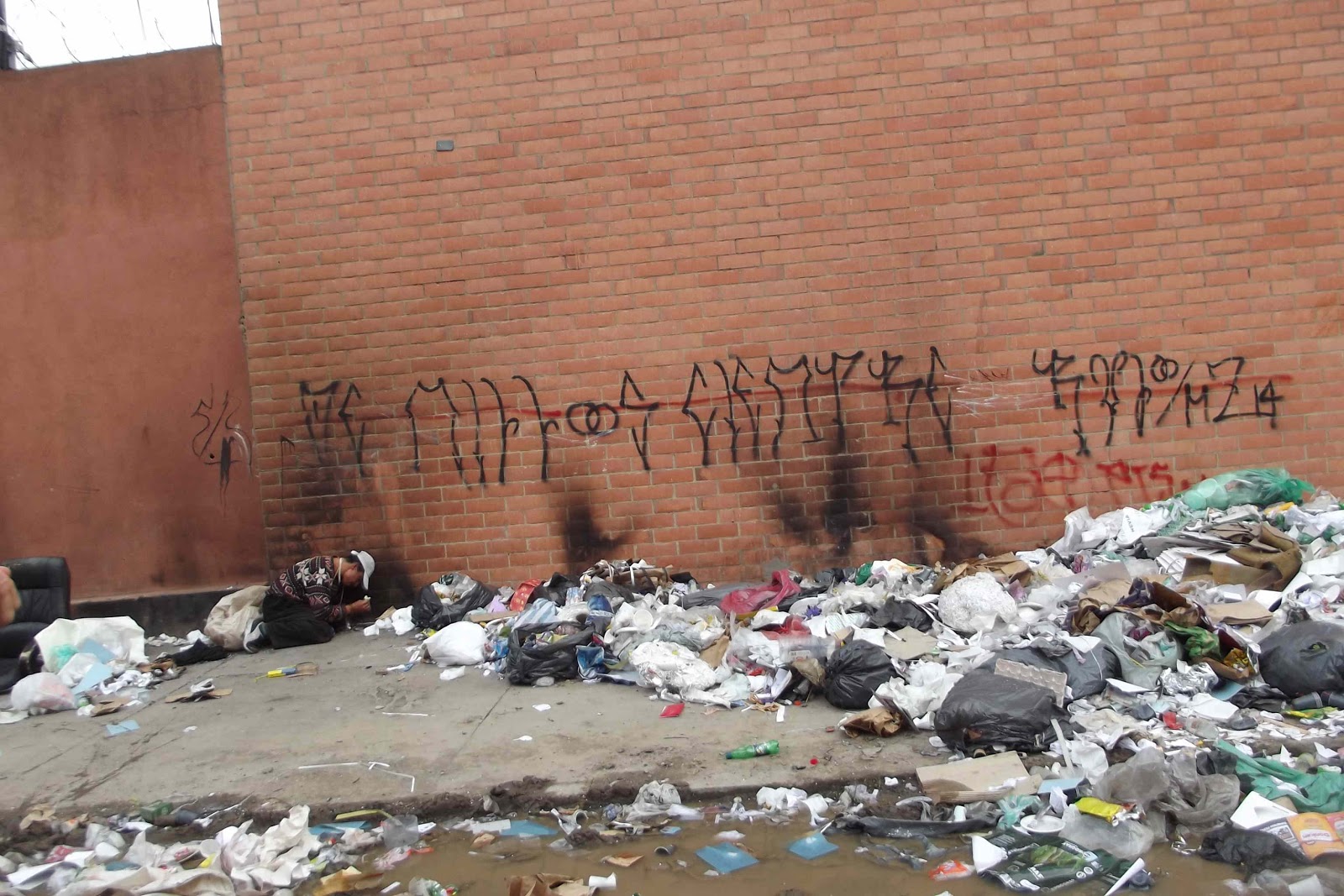
A man appears to be smoking bazuco, a cheap form of crack, amidst a trash pile. 
My interpretation is that Mayor Petro, once a leader of the M-19 guerrilla group, still remains a revolutionary at heart and believed that he could revolutinize Bogotá's trash collection system with a single decree. But these changes, unfortunately, must be implemented incrementally, not in one fell swoop. 

Great for homeless people and dogs...
A police officer stamps out smoldering trash on Ave. Septima. 
For the good of the environment and the city Bogotá needs to implement recycling. After all, the landfill, Doña Juana, is running out of space. But it will require methodical changes. They could start with the low-hanging fruit: supermarkets, traditional markets, city agencies like the parks department, office buildings and maybe apartment buildings, which would receive utilities discounts for separating out organics. That, hopefully, would start a cultural change which would then spread across the city. 

But there's a more immediate measure the city could take to reduce waste: reducing the use of disposable materials. The most obvious example are plastic bags, which are generally used only once and occupy a huge volume in landfills. Across the world cities and even the country of Ireland have dramatically reduced plastic bag usage by placing a small tax, or disposal fee, on each bag used. 

Scavengers and trash behind the Central Cemetery. 


This business on Calle 24 appears to be storing their trash until the city gets its act together. 
By Mike Ceaser, of Bogotá Bike Tours

Sunday, April 22, 2012

Re-Re-Paving - Again!


Last year, the city dug up and reworked several blocks of Carrera 3 in La Candelaria - even tho to us neighbors the street seemed to be fine.

But the apparently unnecessary work was done wrong: only a few months later, workers dug up part of one block again, because water, or another less pleasant liquid, was leaking from a pipe under the pavement.

But, after doing the job wrong undergound, this time they bungled things on the surface. Several big potholes opened in the asphalt.

Today, workers repaved the street's surface. But we'll have to wait to see whether they put on more than a thin layer which will wear away in another month.

I wonder who's made money off of this endless road work, and whether anybody's had to pay for doing it wrong?

More than skin deep?
Moving on to the Santa Fe neighborhood, this sidewalk got reworked, but the contractors seem to have left the job half-done. Is anybody paying attention?
Related posts: Pavement priorities.

Bogotá's Perpetual Public Works

By Mike Ceaser, of Bogotá Bike Tours