Showing posts with label germany. Show all posts

Sunday, July 13, 2014

A Gun Sale Gone Wrong

A Sig Sauer model S P2022 pistol. (Photo from Sig Sauer website)
It seemed to be yet another routine United States arms sale to Colombia: 64,485 Sig Sauer model S P2022 pistols, with a price tag of $28.6 million.

But this sale went wrong - in two different ways.

A military equipment shop in central
Bogotá advertises Sig Sauer products.
Several months ago, the German newspaper Süddeutsche Zeitung reported that German-made Sig Sauer pistols, part of a lot shipped here between 2007 and 2012, were in the hands of Colombian security forces. That meant a violation of German law, since Germany has not authorized the sale of such arms to Colombia out of concerns about human rights violations and Colombia's internal conflict.

The sale put the U.S. government into hot water with the Germans because the U.S. had apparently promised the Germans not to resell the arms to a third country. Ironically, the U.S. government could have legally sold Sig Sauer pistols to Colombia - if they were made in Sig Sauer's plant in New Hampshire. However, the pistols shipped to Colombia were reportedly a mix of U.S.- and German-made arms.

German officials told Semana magazine that the case was "very grave," but that it required more investigation.

Whatever the human rights challenges of Colombian security forces, this apparently illegal sale underlines the importance of regulating and monitoring international light weapons sales, as the United Nations Arms Trade Treaty, which is awaiting ratification, would do.

Perhaps the U.S. and German governments are monitoring these weapons to determine whether Colombian security forces employ them in human rights violations. However, they will not be able to monitor all of the pistols, because last November 100 of them were stolen from the police even before their importation process was complete.

Authorities reported recovering 36 of the pistols and arresting six people, including pawnshop owners, who'd participated in the robbery and black marketing of the guns, reports El Tiempo. A police official had sold the guns for 500,000 pesos, about US $260.00. each. But the other 64 guns are out there, likely in the hands of criminals, who may use them to rob, rape or murder civilians - or even to kill the police the guns were intended for.

By all accounts, Sig Sauers are well-made, long-lasting guns. So, Colombians will have reason to fear these weapons for many years to come.

By Mike Ceaser, of Bogotá Bike Tours

Wednesday, August 22, 2012

Did a Great Colombian Hide a Nazi Past?

Gerardo Reichel, during his second life. 

Gerardo Reichel-Dolmatoff holds a well-earned place in Colombian academics.

After emigrating here in 1939 he pioneered research on indigenous peoples throughout the country. In 1946, he and his wife Alicia Dussan founded the Ethnological Institute of the Magdalena and in 1963 they founded Colombia's first department of anthropology, at the University of the Andes in Bogotá. Reichel-Dolmatoff was also a member of the Colombian and United States academies of science, received many awards and wrote an astonishing 33 books and hundreds of scientific articles, according to his Wikipedia entry. Reichel-Dolmatoff is, deservedly, called the 'father of Colombian anthropology'.

However, if research by a Colombian academic working for a United States university is accurate, the Austrian-born Reichel-Dolmatoff, who died in 1994, was also hiding a horrific past. 

Prof. Oyuela-Caycedo motions to a photo of Nazi
leaders during his talk at the Americanists conference.
(Image from YouTube)
There had previously been hints of links to the Nazis in Reichel-Dolmatoff's youth in Austria, but they were apparently ignored or brushed off as attacks by his enemies. However, in preparation for the 54th International Congress of Americanists, held in July 2012 in Vienna, Austria, University of Florida Associate Prof. of Anthropology Augusto Oyuela-Caycedo began researching the youth of Reichel-Dolmatoff, under whom he had studied. Presumably, the Colombian-born Oyuela-Caycedo expected to fill in some gaps and produce yet another laudatory piece about this 'great man of Colombian academia.'

But, instead, what Oyuela-Caycedo found, with the assistance of researchers in Germany, has threatened the legacy of Reichel-Dolmatoff and perhaps even shaken the foundation of Colombian anthropology.

'The German Revolution,' a dissident Nazi newspaper
 which published alleged extracts from
Reichel-Dolmatoff's diary. (Image from YouTube)
Poring thru pre-World War II newspapers, old Bundestag records and even the Nazi Party's own documents, Oyuela-Caycedo and the Geman researchers compiled strong documentary evidence that the Reichel-Dolmatoff who accomplished great things for Colombian science had between the ages of 14 and 25, been a member of the Nazi Party and the SS, murdered Hitler's enemies and  trained guards at the notorious Dachau Concentration Camp. Oyuela-Caycedo's talk at the Americanists Conference is here, in Spanish, on YouTube.

In his talk, Oyuela-Caycedo read a chilling account, allegedly copied by dissident Nazis from Reichel-Dolmatoff's own diary, describing Reichel-Dolmatoff gunning down of an old man in 1934 during the 'Night of the Long Knives,' the mass murders of Hitler's opponents in the German government. The next year, Reichel-Dolmatoff worked as a guard and trained other guards in the notorious Dachau Concentration Camp, the model for Hitler's system of mass murder, according to Oyuela-Caycedo.

The current issue of Arcadia
magazine reports the story.
But in 1936 Reichel-Dolmatoff suffered something of a nervous breakdown and was briefly institutionalized, Oyuela-Caycedo found. Soon after, Reichel-Dolmatoff was declared 'inapt' to serve in the SS. The current edition of the magazine Arcadia reports that Reichel-Dolmatoff left the SS complaining of head pains. By 1937, Reichel-Dolmatoff was living and studying in France and working with anti-Nazi organizations, according to Arcadia (but the German researchers found no evidence of such anti-Nazi activities). In 1940, Oyuela-Caycedo found, the Nazi Party expelled and blacklisted Reichel-Dolmatoff.

The story seems incredible. But Oyuela-Caycedo found so many coincidences of time and place between the Reichel-Dolmatoff who was an outstanding anthropologist and the Nazi killer with the same name that his case is solid.

"It hurts me to read this," Oyuela-Caycedo says during his talk, "because I knew Gerardo Reichel."

My lingering doubts about whether this was the same Gerardo Reichel-Dolmatoff were mostly cleared away by one line in the Arcadia article: Reichel-Dolmatoff's family had no response to the findings. That suggests that they have reason to believe the account's truthfulness.

A notice issued by the Nazi party seeking
Reichel-Dolmatoff  after he had left Germany.
The story invites reflections about human nature: how malleable and changeable and even unprincipled it can be - concepts which perhaps influenced Reichel-Dolmatoff's own anthropology researches. It also makes me ask what drove Reichel-Dolmatoff out of the SS - was it a core of decency, a kind of weakness of will, or an inability to tolerate terrible crimes? Did he invent his headaches to leave the organization? Certainly, his later anti-Nazi activities and even his studies of Colombia's decidedly non-Aryan indigenous peoples were rejections of everything that Naziism stood for. 

Did Reichel-Dolmatoff leave his family an autobiography to be released 50 years after his death? We can only hope so. It would be yet another contribution to science and the study of man. But we can also regret that Reichel-Dolmatoff kept this part of his life story secret. Perhaps his turn from darkness to light could have provided answers for resolving Colombia's own conflict.  

El Tiempo interviewed two German researchers who are reconstructing the history of Reichel-Dolmatoff and other participants in the Nazi Party. They don't believe that Reichel-Dolmatoff left the movement for ideological or moral reasons, but simply because he came from an elite background and didn't feel comfortable among the Nazi soldiers, who were mostly unsophisticated men. They found no evidence of repentance in his writings or of his reported work for the anti-Nazi resistance.

The researchers don't find Reichel-Dolmatoff's dramatic transformation from apparent Nazi killer to respected humanist at all surprising: they've seen many such cases.

To me, it's yet another indication of the plasticity of human nature. Reichel-Dolmatoff was clearly an intelligent, dynamic person. But he just as easily conformed in a group of vicious murderers as in an elite academic environment.

"We are German historians and are accustomed to cases such as this one and even more jarring ones. We understand that Reichel's history in Germany has caused stupor in Colombia because of his later career. But here it is just one more such case among many," researcher Holger Stoecker told El Tiempo.

Related posts:

Shoa Remembrance in Bogotá

German Immigrants in Colombia

The Sinking of the Resolute

Karl Buchholz, Brave Bookseller

By Mike Ceaser, of Bogotá Bike Tours

Thursday, December 29, 2011

German Immigrants in Colombia


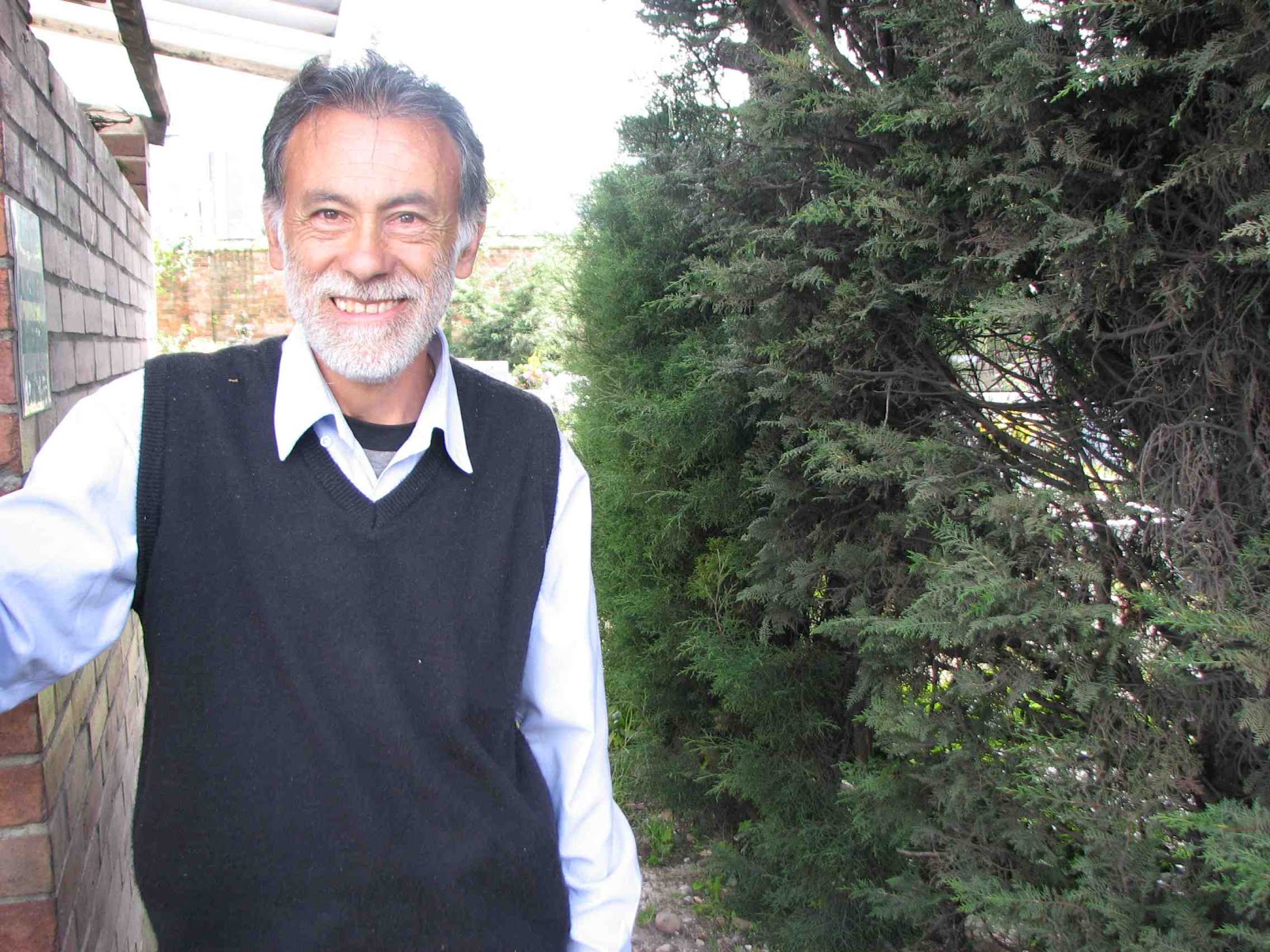
Today, for the first time, during a bike tour we were able to enter Bogotá's Cementerio Alemán, the German Cemetery.

Cemetery administrator Gonzalo.
The German Cemetery is located on the south side of Calle 16, just west of Parque Renacimiento (once the Children's Cemetery) and two blocks west of the Central Cemetery and the British Cemetery.

Gonzalo, who administers the German Cemetery, told us that it opened in 1912 and is still active. It contains about 500 tombs and has capacity for another 500.

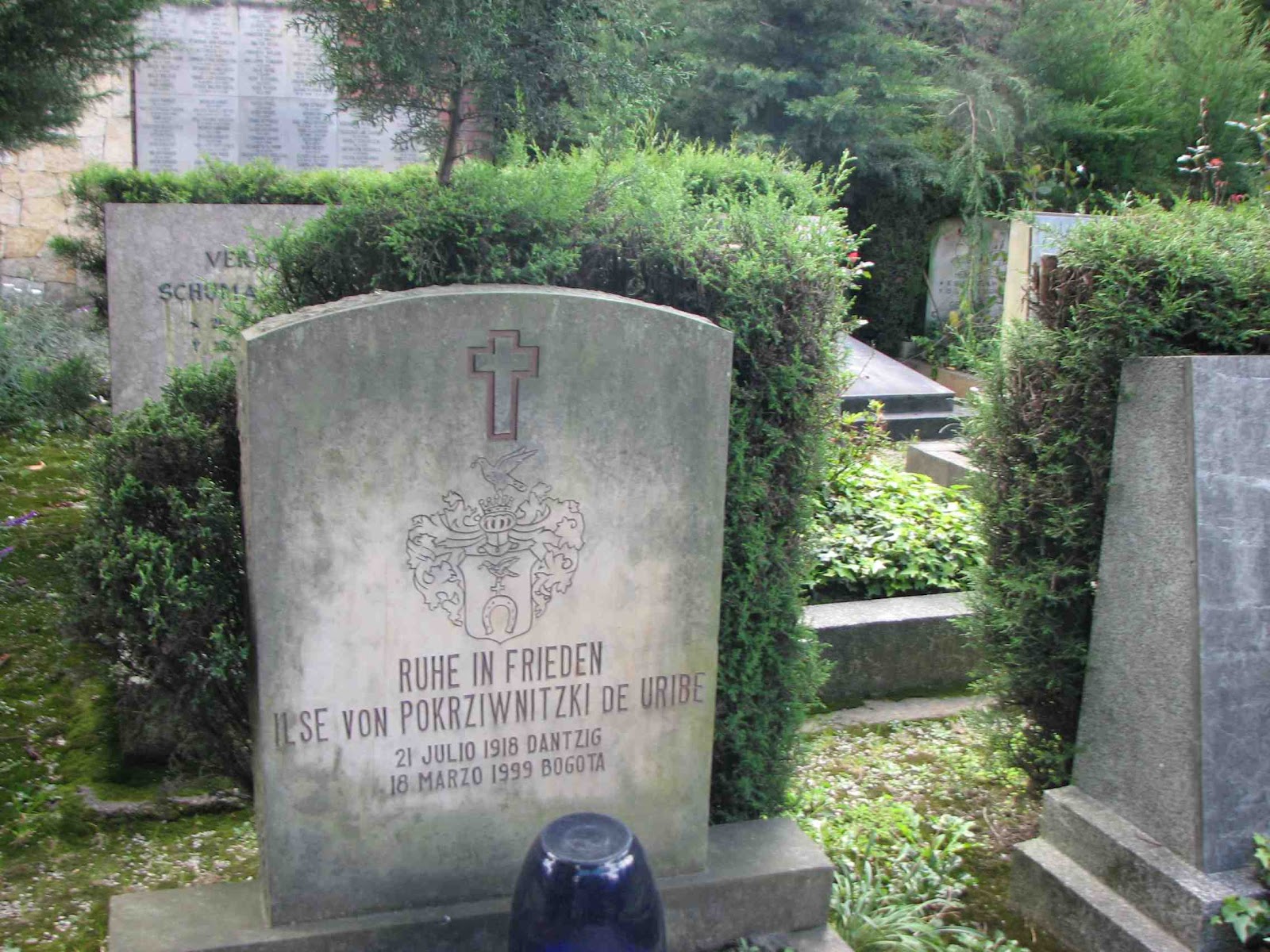
'Rest in Peace'
Asian and European immigrants did not flood into Colombia as they did into more southern South American nations with more temperate climates. But immigrants, including German ones, have contributed a lot to Colombia's history and economy.

German immigrants played important roles in exploration, aviation, jewelry, manufacturing and business, amongst other areas, administrator Gonzalo said. In fact, Colombia's first airline - and one of the first in the world - was the Colombian-German Air Transport Society, founded in 1919. The company eventually evolved into Avianca, today Colombia's largest airline.

Leon de Greiff, poet
Germans also were prominent in Colombian science, the most famous of them being Alexander Von Humboldt, who traveled up the Magdalena River in 1800. Another was anthropologist Gerardo Reichel-Dolmatoff, who fled Hitler's fascism and did pioneering research on Colombia's indigenous peoples and founded the Department of Anthropology of the University of the Andes, the first such department in Colombia.

Antonio Navarro Wolff, ex-guerrilla, and now a
top official of Bogotá.
Other prominent Colombians of at least partially German descent include Leon de Greiff, a Colombian modernist poet of the early 1900s, as well as his son Boris, a chess champion, who died just two months ago. Antonio Navarro Wolff, a leader of the M-19 guerrillas is now governor of Nariño Department.

German immigrants have also played important roles in the fabrics, coffee and banking businesses.

Colombia's most famous German immigrant is probably Leo Siegfried Kopp, a German Jew who founded the Bavaria Beer Company and has become a popular saint in Bogotá's Central Cemetery.

But Carlos Lehder, an associate of Pablo Escobar in the Medellin Cartel, was also of German descent.

Asking for a favor
at the tomb of
Leo Kopp in the
Central Cemetery. 
Colombia was also affected by the dark side of German history - fascism and the Holocaust. Colombia backed the Allies during the Second World War, when some German nationals lost their properties and were either deported or sequestered in a hotel in the tropics. A small number of Jews fleeing Naziism settled in Colombia, and a few Nazi war criminals came here. But their numbers were tiny compared to those who emigrated to nations like Argentina, Chile and Brazil.
This headstone carries a cross,
but the name sounds Jewish.

Returning to the cemetery, like the British Cemetery, the German Cemetery is a peaceful, green oasis in the heart of the city. Not all those buried there are from Germany, or even of German descent. We saw headstones with Polish surnames and at least one apparently Jewish-German name. (On the other hand, the Central Cemetery contains many German surnames.) Perhaps those buried in the German cemetery are Protestants, since the tombs' style is much more plain and austere. Or, maybe those buried there simply felt more affinity for their German heritage.

Related posts: A Glimpse of Historical Tragedy , Shoah Remembrence in Bogotá, Colombia in World War II , Karl Buchholz, BooksellerDid a Great Colombia Hide a Nazi Past?, The Sinking of the Resolute

See also: Germans in Latin America (Spanish).

Enrique Biermann, a professor at Bogotá's National University, has written a book about Germans in Colombia: Distant and Distinct: German Immigrants in Colombia.
An angel on a tomb. 
Friede (Peace); The entrance to Bogotá's German Cemetery.
The pair of hammers mean the man was a geologist. 


A coat of arms on a headstone. 

By Mike Ceaser, of Bogotá Bike Tours

Wednesday, December 7, 2011

Colombia in World War II

A sailing ship called a 'goleta,' like Colombia's The Resolute, sunk by a Nazi U-boat in 
Today is the 70th anniversary of Japan's 1941 attack on Pearl Harbor, which brought the United States into World War II - and pulled Colombia in in its wake.

Colombia, like most of Latin America, formally backed the Allies during the war, lending use of its territory and natural resources, but did not participate in fighting. Colombia was, however, strategically important because of its nearness to the Panama Canal, which the Allies feared could be attacked by Germany or Japan.

At the war's start, many Colombians still resented the U.S. for its role in turning the province of Panama into an independent country in order to dig a canal across the isthmus. But U.S. Pres. Franklin Delano Roosevelt had improved relations with his Good Neighbor Policy. Also, then-Colombian Pres. Eduardo Santos (the great uncle of current Pres. Juan Manuel Santos) was a Liberal and had studied in France, and so sympathized with the French, who were suffering under Nazi occupation.

After the Pearl Harbor attack, Colombia broke relations with the Axis powers and allowed the U.S. to station troops in the country - a relationship which has continued until today. Colombia had also accepted some Jewish refugees from Europe during the pre-war years, but, like most countries, shut the door in the late 1930s.

Extra! Extra! Read all about it! Colombia declares state of beligerance towards the Axis powers.
In June, 1942, a Nazi U-boat sank the Colombian sailing ship The Resolute, killing six sailors. (Some sources say the Germans sank three Colombian ships.) In response, Colombia declared a state of 'belligerancy' against the Axis powers. In 1944, the Colombia destroyer ARC Caldas, escorting a tanker on its way to Panama, sighted and sank a German U-boat, apparently Colombia's only hostile action during the war.

The Hotel Sabaneta in Fusagasugá, where
several dozen Germans and Italians
were interned during the war.
More troubling, Colombia, like much of Latin America, participated in the U.S.-backed policy of monitoring, expelling and interring Japanese, German and Italian citizens. A group of prominent Japanese and Germans were even put aboard a ship headed toward New Orleans and then the Portuguese colony of Mozambique in Africa, altho it's not clear whether they got there. Many other citizens of German, Italian or Japanese origin had their property confiscated.

Another group of several dozen Japanese and German citizens was interned during the war, under the protection of the Spanish and later the Swiss embassies. They apparently suffered little except for boredom, in a hotel in the tropics.

One colony of Japanese farmers in Cauca province received particularly close observation by Colombian officials, because of fears that they might build an airstrip, from which planes could attack the Panama Canal.

Biblioteca Luis Angel Arango: Colombia and Allied Cause in World War Two - Thanks to the BLAA for the photos of the hotel and the El Tiempo headline. 

The Japanese Community in Colombia During World War II

By Mike Ceaser, of Bogotá Bike Tours