Showing posts with label nicolas maduro. Show all posts

Saturday, May 19, 2018

Can Venezuela Pull a Malaysia?

Najib Razak, ex-Malaysian
prime minister, who lost an
election this month.
A notoriously corrupt strongman appears to hold a lock on his country's leadership. In the run-up to elections, he uses oil income to saturate the country with his campaign ads, controls most of the media and uses gerrymandering and other tricks to ensure his reelection victory.

The nation I have in mind is Malaysia, the southeast Asian nation which held national elections ten days ago. But I might as easily be talking about Venezuela, which is to hold a vote tomorrow in which its authoritarian president Nicolas Maduro is expected to use a rigged system to get himself reelected, despite running his oil-rich nation into the ground. In both nations, the government used legal charges and technicalities to bar opposition candidates from even running in the election.

To everybody's amazement, Malaysia's opposition party won the election, and the Barisan Nasional coalition, which had ruled Malaysia since independence in 1957 lost power.

That might provide a glimmer of hope for the opposition in Venezuela in tomorrow's voting. There,
Venezuelan president/dictator Maduro.
Pres. Maduro has taken control of nearly all the media and government institutions and is allegedly using payments and intimidation to win tomorrow's election.

Colombian Pres. Santos reported this week that Colombia had seized a big shipment of food allegedly intended to be used by the Venezuelan government to pay for votes, altho much of the food was already rotten. Santos also charged that the Venezuelan government planned to give Colombians Venezuelan ID cars and have them vote for the government.

But Venezuela differs in important ways from Malaysia, where the opposition candidate who won the prime ministryship had already been prime minister, and so many people had a positive image of him. On the other hand, Malaysia's economy was fairly strong, whereas Venezuela's is in free fall, potentially motivating many people to vote against the government.

But, barring a miracle, Mauro will win reelection tomorrow and continue stiffening his dictatorial rule and worsening his nation's economic disaster. And hundreds of thousands of Venezuelans will continue pouring into Colombia.

And the Malaysian election likely has redoubled Maduro's determination to win at all costs tomorrow. After all, Malaysian's ex-leader may now be put on trial for his alleged monumental corruption.

By Mike Ceaser, of Bogotá Bike Tours

Monday, July 31, 2017

Adiós to Venezuela's Democracy

Maduro and followers celebrate their 'victory' in rigged voting in Sunday's election.
During the 1970s and '80s, when military coups installed right-wing dictatorships across much of South America, Venezuela maintained a democracy, if a very imperfect one. Now, ironically, democracy has brought a leftist dictatorship to Venezuela.

Perhaps the best evidence of Venezuelan Pres. Nicolas Maduro's anti-democratic intentions is the fact that he never permitted regional elections supposed to be held late last year - and which his party was sure to lose. Maduro claimed that the country, which has the world's largest oil reserves, lacked the money to pay for elections, and called democracy a luxury for the elites.

Yet, miraculously, Maduro had no trouble finding the money for Sunday's constitutional assembly - which he made sure he'd win.

The Maduro government has also packed the Supreme Court, done all it could to negate the results of unfavorable elections, shuttered hostile media, imprisoned political opponents - and even briefly dissolved the opposition-dominated National Assembly.

But none of the Venezuelan government's anti-democratic measures have come close to Sunday's election of a constitutional assembly, manipulated to ensure a pro-government majority, despite Maduro's extreme unpopularity. The assembly has apparently unlimited powers to rewrite the country's constitution and remake its government.

The voting for the assembly representatives included manipulations such as giving rural voters - who have remained loyal to Maduro - disproportional representation, while reducing representation for city dwellers, who overwhelmingly reject Maduro. (Come to think of it, that arrangement is a lot like the United States' unfair and illogical Electoral College - which gave us president Trump.) And the voting system also gave pro-Maduro social organizations preponderant weight in the voting.

Government workers were ordered to vote or lose their jobs. Even so, media observers reported that voter turnout was light.

What's more, many experts say that Maduro lacked the authority to call this vote without first holding a popular referendum. But Maduro knew he'd lose any such referendum.

The Venezuelan opposition boycotted the vote in order to not give it legitimacy. As a result, Maduro's victory will be close to 100%, whether votes are counted fairly or not.

The new Constitutional Assembly's powers aren't defined, and may be unlimited. Expect Maduro to order his minions to eliminate the country's hostile National Assembly and to remove the attorney general, Luisa Ortega, a courageous politician who stood on principle in the face of the government's violations of human rights and trampling of its own Constitution.

Ortega charged that Venezuela was turning into a dictatorship.

In fact, immediately after the vote, Maduro called for removing National Assembly legislators' legal immunity and for replacing Ortega. Two prominent opposition leaders were quickly arrested.

The travesty will continue as long as Venezuela's armed forces - the police and military - continue backing Maduro, and so far they show no signs of wavering.

Already, the governments of Colombia, Mexico and Panama have said they will not recognize the voting's results. But if not, how will they deal with a government they consider illegitimate?

The U.S. and other nations have threatened the Maduro government with sanctions for holding the assembly vote. But don't expect the Trump administration to make the single move which could topple Maduro - cutting off oil sales to the United States. That's because doing so would hurt too many big corporations and lose Trump popularity among drivers.

Maduro and Trump, two incompetent, populist leaders, are also co-dependent.

By Mike Ceaser, of Bogotá Bike Tours

Friday, April 28, 2017

Venexit

Venezuelan Pres. Nicolas Maduro has become increasingly dictatorial.
So, you're self-proclaimed socialist 'revolution' is being criticized harshly as undemocratic by the head of an international organization you belong to.

And for good reason: After all, you've invented obstacles to block a recall referendum to which your Constitution gives citizens a right.

And you've used the Supreme Court - which you recently packed with your supporters - to annul every law issued by the opposition-dominated Parliament.

And you've even suspended regional elections, which your government would be sure to lose.

Not satisfied with all of that, you've shut down and banned critical media.

So, it's perfectly understandable, if still unjustifiable, that Venezuelan Pres. Nicolas Maduro intends to withdraw his nation from the Organization of American States (OAS), whose leader has strongly criticized Maduro's trampling of democratic institutions.
Besides his authoritarianism, Maduro has been an
incompetent ruler.

The Venezuelan government's flight from well-founded criticism marks the sad end of one of Latin America's oldest democracies. And Venezuela's descent into authoritarianism and violent repression of government opponents creates many potential problems for Colombia, beginning with the economic and political refugees now flooding across the border.

Authoritarian states are more likely than democracies to enter violent confrontations, and Colombia and Venezuela have a history of tensions, over territory, smuggling, migration and the activities of illegal organizations.

And the situation is worsened by Venezuela's economic tailspin, which could drive Maduro to seek a scapegoat - who could be Colombia.

Unfortunately, Venezuela's pending withdrawal from the OAS will only confirm its path toward dictatorship.

By Mike Ceaser, of Bogotá Bike Tours

Tuesday, October 11, 2016

Trumping Latin Democracies

Donald Trump, would-be strongman.
U.S. Republican presidential candidate Donald Trump and Venezuelan Pres. Nicolas Maduro may
seem like polar opposites. One is a wealthy conservative, the other a leftist who started out as a bus driver.

The two, however, do have at least one characteristic in common: Authoritarianism.

At the last U.S. presidential debate, Trump told Democrat Hillary Clinton that if he were president, she'd "be in jail," because of her mishandling of government e-mails. Evidently, Trump had forgotten that imprisoning people is the job of judges and prosecutors, not of presidents - at least in a democracy.

Nicolas Maduro, Venezuela's
authoritarian president.
But Trump might find a model in Maduro, whose government has imprisoned numerous opponents, most prominently Leopoldo Lopez, an ex-mayor and potential presidential candidate, whose trial was called a farce by many human rights organizations. Lopez is serving a 14 year prison term for supposedly inciting protests using subliminal signals.

Not satisfied with jailing opponents, the deeply unpopular Maduro has also used his puppet Supreme Court to declare Parliament, where the opposition has a majority, 'unconstitutional' and unable to issue legislation. Maduro also announced that he will instruct the Supreme Court to approve the national budget, even tho the Constitution explicits gives this job to Parliament.

Among Maduro's long list of authoritan, anti-constitutional actions is also using his puppet Electoral Council to put obstacle after obstacle in the way of a recall referendum the opposition wants to organize against him - another right provided in Venezuela's Constitution. And Maduro's government recently said that it won't hold governor and regional legislative elections this year because it can't afford to - this in an oil-soaked nation which throws billions of dollars away each year on corruption and giving away gasoline.

"The priority isn't to hold elections," Maduro said. "What is the country's priority? Fulfill the whim of the oligarchy or recover the economy?"

Leopold Lopez,
Maduro's political prisoner.
Under Maduro's incompetent mishandling, Venezuela's economy is sinking, it has the world's highest inflation rate and shortages of basic goods like sugar, flour, toilet paper and medicines. It also has one of the world's highest homicide rates.

What Venezuela needs most are elections, to throw out Maduro and his allies and restore sanity. understandably, Maduro doesn't want to permit votes he knows he'd lose.

Sadly, the story is not so different in nations like Bolivia, Ecuador and Nicaragua, where leftist leaders have entrenched themselves and are trying to become presidents-for-life.

In that sense, Brazil and Guatemala, both embroiled in corruption scandals, should be admired. There, at least, the democratic institutions have had the resiliency to remove flawed presidents and investigate their alleged misdeeds.

Would the U.S.'s own institutions be strong enough to withstand a President Trump?

Hopefully, we'll never have to find out.

Check out the excellent NY Times story about this.

By Mike Ceaser, of Bogotá Bike Tours

Wednesday, September 9, 2015

Maduro and Trump: Separated at Birth?

Nicolas Maduro.
Whenever the opportunity comes up, expect Venezuelan Pres. Nicolas Maduro to denounce U.S. billionare presidential candidate Donald Trump as a right-wing, xenophobic would-be dictator.

And, if he ever gets the chance, expect Trump to denounce Maduro as a xenophobic, left-wing, bannana republic tyrant.

Both should be careful about what they say, since they seem to be blood brothers, despite supposedly being ideological opposites.

Trump boasts that if elected president of the United States he'll expel all illegal immigrants, whom he blames for the U.S.'s crime troubles, and build a wall along the Mexican border - at Mexico's expense. Those claims are absurd, of course. However, to see an example, he can just look south to the Venezuelan-Colombian border.

Donald Trump.
As Trump does the Mexicans, Maduro blames Colombians for his country's criminal and ecnomic troubles. And, as Trump would do, Maduro has expelled Colombian immigrants and tried to shut down the border.

The result? A humanitarian crisis, accusations of rights violations - and Venezuela's economy continues suffering and its crime epidemic continues.

Trump calls himself a conservative, Maduro calls himself a leftist. But, when it comes to futile, abusive national policies, ideological opposites seem to intersect.

Trump's wet dream? Deported Colombians carry their belongings across a river from Venezuela into Colombia. (Photo: Telemundo)
By Mike Ceaser, of Bogotá Bike Tours

Wednesday, March 11, 2015

A Venezuelan Threat to Whom?

Nicolas Maduro: Hapless leader
or threat to Washington?
“I, BARACK OBAMA, President of the United States of America, find that the situation in Venezuela....constitutes an unusual and extraordinary threat to the national security and foreign policy of the United States, and I hereby declare a national emergency to deal with that threat." 

Give us a break. Venezuela is near being a failed state. It's economy's going down the tubes, its government's turning increasingly corrupt, authoritarian and repressive, and Venezuelans' lives are becoming tougher and tougher.

Venezuela is a threat...to Venezuelans and probably to Colombians and other neighbors. But an 'extraordinary threat' to the U.S.'s national security and foreign policy?

Venezuela was perhaps once a threat to U.S. foreign policy - back when Chavez was alive and admired, and when high oil prices gave Caracas a full wallet to buy and influence foreign heads of state. But today Venezuela is widely seen as the basket case it is and has been reduced to begging support from its few allies. Caracas is in no position to rally anybody against the U.S. Even Venezuela's long-time ally Cuba has pivoted toward Washington.

Venezuela's worst-case - and increasingly likely - scenario is a larger scale repeat of its its 1989 Caracazo social explosion, when riots led to thousands of deaths. The difference is that today the economy is even more distorted and the country even harder up than back then, so things might be even worse, and Venezuela could emerge from the crisis as a full-fledged dictatorship.

But that dictatorship scenario is a threat to Venezuelans rather than to the U.S. As many will recall, Washington got along just fine with dictators and strongmen in Brazil, Argentina, Chile and Peru - not to mention China and Washington's blooming friendship with communist Cuba. Or maybe I missed Washington's crack-down on Saudi Arabia for being a dictatorship, not permitting free speech or religious practice, and furiously repressing women, dissidents and religious minorities.

And, the Washington officials who denounce Venezuela should keep in mind that they are financing the behavior of Caracas, which still sells most of its oil to the U.S.

The Caracas Chronicles blog speculates that Venezuela could emerge as a base for Islamic terrorism - which is an absurd, wild-eyed scenario for a highly-Catholic nation still dependent on U.S. Or turn into a narco-state. But the U.S. has long co-existed with state-tolerated drug trafficking, and will continue losing the War on Drugs until it abandons failed prohibitionist policies.

On the other hand, Obama's declaration plays right into Venezuelan Pres. Nicolas Maduro's rantings about the U.S. conspiring to invade and overthrow him. After all, declaring a nation an 'extraordinary threat' sounds like a great justification for invasion.

Venezuelan Pres. Maduro didn't hesitate to exploit the new diplomatic crisis, which he called "the most aggressive, unjust and harmful blow against Venezuela." Maduro announced that he would introduce an enabling law into the National Assembly giving himself additional powers to deal with the situation. Those familiar with Venezuelan politics tknow that means more quasi-dictatorial powers for Maduro.

Disturbingly, Venezuela's Ambassador to the Organization of American States said during a television interview that a sharpshooter's bullet makes a different noise when passing thru the skull of a government opponent, because "the sound is much less, like a crack, because the cranium is hollow and the bullet passes thru rapidly."

A comforting comment for opponents in a supposedly democratic nation.


By Mike Ceaser, of Bogotá Bike Tours

Friday, February 27, 2015

Venezuela Vs. Colombia's Media

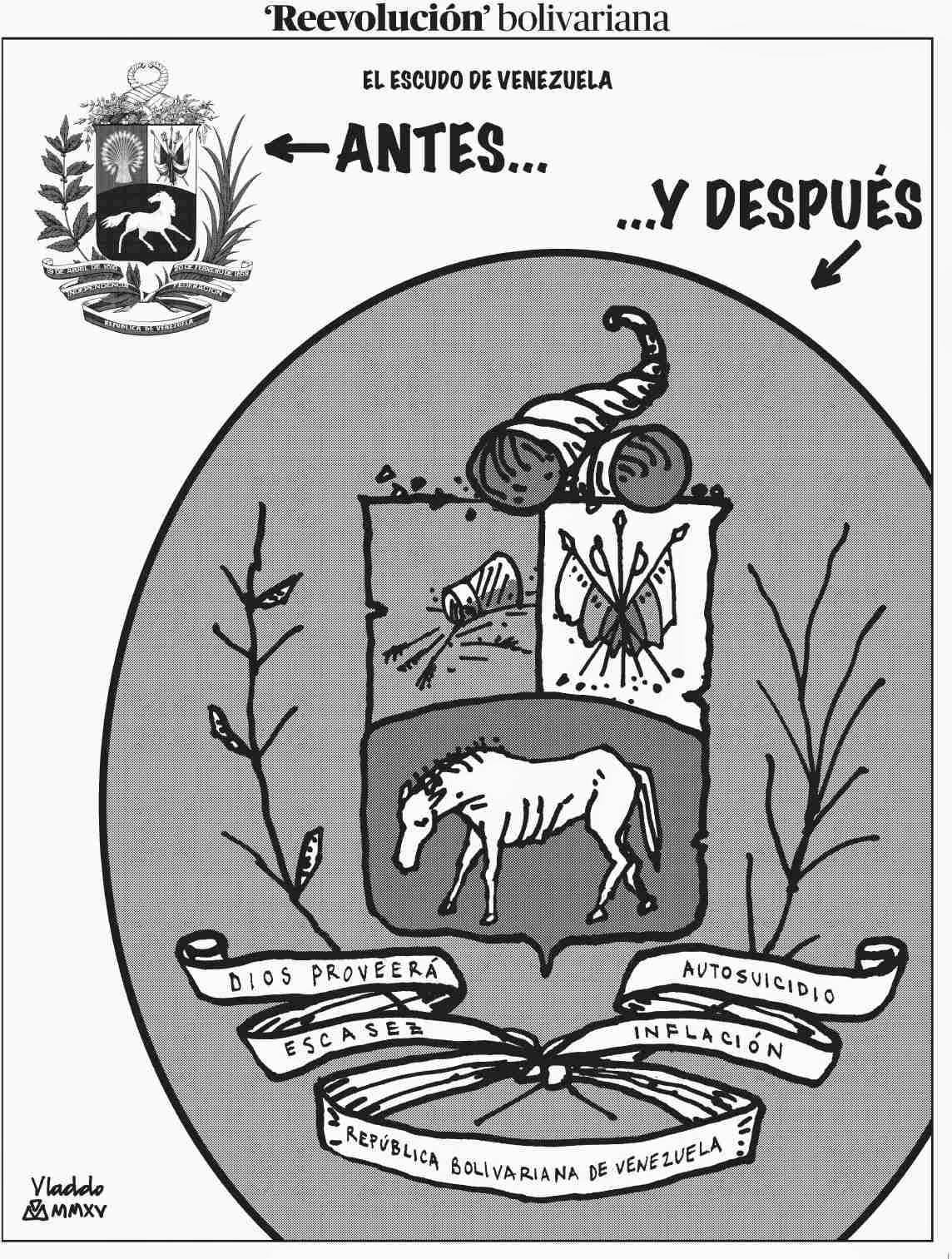
http://www.semana.com/caricaturas/vladdo/articulo/vladdomania-edicion-1708/415619-3
Disparaging - but a coup? (From Semana magazine)
Maduro says that paramilitaries
infiltrate from Colombia.
His popularity at 20%, his nation's economy in collapse, and his democratic credentials increasingly questioned, Venezuelan Pres. Nicolas Maduro is fighting back - against the Colombian media.

When Semana magazine cartoonist Vladdo published a cartoon portraying Venezuela's coat of arms with a sickly horse, empty cornucopia and empty branches, Maduro was ready.

"I reject the campaign of manipulation, lies and hate in Colombia against Venezuela, Nicolas Maduro, against Hugo Chavez and the Bolivarian Revolution," Maduro thundered over a national 'cadena' (chain), when all Venezuelan radio and television stations are required to carry his speeches.

Madura offensive against
the Colombian press.
Whether Vladdo's portrayal is accurate or not - and it sure seems true that Venezuelan shelves are empty and its people discouraged - the context is revealing. Maduro attacked Colombian media by enslaving (literally 'chaining) a Venezuelan media which has already been tamed by official threats, intimidation and lawsuits.

Over the past several years, the Venezuelan government has progressively taken away broadcasting licenses and bought out critical broadcasters and newspapers. Surviving independent papers struggle to obtain paper to print on. And the famed opposition opinion paper Tal Cual, run by old leftist Teodoro Petkoff, it switching from being a daily to a weekly under the burden of government lawsuits, lack of advertising and lack of newsprint.

So it's not surprising that Maduro, used to a pliant and passive media back home, would object to a critical one next door.

At the same time, of course, everything Colombian provides Maduro with a convenient target to attack. In that respect, Maduro's use of the term 'Santanderean oligarchy' is also telling. Maduro was referring to Colombian revolutionary hero and president Francisco de Paula Santander, who broke with Simon Bolivar after independence and is famous for telling Colombians that 'Weapons have given you independence, but laws will give you liberty.' In contrast to Santander, after independence Bolivar wanted to discard the Constitution and make himself lifetime president - much as the Chavez-Maduro dynasty, whch has ruled for 16 years, has done in Venezuela.

By Mike Ceaser, of Bogotá Bike Tours

Saturday, October 25, 2014

Nicolas Maduro Turns Green


Pumping nearly-free Venezuelan gasoline. (Photo: Flickr)
Believe it or not: The leader of major oil exporter, who spends billions of dollars every year to pay people to burn gasoline, is denouncing oil production for destroying the planet.
Barbarous, savage and anti-human?
Preparing for a fracking job. (Photo; Wikipedia)

But Venezuelan Pres. Nicolas Maduro doesn't mean all kinds of oil production, of course. Maduro has denounced hydraulic fracturing, or 'fracking', which he calls "barbarous, savage and anti-human."

Fracking does have its special dangers, including causing small earthquakes, consuming lots of water and maybe polluting groundwater. But its greatest danger is that, like all hydrocarbon production, it pumps carbon into the atmosphere, driving global warming. According to data from The Guardian, in 2010 Venezuela produced 5.8 tons of carbon per person per year, compared to 1.6 for Colombians and 2.3 for Brazilians.

“What stands out is the squandering of petrol at the cheapest price in the world – two cents of a dollar per liter – which does not even cover production costs,” Juan Carlos Sánchez, a member of the Intergovernmental Panel on Climate Change (IPCC) told IPS News in 2012.

Since then, the price of gasoline in Venezuelan has plummeted as inflation there has soared, making the country even more wasteful.

Big, new, gas guzzlers in Venezuela. (Photo: Flickr)
Add to that galloping deforestation, and Venezuela manages to rival even some rich, developed nations, such as Switzerland, in its pollution.

But all this irresponsibility and selfishness hasn't stopped Venezuelan leaders from denouncing other nations behavior.

"We have no doubt that (failure of anti-climate change agreements) is due to the irresponsible attitude and lack of political will of the most powerful nations," late Venezuelan Pres. Hugo Chavez said at a climate conference in 2010. (Nor has their hypocrisy stopped leftists from non-judgmentally quoting Venezuela's leaders as they spout off.)

Chavez was right about other nations' irresponsibility, of course, but that doesn't change his own hypocrisy.

Maduro's real complaint is not the fracking is destroying the planet, but that it is destroying Venezuela's economy. Fracking has enabled the United States to become a huge petroleum producer, pushing world oil prices below the level at which Venezuela can meet its expenses - including the cost of giving away gasoline.

All of which reminds me of a time while I was living in Caracas when, as a journalist, I was covering some sort of chavista revolutionary conference held in a central Bogotá high-rise. As I was looking over the event's program, which included speeches denouncing genetically modified foods - which haven't harmed anybody, as far as I know - I looked out a window at hillside slums, where towers of black smoke showed where garbage was burning - pumping carcinogenic toxics into the air. But nobody cared.

By Mike Ceaser, of Bogotá Bike Tours

Saturday, June 29, 2013

Is Venezuela's President Actually a Colombian?

Venezuelan Pres. Nicolas Maduro.
Should he change the flag? 
Voices in Venezuela's opposition are suggesting that Pres. Nicolás Maduro was born in Colombia - which would make him ineligible to lead Venezuela.

It smacks of the smear campaign against U.S. Pres. Barack Obama - except that in Maduro's case the charges appear credible.

The critics and Colombian newspapers have produced birth certificates showing that Maduro's mother and sister were born in the Colombian border city of Cucuta. And Cucuta residents recall playing soccer there with the youthful Maduro - who has always claimed to have been born and grown up in Caracas.

That's all suggestive, but proves nothing. What seems more significant is the fact that Maduro and his people haven't made the logical response of producing birth and baptism certificates, school records, newspaper clippings or other evidence documenting Maduro's birth and childhood

Instead, only a silence, which speaks loudly.

In contrast, Obama provided his birth certificate and newspaper announcements of his entry into this
Cucuta, Colombia. Maduro's birthplace?
world.

Of course, it shouldn't matter (except to the degree that it speaks to Maduro's honesty). Maduro didn't choose his birthplace, and it's irrelevant to his abilities as president. Lots of people believe he's a terrible president for Venezuela - but I've never heard any suggest that he's disloyal, a Colombian plant, or anything like that. Rather, the feeling on this side of the border is that Maduro has used Colombia as a convenient whipping boy for his many domestic problems.

Peruvian Pres. Alberto Fujimori, the son of Japanese immigrants, suffered from similar birthplace doubts, which were never resolved. Fujimori polarized Peru - as Maduro has done - stabilizing the economy and beating back the Shining Path guerrillas, but violating civil rights and unleashing huge corruption scandals. He's now spending his last years in solitary confinement in a high security Lima prison. But, whether Fujimori was born before his parents boarded the boat to Peru, on the boat, or after landing, has no relevance to his accomplishments and crimes.

The same's true of Maduro.

Perhaps those of us who believe that Maduro is following Chavez's policies of driving his nation down the tubes should be grateful to Maduro for any change in nationalities. After all, if he is Colombian born and had stayed in this country, might we be facing the scary possibility of Maduro in the Casa de Nariño?

By Mike Ceaser, of Bogotá Bike Tours

Tuesday, April 16, 2013

Venezuela's Un-President

Maduro is dwarfed by his predecessor, Hugo Chavez.
50.5% to 49% is a mathematical victory for Venezuelan President Nicolas Maduro.

But it's a huge defeat relative to the double-digit victories racked up by ex-President Hugo Chavez, who died six weeks ago.

It's also a defeat compared to the ten-point margin which many polls predicted for Maduro.

It's also defeat when the Chavez sympathy vote is figured in. And it's a defeat when you consider that all of the government was converted into a Maduro election machine.

And it's a defeat in light of the many substantive charges of corruption.

The razor-thin victory of Maduro, Chavez's chosen heir, leaves Venezuela with a weak new president.
1989 Caracazo rights in Caracas. Coming back?
Maduro compounded his own troubles by first promising a recount and then backtracking, as the National Electoral Council announced a rushed inauguration.

Assuming that public protests or a restless military do not oust Maduro, he'll be a president without manuevering room and facing huge challenges, in particular a disfunctional economy inherited from Chavez.
Venezuela has a soaring homicide rate and the highest inflation rate in the region. Stores lack basic foodstuffs. Corruption is rampant. Those are problems which a nation swimming in oil that's at $100 per barrel should be able to deal with - but Chavez's populist policies left Venezuela with huge deficits and expensive subsidies, such as almost-free gasoline. As a weak president with little charisma whose legitimacy is under question, Maduro will not risk generating public discontent by reducing those subsidies - until he's forced to. Once the deficits become overwhelming and the Russians and Chinese refuse more loans, the Venezuelan government will be forced to make huge economic corrections, and deadly riots like the 1989 Caracazo may repeat themselves.

Ironically, El Caracazo is often seen as the origin of Chavismo. Now, the populism-and-bust pattern carries a warning for chavismo.

Already, Maduro's vow to block an opposition protest march suggests that his strategy for holding onto power is to become more authoritarian - like Venezuelan allies Cuba, China, Belarus and Russia.


For Colombia, Venezuela's continued instability is bad news. But it's also a lesson about the great dangers of populism.


By Mike Ceaser, of Bogotá Bike Tours