Showing posts with label tires. Show all posts

Monday, September 28, 2015

Maximum Garbage?


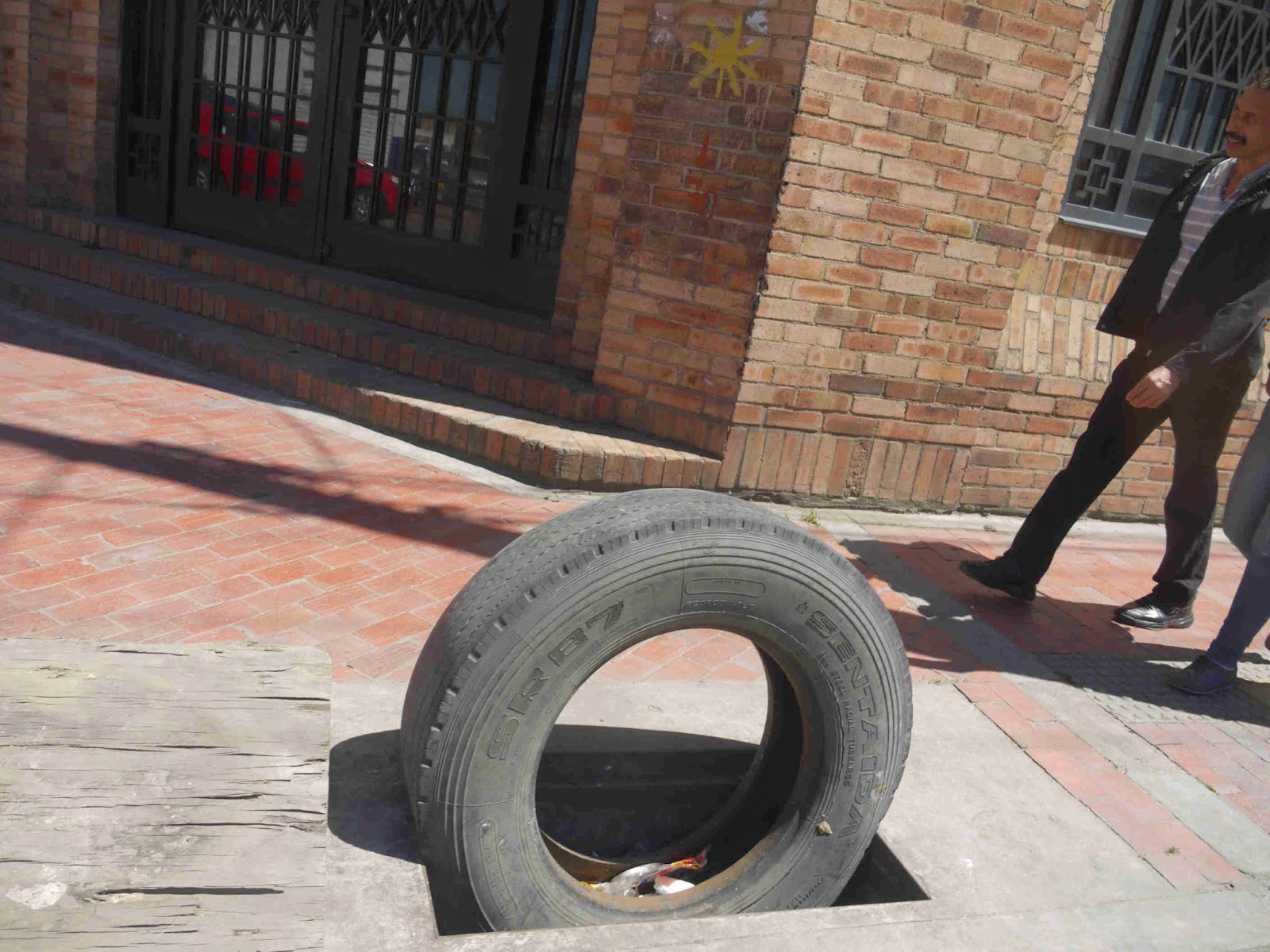
One tire on its way to the dump.
Take a look at the drama going on on Calle 24, behind the Central Cemetery, to get a feel for the absurdity - or nonexistence - of Bogotá's solid waste policy.

One by one, city workers are dropping old tires from windows or rolling them out of doors, then loading them into trucks to drive them an our outside the city...where they'll be dumped into a 'tire cemetery.' And they'll be at it for a good deal longer, judging from the piles of tires remaining inside the buildings.

The fate of used tires has been an ongoing crisis in Bogotá, especially since about a year ago, when an illegal tire dump caught fire, spewing toxic smoke which turned the city's air grey for days. City leaders vowed to take action...and held a series of meetings with tire industry representatives, which have come to nothing.

And another tire.
Of course the meetings came to nothing. The tire industry doesn't want to bother itself with the cost and trouble of the disposal of its products. And god forbid that the city would force them to. After all, that might create a precedent and make the producers of styrofoam containers, plastic bottles, cigarrettes, plastic bags and the innumerable other products which litter our streets, clog rivers and fill landfills fear that they too might have to take responsibility for the impacts of their products.

No need to observe that other cities have confronted these problems with deposit systems. But Mayor Petro persists with his fantasy that a p.r. campaign accomplish the same here. (Perhaps Petro doesn't want to offend the industrial interests which he hopes will support his campaign for president. God forbid.)

In fact, the tires were dumped into these vacant buildings by the city's UAESP, which is supposed to handle recycling, and whose slogan is 'Basura Cero' but should be 'Basura Maxima.' Now, these tires will sit in a dump where they might catch fire. And the tire avalanche continues, with no solution.

A few more left inside.
The best guarded tires in town.
Workers are walling up the buildings. Displaced people occupied one of them last week, exposing the illegal tire dump.
Sure thing.

By Mike Ceaser, of Bogotá Bike Tours

Monday, September 21, 2015

Our Home for Used Tires

Displaced people wait on a Median Strip.
You'd be angry, too, if you were out on the street and your potential home was occupied by...discarded tires.

Displaced people tossed tires onto the sidewalk.
(Photo; El Tiempo)
That was why a group of people who said they'd been displaced by Colombia's violence occupied a vacant building behind the Central Cemetery today and tossed the used tires stored inside out into the street.

Workers move tires out of the building.
Where will they take them? To an illegal dump?
The situation captures the intersection of two Colombian disfunctions: the lack of solutions for people displaced by the internal armed conflict - some say that Colombia has up to six million displaced people, perhaps the second-largest number in the world. And Bogotá's inability to find a solution to the problem of used tires, which are tossed onto sidewalks, median strips and parks. In this case, this vacant building had been filled with old tires, which waited there for some homeless person to crawl inside, light a fire and start a viciously polluting conflagration. Other cities have found ways to reuse, or at least responsibly dispose of, used tires. But that costs money, and Bogotá officials don't want to offend the tire companies by forcing them to charge deposits.

As for the displaced people, they charge that the government has failed them on promises to provide new homes, and are demanding a solution.
Much of the building is still packed with tires, which generate huge pollution when burned.
A displaced man from El Chocó tells how he was driven from his home by paramilitaries.


Used tires wait on a sidwalk along 26th Street, near the National University.
By Mike Ceaser, of Bogotá Bike Tours

Monday, April 13, 2015

Where Have All Those Tires Gone?


Just a few months ago, the used car and truck tires littering parks and sidewalks across Bogotá were making headlines: In particular, after an illegal lot with thousands of tires caught fire, turning the air grey for days.

Then, government and tire industry leaders - and apparently did nothing.

Recently, however, I seem to see fewer tires on the sidewalks, making me wonder where they've gone.


This pile of tire shreds near Calle 26...

....were helpfully covered up recently.

Then, one day, I happened to look thru a gap into this nondescript vacant building behind the Central Cemetery.


The building is packed with hundreds, perhaps even thousands, of used tires.

Waiting to burn.
One day, a homeless person will sneak in to sleep and light a fire; the tires will ignite and smolder for days, turning the sky grey. A few months ago, an unregulated tire dump caught fire and polluted Bogotá's air for days.


But there is a solution: Apply a deposit to tires (and many other waste products), creating an incentive for people to dispose of them properly, as well as a subsidy for processing them into, say, asphalt.


By Mike Ceaser, of Bogotá Bike Tours

Wednesday, January 7, 2015

A Tire Mountain Grows in Bogotá

Dozens, or hundreds, of discarded tires piled on a Caracas Ave. median in central Bogotá.
This mountain of used tires magically appeared, reportedly this morning, on the median strip of Caracas Ave. by Calle 17. Where they came from is a mystery, even tho they look like motorcycle tires, and a block away is one of the city's motorcycle districts, where tires are sold and changed. But that's no reason to think there's any connection.

Still, the tires are there, and will undoubtedly remain while more arrive, until someone sets fire to them, or our tax money pays for them to be hauled to a probably unregulated dump, where they'll breed mosquitoes until they eventually catch fire. In the 'best case', they'll end up in the city's Doña Juana landfill, which is almost full, despite Mayor Petro's ineffective 'Zero Garbage' program.

As we all can see, Bogotá's sidewalks, parks and streetcorners are becoming inundated with discarded car and motorcycle tires, while city officials look on passively, and fantasize that recycling programs are functioning.

What Bogotá needs to do is charge the tire industry for the disposal of its products. Each tire purchase would include a deposit, part of which would be returned when the tire is correctly disposed of. The rest of the deposit would pay for some recycling process, such as shredding the tires and incorporating the material into asphalt.

But will the supposedly environmentalist and sustainability-minded Mayor Petro put into action such a policy? Don't count on it, especially in an election year.


Scenes from the neighboring motorcycle district. Is it possible that the tires are coming from here?

Sleep tight, you motorcycles, in those comfortable pijamas.
Across Ave. Caracas, yet another tire pile, altho these look like car tires.
Near motorcycle alley, more tires pile up on a sidewalk.
According to El Tiempo, some 2.5 million used tires are generated annually by the city of Bogotá, of which 750,000 are discarded illegally.

As a public service, I've come up with some ideas about how to use those 2.5 million waste tires:

As footrests.
As bumpers.
For urban gardening.
To mark holes in streets and sidewalks, where covers have been stolen, so that people don't fall in.
As sidewalk sculptures.
As taller sidewalk sculptures.
As advertising, to sell more tires, which will end up on sidewalks.
To protect fire hydrants.
Great, now only 1,999,978 more tires to find uses for (not counting the ones discarded today).

By Mike Ceaser, of Bogotá Bike Tours

Thursday, November 6, 2014

The Great Tire Fire

'Alert in four neighborhoods for odor from burnt rubber.' (Photo: El Tiempo)
Smoke rises from the tire dump fire in Fontibon.
(Photo: Twitter via Noticias Caracol)
A tire dump has in Fontibon has burnt for the last several days, sending thick smoke into the air and prompting health alerts from authorities.

Which was fair enough. But what about every single other day, when authorities don't issue air health alerts? Does that mean Bogotá's air is breathable?

'What effects do burnt tires have on health?' (Photo: El Tiempo)
Bogotá media, such as El Tiempo, gave the tire fire big coverage.

A sardonic commentary. Photo: Facebook
Smoky haze hides the hills in La Candelaria.
Compared the tire conflagration, Bogotá's 'normal' air pollution is almost healthy...
Smoke rises from a routine fire (burning tires?) behind the La Sabana train station today.
Homeless people hang out behind the Estación de la Sabana on Calle 13, where they burn collected trash to separate out the metals in order to sell them.

On Calle 13 near San Victorino Plaza today TransMilenio buses belch smoke.
The TransMilenio system is the pride of Bogotá - but many of the buses are 'rolling chimneys.'

A masked man walks across Plaza San Victorino.
In the wake of this disaster, authorities will talk about imposing strict regulations on dumps, and then do nothing.

But there's a deeper, more systematic problem here, which Bogotá authorities will be sure to ignore. The city is being inundated by trash, including used tires, which nobody seems to know what to do with. Grind them up to make asphalt? Hang them from trees as playground equipment? After that, you'll still have 99% of them left, accumulating on streets, parks and in dumps, where homeless people ignite them for warmth and they collect water and breed mosquitoes. 

Either society in general can spend a small fortune collecting and burying these tires, thus socializing yet another cost of the auto industry. Or, Colombia could do what many other nations do and tax tire manufacturers and importers and use the tax revenue to dispose of their products.

Update: Several days after the fire, the tires continue smoldering. According to city air measurements, pollution levels hit five times the maximum acceptable levels - and none of the measuring stations were near the fire.

Headed for burning? Discarded tires wait on a sidewalk for someone to collect them.


By Mike Ceaser, of Bogotá Bike Tours

Monday, August 11, 2014

The Used Tire Tsunami

Trash and tires. Looks like a homeless person will burn these tires, turning them into toxic air pollution.
They're everywhere: Discarded on sidewalks, abandoned in empty lots, tossed onto median strips, rolled into rivers....Old, used and useless tires are becoming part of Bogotá's landscape. The proliferation of car and truck tires is yet another example of how cars privatize benefits while passing their costs, including noise, pollution and congestion, onto society.

A tire decorates a sidewalk.
Expect the Petro administration to make some pronouncements and posters urging Bogotano car owners to do the right thing by spending time and money to properly dispose of old tires. But Petro's fantasies about people being altruistic and civic minded are, sadly, mostly fantasies. Instead, many people and businesses find it cheaper and easier to dump old tires in the nearest empty public space - where they collect water and breed mosquitoes and can catch fire, pouring thick, oily smoke into the air. Even when the tires are trucked off to a dump, they cause the same problems.

Bogotá generates some 2.5 million used tires per year, according to the Secretaria de Ambiente, 30% of which end up dumped in parks, rivers and fields. In 2010, the city issued a resolution requiring tire sellers to accept used tires free of charge. But either that doesn't happen, or the sellers just toss those same tires back out onto public space.

Will this guy use these tires - or dump them?
The only real solution here are measures which Petro doesn't believe in - legal penalties and economic sanctions. Tire manufacturers and importers should be charged a tax on each tire. That money would be used to pay a deposit for each tire turned in and properly discarded. If used tires do not disappear from the landscape, then the tax would increase. The tire industry would also have to pay to develop a system to reuse or recycle the tires, perhaps by turning them into paving material.

But don't expect any real solutions from Petro, who seems to fear most hurting the interests of big business.

This tire shop tosses its discard tires by its own doorstep.
Used tires piled up outside a tire shop. Will they be tossed in a river tonight?
By Mike Ceaser, of Bogotá Bike Tours