Showing posts with label marijuana. Show all posts

Sunday, June 24, 2018

Colombia's Medical Marijuana Hits a Speed Bump

Coca leaf and cannabis cures for sale in a Bogotá market.
Are the two plants really so different?
Colombia is by far the planet's biggest cocaine producer, and the cocaine economy is booming, more than quadrupling over recent years.

Now, Colombia wants to be a world leader in another drug: marijuana.

The country's cannabis strategy is full of ironies, of course. Colombia was a world marijuana leader back in the 1970s and '80s, when Colombian Gold was prized in California high schools like the one I studied in. Of course, today pot is legal in California (although it can't be imported), and California produces lots more high quality pot than Colombia does.

But hot, humid Colombia has lots better growing conditions than do temperate nations like the U.S.,

Canada and Europe, where marijuana is increasingly legal or tolerated. In particular, Colombia has drawn lots of investment from Canada, which is in the process of legalizing recreational cannabis, altho the Canadians are careful to stress that their Colombian investments involve only medicinal marijuana.

Colombia's cocaine industry continues costing the country immense amounts of money to pay for carnage and law enforcement, while its marijuana businesses will soon be paying taxes and creating legal employment, like the tobacco and alcohol industries.

Is there a lesson here about the best way to manage mind-altering substances?

Colombia's cannabis industry suffered a black eye a few weeks ago when a group of Israeli cannabis tourists and their guide were kidnapped after visiting a medicinal marijuana plantation near Cali. The kidnappers, who were apparently dissident FARC guerrillas, released the tourists but killed the guide, after demanding an astronomical ransom from her family. Whether the kidnappers were motivated by money or paranoia about strangers entering their region is not clear. But the tragedy was only marginally related to marijuana, which was what drew the tourists into the troubled region, but did not cause the crime.
Mónica Berenice Blanco Sossa,
m
urdered Argentine-Colombian tourist guide. 

Some have suggested that the tragedy was the fault of the guide and the tourists for pursuing mind-altering substances. That's an interesting sentiment. I'll wait for them to prohibit tourists from consuming alcohol, tobacco and caffeine, as well.

By Mike Ceaser, of Bogotá Bike Tours

Saturday, May 5, 2018

The March for Legal Marijuana

A few scenes from today's march for legal marijuana - at least for medical purposes.

Leading the marijuana army.
For years, one was allowed to carry up to onegram of cocaine and five grams of marijuana 'for personal use.' The law was reversed during Alvaro Uribe's presidential term because some police said that dealers escaped justice by carrying only that small amount.


'Yes to the personal dosis.' (And then, for sure, we'll stop at our medical dosis.


Something's in the air.


The police, more used to arresting and shaking down those they catch with pot, escort the protesters.


By Mike Ceaser, of Bogotá Bike Tours

Wednesday, January 17, 2018

Marijuana Nation?

Selling medical marijuana products near La Plaza Bolivar.
With 50 million people, Colombia has about 0.657894% of world population.

Yet, the latest United Nations plan alloted to Colombia an incredible 44% of the world's legal medical
Pot products for sale in Bogotá.
cannabis production.

No, it's not that all Colombia suffer from ailments treatable only by medical marijuana. Rather, I suppose, Colombia was one of the few nations to bother to apply for the U.N.'s marijuana allotment. Add to that the warm tropical climate with lots of rainfall and humidity that favor pot production, as well as a government which has legalized medical marijuana and criticized the War on Drugs, and Colombia looks like a pretty nice fit for industrial marijuana plantations.

A lot of Colombian pot apparently will head north to Canada, where growing conditions aren't so good.

Coca and pot products.
By Mike Ceaser, of Bogotá Bike Tours

Saturday, May 6, 2017

Marijuana Marchers vs. the Police

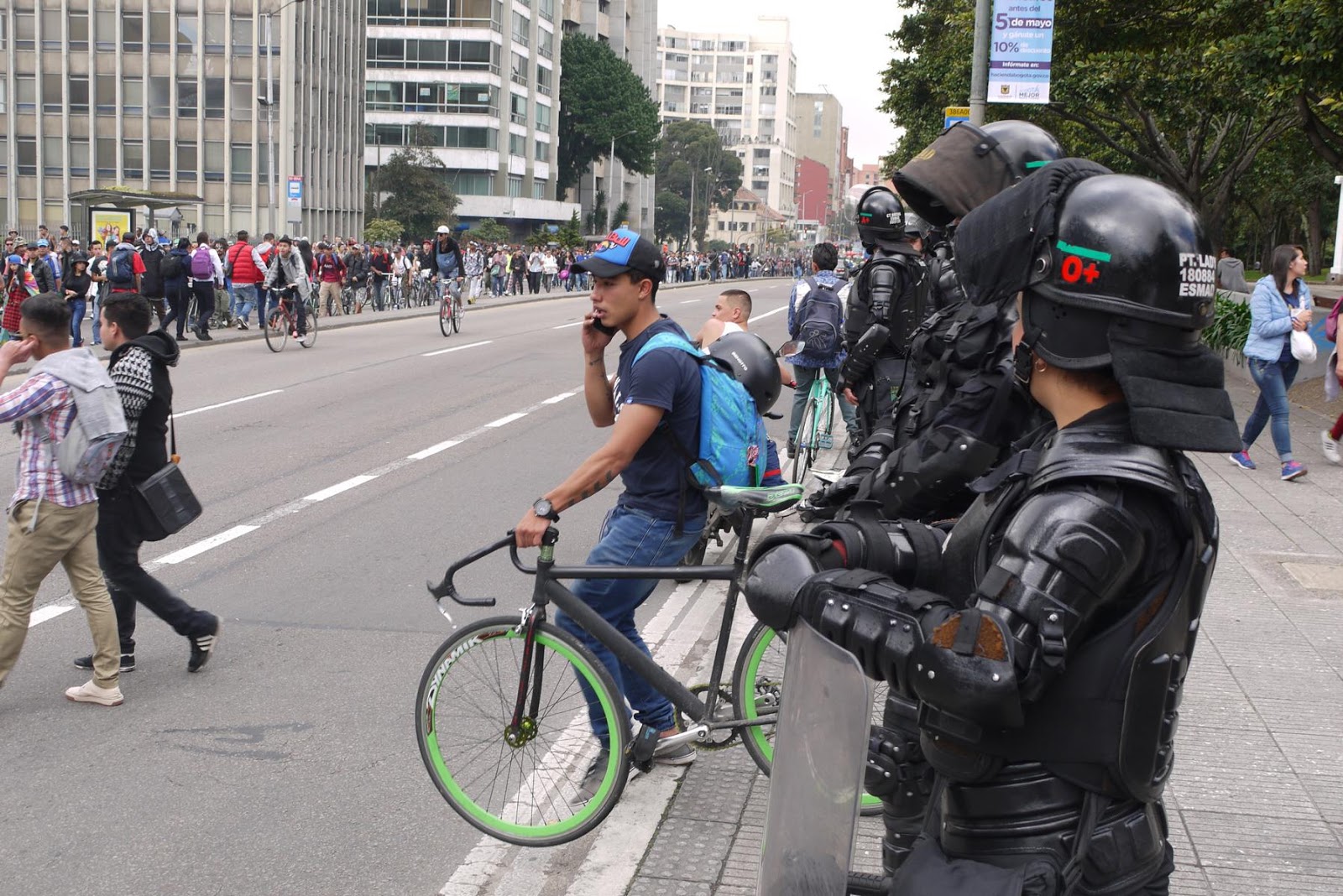
Riot police on Carrera Septima, by the Parque Nacional, with marijuana marchers in the background.
The marijuana march was massive. 
Today's marijuana legalization march brought out thousands of people, mostly young, who marched down Carrera Septima and ended up on the Plaza del Periodista - until the cops swept in and drove them out.

It was a bit of a surreal scene. An anti-riot police tank arrived and proceeded to make a long speech - in English - advertising the speaker system's capacities. Then, they gave the marijuaneros ten minutes to clear out.

'This march has been carried out without incident so far,' said the loudspeaker.

One group held a 'Yes to the personal dosis' banner in front of the tank, to no avail. Afew protesters threw bottles at the tank, and one spray painted something illegible on its side. But soon, the cops started tossing acoustic bombs and the plaza quickly emptied out.

What was the point? Why didn't they just let them stay and smoke?


The marijuana march ended in La Plaza del Periodista, in La Candelaria, which was packed.


About 6:30 p.m. the police arrived, on foot, motorcycles and in tanks.

A pot protester writes graffiti on a anti-riot tank.

A 'Yes to the Personal Dose' banner confronts a tank.

A photo opportunity for foreigners.

The plaza cleared out quickly. I didn't smell tear gas, but the cops apparently threw sonic bombs.


A line of riot police on Plaza del Periodista.

The empty plaza, crowded just a few minutes before.

Yet more cops come motoring in.

By Mike Ceaser, of Bogotá Bike Tours

Saturday, October 10, 2015

Scenes From The Cannabis Festival


Today's medicinal (and recreational) marijuana fest on The Parkway in Teusaquillo neighborhood.

A marijuana muffin.
Colombia's pot laws seem to be in flux. Until the Uribe presidency, possession of the 'minimal dose' of pot and other drugs, including hard ones, was legal, altho sales were prohibited. Under Uribe, that right was ended. However, over the past few years, courts seem to have reaffirmed that 'right of self expression,' at least for addicts. And I've read of court rulings permitting people to have one, or in another case, eight, pot plants at home.

But on the street the law is a different matter. Recently, a friend of a friend was stopped on a street in La Candelaria by some cops, who found a bit of marijuana in one of his pockets. They threatened to arrest him, which would mean 24 hours in a drunk tank, with criminals and addicts, who would steal from him. He implored the police, pointing out that he needed to work the next day.

"Well, then help us out," the police told him.

He gave them the 30,000 pesos he had on him, and they let him go. He felt lucky that he hadn't been carrying more money, or they would have taken all of it.

Drug prohibition is a huge income source for corrupt police.


Expo-Cannabis!
A smell of marijuana salve.
Something to cure all your ills.

Marijuana skateboards.
The Association for the Development of the Colombian Cannabis Industry, with the unfortunate acronym 'ADICC.'

Paraphenalia for only legal uses.
Read about weed.

Radio Marimba.
Read the book on pot.
By Mike Ceaser, of Bogotá Bike Tours

Monday, January 5, 2015

Galán Jr. Vs. Galán Sr.

Senator Juan Manuel Galán stands in front of a photograph of is father, Luis Carlos Galán, who was assassinated in 1989 by narcotraffickers.
When presidential candidate Luis Carlos Galán was assassinated in 1989 by a conspiracy led by drug cartel Pablo Escobar, Galán became a symbol of the fight against drug traffickers.

But today his son, Senator Juan Manuel Galán, is betraying his father's memory, some say. After
'...it was prohibitionism which assassinated my father...'
Sen. Juan Manuel Galán, in El Tiempo.
all, the elder Galán was murdered by drug traffickers. In contrast, the younger Galán is sponsoring a bill in Congress to regulate medical marijuana, and he advocates the legalization and regulation of all drugs, including cocaine.

But, in an interview in today's El Tiempo, Juan Manuel argues that, in a sense, it wasn't only the narcotraffickers who shot down his father in Soacha in 1989.

"With the passing of years, I've reached the conclusion that it was (drug) prohibition which assassinated my father," Galán said. "It was prohibitionism which fed the narcotrafficking mafias, making them feel strong enough to intimidate and corrupt the state and assassinate anybody who got in their way."

Agree with him or not, the younger Galán's viewpoint - and the very fact that it fits into the mainstream political conversation - shows how the drug control landscape has been transformed from the days when the War on Drugs and 'Just say NO' were the only policy options permitted.

Juan Manuel Galán predicts that eventually all drugs, including cocaine, will be legal and regulated. He may be proved right. But that day's still a long way away, and before it comes many more Colombians will be the victims of drug-related killings.

By Mike Ceaser, of Bogotá Bike Tours