Showing posts with label displacement. Show all posts

Thursday, November 24, 2011

The Displaced Demand their Rights

Displaced people march on Plaza Bolivar.
Carlos, displaced from Cauca province. 
A group of several dozen displaced people have been demonstrating on Plaza Bolivar every morning, demanding that the government give them land and other benefits they say they were promised.

Displacement of peasants by Colombia's armed groups is one of the country's largest and least-visible tragedies. Carlos, who was carrying a poster this afternoon, said that his group came from the department of Cauca, near the Venezuelan border. There, he said, his family had raised pigs and chickens and grown bananas and yucca until they were driven from their land by the Aguilas Negras, or Black Eagles, armed groups which many say have taken the place of Colombia's vicious right-wing paramilitary forces. Like the paramilitaries, the Aguilas traffic drugs, but they appear to lack the paramilitaries neo-fascist politics or their hostility to the leftist guerrillas.

Carlos said people in his group had been driven off of their land by leftist guerrillas, right-wing paramilitaries and even government forces. Often, these armed forces accuse peasants of being allies of their enemies.

Some estimate that there are four million displaced people in Colombia - nearly ten percent of the population. But numbers are inexact, because many of the people slowly integrate themselves back into society.


The displaced demand our rights. 


By Mike Ceaser, of Bogotá Bike Tours

Thursday, March 24, 2011

Emberas in Bogotá: End of the Road?


Recently, it seems to me that more and more indigenous Embera people have been appearing on Bogotá sidewalks, where they generally sell small handicraft works.

A traditional Embera community. 
The Emberas, small farmers who live in western Colombia as well as parts of Ecuador, Costa Rica and Panama, have been in the news recently for the wrong reasons: They've been driven off their lands by drug bands, guerrillas and paramilitary groups.

I spoke to two young Embera women who, with their infants, were selling woven wristbands and other handicrafts on the Seventh St. sidewalk. To me, their situation seemed tragic, but they said they were happy in Bogotá - altho their limited Spanish made me wonder how well we were communicating.

Here's an El Tiempo article about Spanish classes for Emberas in Bogotá. I was surprised to see they're not encouraging them to return to their communities.

But how happy can the Emberas be having traded their lives in the jungle for crowded and bare rented rooms in Bogotá's violent, drug-saturated San Bernardino neighborhood? Am I romanticizing the Emberas' traditional lifestyle by saying that quiet, fresh air and clean water are better for them than Bogotá's chaos, noise and pollution? Is it presumptious and selfish of me to say that they're better off lacking TV and Internet, where their children are unlikely to find much education?

Certainly, indigenous people have the same rights as anybody else to pursue the advantages of civilization. But this isn't the way to do this. The young Embera women, who looked like teenagers but said they were 18 and 25, are losing their culture and family structures. Both said that the fathers of their infant daughters' had left them for other women. One told me that her father had been murdered by guerrillas. The babies were munching on packaged junk food, perhaps given to them by well-meaning passerby. But processed foods are bad for all of us. And these children, used to fresh fruits, vegetables and meats and lots of exercise, are going to be sickened by these foods and likely to become obese and diabetic. I see lots of young indigenous people in Bogotá, often studying in universities. But the great chasm between a simple farming/hunter-gatherer existence and city life is too great, and I'm afraid that these people are doomed to ill health and to fall prey to exploitation by criminals.

From the jungle to a Bogotá sidewalk
In Bolivia I visited a slum occupied by indigenous people who until a few decades before had been hunter-gatherers living in isolated bands. Then came a war, railroads, alchohol and missionaries who took away their traditional owl worship and taught them to pray to Jesus. The people I met were formally Christians, but they lived in miserable shantytowns of tin and cardboard and survived off of prostitution and theft.

By Mike Ceaser, of Bogotá Bike Tours

Friday, March 11, 2011

Displaced - Again!


About two years ago, as they tell it, families who had been driven from their farms by illegal armed groups and fled to Bogotá, moved out of a government shelter and into a vacant building in the run-down Santa Fe neighborhood, behind the Central Cemetery and just a few blocks from the red light district.

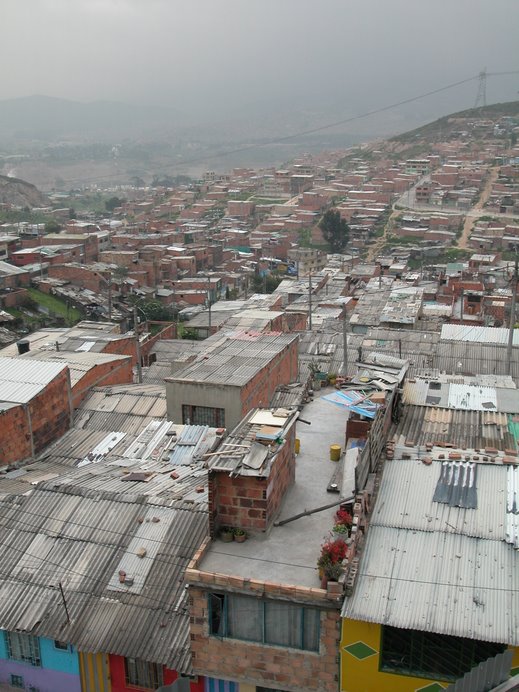
Colombia has millions of displaced people - mostly peasants who have been driven from their homes by armed groups - and become refugees in their own nation.

Around mid-day, cops wait on either side of
the New Social Era building.
About 80 people, including many children, lived in the building, which says 'New Social Era' on its front, belonged to the government's Bienestar Familiar (Family Wellbeing) agency, and worked in informal, low-wage jobs, such as construction and as street vendors.

Almost all of the displaced families had been farmers, and most blamed the right-wing paramilitary groups for driving them from their homes. Many charged that the paramilitaries had attacked them in collaboration with the regular military, in order to hand over their land to powerful corporations. Now, they suspected, the government was evicting them again to clear the way for urban renewal projects. 


Where to next? Police moved out the furniture
and piled it on the sidewalk
There is in fact a great deal of evidence that the outlawed right-wing paramilitaries have collaborated with the regular military - at least in the past. In recent years, many of the paramilitaries have signed peace deals with the government and disbanded, altho new criminal groups have sprung up in their places. Colombia's military says it's cut ties to the paramilitaries, and in fact many paramilitary leaders are in prison

Yesterday  morning, riot police and social welfare workers arrived on the street. Witnesses said they used tear gas and physical force to remove the building's occupants. 

The displaced people said that the government had offered them a few day's lodging in a shelter, but that they didn't know where they'd go afterwards - perhaps another vacant building.

The Colombian government is developing a Law of Victims and a Land Law, intended to compensate victims of the country's conflict. 

This woman said the police had injured her while dislodging the occupants from the building. 

This man, who identified himself as a human rights worker, asked whether children were more important than a building.


A woman who also identified herself as a human rights worker criticized the United States for funding the Colombian government, which she blamed for the displaced people's plight. Like others, she pointed out that members of illegal guerrilla and paramilitary organizations who demobilize often receive more government benefits than do those victimized by such groups.

One regular city cop I spoke to sympathized with the displaced people's situation. He said he hoped that the city wasn't emptying the building, 'in order to just leave it sitting there.' The squatters' situation has been a long-running drama. The police told me that they'd first tried to negotiate with the people. 

By nightfall, the people were gone.

Two days later, the building sat quiet and empty. 

When were the windows broken?

By Mike Ceaser, of Bogotá Bike Tours

Monday, February 28, 2011

The New Bands - Same old Thing?

Members of the 'new bands,' many of whom are ex-paras. (Photo: El Tiempo)

El Tiempo published this big report Sunday about the emergence of 'nuevas bandas' - criminal bands composed of ex-members of supposedly demobilized paramilitary organizations.

According to the newspaper, these new criminal organizations have displaced more peasants than the FARC and ELN guerrillas, as well as carried out more violent attacks than both guerrilla groups combined.

For some reason, I don't feel surprised. According to lots of reports, the paramilitary demobilization was a sham, and the groups continued operating in many remote regions. How could it be different? The paramilitary leaders generally entered into negotiations with the government only because they expected to receive a short, comfortable 'detention' and then retire comfortably on their ill-gotten millions. (In fact, many of them are instead in U.S. prisons, but their organizations continue.)

A narco-submarine (Photo: El Tiempo)
Meanwhile, back in the regions where the paramilitaries operated, the same forces which gave rise to them haven't changed: ranchers, businesses and others still fear the guerrillas and seek armed protection. At the same time, lots of illegal drug money flowing thru the region finances violent outlaw groups.

The new bands, however, seem to lack the paramilitaries' pseudo-fascist political ideology.

By Mike Ceaser, of Bogotá Bike Tours

Tuesday, November 9, 2010

Displacement - the Unseen Tragedy

Colombia is not the world leader in many things. But the country may now be the world's no. 1 in something very  tragic - human displacement.

The phenomenon of desplazados has been a chronic problem in Colombia, as outlaw guerrillas and paramilitaries - and sometimes even the military itself - have forced peasants and townspeople to abandon their homes and farms. Often, the victims' only alternative is death.

After five years living in Colombia, much of that time working as a journalist, I've heard dozens of horrific stories of displaced people. In many cases, their family members were murdered by outlaw groups, their children or husband forced to become guerrilla or paramilitary fighters, and their land and livestock stolen by the outlaw groups.

Traditionally, Colombia has been considered to have the world's second- or third-largest number of displaced people, behind countries such as the Sudan, the Congo and Iraq. But a report the other day by a United Nations official in Ecuador says that Colombia with some 3.7 million displaced people (in addition to 350,000 refugees, most of them in Ecuador) has the world's largest refugee population.

The Colombian government denies this.

It's not easy to measure, since Colombia's is a long-running, relatively low-level conflict, and the displaced people slowly reintegrate themselves into society, making them a fluid, rolling population. But whether Colombia is number one or not is really just a technicality. The fact that Colombia has millions of displaced people is a tragedy from every perspective. And for the displaced themselves, the numbers and Colombia's ranking don't really matter.

What really matters is for these outlaw groups to stop terrorizing Colombia's humblest people, and for the government to quit debating numbers and do more to try to address this tragedy.

By Mike Ceaser, of Bogotá Bike Tours

Wednesday, May 26, 2010

Colombia's economy has grown. Its democracy is functioning, despite corruption and numerous human rights violations. The courts have shown their independence. The cities are becoming more modern and attractive, with hotels popping up like mushrooms.

But, out in the countryside and in the cities' huge slums, the human rights situation continues agonizing.

According to the recent Amnesty International report, almost 300,000 people were forced from their homes last year, the guerrillas continue kidnapping, recruiting children and planting landmines and paramilitaries have murdered human rights activists.

Let it not be forgotten.

Written by Mike Ceaser