Showing posts with label infrastructure. Show all posts

Tuesday, August 29, 2017

Odebrecht Bulldozes the Environment

Odebrecht didn't stop at paying off politicians.
The 1071-km Ruta del Sol is to run from near Bogotá
to the coast near Santa Marta.
Odebrecht, the Brazilian construction giant whose name has become synonymous with corruption thanks to close to a billion dollars in bribes to governments across Latin America and Africa, did not stop at obtaining contracts on corrupt basis.

The company and its business partners also violated and ignored environmental laws on at least one of its headline projects in Colombia, according to a new report by Colombia's Controlaria.

The Controlaría found 442 violations of the environmental licenses of the $4 trillion peso-plus project, of which Odebrecht is part of the consortium. These involved waste water disposal, lack of reforestation, noise, mishandling of wildlife, and others.

The consortium "is not only not complying with the terms of the environmental licenses, but is not making any effort to comply," the Controlaria wrote.

Odebrecht bribed officials throughout
Latin America.
(Image: Notimerica)
But that's only the beginning of the scandal: It turns out that the National Environmental License Authority, the ANLA, did not fine the consortium a single time for those violations.

And even worse, other megaprojects, such as the dredging of the Magdalena River and the repair of the
Canal del Dique, are being carried out without even bothering with environmental permits, and in the case of the river, the ANLA has not bothered to oversee the project for nine years, the Controlaria found.

Is this a matter or corruption or just sheer apathy and laziness by supposed government watchdogs? Probably both.

For one of the planet's most biodiverse nations, and which claims to treasure its natural wealth, this situation goes way beyond scandalous. And it's in addition to the inherent damage done by these proyects, such as drying out wetlands, dumping silt into rivers and oceans, and facilitating deforestation by slash and burn farmers.

By Mike Ceaser, of Bogotá Bike Tours

Sunday, October 25, 2015

The Infrastructure Election

Enrique Peñalosa, mayor-elect of Bogotá.
Enrique Peñalosa got the most votes in Bogotá's mayoral election, but the big winners may be construction companies.

A look over campaign contributions as summarized by El Espectador, using information from the Cuentas Claras website (I couldn't get the site to work myself) shows that construction companies financed much of the campaigning, particularly Peñalosa's.

Ex-Mayor Enrique Peñalosa, who led in nearly all the pre-election polls, had the biggest campaign chest. $1.6 billion pesos. El Espectador's article lists at least six builders who contributed to him, and also notes that Peñalosa's 'legal representative' is a director of two construction companies.

At least one of Peñalosa's contributors suffered a recent controversy. Ladrillera Santafe, which mines and sells building materials, was criticized this year by rural residents of Cundinamarca for plans to open three big clay mines, for brickmaking. The critics charged that the mines would destroy the region's ecotourism potential.
There's lots of money in that construction,
whether necessary or not.

It's not hard to see why builders might want Bogotá's new mayor to owe them a favor, since the city
will likely spend a fortune on construction in the next years, on a metro line (sure to cost at least U.S. $10 billion), new roads and bridges, replacing the El Campin football stadium, remaking the Rio Bogotá and many other projects.

But whether such infrastructure is really necessary is another question. Yes, Bogotá has huge traffic jams. But it's well documented that expanding roadways only generates more traffic. The congestion could be reduced much faster and less expensively by discouraging driving, by taxing gasoline more and with a London-style congestion fee. Yes, a metro line would be nice, but the city can't figure out how to cover its projected budget, which is likely to double projectsion. (Peñalosa favors a less expensive, faster-to-build elevated metro line.)

But whether or not the city needs such projects, with construction companies whispering in the mayor's ear, they're much likelier to be built.

People and companies may contribute to candidates for many reasons, including friendship, ideological affnity and respect, but undoubtedly the biggest reason is personal interest: The contributor believes that the candidate, if elected, will promote the contributor's interests, whether by pouring money into their sector of the economy or favoring their specific company. And I suspect that many believe that, if they help get their man or woman into office, he or she will return the favor by funneling city money their way.

That might be good for the company, but not for the city, if the contributing company charges more, is corrupt or less competent than other companies who did not grease the wheels with campaign contributions. Much government spending is not necessary in the first place. For an example, look at the United States' huge and absurd agricultural subsidies, which persist mostly because a few farm states like Iowa have a disproportionate influence in presidential elections.

Whether the builders' investments in Peñalosa's campaign pay off may depend on which Peñalosa governs Bogotá. This Peñalosa campaign video is mostly about building and widening roads all over the city, despite roads' negative impacts on noise, pollution and quality of life - and the fact that they quickly fill up as well.

On the other hand, El Tiempo's summary of Peñalosa's plans emphasizes more sustainable projects such as expanding public transit and bike lanes.

Which Peñalosa will govern Bogotá?

Full disclosure: My business, Bogotá Bike Tours, has benefited indirectly from the construction companies' largesse because we've rented bikes to the Peñalosa campaign.


By Mike Ceaser, of Bogotá Bike Tours

Tuesday, November 12, 2013

Crumbling Bogotá

'Something is Happening Here.' Demonstrators call attention to stalled, rusting work on 26th Street and Ave. Septima. In the wake of recent rulilngs say that the project was acceptable, I had exoected work would restart on the bridge over this avenue.
Despite Bogotá's and Colombia's strong economies, parts of the capital are crumbling and peeling. 

Today I met members of an arts collective holding a ceremony to call people's attention to an unfinished bridge over Calle 26th, which they call a white elephant. (Neighbors objected to the plan to roof over 26th and expand the adjoining Parque de la Independencia.) With construction work stopped for more than a year, but project is crumbling even before it's finished. They also plan to demonstrate by a nearby drug-filled alley and at other social blights.

The theatre group calls itself Waja, a Wayuu word meaning 'our community.' Gustavo, an organizer, told me that their goal is to have people "ask what's going on." But I didn't see many people stop to ask anything. Find them at Laboratorio Experimental de Performance.

Still unfinished, the work is already rusting and crumbling. 
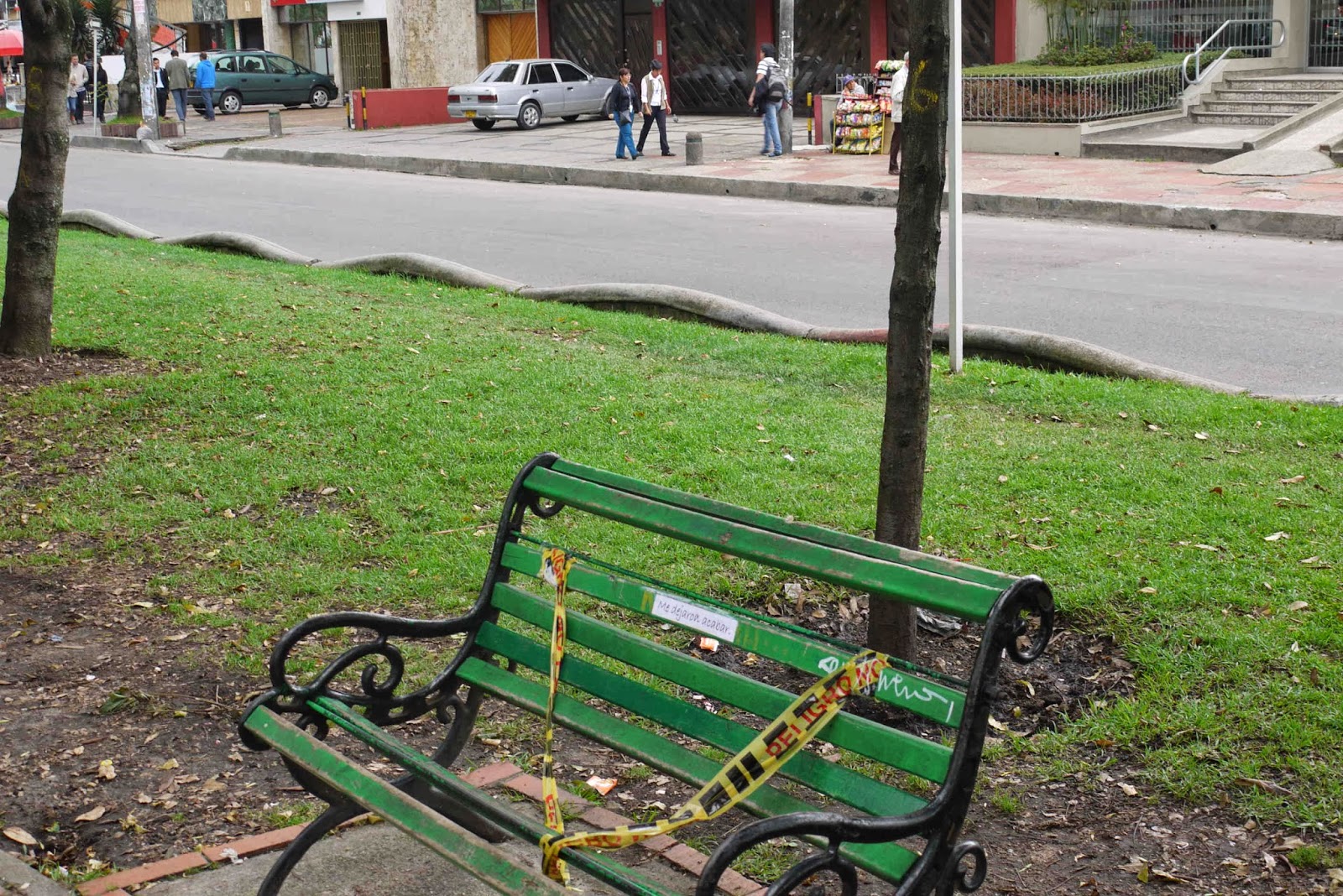
What have you done to help me? asks a bench on the Parkway in Teusaquillo.
Someone labeled these decaying park benchens on The Parkway in Teusaquillo. 

'Ma acabaron.' (They finished me) 
'I'm in a critical state,' announces another bench on The Parkway. 
Students of the public National University have protested several times in recent weeks demanding more money to repair buildings. Someone also placed humorous protest signs around campus.
'Threat of ruins,' declares a sign on the National University's camppus.
Students walk past the nursing building, which looks like it needs a doctor. 
'Tomorrow well-being will mean hardhats for everybody. Don't let the roof fall on you.' Recently, part of the law school's roof collapsed during heavy rains. 

'62 of the University City's 129 building's need work.'
The law school, whose roof repotedly collapsed recently. 

Work going on on the enginering building.
By Mike Ceaser, of Bogotá Bike Tours

Saturday, March 9, 2013

Finally, Sanity Strikes Public Works


Passers-by watch work on the bridge over 26th St. 
After months at a standstill, work resumed today on the bridge over 26th St. connecting Independence Park to the Museum of Modern Art. The work was halted last year after residents of the Torres del Parque, located behind the nearby Plaza de Toros (the bullfighting stadium) sued, citing damage to the park and design mistakes.

This week, a court nixed the Torres residents' lawsuit.

A view of the partly-completed bridge, taken from
a window of the Museum of Modern Art. 
The project is certainly imperfect. But leaving it half-done or even dismantling it were the very worst of the possible options. The finished project will be a nice addition to the city center and restore a bit of the park, which has been sliced up by road construction.

The unfinished bridge is also preventing the extension of the 26th St. TransMilenio express bus line east to the Universidades Station. (For its part, the western end ends about 1.5 kms from the airport, and if and when it will be completed isn't clear.)

Placing a beam. 


By Mike Ceaser, of Bogotá Bike Tours

Sunday, January 22, 2012

One More Year!!!???

A unicyclist pedals behind a bus across the half-demolished Seventh Ave. bridge over 26th St.
Work left to do:
26th St. at 7th Ave. 
In an interview in today's El Tiempo new Mayor Gustavo Petro says that the 26th St. Transmilenio line - which was supposed to be completed in 2010 - will not be operating in March of this year, or even in August, as temporary Mayor Clara Lopez had promised.

A car makes its way down
26th St., amid construction.
Petro said that, because of various delays, particularly the need to demolish and rebuild Seventh Ave.'s bridge over 26th St., the project would not be operating until 2013.

Hopefully, Petro was describing a worst-case scenario in order to see the project finished earlier and appear efficient. He suggested as much, by asserting that the bridge project should take much less than a year.

The trench on Seventh leads to the
planned National Museum TM station. 
Lots of other projects also need finishing: the city still hasn't managed to purchase a plot of land it needs for an on-ramp near the City Council building because the owners are insisting on more money. And the huge roof structure being built over 26th east of Seventh Ave. to connect Independence Park with the Museum of Modern Art has been delayed by neighbors' lawsuits. And then there's the National Museum TransMilenio station, where work is just starting.

Several of the pedestrian
bridges over 26th are completed
 and being used, altho not
officially open yet.
The delays are frustrating not only because finally getting TransMilenio running on these avenues would facilitate the city's transit. More critically, these two TransMilenio corridors are required for Bogotá's more ambitious plan to get traffic moving and reduce pollution: the Integrated System of Public Transit (SITP). Beyond that are the planned subway and possible streetcar line along Seventh Ave.

Of course, all of these ambitous infrastructure plans mean another thing: Expect Bogotá to resemble one big construction site for a long, long, time.


26th from overhead. 

Seventh Ave's bridge is already half-demolished. 


Heavy work on Seventh Ave. 


By Mike Ceaser, of Bogotá Bike Tours

Tuesday, February 15, 2011

A Rail 'Canal' Through Colombia?

Colombian coal train 
Being the only South American nation with coasts on two oceans has long been a source of geological pride for Colombia, but of little practical value. The nation is very mountainous, its transportation infrastructure rudimentary and its long Pacific coastline is remote and roamed by guerrillas, paramilitaries and drug smugglers.

However, the Chinese and Colombian governments are now discussing the possibility of building a several-hundred kilometer railroad line from near Cartagena to a spot on the Pacific coast, most likely Buenaventura.

One has to wonder about the project's economics. After all, the much shorter Panama Canal is nearby, and Panama even has its own shorter rail line across the isthmus.

The rail line would certainly improve Colombia's own transport, particularly for coal. Coal is not environmentally friendly and environmentalists worry that the line will slash through the roadless Darien Gap region. But rail lines are much better than highways, especially in tropical regions, where the roads open jungle areas to slash-and-burn agriculture.

The plan also highlights China's rise in the world. The world's first major modern canal, the Suez, was built in 1869 by French investors and later controlled by the British. The Panama Canal was dug a century ago by the United States (after slicing Panama off of Colombia, whose legislators had opposed the project). Now, the planet's economic center of gravity is shifting into East Asia. 


All of which suggests a troubling scenario: a powerful China dominates the economies and politics of Colombia and other regional countries as the U.S. did in the region for decades. 

One wonders too whether this project, if it happens, will create tension between Colombia and Panama, which is investing billions of dollars in expanding the Panama Canal to accept bigger ships.

By Mike Ceaser, of Bogotá Bike Tours