Showing posts with label false positives. Show all posts

Sunday, September 24, 2017

The Fiscalía's New Museum

Inside Bogotá's newest museum - the Fiscalia's.
Add to Bogotá's memorable museums its newest one: The Fiscalía's.
Carlos Lehder.

Yep, seriously. The Fiscalia, or Attorney General, the agency charged with accusing and prosecuting criminals, has played a key role in the biggest dramas in Colombia's recent decades, many of which are on display in the new museum. Most impressively, the museum also includes the government's own sins.

The museum is also unintentionally a testament to the violence, corruption and general mayhem which drug prohibitionism has inflicted on Colombia. Not surprisingly, one subject the museum does not touch is decriminalization - despite its demonstrated success - because it would take away the Fiscalia's business.

Everybody's heard of Pablo Escobar, but many fewer know the name Carlos Lehder - even tho he was crazier and perhaps even richer than Escobar. Lehder admired both John Lennon and Adolf Hitler. He tried starting his own populist political party. And he even bought a Caribbean island, kicked off the inhabitants and used it to party and stockpile cocaine. But he was so unstable that Escobar supposedly betrayed him to the DEA. Lehder is still rotting away in a U.S. federal prison.

Model of an early drug-smuggling sub.
Supposedly, Escobar bought a used Soviet submarine to smuggle cocaine north, but never actually used it. Today, drug cartels build home-made diesel submarines and even aquatic drones, load them with cocaine and send the drug north.
Martyred Justice Minister
Rodrigo Lara Bonillo.

Another less-remembered character of the era was the crusading Minister of Justice Rodrigo Lara Bonillo, who prosecuted members of the Medellin cartel and was gunned down for it in Bogotá in 1984. His killing triggered the war between the government and Esocbar.

In the end, the leaders of the less-famous Cali cartel were captured and extradited to U.S. prisons, where some still remain. In contrast, many Medellin cartel leaders gave themselves up and received short sentences in Colombia - despite being much more murderous.

A jet ski which supposedly
belonged to Pablo Escobar.
Both the Medellin and Cali cartels were destroyed during the 1990s, and the paramilitaries and most guerrillas have also since disbanded. Yet, today Colombia probably exports record amounts of cocaine.

Bloque de Busqueda members looking at Esocbar's corpse
on a Medellin rooftop in 1993.
However, foreigners, particularly those recently arrived in Colombia, may not recognize other episodes - such as the Proceso 8000.

In the Proceso 8000, Liberal Party Pres. Ernesto Samper's (1994-98) presidential campaign was discovered to have received money from the Cali cocaine cartel.

The investigation brought the conviction of other government officials, but Samper himself was found 'neither guilty nor innocent' by a Congress - altho today few doubt he knew about the dirty money. It led to Washington canceling Samper's U.S. Visa - a huge embarrasment for a close ally - and the U.S. The episode was named after a folder containing key documents - altho I did not see that folder in the museum.

Cali cartel leaders on their
way to prison in the U.S.
One might trace Colombia's rejection of its traditional political parties and the eventual election of Pres. Uribe partially to the Proceso 8000 scandal. After Samper, came Pastrana's failed negotiation with the FARC, and then Uribe's U.S.-backed military offensive against the FARC, which many believe forced them to the bargaining table - albeit at a huge cost in human rights. The hard-right Uribe did not come from either of the two traditional political parties.

Display about the FARC guerrillas.
After the end of the Cali and Medellin cartels, the violence and narcotrafficking didn't let up. Colombia still had to deal with the socialist FARC and ELN guerrillas, which were born in the 1960s, and their right-wing paramilitary enemies.

A captured FARC document listing weapons,
including gun cartridges and explosives.
The government didn't defeat any of these groups. The paramilitaries demobilized during the mid-2000s, receiving up to 8-year terms, despite horrific crimes. The government also negotiated a controversial demobilization deal with the FARC and is now talking to the ELN.

FARC propaganda.
A laptop belonging to FARC leader 'Mono Jojoy' recovered
after he was killed in a government bombardment in 2010.


Probably the darkest chapter in recent Colombia history was paramilitarism - the right-wing death squads organized by landowners with government and military collaboration, which carried out many massacres, often of campesinos, including women and children, based only on suspicion of sympathy for the guerrillas.

The jeep driven by police investigating crimes in
1989 in Santander Department. 
One of the more notorious of the massacres carried out by paramilitaries with collaboration from the regular military was that of La Riochela, in 1989 in Santander Department. Fifteen judicial investigators had traveled to a remote area to investigate killings. Paramilitary fighters stopped them and cold bloodedly murdered twelve of them under orders from a Medellin cartel leader and with support from the regular military. After the killings, the 'paras' hid their weapons in a military base.


Victims of the La Rochela massacre.

Yet another dark chapter involving the regular military were the 'false positives' killings during the
Uribe government. At that time, the military gave military units rewards of bonuses and time off for killing guerrillas. Some units responded by kidnapping poor young men, killing them and disguising them as guerrillas in order to collect the rewards. The killings received national attention when a group of young men were kidnapped from Soacha, in south Bogotá, and later found dead near the Venezuelan border, labeled as guerrillas.

An exhumation kit for buried corpses.

Running thru the museum's displays, of course, is the subject of drug trafficking, which has helped finance nearly all of Colombia's violent groups (and some non-violent ones).

A cocaine.making lab. Lots of chemicals involved. Cocaine is niether green nor organic.
And cocaine can and has been smuggled inside nearly everything.
Coffee beans with cocaine inside.

'Candies' used for smuggling cocaine.

Colombian clock used for smuggling cocaine.

Pool balls, used for smuggling cocaine.

A car tire used for smuggling cocaine.
Unsurprisingly, the museum does not touch the subject of decriminilizing drugs, a policy which has produced lots of benefits when tried in Portugal. That doesn't surprise, because such a policy would reduce the Fiscalia's business.

The Museo de la Fiscalia is located in this building on Carrera 13 just south of Calle 19, in central Bogotá.
You can leave your bike in the parking lot across the street. Admission is free. 

By Mike Ceaser, of Bogotá Bike Tours

Sunday, May 4, 2014

Demanding Justice for a Murdered Son


In late September 2006, Raul Antonio Carvajal, a 29-year-old army corporal, called his father and told him that his superior officers had ordered him to kill innocent people and turn their bodies over as supposed guerrillas. Carvajal disobeyed the command, his father, also named Raul Carvajal, said, and 18 days later, on October 8, he was murdered himself, his father said.
Raul Carvajal, right, tells a passer-by
the story of his murdered son.

The elder Carvajal has been protesting the last several days with his truck covered with billboards denouncing the Alvaro Uribe administration parked in front of the San Francisco Church at the intersection of Carrera Septima and Ave. Jimenez.

Carvajal says that the courts and government have ignored his demands for justice. He believes that is because of the continuing influence of ex-Pres. Alvaro Uribe, who was recently elected to the Senate, and of current Pres. Santos, who was Uribe's minister of defense. In what became known as the False Positives scandal, thousands of young men, mostly peasants, were murdered by military units and labeled as guerrillas in order to earn bonuses and time off. In the investigations and prosecutions which followed, neither Santos nor Uribe was directly implicated in the crimes. According to United States diplomatic cables released by Wikileaks, Santos wanted the killings investigated at the time.

Carvajal believes that his son was murdered by other members of the military for either refusing to participate in the killings or trying to report them.

"I want the world to know about these killings," Carvajal says. "I want justice done."


By Mike Ceaser, of Bogotá Bike Tours

Wednesday, July 3, 2013

Murderers: Select Your Victims Carefully!

When two taxis drivers and their accomplices assaulted a foreigner who'd just left a north Bogotá bar recently, they committed the worst mistake of their lives. The victim of their would-be paseo millonario turned out to be a United States DEA agent, who fought back and fled the taxi, only to die soon after from stab wounds.

The Colombian police, supported and pressured by the U.S., made quick work of this robbery-turned-tragedy. The upscale crime scene was full of video cameras, which, combined with sources amongst the taxi drivers, enabled the police to identify the alleged muggers. Today, some six people are in custody and there's talk of them being extradited to the U.S. for trial and imprisonment (which makes not sense to me). City officials are looking at ways to reform the taxi industry to keep out criminals.

The episode is a success for the law and hopefully sends a message to perpetrators of the notorious paseo millonario, or secuestro express, in which taxistas and their accomplices rob passengers and drive them around, forcing them to withdraw money from their bank accounts.

A graffiti on a pole in central Bogotá pays tribute to
the mothers of the false positives victims from Soacha .
But contrast the quick handling of the DEA agent's case with that of five young men from Soacha, a poor area in south Bogotá, who five years ago were kidnapped, murdered, disguised as guerrillas and deposited in mass graves near the Venezuelan border. They were the most notorious victims in the 'false positives' scandal, in which military units kidnapped and murdered thousands of young men and dressed them as guerrillas in order to obtain bonuses or vacation time.

More than 21 military personnel have been charged for either participating in the killings of the five Soacha victims or the ensuing cover-up.

But today, the mothers of the five young men complain that the case has stalled as the courts accept one delaying manuever after another from the mlitary lawyers.

"It's not fair that, after five years of the case, every time we go to court, the military officials say 'There's no hearing. Stop the hearing,' one of the mothers told El Espectador.

The women also complain that their own lawyers no longer return their telephone calls - perhaps because the women are poor, or because the lawyers have been intimidated or threatened. Recently, a judge denied the women's request to carry out a key round of tests on the evidence. The horrific false positives episode, which took place during the aggressive anti-guerrilla war carried out by the Uribe administration, received a great deal of attention in the Colombian and international press. Human rights organizations denounced the killings.

It's great to see Colombian police respond aggressively and effectively in the DEA agent's case. He was newly married, and the capture of the apparent killers provides some solace to his wife and family. But if only the legal system gave equal importance to all victims, particularly when they are the humblest Colombians.

Tuesday, December 4, 2012

The False Positives Victims, Still Seeking Answers


Relatives of young men, including some from the poor south Bogotá neighborhood of Soacha, who were kidnapped and murdered in the military's 'False Positives' scandal, demonstrated today on Plaza Bolivar.

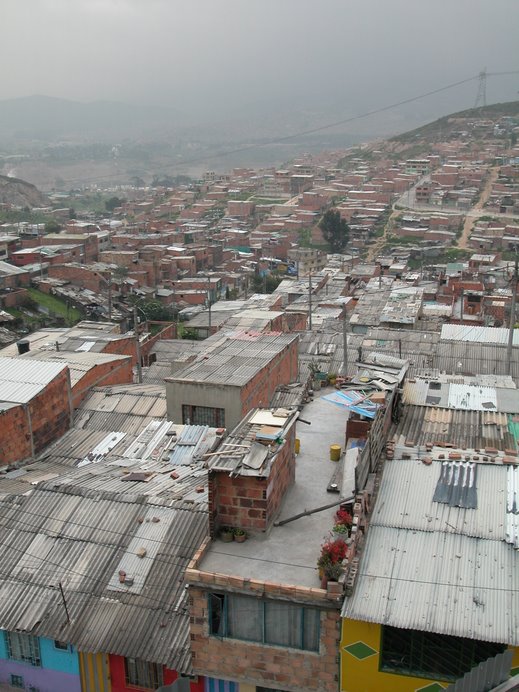
The victims were promised good jobs in the countryside, but were instead murdered and disguised as guerrilla fighters so that military units could earn rewards of head money and days off. Several thousand yong men were murdered as 'false positives.' Years after the scandal became public, only a few soldiers and offices are in prison and many families are still looking for answers.


By Mike Ceaser, of Bogotá Bike Tours

Saturday, April 7, 2012

Painting the Poles on la Septima


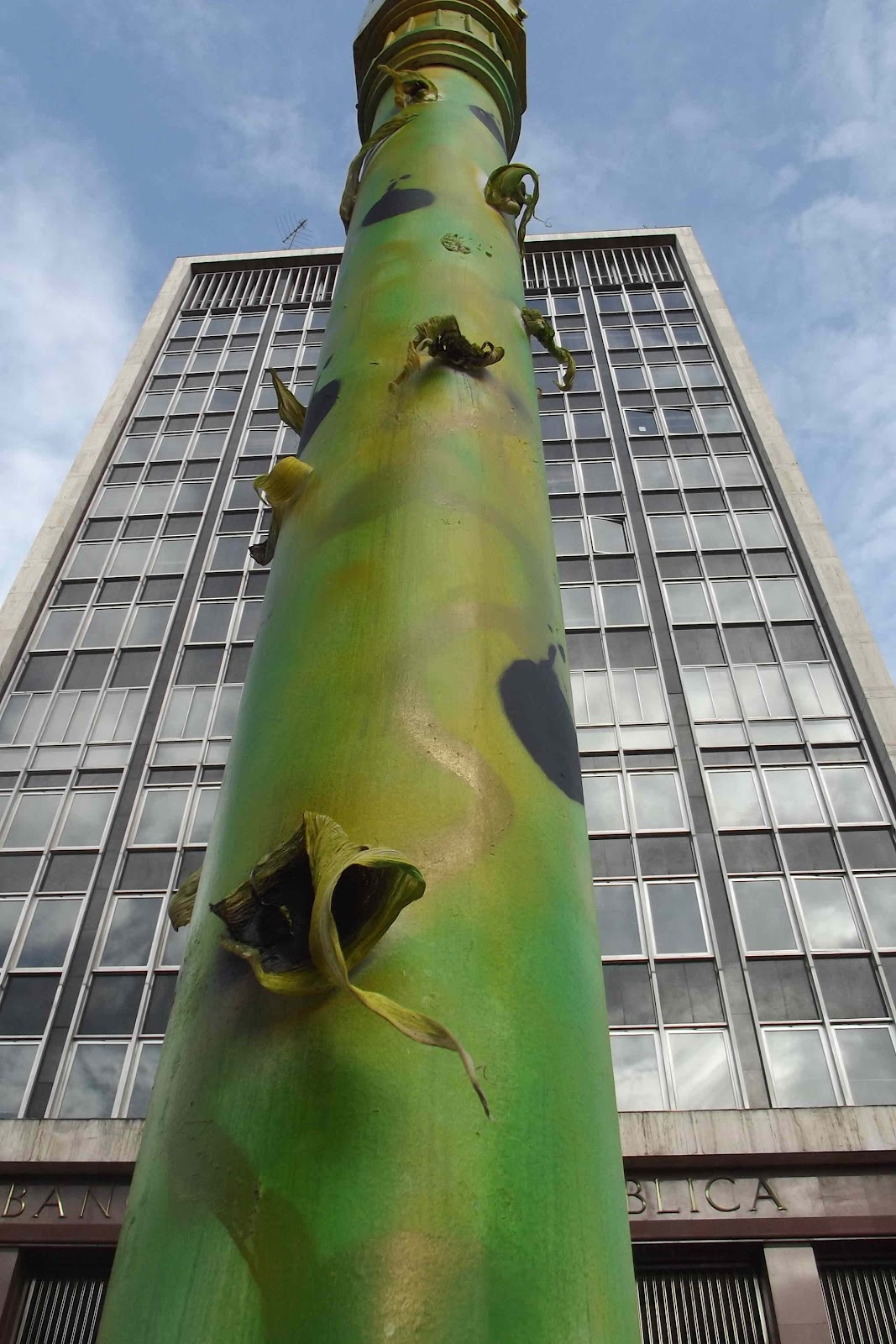
The light poles along Ave. Septima in downtown Bogotá between Plaza Bolivar and Parque de la Independencia suddenly look much more colorful.

Grafiteros participating in a contest sponsored by the city and Rayuela Foundation, a human rights NGO, painted them. Many of the artworks are about killings of civilians, and in particular the False Positives scandal, in which some military units kidnapped and killed young men and disguised them as guerrilla fighters in order to receive time off or cash bonuses.

The paintings are to commorate the 'Day of the Victims,' set on April 9 to coincide with the 1948 assassination of populist politician Jorge Eliecer Gaitan.

I took lots of pictures today, because within a few days this new street art will likely be covered by advertising posters.


A human target. 
A man contemplates the memorial to populist politician Jorge Eliecer Gaitan, assassinated in 1948 at the corner of Seventh Ave. and Jimenez. 
'This space designated for the institutionalization of memory and the popular struggle.'
An acrobatic painter. 


Peace signs on La Septima. 

Your son (is a target).
The Bogotazo riots followed Gaitan's assassination.

Boom or bomb?
'Crimes of the state.'


'How many more?'


'Mother from Soacha.' Soacha is a poor district in south Bogotá. Several young men disappeared from there and  were discovered in mass graves near the Venezuelan border, labeled as guerrilla fighters. They were victims of the False Positives'scandal. 

Creating a moveable memorial for Gaitan. 


'Peace.' Behind it a family of supposed displaced people sit begging. I've seen them around for months, and they seem to have become 'professional displaced' people. Their children have a sad future. 


By Mike Ceaser, of Bogotá Bike Tours