Showing posts with label drummond. Show all posts

Wednesday, July 9, 2014

Dirty Business: Corporations and Violence in Colombia

Rail cars carrying Colombian coal toward the sea.
(Photo: Colabradio)
Drummond coal company's Colombian operations are in hot water, once again. A recent report by the European NGO Pax Christi claims that Drummond and a second coal exporter, Prodeco, paid money to right-wing paramilitary groups which murdered thousands of people and drove tens of thousands off of their land.

Both Drummond, which is based in Alabama, U.S.A., and the Swiss-owned Prodeco, deny paying money to or collaborating with the paramilitaries. Drummond points out that several paramilitary leaders who accuse the company have changed their stories and even received payments from an attorney suing the companies.

Nevertheless, charges that they used violence to repress workers have dogged many corporations
A protester accuses Drummond Coal Co.
of working with paramilitary death squads.
The company denies any links
to the paramilitaries.
(Photo: Southern Studies
foreign operating in Colombia.

Undoubtedly, the most infamous case involved the United Fruit Company (predecessor of Chiquita Corp.), which in 1928 faced strikes by banana plantation workers protesting exploitative work conditions. The workers went on strike, and in December 1928 soldiers massacred an unknown number of strike leaders gathered in the town plaza of Ciénaga. That massacre became a key episode in Gabriel Garcia Marquez's novel 'One Hundred Years of Solitude' and launched populist leader Jorge Eliecer Gaitan to fame.

Some historians believe that the Colombian military acted murderously because it believed that if it did not United States Marines stationed off of the coast would invade Colombia in defense of the banana company.

An oil pipeline bombed by the ELN guerrillas.
Photo: (El Colombiano)
In 2007, Chiquita Corp. confessed to the U.S. government that it had made multi-million dollar payments first to leftist guerrillas and later to paramilitaries which controlled the region around its Colombian plantations. Chiquita paid a $25 million fine to the U.S. government, but nothing to the victims in Colombia.

Chiquita claims it had no choice but to pay off the armed groups in order to protect its employees from kidnapping or murder. But Chiquita, like the other companies, did have an alternative - to pull out of Colombia rather than finance violent organizations which were terrorizing and murdering civilians.


A present-day Colombian banana plantation worker.
(Photo: Al Jazeera)
During the late 1990s, U.S.-based Occidental Petroleum found itself in a similar situation around its Caño Limon oil pipeline in Arauca Department, where guerrillas had bombed the pipeline and threatened employees. Occidental responded by hiring AirScan, a private security company, which used its own surveillance aircraft to supply the Colombian military with locations of guerrilla fighters. In 1998, using AirScan-supplied coordinates, the Colombian military dropped a cluster bomb on the small town of Santo Domingo, killing 17 civilians, including 7 children. Survivors of the attack sued Occidental, but have lost. In December 2012, the Inter-American Human Rights Court condemned the Colombian government for the bombing, which the government had alleged was caused by a guerrilla truck bomb.

The Santo Domingo episode also implicated the United States government, which had provided more than $100 million in military protection to Occidental.

The leaders of the banana workers' strike.
(Photo: Wikipedia)
It strains credulity to believe that any company doing business in a region terrorized by leftist guerrillas - who attack foreign corporations for both nationalistic motives and financial ones - would not collude in some way with the right-wing paramilitaries which protect businesses by fighting those guerrillas.

Recent violence committed in Santander Department by ELN guerrillas exemplifies that situation. The guerrilla group, which is 'celebrating' its 50th birthday, has bombed a pipeline and an oil workers' encampment and sowed the region with land mines.

"The military in Colombia was very ineffective at guerrilla warfare," Terry Collingsworth, the U.S. attorney who is suing Drummond as well as other large corporations, said recently in an interview with Alternativa Latina Radio. "The (paramilitaries) were very adept at guerrilla warfare....They were largely successful; they drove the FARC way into the mountains and protected areas where there were coal mines and bananas."

"We believe...that virtually every major company that was operating in these guerrilla areas of Colombia actually was a partner with this terrorist organization," added Collingsworth.

But almost all large companies have denied collaborating with illegal groups, and lawsuits against them have consistently failed.

Cases such as those against Occidental, Chiquita and Drummond suffered a blow recently when a U.S. Supreme Court ruling narrowed the jurisdiction of the Alien Tort Statute, which has been used to sue U.S. companies for alleged crimes committed outside the U.S.

The results of court cases aside, Pax Christi is not the first European NGO to criticize foreign coal operations in Colombia. A 2013 report by urgewald & FIAN called 'Bitter Coal - a Dossier on Germany's coal imports,' observed that "Germany's use of hard coal is on the rise. Although 75% of "our" hard coal is imported, the origin of this coal and the associated impacts do not figure in decisions on the construction of new coal-fired power plants and play almost no role in the debate on Germany's energy policies."

Almost one-third of Germany's coal imports come from Colombia.

The report's English-language summary goes on to list human and environmental harm including forced displacement, chronic poverty and malnutrition and the possible rerouting of a river for the El Cerrejon coal mine. The report did not mention climate change, air pollution or the contamination of seawater when coal is loaded onto ships for export.

"Paramilitary forces waged a reign of terror in the main coal mining provinces La Guajira and Cesar over many years. Although the situation has improved since the official demobilisation of the paramiltary, human rights abuses and repression are still rampant in these regions."

There's a second level of moral issues here. Some of the European nations, particularly Germany, which issue reports denouncing abuses by coal companies in Colombian have been shutting down their nuclear reactors for supposed environmental motives. Nuclear energy, however, produces miniscule amounts of pollution compared to coal and, while there probably are human rights abuses associated with uranium mines, I haven't heard of them.

As I see it, the European nations are exchanging the exaggerated dangers of nuclear energy for the very real dangers and damages of coal.


By Mike Ceaser, of Bogotá Bike Tours

Thursday, January 16, 2014

Mining's Curse

An anti-mining mural by Toxicomano on 26th Street in Bogotá. The text says 'Water is worth more than gold.' 
The misbehavior of Drummond Coal company has made headlines in recent weeks. The United States-based coal miner and exporter was fined recently for spilling coal into Santa Marta Bay, and now has been forced to stop exports because of its failure to replace its barges with a direct loading system, despite having been ordered to do so years ago.

Colombian coal production has boomed in
recent years as security has improved.
Nearly all of Colombia's coal is exported. 
Today's El Tiempo reports more government allegations against Drummond, including that it extended a pier without a permit and used higher-capacity barges than it had reported. If those and other charges are confirmed, Drummond could be subject to more big fines.

Drummond has helped make Colombia the world's fourth-largest coal exporter, but left a trail of controversy. The company has also been sued for allegedly collaborating with right-wing paramilitary groups to repress and even murder union leaders. Drummond denies the accusations. Pres. Juan Manuel Santos calls mining one of the 'locomotives' of Colombia's economy, and mining pours huge sums into the economy - but at a great social and environmental cost.

An exhibition in the Claustro de San Agustin paints a dire picture of mining's impacts on
El Cerrejon coal mine. 
Colombia's environment and indigenous people. Controls on the industry are weak, according to the exhibition, and much of Colombia's mining is carried out in highly biodiverse regions and even in 'protected' areas. Unlike many other mining nations, Colombia does not require environmental impact studies for mineral exploration, but only for actual exploitation. And the country has only 15 government inspectors to oversee 6,000 mines.

Ironically, the requirement that mining companies replace their barge loading systems with direct loading systems such as conveyor belts will produce different environmental impacts if the transport ships must approach the shore, requiring dredging of the seafloor.

Black stain in Santa Marta Bay, apparently
from coal exporting. (Image: Alejandro Arias)
Today, the Contraloria released its second report about mining, titled 'Mining in Colombia: Institutionality and Territory,' which found that in many cases mining licenses are granted without sufficient requirements to restore the area, and that licenses are often granted without considering the environmental and social impacts of the projects. The government also does not consider the often violent conflicts generated by mining projects, which are usually located in regions with weak government presence. And those areas with the most mining are usually the poorest with the lowest quality of life, according to the Contraloria's report. That is in part due to mining's negative health impacts and to the low salaries of mining jobs.

This week, neighbors spotted a black stain in the waters near Santa Marta, apparently caused by coal. Drummond said that it didn't cause the pollution, which may come from another company washing off its coal loading equipment.

Coincidentally, a United Nations report released today also found that coal mining in Cesar Department has actually increased poverty in the region, as well as drug addiction and prostitution by young women.

(Images below are from the exhibition in the Claustro de San Agustin)
Foreign mining companies working in Colombia. With five major mines, Canadian companies dominate Colombian mining. There are also two South African-owned mines and one owned by the United States-based Drummond Coal.
Colombia has only 15 inspectors for its 6,000 mines. And Colombia does not require environmental licenses for exploratory work for minerals. 
In several Colombian departments, illegal mines far outnumber legal ones. 
Pres. Alvaro Uribe gave mining companies huge tax benefits and removed restrictions on their expansion. 
More than 200 mining licenses are partly or completely within indigenous territories. 
Many 'protected areas' have mines or proposed mines within their borders.
'Many foreign companies use mining methods which are banned in their home countrties.'
By Mike Ceaser, of Bogotá Bike Tours

Monday, August 12, 2013

Drummond Coal's Cynical Strategy

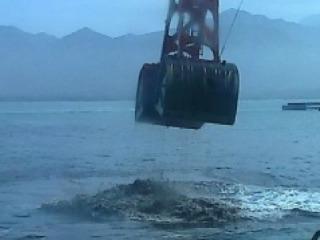
Coal or just dirty water? A crane dumps material
from a Drummond coal barge into the sea. 
Between the night of Jan. 12 and the morning of the 13th a barge used by Drummond coal started to sink, causing the company to allegedly dumped 500 or more tons of coal into the sea near Santa Marta.

But instead of leading to stricter environmental governance, Drummond's aggressive legal response could hobble Colombian environmental law enforcement.

The spill might never have been revealed at all, if not for the president of the Association of Sick Workers of the Drummond Port (Asotredp), an ex-Drummond employee, who publicized photos of the dumping and alleged that Drummond had dumped coal into the sea several times previously after ignoring the Port captain's orders to cease loading during bad weather.

After the January episode came to light, environmental authorities responded with fury.responded with fury.

"Drummond did not adecuately activate a contingency plan, according to what is established in the management plan, since it did not inform local authorities of the emergency in an opportune and effective manner," said Luz Helena Sarmiento, director of the National Environmental Licenses Agency (ANLA).

Minister of the Environment Juan Gabriel Uribe said that Drummond could be fined almost 3 billion pesos - $1.5 million dollars - and that the company had compounded its violation by delaying reporting the spill.

"They had three days to report what happened, and they violated that term," Uribe said.

Drummond asserted that it had dumped only water mixed with coal into the sea, that it had had had no obligation to report the incident to the ANLA, and that the rest of the coal had actually been transferred to another barge - altho authorities questioned that claim.

Despite the companies' assertions, authorities temporarily suspended its right to ship coal.

One might expect that, in such a situation, Drummond would swallow its medicine and work with environmental authorities to clean up its act and help improve environmental practices - but it doesn't look that way. Instead, on its website the company whines that it "feels like a victim themselves" (sic). And, El Espectador reports, Drummond is using a legal strategy that could permanently hobble environmental law and authorities trying to regulate mining.

On the one hand, according to El Espectador, Drummond has filed a tutela - a legal complaint - claiming that it is not the ANLA but the Maritime Directorate which should be investigating and sanctioning these sorts of environmental violations. That would drastically reduce the possible fines and roll back environmental norms by a decade. And, how many people believe that a Maritime agency would be a vigorous environmental watchdog?

Drummond also filed three other legal complaints accusing the ANLA of violating Drummond's rights and of bias against the company.

The lesson here, if Drummond's strategy succeeds: Don't mess with Drummond, or else your environmental laws will be weakened and your environmental agencies handicapped by charges of unfairness. Colombia's already weak environmental enforcement system could be permanently handicapped further.

Of course, many mining and other companies would smile at that prospect.


By Mike Ceaser, of Bogotá Bike Tours

Saturday, February 9, 2013

Colombia's Real Coal Crisis

A crane dumps coal into Colombian coastal waters.
(Photo: NTN24)
As everybody who follows the news knows, environmental authorities have revoked Drummond Corp.'s export license, after it reportedly dumped tons of coal into a bay. And Colombia's largest mine, El Cerrejon, has suspended operations because of a strike, while a third mine is also not operating because of pay disputes. Altogether, about 85% of Colombia's coal production is shut down. The production stoppages in Colombia, the world's fourth-largest coal producer, have hiked world coal prices.


But, while Drummond and El Cerrejon will eventually restart operations, their troubles are symptoms of profounder problems in an industry which Pres. Juan Manuel Santos has called one of the 'locomotives' of the economy. Cheap natural gas produced thru fracking has reduced coal's share of the market, slumping its price and generating employer-union tensions. And, if the world someday gets serious about addressing global warming, coal, the dirtiest fossil fuel, is certain to suffer.

Coal also damages the environment on a smaller scale. El Cerrejon, for example, has expansion plans which include rerouting La Guajira's only river.

Rail cars carrying coal. In many areas, residents complain that
these coal shipments cover communities with coal dust.
And, like many of Colombia's big resource industries, the coal industry has become entangled by accusations of human rights violations. Drummond, in particular, is fighting lawsuits alleging that the company had links to right-wing paramilitary groups, which assassinated union leaders. The company denies the accusations. Last year, a one-time Colombian paramilitary leader testified that Drummond had paid the paramilitaries millions of dollars to assassinate union leaders, according to news reports.

Coal, along with oil and natural gas production, is also distorting Colombia's economy, according to a recent OECD report. That could continue over-valuing the Colombian peso, suffocating the manufacturing sector. And, in a longer view, by continuing to produce fossil fuels, Colombia is contributing to global warming, which may very well devastate the country's environment and economy in future decades.

Is Colombia's dependence on coal and other fossil fuels inherently disfunctional or something which the country can exploit constructively?

Perhaps only time - and Colombian authorities - will tell.

By Mike Ceaser, of Bogotá Bike Tours

Friday, February 4, 2011

A Step Forward for Alleged Drummond Victims

A funeral of a mining union member (Semana.com)
In the latest turn in a long-running lawsuit against Alabama-based coal mining company Drummond, an Alabama court has ruled that the children of Colombian union organizers murdered by paramilitaries can sue the company in the U.S. for damages.

Jorge 40 - back in his jungle days.
In March 2001, paramilitary fighters pulled the union leaders off of a bus carrying Drummond mine workers and then killed the two men.  Jorge 40, a paramilitary leader now imprisoned in the U.S., later confessed to ordering the killings. But Drummond rejects allegations that the company colluded with the paramilitaries in the killings in order to repress union activity. The case has received additional attention because ex-Colombian Pres. Alvaro Uribe, who has been dogged himself by allegations of paramilitary ties, will have to testify in the case, although he is not accused himself.

Despite this victory, the plaintiffs are still a long way from collecting anything. Business collusion with paramilitaries, also called 'death squads' because of the massacres they committed, was apparently widespread for many years in Colombia. Like Colombia's leftist guerrillas, the paramilitaries are considered to be terrorists by the Colombian, U.S. and European governments. The Chiquita banana company even confessed to the U.S. government to having paid protection money to leftist guerrillas and later right-wing paramilitaries and paid a $25 million fine. However, proving any Drummond collusion with the paramilitaries has proven more difficult. Nevertheless, the case has damaged Drummond's public image, and the company is said to be looking into selling its Colombian mines.

By Mike Ceaser, of Bogotá Bike Tours

Friday, November 5, 2010

Skeletons Chase Uribe

Soon to Testify.
The other day as he was leaving an event at Georgetown University, where he teaches a course, someone threw something at Colombian ex-Pres. Alvaro Uribe.

Doubtlessly to the relief of Uribe and his bodyguards, the object wasn't a bomb or a rock, but rather a piece of paper. Still, the document means trouble, because Uribe was being subpoenaed for a trial in which coal mining giant Drummond is accused of collaborating with paramilitary groups, which are notorious for murdering unionists and leftists across Colombia.

Uribe isn't accused of anything himself. But he's got to be looking over his shoulder these days, and this subpoena will make him more cautious about future travel plans, just as many ex-officials of the last Bush administration must be. Throughout his political career, after all, Uribe was dogged by suggestions that he and his family were linked to the far-right paramilitaries, who committed some of the most horrific human rights violations in Colombia's history.

By Mike Ceaser, of Bogotá Bike Tours