Showing posts with label justice. Show all posts

Saturday, March 10, 2018

A Deadly Idea

Calling for death for the corrupt on Carrera Septima.
Death penalty for the 'corrupt,
criminals and rapists.
Among all the good, bad and indifferent ideas being offered in this election season, perhaps the most disconcerting and disappointing one is the Green Party candidate's call for capital punishment - for corruption, rape and just generally being a 'criminal.'

The death penalty does not exist in Colombia, even for crimes such as mass murder. Popeye, one of Pablo Escobar's assassins, who murdered hundreds of people, was released from prison about one year ago.

Colombia's 'Green Party' (formally called the Alianza Verde) isn't really so green. But the party is leftist and anti-violence. Presumably, it's against killing bulls in bullfights. But here's a Green candidate calling for the wholesale slaughter of Colombians for even the most minor criminal  offense. Just the crime of corruption by itself would undoubtedly mean the bloody end for many public functionaries if my experience and the tales I've heard are true.

Would this candidate, if he enters Congress, really want to have many of his colleagues executed?

In a society such as Colombia's, which is yearning for peace, such a harsh, vicious and radical proposal is the wrong thing to say - particularly coming from a leftist party.

By Mike Ceaser, of Bogotá Bike Tours

Sunday, September 11, 2016

Injustice, Recycled

Extradited paramilitary leader Salvatore Mancuso.
The New York Times has this long and detailed piece about the light punishments received by many of the far-right paramilitary leaders who demobilized in the mid-2000s and were extradited to United States prisons.

The story makes a strong point: these guys, who may have smuggled tons of cocaine - not to mention ordering massacres, rapes, kidnappings and forced displacements - have gotten shorter sentences than some streetcorner pushers. (Here's ex-Pres. Uribe's response to the story.)

The story, however, is a bit narrow. While the paras' sentences are scandalously short, in the U.S. they did more time on drug charges than they would have back in Colombia for crimes, including crimes against humanity, under the infamous Justice and Peace Law. And, in theory, the death squad leaders are supposed to be returned to Colombia to be prosecuted for their non-drug crimes, altho the Times reports that many have obtained residency in the U.S., apparently as payback for revealing their cocaine smuggling secrets.

As a result, crimes such as massacres, kidnapping, rape and forced displacement, may never be punished at all.
A paragraph from the New York Times story listing some of Mancuso's alleged crimes.
Impunity? Aftermath of the massacre of Bojayá, in which a
FARC missile  landed on the town's church, klling more than
a hundred women and children hiding inside.
But the biggest scandal here, in the eyes of many, is that Colombia is about to do it all over again with the FARC guerrillas. The FARC have also committed horrendous crimes and human rights abuses, if perhaps not on the same scale as the paramilitaries', and under the peace agreement their leaders can not be extradited and will not even go to prison, as long as they confess what they've done. Instead, they'll get 'special detention,' a vague term likely to mean restricting them to a specific municipality.

And FARC members guilty of crimes against humanity, as long as they have confessed, will even be eligible to serve in Congress in one of the FARC's ten guaranteed seats.

None of which is to say that the FARC-government peace deal is not a good thing. However, political leaders should be careful that the FARC deal does not follow the paramilitaries down a path of injustice.

By Mike Ceaser, of Bogotá Bike Tours

Thursday, April 3, 2014

What's a Life Worth? It Depends.

On their way to the States. Taxi drivers to be extradited for the murder of U.S. DEA agent James Watson. (Photo: El Tiempo)
What's a life worth?

It depends a lot on who you are and where you're from, it seems.

Today's headlines report that seven Colombians who participated in the kidnap/murder of U.S. DEA
Murdered DEA agent James Watson. 
agent James 'Terry' Watson last June will be extradited to the U.S., where each could spend 45 years in prison.

It's not what these guys expected when they decided to mug a man leaving a ritzy bar in Bogotá's upper-crust Parque de la 93 neighborhood. After all, most muggers undoubtedly are never arrested, and those who are spend little time in prison. But Watson fought back and his assailants stabbed him fatally.

Now, that single murder - which may not have been intentional - could send men to prison for a grand total of 315 years.

Don't get me wrong. These guys are predators, and deserve many years of punishment - perhaps even 45 years each. They belonged to a band which had undoubtedly committed lots of muggings, and very possibly other murders.

Ramon Isaza and paramilitary troops. (Photo: Semana)
But it's hard to ignore the contrast with the punishment of some of Colombia's vicious ex-paramilitary leaders, seven of whom who are soon to complete eight-year prison terms agreed to under the controversial Peace and Justice Law negotiated during the presidency of Alvaro Uribe.

Among those expected to be released are Ramon Isaza, a paramilitary leader from the Magdalena Medio region, where paramilitary groups murdered some 1,500 people, some of them after brutal tortures, according to government investigators. Making the not-unrealistic assumption that Isaza had responsibility in that number of killings, he paid less than two days' prison time for each victim.

Ex-paramilitary leader Banquez Martinez talks to victims
of his fighters. (Photo: El Universal)
Another ex-paramilitary commander expected to be released soon is Úber Banquez Martínez, alias El Salado Massacre in the year 2000, in which perhaps more than 100 people were murdered, many with chainsaws, including a six-year-old girl and a 65-year-old woman. The paramilitaries got drunk and played loud music while raping, torturing and murdering their victims, who included pregnant women.  Then they played soccer with their heads.
'Juancho Dique', who commanded the

That was only one of a half-dozen massacres commanded by Banquez Martinez. But, considering only El Salado, he served less than one month for each killing.

Nobody believes that the justice system is really fair or just. But, couldn't punishments be a little less inequitable?

By Mike Ceaser, of Bogotá Bike Tours

Wednesday, February 26, 2014

The New Drunk Driving Law Hits Home

On his way home: Killer Salamanca smiles
as he's led out of court.
Colombia's strict new drunk driving law, intended to crack down on drunks - for whom driving and even killing others had been a forgiveable offense - has finally hit home, unfortunately.

Fabio Salamanca, the rich, spoiled kid who slammed into the back of a taxi, killing its two women passengers and leaving the driver a quadriplegic while driving drunk last July, has received five years of 'house arrest.'

Salamanca's story is just the most recent legal travesty involving a drunk driver. In Salamanca's case, the judge reduced the charge from 'intentional homicide' to 'culpable homicide.' A sentence of only five years made him eligible for home detention under the new legal code. But, paradoxically, the judge didn't apply the new drunk driving law, which would have required Salamanca to do his time in prison.

House arrest doesn't have the most secure reputation in Colombia. And Salamanca's house is likely to be very comfortable, even after his family paid some 800 million pesos to the victims and their survivors.

That others should be so fortunate. An acquaintance of mine was caught last year transporting seven kilos of
'Fabio Salamanca, convicted and sent home,'
reports El Espectador.
marijuana, which he was going to use (mostly) for making health and hygiene products such as soaps. (Ironically, some public health experts believe that wider use of marijuana makes the roads safer because smoking and driving is less dangerous than drinking and driving. And, if not for the availability of pot, some of those high drivers would have been on the road drunk.

Roberto Bastidas, father of one of the women victims, told El Espectador "The justice system favored this young man because he had money....I lost my daughter, and no amount of money will bring her back to me."

For his part, the paralyzed taxi driver said that he'd gladly trade places with Salamanca, who smiled as he was escorted out of the courtroom.

The new, stricter drunk driving law has had at least one impact, however. Bavaria, Colombia's dominant beer company, told Bloomberg Business Week that Colombians are drinking less.

Colombia's didn't celebrate last Christmas with their normal binge drinking, Bavaria President Grant Harries told Bloomberg.

Normally, drinking “starts straight after they get their (Christmas) payout, and then it really takes off," Harries said. "But it didn’t take off, and this was the impact that we were feeling.”

Pity those folks at Bavaria. But Harries said that Colombian beer drinking is picking up again - and with it, perhaps, drunken driving, as well.

By Mike Ceaser, of Bogotá Bike Tours

Saturday, December 14, 2013

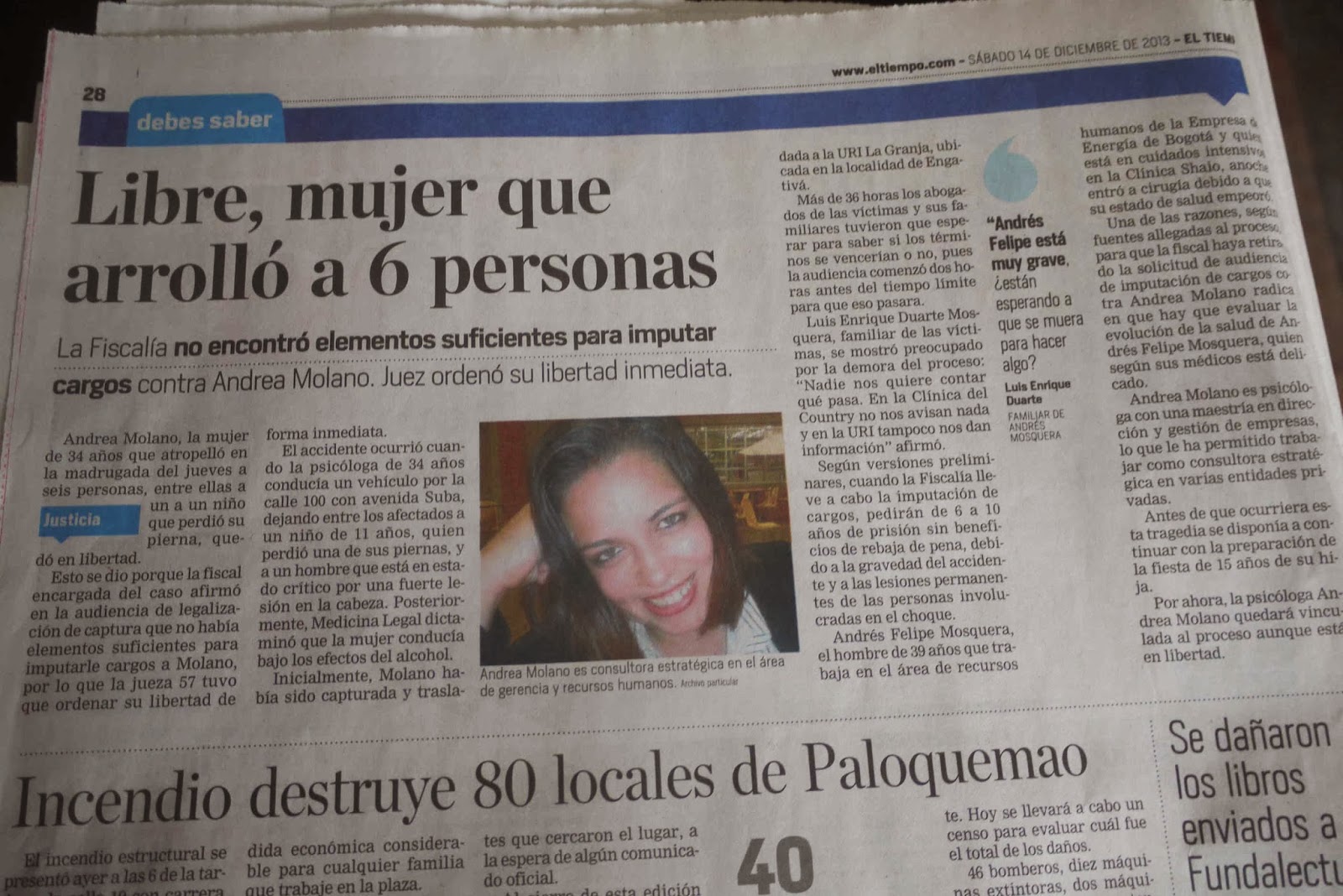
Drunk Driving Out of Prison

http://www.eltiempo.com/colombia/bogota/legalizan-captura-de-conductora-que-atropello-a-seis-personas_13286102-4
Today's El Tiempo reports that a judge freed a woman who hit six people while driving drunk.

It's like a broken record. Someone gets drunk, hits and maybe kills people. The victims go to the hospital, the driver goes home to relax and recover.

In the most recent case, a woman hit a group of children and adults waiting for a bus to take them to the last day of school. One victim is in critical condition with head injuries, and an 11-year-old boy had to have his leg amputated.

But the driver, a 34-year-old psychologist, was freed and allowed to go home - altho it appears likely that she will ultimately be charged.

It's latest the latest travesty involving a drunk driver.

Fabio Salamanca, a wealthy young man, rear ended a taxi July 12, killing its two women passengers and leaving the taxi driver paralyzed. According to news reports, in late November Salamanca's charges were reduced, opening the possibility of home detention, after his family paid 'compensation' to the victims' families.

Last year, Juan Carlos Varela Bellini. heir to a wealthy Cali family, was drunk driving his Mercedes Benz in La Calera last year and ran over four motorcyclists, killing three and severely injuring a fourth. Varela's family paid the victims and the 27-year-old is serving his sentence in his family mansion.

Altho the victims, who are usually from humble backgrouinds, apparently agreed to these soft sentences, they did so for financial motives, not for justice. Such sentences offer terrible examples and weaken the fear of punishment for those considering getting behind the wheel after a few drinks.

For me, these cases also create an absurd contrast with what happened to an acquaintance who made products like soaps out of marijuana. (I'm sure he smoked the stuff, two.) Riding the bus back to Bogotá after a purchasing trip, police discovered he was carrying several kilos of marijuana. The guy is now serving a seven year prison sentence. (And no home detention for him.)

The case is particularly ironic to me, since marijuana use may actually reduce highway fatalities. That's because driving, while high on pot is certainly dangerous, it's less dangerous than driving after drinking alchohol. And, where pot is easily available, some consumers apparently shift from highly dangerous alcohol to less-dangerous marijuana, making the roads safer.

By Mike Ceaser, of Bogotá Bike Tours

Saturday, August 24, 2013

Two Kinds of Harvests

Campesino:'I farm coffee, rice, corn and cacao...And what do I harvest? Losses.'
FARC Guerrilla: 'I plant terror and death. What do I harvest? Trips to Cuba and seats in the Senate.'
This editorial cartoon in today's El Tiempo captured for me the paradox of Colombia's protests by campesino farmers and other, which coincide with government-FARC guerrilla negotiations in Havana, Cuba. Many believe that the FARC are promoting the protests by the farmers, who complain that subsidized agricultural imports have depressed farm prices so much that they lose money on their harvests.

The cartoon captures the irony that the guerrilla leaders, who claim to be the campesinos' defenders, look to do quite well off of this situation. They're living comfortably, maybe even luxuriously, in Havana during the negotiations. If a deal is reached, the FARC, who have committed countless abuses against campesinos and others, may get seats in Congress.

Go figger.

By Mike Ceaser of Bogotá Bike Tours

Friday, July 19, 2013

Crime and (Little) Punishment

United States authorities are finding new legal arguments to extradite a group of taxi drivers and accomplices who allegedly robbed a murdered a DEA agent in Bogotá's ritzy Parque de la 93 neighborhood a few weeks ago. Now, the U.S. is accusing them of kidnapping for their attempted paseo millonario robbery-gone wrong.

An alleged drunk driver, now de-stressing in hospital,
and the results of his fatal work. (Foto: ElEspectador.com)
When the taxi drivers thot they'd spotted another wealthy, vulnerable gringo leave a bar with a few drinks in him that night, they surely never imagined that soon U.S. Attorney General Eric Holder would be vowing harsh punishments for them.

People who commit robbery and murder deserve no pity, and I won't be sorry if they spend decades in prison. After all, these guys had criminal histories, almost surely had robbed and perhaps murdered previously, and would undoubtedly still be at it today if they hadn't grabbed the wrong gringo.

Still, it's impossible to ignore the huge contrast between this case, which has made international news and triggered plans to reform Bogotá's taxi policies, and other killings.

During the aftermath to the DEA agent's murder, a drunk driver in an Audi slammed into a taxi, killing its two female passengers and leaving the taxi driver partially paralized. El Tiempo reports that the man's initial medical examination found no stress problem at all.
Not a punishable crime? (ElEspectador.org)

The drunk driver is now in a hospital, where the poor guy is being treated for 'severe stress' he supposedly experienced from killing two innocents and injuring a third.

Most likely, this drunk driver, like so many others, will escape with a slap on the wrist. Once his comfortable hospital stay ends, he'll likely receive a few years of home detention - of questionable enforcement - and then be driving again.

(In fact, at the drunk driver's July 30 court hearing the judge sent him home, saying he wasn't a flight risk. The victims' relatives expressed anger. Strangely, another drunk driver, who killed one person, was sent to jail the other day. The judge sounded like she was on the driver's side, saying that he was 'innocent until proven guilty - even tho he'd confessed - and asserting that, since he was from a wealthy family he wouldn't flee. (So only the poor deserve prison.) Finally, she congratulated the driver for 'resisting media and social pressures.'

Clearly, for her honor, the victim here is the killer drunk driver.

 It all makes one wonder whether something incorrect happened between this wealthy family and the judge.)

Citizen groups and some parliamentarians have made repeated attempts to give drunk drivers real punishment. But other members of Congress - some of whom have been known to drive drunk themselves - don't seem interested in making the laws stricter. At the same time, social and economic factors allow drunks, who often pay off victims or seem to have connections with judges and authorities, to get off lightly.

It's impossible not to read an economic lesson into these two crimes: Taxi drivers, who are usually lower middle class, get the book thrown at them for assaulting a wealthy foreigner, while drunk drivers, who are often wealthy, get off easy.

Check out this dramatic video of a wrong-way drunk driver hitting a man carrying his daughter to school on Thursday in south Bogotá. The driver, who'd had previous drunk driving charges, then allegedly tried to bribe and threaten the victim and attacked police.


By Mike Ceaser, of Bogotá Bike Tours

Wednesday, May 1, 2013

Indigenous Justice: Equality under the law?

Cruel and unusual? An indigenous man being punished with El Cepo. (Photo: El Tiempo)
The other day an indigenous community in Cauca Department condemned two alleged FARC guerrillas to 40 year prison terms for the murders of local indigenous leaders.

Trials under traditional laws have recieved a lot of attention lately. They mean autonomy for indigenous communities and often deal out a kind of direct and immediate punishment, but also bring up lots of questions about fairness, equity and human rights.

The two alleged guerrillas convicted this week were accused in the killings of four local people, including a city councilman and a traditional healer. But El Tiempo reported that the hearing "resembled a political of the FARC."

According to the community half of the 65 homicides of indigenous people in North Cauca in recent
Fair Trial? An indigenous community hearing in El Cauca.
(Photo;: El Tiempo)
years were committed by the FARC. That's a terrible toll, but how much justice is there in punishing a few individuals just because they belonged to an organization which committed crimes?

And are indigenous 'trials' fair by western standards? By my reading of the news stories, the hearing lasted less than a day. Since reporters weren't allowed to watch, it's not clear whether witnesses were called, whether the accused were allowed to defend themselves, whether they were allowed attorneys or other basics of fair trials.

In July of last year a Nasa indigenous community in El Cauca sentenced three FARC guerrillas to 30 lashes each and a third guerrilla, a minor, to 10 lashes after indigenous guards captured them carrying weapons with the apparent intention of attacking a military post on indigenous territory. The Nasa said they punished the three men and the boy not for belonging to the guerrillas but for placing the community in danger of an attack by the military.

Other traditional punishments by that community include 'banana planting' - burying the criminal up to his neck - and 'El Cepo' - locking the criminal by his feet  for days or weeks.

Indigenous courts have also handed out sentences which from an outsider's perspective may seem far too weak or too harsh. In another case in El Cauca a man was sentenced to five years' detention for raping five children, three of them his daughters. In contrast, I've read about indigenous convictees serving long sentences for minor offenses, or despite their apparent innocence.

Article 246 of Colombia's Constitution says that "indigenous authorities may exercise jurisdictional functions inside their territory in conformity with their own rules and procedures," as long they don't violate Colombian law.

But indigenous laws and practices are based on traditions and practices far different from the western legal tradition on which conventional Colombian laws are based.

What is fair, and who defines it?

These punishments also invite reflection on how the FARC guerrillas will be treated in any peace treaty reached with the government. Many of the guerrillas have committed serious crimes, such as murder, recruiting child soldiers displacing peasants and planting landmines.

How will conventional justice compare to the indigenous version?

By Mike Ceaser, of Bogotá Bike Tours

Monday, October 22, 2012

Drunk Driver Who Killed Three "Is not a Criminal."


Motorcycles lined up outside Bogotá's Central Cemetery
during the motorcyclists' funeral.
In another in Colombia's long series of cases of fatal drunk driving being considered a forgiveable act, the wealthy Caleño businessman who mowed down three motorcyclists and injured one more with his Mercedes Benzoutside of Bogotá while apparently drunk, will now get out of jail.

The driver "was transferred from La Modelo Prison to a site of special detention," attorney Iván Cancino told reporters the other day. 'Special detention' apparently means 'home sweet home'.

A motorcycle club was returning from an outing in La Calera the night of July 7, when Juan Carlos Varela Bellini smashed into them. Immediately after the accident, some witnesses said, Varela Bellini offered witnesses bribes and tried to pretend that he hadn't been driving. Varela Bellini also attempted to flee the scene of the accident and evade the drunkeness test, a judge said. Now, Varela Bellini has agreed to pay the survivors 1,400 million pesos, or a little over one million dollars, in return for dropping charges. That seems like mighty little for three lives, and makes you wonder if anything else was behind it. (The agreement was approved by prosecutors and a judge, Varela Bellini's lawyer said.)

"The important thing is for the world to know that Juan Carlos Varela Bellini is not a delincuent," the accused's lawyer said.

Motorcycle club members at their companion's funeral.
Varela Bellini, 25, belongs to one of the wealthiest and most elite families of the city of Cali, as you can read in this sympathetic story about his misfortunes in Jet Set magazine. How sad it would be for this young man's future to be ruined just because he killed three people. But, it may not be. By paying what is a small fortune for the victims' families, but not much for Varela Bellini's clan, he likely will go on in comfort.

Sure, the survivors will be better off with their pockets full. But those of us on the road in front of drunk drivers feeling confident that they'll get off lightly for any accident, are worse off. That's why drunk driving is a crime against both the individual victims and society in general. By letting drunks off easy the legal system sends a loud and clear message that driving drunk is no big deal, so go ahead and risk it.

And that drunk driver just might be Varela Bellini again. I haven't heard that they've taken away his driver's license or his Mercedes.

If I carry a gun or a knife or a hammer, get drunk and injure someone with those things, aren't I a criminal? Is a car, which is much bigger and potentially more deadly, any different? As I understand it, in other nations' legal systems, when you get drunk and lose control of your behavior, the law makes you responsible for your actions.

But, that's apparently not true in Colombia - at least not when you're rich and behind the wheel.

Related:


The Motorcyclists' Tragedy


Motorcyclists Rev Up Against Drunk Driving


By Mike Ceaser, of Bogotá Bike Tours

Sunday, July 22, 2012

The Bankers' Prison?

Not going to jail for pocketing billions. 
That strange concept occurred to me after reading about the scandal at the HSBC bank, which laundered many millions in money from drug sales, as well as outlawed organizations and nations. HSBC, too, is apparently only an example of widespread practices in the banking industry.

So I Googled combinations of 'banking executives' and 'money laundering' and 'prison' - and came up quite empty. I did find one case - from 1994. I'm sure there have been others since, but they seem to be very few.

In contrast, of course, innumerable poor people have gone to prison for cultivating a patch of coca or marijuana plants, or smuggling a few ounces of a prohibited psychoactive substance.

The inequity is huge and obvious, but the solution difficult as long as wealthy bankers can hide behind teams of lawyers and corporate shields.

One solution would make everything more equal, however: Decriminalize drugs, and make their profits just as licit as those from whiskey, tobacco and orange juice.

Then, banks would have one less thing to worry about, governments would have lots more taxes, and lots of poor people would get out of jail.

By Mike Ceaser, of Bogotá Bike Tours