Showing posts with label san andres islands. Show all posts

Saturday, June 8, 2013

More Canal Trouble for Colombia?


A threat to Colombia? Old plans for a canal across Nicaragua are coming back. (Photo: Wikipedia)
In 1903, Colombia had just finished the bloody Thousand-days civil war. In Colombia's presidency was José Manuel Marroquín, a philosophy professor who reportedly was more passionate about writing books on grammar than governing. And the country was still smarting from the dismemberment it suffered when Ecuador and Venezuela broke away from La Gran Colombia.

It could have been Colombia: Construction of the Panama Canal (Photo: Wikipedia)
Enter the United States, led by Pres. Theodore Roosevelt, a military man, believer in Manifest Destiny and wielder of the 'big stick,' who was bent on expanding the U.S.'s power across the hemisphere.

A ship crosses the Panama Canal.
Roosevelt wanted to dig a canal across Central America to connect the Pacific and Atlantic oceans and save ships the long and dangerous passage around around the southern tip of South America. And the Colombian province of Panama was the logical place to dig it, since the French had already done years of excavation there. (The alternative was digging across Nicaragua.)

No warrior: Colombian Pres. Jose
Manuel Marroquin.
Bogotá's relationship with Panama was already tenuous. The province was isolated from the rest of Colombia - today, there's still no land connection between the two nations - and many Panamanians had long aspired for independence - even rebelling several times. The Panamanians also resented their sufferings during the Thousand Days War, which they felt was fought over issues foreign to them.

So, when Washington approached Bogotá proposing digging a canal across Panama, Colombian leaders worried. Bogotá had less than a century before already lost much of its territory, and now this big power from the north was proposing digging a trench across the country and then assuming long-term control of the corridor.

Colombia's Congress gave the Yanquis the cold shoulder and made big demands for the canal concession.

Theodore Roosevelt:
A rough rider.
The strategy backfired disastrously for Colombia. Roosevelt encouraged the Panamanians to stage yet another revolt and immediately recognized Panama's independence. Roosevelt even sent down U.S. warships to prevent Bogotá from putting down the rebellion.

Instead of losing temporary control of a corridor of land, Colombia lost a whole province.

It's interesting to think about how things would be different if Colombia had cooperated with the Roosevelt administration. Today, Panama would likely still be a Colombian province, giving Colombian much more economic and geopolitical importance.

But there's no changing history.

And today, Colombia's unfortunate relationship with Central American canals may be heading for a repeat.

The recent Hague International Justice Court's ruling expanding Nicaragua's Caribbean waters breathed new
Nicaragua still claims Colombia's San Andres archipelago,
located off of Nicaragua's coast. A nearby canal would
 impact them economically, geopolitically and
environmentally. 
life into that nation's hopes to build its own canal between the oceans. A canal across Nicaragua would be longer than Panama's, but have huge advantages. It would be a sea-level canal, meaning that ships would not have to be lifted and lowered in locks as the Panama Canal does, and it would be wider and deeper than Panama's. The world's biggest ships, mostly oil tankers, already can't fit thru the Panama Canal and still won't even be able to after that canal's current expansion is completed.

The Nicaraguan government is moving ahead with a concession to a Chinese company to dig a canal across the country. (There had also been talk of the Chinese building a 'dry canal' in the form of a railroad line between Colombia's Pacific and Atlantic coasts.) After the Hague ruling, some Colombian officials even suggested that the Chinese interest in building such a canal could have influenced the Chinese judge on the panel, but there's no evidence for that.

The Seaflower Marine reserve around the San Andres
archipelago would be hit with pollution and exotic species,
as well as huge sea traffic, if an inter-ocean canal is
dug across Nicaragua. (Photo: Unesco)
But a canal across Nicaragua could mean trouble for Colombia. It would inevitably increase Nicaragua's influence in the Caribbean, increasing pressure on Colombia's sovereignety over the San Andres Archipelago off of Nicaragua's coast. Nicaragua has long claimed the islands.

Adding a major shipping channel will also produce huge environmental impacts from ship movement, ship wastes and the introduction of exotic species. That's particularly worrying for Colombia's Seaflower Marine Sanctuary around the San Andres Islands. (Colombia is using the sanctuary to challenge the recent Hague court ruling, but its chances for success look slim.)

By Mike Ceaser, of Bogotá Bike Tours

Thursday, December 6, 2012

What's on a coat of arms?

What's Panama doing there? Colombia's coat of arms, as displayed in Bogotá's bullfighting plaza.

Should the Andean condor fly off of the coat of arms
before it flies into extinction?

A coat of arms sounds like something out of the age of knights and castles - and it is. But Colombia's has taken sudden timeliness thanks to the controversy with Nicaragua over the San Andres archipelago - which are absent from the coat of arms.

The gorro frigio, a symbol of liberty
and revolution....
The coat of arms is not only a throwback to a past era, but Colombia's also happens to be a holdover from times past. The current coat of arms, or escudo nacional, was adopted in 1834 and features Panama, which became an independent nation in 1903 and Colombia has little chance of regaining. In recent years, senators have proposed replacing Panama with the San Andres archipelago, an idea which seems to have gained new strength in the wake of an international court's ruling reaffirming Colombia's possession of the archipelago but slashing Colombia's Caribbean sovereignety. Nicaragua has protested the proposed change.
...might be replaced by the popular
sombrero vueltiao.

Panama isn't the only controversial element on the coat of arms. Some have called for removing the Andean condor, both because it feeds on corpses and because it's threatened with extinction. Others have proposed changing the gorro frigio, a symbol of liberty and revolution, with the more contemporary and well-known sombrero vueltiao.


By Mike Ceaser, of Bogotá Bike Tours

Wednesday, November 28, 2012

Colombia: International Outlaw?

That's what it looks like after Colombia withdrew from the Bogotá Pact, which gives the International Court of Justice in the Hague jurisdiction over disputes between members.

Colombia's motivation is obvious: Colombians didn't like the court's ruling last week expanding (from Colombia's perspective) Nicaragua's maritime sovereignty in the Caribbean at Colombia's expense.

But the ruling leaves Colombia with one less international legal mechanism to peacefully resolve disputes between members and erodes Colombia's authority in every international organization. The pact, signed in 1948, is formally named The American Treaty for Peaceful Solutions, and it appears to have worked. As far as I know, there's never been a war between two nations which had ratified the pact. (Peru and Ecuador fought their border wars before Ecuador's 2008 ratification.) Previous to the pact, however, Latin American nations fought numerous border wars, including the ones which dismembered Paraguay and Bolivia and the 1932 Peru-Colombia war over Leticia.

Several border disputes, including ones between Chile and Argentina, Chile, Bolivia and Peru and another between Colombia and Venezuela over their border in La Guajira - which brought them close to war in 1987 - still fester in the region. The Bogotá Pact provides a presumably objective authority to resolve those peacefully, if not to everybody's liking.

By withdrawing from the Pact, Colombia rejects the authority of that court. But its decision comes too late juridically. After all, at the time the court ruled last week, Colombia was still a member of the pact and recognized the court's authority. And the Colombian government should also remember that, along with expanding Nicaragua's waters, the court also reaffirmed Colombia's sovereignety over the San Andres islands and their surrounding keys - which was what Colombia had asked for in the first place. By rejecting the new maritime boundary, Colombia also delegitimizes the ruling on the islands and keys.

Nicaragua has said it is sending military ships to patrol the waters which it now considers its territory. But Colombia says it is maintaing warships in the region. Does this sound like a threat of war?

Colombia's decision to leave the Bogotá Pact, like a child who abandons a game because he didn't win all he wanted, will also delegitimize Colombia in all international organizations, because other nations will suspect that Colombia, if it doesn't get its way, will simply abandon the field.

Colombia's decision, "means not only a violation of an international norm, but also confronts Colombia against the United Nations system and the international community," Walter Arévalo, professor of international relations at the Universidad del Rosario, said in an analysis published on the Congreso Visible website.

That's not a good position for a nation like Colombia, which has relied heavily on international cooperation, to be in.


By Mike Ceaser, of Bogotá Bike Tours

Tuesday, November 27, 2012

Another Loser in The Hague: Drug Warriors?

Drug smuggling routes north. (Image: COHA/DEA
Count another loser from last week's ruling by the International Court of Justice in The Hague: The War on Drugs.

On the one hand, the ruling dramatically expands Nicaraguan waters at Colombia's expense (if Colombia accedes to the ruling). Greater sovereignty by Nicaragua, an ideological opponent of Washington, could complicate the United States-backed drug war. How much, however, is questionable, since other nations, including Colombia, have the right to navigate those waters.

But the drug war will be weakened for a more important reason. Much of the cocaine and heroin smuggled to the U.S. from South America moves across the Caribbean, skipping from island to island to the mainland in go-fast boats or small planes. Suddenly, all of those already poor San Andres fishermen, with little education and limited job options, may see their incomes slashed by the court's decision. (Nicaraguan Pres. Daniel Ortega has said that San Andres fishermen will still be able to fish those waters - a promise which may be forgotten once Nicaraguan fishermen start complaining.)

What can the San Andres residents do when their fishing is restricted but their kids still need to eat? Of course, they can still navigate those waters, just not fish them. Inevitably, some will think about a highly profitable, if more risky, income alternative.

Interstingly, a week ago Pres. Santos said that the war on drugs has been "like a stationary bicycle" and outgoing Mexican Pres. Felipe Calderon told The Economist magazine that ending the drug trade was "impossible" and suggested alternative policies.

By Mike Ceaser, of Bogotá Bike Tours

Sunday, November 25, 2012

San Andres' Other Big Loser: The Environment?


The International Court of Justice's ruling last week slashing Colombia's territorial waters around the San Andres Archipelago was a disaster for the islands' fishermen, whose fishing opportunities appear to be drastically curtailed.

Ecotourism in San Andres' biosphere
reserve. (Photo: Changemakers)
But the environment will also suffer if Nicaragua does not continue Colombia's conservationist policies in maritime areas the court transferred to Nicaraguan control. Those areas include 54% of the  349,800 square kilometer Seaflower Biosphere Reserve and Marine Protected Area, which surrounds the islands. According to the San Andres government, it constitutes the largest marine protected area in the Americas, with more than 400 fish species, 54 soft coral species and 48 hard ones, 130 sponge species, 4 turtle species and 157 species of birds, among lots of other biodiversity.

 In addition, a year ago Pres. Juan Manuel Santos promised to ban oil drilling around the islands.

San Andres fishermen. They may find their
livelihood devastated in multiple ways.
Will Nicaragua be a good steward of its maritime environment (assuming that Colombia recognizes the court's ruling)? Unfortunately, Nicaraguan officials' initial remarks after the court decision have been about exploiting the region's resources, including undersea oil.

The answer is important not only for the region's biodiversity, but also for the fishermen's livelihoods. Fish do not recognize political frontiers, and destroying their breeding habitat will destroy fish populations throughout the Caribbean.


Doomed world? Fish swim in the Seaflower reserve. (Photo: ABC.es)


By Mike Ceaser, of Bogotá Bike Tours

Thursday, November 22, 2012

Colombia the Crybaby?

The islands are still Colombian, but not much of the sea is.
In the wake of the International Justice Court's ruling shrinking Colombia's slice of the Caribbean Sea, Colombian officials from the president on down have called the decision flawed, vowed to challenge it and threatened to withdraw from the international court's jurisdiction.

The decision is certainly unfortunate for the people of the San Andres archipelago, who's fishing opportunities have been drastically reduced. But, to a layman like myself, the ruling does seem reasonable. After all, Nicaragua's coast is much, much longer than the islands', so doesn't it make sense for Nicaragua to get a corresponding lion's share of the nearby waters? Colombia, remember, has lots of territorial waters off of its Pacific and Atlantic coasts. And the court DID reaffirm Colombia's sovereignety over the keys (tiny islands), which had received all the attention before the ruling. A phyrric victory is still a victory.

Colombia's territorial waters
before the court ruling.
(Image from Wikipedia)
And the International Court of Justice is a highly respected institution with no apparent motive for bias. So, its ruling deserves the benefit of the doubt.

But Colombia's attitude is shortsighted and self-destructive for a more fundamental reason. Historically, Colombia has consistantly and creditable respected the decisions of international bodies, even when they denounced Colombia's record on human rights violations. That attitude has undoubtedly earned Colombia respect among international observers. And it's a way of banking moral credits for the day when international tribunals favor Colombia against another country. Then, Colombia can say:

'Look, we honored the decision when it went against us, so it's your responsibility to respect this decision that's unfavorable to you.'

Or, until this week Colombia could have said that.

Colombia's dramatically reduced sea possessions.
(Image from Nicaragua Dispatch)
But, by making an about-face after having promised to respect the Justice Court's ruling, Colombia ends up looking like a crybaby and a sore loser. And the day an international ruling comes down in Colombia's favor - for example over the long-running border difference with Venezuela - the losing nation will surely point to Colombia's attitude in the San Andres dispute to argue that it needn't respect the latest decision.

By trying to reject the court's authority, Colombia is behaving like Venezuela, which has simply stormed out of international organizations which criticized its actions on human rights and other issues.

Finally, Colombia's position is futile because, as Colombian leaders have acknowledged when not grandstanding for domestic consumption, they WILL honor the court's ruling.

Colombians should step back and look at the big picture. While the sea territory change is a blow to the residents of San Andres and to national pride, on a national economic scale it's not very significant. Colombia's international image and reputation are much more important.

Colombia should also not lose sight of the fact that Nicaragua is a tiny and very poor nation with a leader who seems to be making himself into a dictator. Nicaraguans deserve a break, too.

President Santos has condemned the International Justice Court's ruling.
By Mike Ceaser, of Bogotá Bike Tours

Monday, November 19, 2012

The Keys to Losing an Archipelago?

Colombian officials cheered this morning as the International Justice Court in the Hague ruled that Colombia was the rightful owner of not only the islands of San Andres and Providencia, which historically have been claimed by nearby Nicaragua, but also some bits of land portruding from the Caribbean whose ownership had been disputed.

But the cheers turned to laments when the court read the other half of its decision: that Nicaragua possesses a 350 miles 'exclusive economic zone' extending east from its coast into the Caribbean. The court's reasoning seems sensible and fair enough, since that economic zone is standard around the globe. But it leaves the San Andres archipelago enclosed in a narrow corridor of Colombian waters, and leaves two of those bits of land, called keys, and their 12 mile territorial waters surrounded completely by Nicaragua's exclusive economic zone.

Nicaragua's petty tyrant Daniel Ortega is celebrating his nation's 'triumph' in the international court. And well he should: besides a boost to his tiny nation's international prestige and his own beleagured political prospects, the expansion of Nicaragua's economic zone also means more opportunities for Nicaraguan fishermen and probably oil exploration, which Colombia had banned in waters it controlled around the islands.

The big losers here are the archipelago's fishermen, and possibly Colombia itself. The court slashed the islanders' fishing territory, endangering their livelihoods and an important part of the island's economy.

It's possible that island residents will soon reason: 'If we were only part of nearby Nicaragua instead of far-away Colombia, we'd be able to fish far and wide'.

In the short term, the Hague court's ruling reaffirmed Colombia's sovereignety over the San Andres archipelago and its nearby keys. But in the long term, by changing the San Andres residents' economic interests, the ruling could well weaken the island residents' allegiance to Colombia.

San Andres is a real political and geographical anomaly. The first Europeans to settle the islands were English Puritans (whose language still endures on the islands). Later came African slaves and pirates of various nationalities. After the South American revolutions, the islands belonged to La Gran Colombia, if only tenuously so, as did the isthmus of Panama. When American President Teddy Roosevelt chopped off Panama and made it independent in order to dig a canal across it, the archipelago stayed part of the rest of Colombia, leaving us with the geographical anomaly we have today.

More broadly, Colombia's possession of these distant islands has probably influenced Colombia's geopolitical alliances. It's part of the reason why Colombia has cool relations with Argentina and warm ones with Great Britain, which has its own dispute with Argentina over the far-away Falkland Islands just off of the Argentine coast. And it may also be why Colombia, Chile and Britain get along well: Chile possesses Easter Island way out there in the Pacific Ocean.

By Mike Ceaser, of Bogotá Bike Tours

Thursday, July 26, 2012

I Spy, You Spy: So What?

Nicaragua's arrest of an alleged Colombian spy has again ruffled relations between the two countries, which have an old dispute over the San Andres archipelago and its surrounding waters.

While these latest accusations could be false, it should be no surprise that Colombia does whatever it can - aboveboard and via subterfuge - to collect economic and military information about Nicaragua - and it's a sure bet that Nicaragua does the same about Colombia.

Even war planning is natural between to such adversaries. But it's a pretty certain bet that no sane mind in either government would want an armed conflict. For Colombia's part, any attack on Nicaragua would gain it little, cost money and lives and bring down on Bogotá the world's condemnation, in addition to all the moral issues. Nicaragua would have all the same reasons to avoid war, as well as the fact that it would get beaten soundly by Colombia's much larger and more tested military.

None of which, of course, means that an unpopular leader might provoke a confrontation in order to rally nationalist sentiment.

An international court in The Hague is now evaluating Colombia and Nicaragua's conflicting claims to the San Andres archipelago and surrounding waters. Colombian government officials have promised to accept the court's ruling. Nicaragua's have not - because they know the court won't give them the islands, over which Bogotá has long exercised sovereignety.

Grindingly poor and underdeveloped, Nicaragua does its impoverished people no favors by keeping this old and futile dispute alive. But it serves the politicians in Managua well, by distracting Nicaraguans from their pressing troubles.

By Mike Ceaser, of Bogotá Bike Tours

Saturday, April 28, 2012

Drawing Lines in the Sea

San Andres Island: Disputed territory.
Colombia and Nicaragua are in the International Court of the Hague arguing over the ownership of some tiny keys and a patch of water in the western Caribbean.

It's a long-running dispute, with roots going back to Spanish colonial records of the early 1800s. The court's decision, which could be many months away, will affect fishing rights in the area and possibly underwater petroleum resources. But the biggest thing riding on control of a speck of territory almost nobody's visited is undoubtedly national pride.

Lines of dispute. 
Nicaragua still claims control of the whole archipelago, a stereotypical tropical island paradise consisting of San Andres, Providencia and Santa Catalina. But in a preliminary 2007 ruling the court said they were part of Colombia. And it'd be completely unimaginable for Colombia to hand over the islands, where Colombia has made great efforts to establish its sovereignety and which form an important part of the national identity.

Colombia bases its legal case mainly on two documents: an 1803 decree by the Spanish crown making the islands - and also Nicaragua's Mosquito Coast - part of La Nueva Granada, Colombia's colonial antecessor. That decree was rescinded just three years later, so it doesn't mean much. But it's something.

San Andres and Providencia islands.
A long, long, way from home. 
In 1928 Colombia and Nicaragua signed a treaty recognizing Colombia's sovereignety over the San Andres archipelago. Nicaragua argues it signed that treaty under duress, since it was actually occuppied by American troops at the time, and Washington felt indebted to Colombia for having taken away Panama. So, the Nicaraguans are right that the 1928 treaty can carry little legal or moral weight.

But Colombia has occupied and exercised sovereignty over the archipelago for many decades.

Additionally, in 1822 the islands' residents voluntarily adhered to Colombia, and in 1903 they rejected a U.S. invitation to become part of the U.S., both of which seem like strong signs of allegiance to Bogotá.

Nicaragua, on the other hand, rests its claims mostly on geography: the islands are lots closer to the Nicaraguan coast. But, applying a geography test to the whole world would result in wholesale and impossible reshuffling of territories.

In today's world, it's just not going to happen.

Colombian officials have said that if the Hague court gives some of those keys and reefs to Nicaragua, Bogotá will accept the ruling.

That might be the best outcome. Colombia keeps the archipelago, which it would in any case, and Nicaragua recovers a bit of national pride, and fishing rights.

This article lays out the case for Nicaragua.

By Mike Ceaser, of Bogotá Bike Tours

Wednesday, April 4, 2012

San Andres and the Falklands....eeerrr...Malvinas


Watching penguins in the Falklands.
(Photo: Falklands Islands.com)

Besides drugs, another issue sure to be discussed at the Summit of the Americas will be the windswept archipelago off of the Argentine coast, called the Falklands Islands by the British and the Malvinas by the Argentines and most of Latin America.

They're frigid, windy places with a few thousand people and lots more sheep. But they have economic value in the fisheries and hydrocarbons in the waters around them. And, even more value in terms of national pride.

They're also suddenly relevant to Colombia, because Colombia has friendly diplomatic and commercial relations with both nations claiming the islands, and would have a hard time choosing sides. In fact, some other Latin Americans labeled Colombia a traitor against its Latin neighbors because it didn't back Argentina against Britain in their war over the islands 30 years ago.

Sunny San Andrés.
The Falklands/Malvinas dispute could also have a geopolitical relevance for Colombia because of its parallels to Colombia's own dispute with Nicaragua over the Archipelago of San Andres and Providencia, which lies not far off of Nicaragua's coast. The archipelago is a geographical and historical oddity. The first Europeans to settle there were English Puritans. Later came pirates, Spanish, French and Africans. The islands became so notorious for smuggling that today Colombian cities have shopping areas called Sanandresitos with a reputation for selling contraband products. The islands finally became Spanish colonial territory, and Colombia inherited them with independence - at least according to the Colombian version of history. (In another similarity to the Falklands, the people of San Andres and Providencia still speak a kind of English, albeit mixed with Spanish and other tongues.)

The San Andres archipelago once made geographic sense for Colombia. But after U.S. Pres. Teddy Roosevelt encouraged Panama to rebel and made it into a separate country in order to dig a canal, the archipelago stayed with the rest of Colombia, stranded off of the Nicaraguan coast.

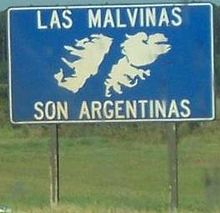
A sign in Argentina says
'The Malvinas are Argentinean."
Today, both Colombia and Nicaragua claim the islands and their surrounding waters based on complex historical evidence. Enrique Gaviria, president of the Colombian Historical Academy, told El Tiempo the other day that Colombia should support Argentina's claim to the Falklands because it's based on the same argument as Colombia's claim to San Andres: that both South American nations inherited certain Spanish colonial rights. However, Colombia could also use part of Britain's basis for claiming the Falklands: they've controlled the islands for a long, long time, and the people living there consider themselves British (or in the San Andres' case, Colombian) citizens. 

In fact, both Argentina's and Nicaragua's claims are outdated exercises in nationalism. If geography trumped a place's history of continuous occupation, then we'd need to carry out wholesale transfers of territory all around the world, including giving Alaska back to Russia (or Canada) and Spain hand the Canary islands over to some West African nation. Many of the little pieces of land dotting the Caribbean Sea and Pacific Ocean would change ownership, creating a sort of international chaos. Right or wrong, that isn't going to happen. 

Just like home:
A church in the Falklands. 
Centuries-old treaties and arguments about which European nation's sailing ship first spied an island half a millenium ago seem utterly irrelevant for deciding the fate of a piece of land and its population today. Argentina should get on with it and focus on the many more important problems it has.

The residents of San Andres and the Falklands feel respectively Colombian and British. Both nations appear to administer competently their far-away possessions and the islanders haven't expressed a wish to change nationalities. Until they do, it's best to leave well enough alone.

The legality of their claims aside, the Nicaraguan and Argentine positions also look like lost causes. In military terms, Colombia and the United Kingdom are the much more powerful nations, as Britain demonstrated by retaking the Falklands 30 years ago. The Argentine dictatorship's military invasion of the Falklands, and the thousands of military casualties, turned the islands' sovereignty into a matter of national pride, and thus probably eliminated any possibility of a negotiated settlement. Since then, to its great credit, Argentina has slashed its military budget, making another military adventure unthinkable.

Someday, however, geography and migration may accomplish what arms and diplomacy have not. The British government says that the people of the Falklands should be able to decide their nationality. It turns out that the waters surrounding the Falklands may contain considerable natural gas and petroleum. If those are exploited, the invasion of workers could change the islands' population from Anglo Saxon to Latino - and at the same time perhaps the people's national loyalty.


By Mike Ceaser, of Bogotá Bike Tours