Showing posts with label Central Cemetery. Show all posts

Thursday, September 20, 2018

The Cemetery's Art of Discord

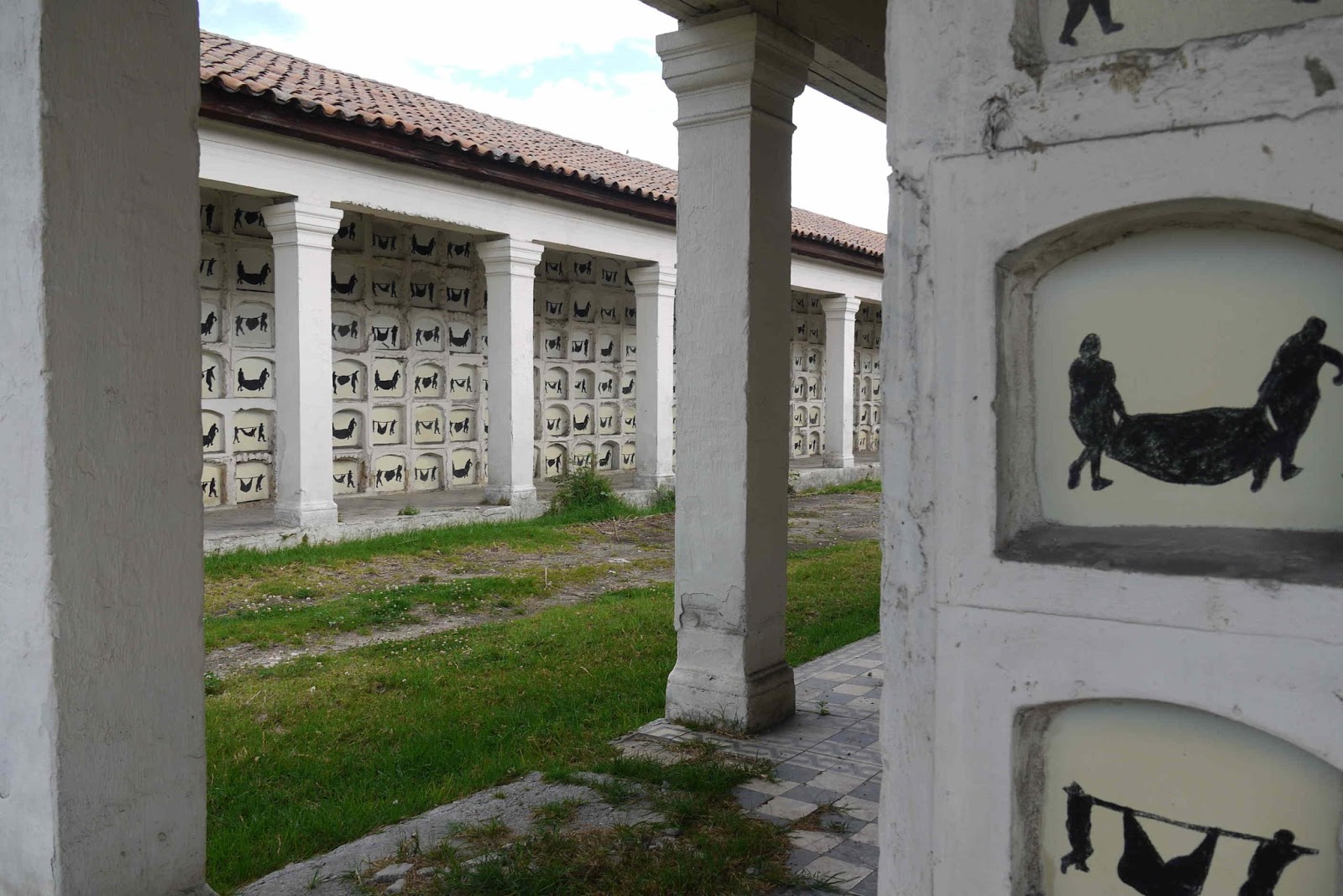
The empty mausoleums along 26th Street, with their stencils commemorating the conflict's victims.
Does anybody notice? Drivers pass the
mausoleums decorated by Gonzalez.
You've probably noticed them while traveling east along Calle 26 past the Central Cemetery: the mausoleums decorated with stenciled images of men carrying stretchers and corpses representing victims of Colombia's violence.

The thousands of images are the work of artists Beatriz Gonzalez and a partner and provide a

haunting reminder of Colombia's violence, in particular the victims of the 1948 Bogotazo riots...for those who notice them. My impression is that few do, (despite enforced viewing from Calle 26's chronic traffic jams), and even fewer pay attention.

Gonzalez is now fighting to preserve the artwork in the face of city plans to create a park in the old block of the Central Cemetery.

The stencils of the discord.
Historical memory is important. But so is greeen space, particularly in a poor neighborhood with little of it. A football pitch, a skateboard park and a basketball court would give the youths of the troubled Santa Fe neighborhood behind the cemetery an alternative to drugs and gangs. Some young rappers from Santa Fe whom I knew used to tell me almost routinely about their friends getting stabbed and even murdered. I understand that today one of those same rappers is dead and another is an addict.

And, if the city does the sensible thing by using part of the land for recreation while preserving one of the mausoleums, with explanatory information, lots more people would see the memorial and we might have fewer murders to lament.

The situation strikes me as absurd. But not nearly as absurd as the land across the street and the other a few blocks west by the Jaime Garzon mural, which could be nice public parks if the city did not fence them off with barbed wire. Go figger.


Mike Ceaser, of Bogotá Bike Tours

Tuesday, October 31, 2017

Back to the Central Cemetery

Central Cemetery of Bogotá.
A Bodmer sister. Here family lost at least
4 daughthers to epidemics or house fires around the
turn of the last century,
according to local rumors.
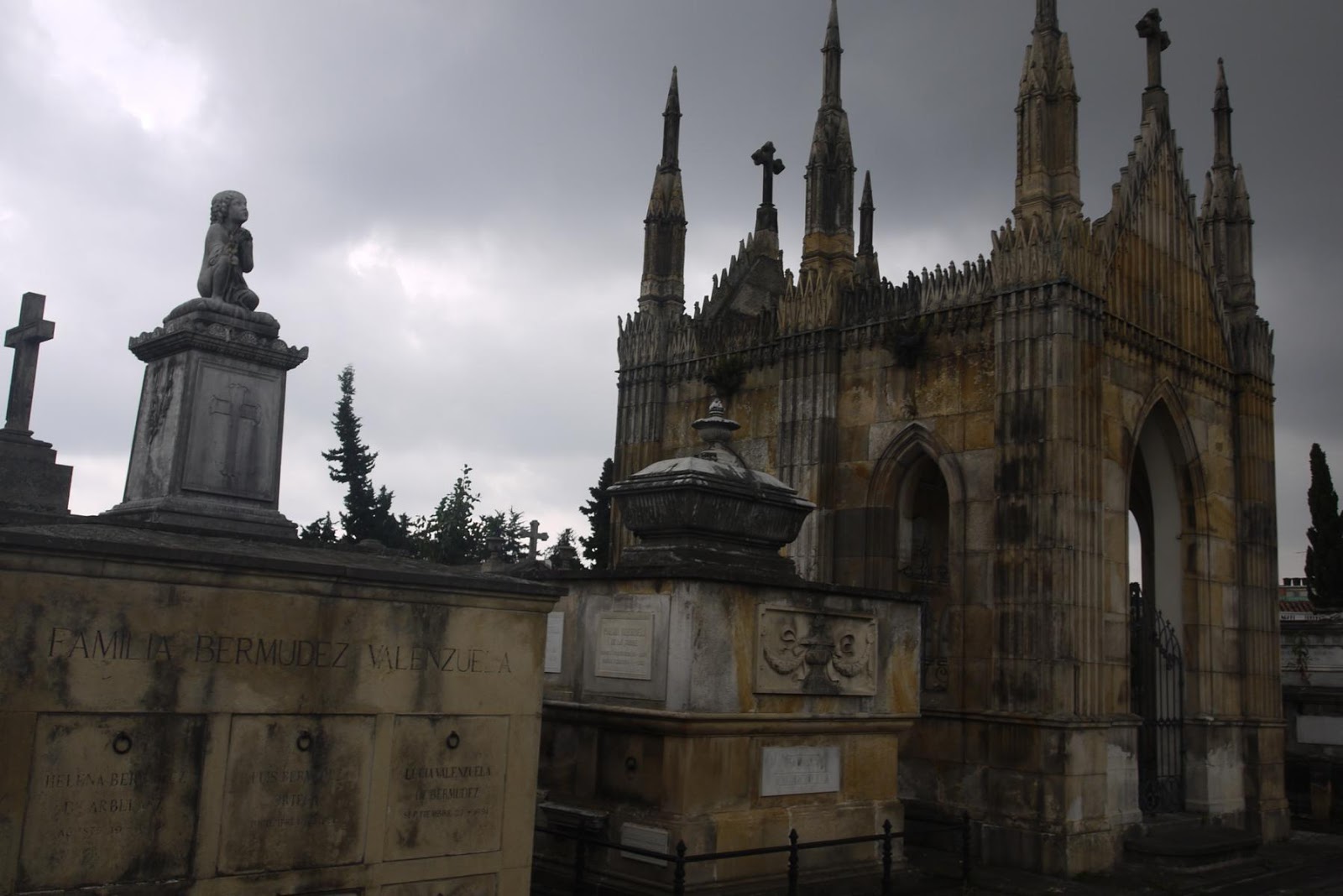
In tribute to Halloween, some pictures of Bogotá's Central Cemetery, which I visited a few days ago, after staying away for years. That's because the cemetery, located beside the Santa Fe neighborhood and near the red light district, has a reputation for muggings, drug taking and even shoot-outs.

That seems to have changed, however, with the cemetery's new policy of keeping its gates shut and asking for visitors' IDs, the cemetery seems to have become safer.

Nevertheless, the new do-not-enter policy also took away a lot of the cemetery's life and local color: No line of believers at Bavaria brewery founder Siegfried Kopp's tomb, waiting to give the man flowers and ask him for supernatural favors. No transvestites noting their lottery numbers on Salomé's headstone. No followers rubbing 20,000 peso bills on Garavito's tomb. Nobody scattering seed to the pigeons.

But if the cemetery has lost a lot of its old atmosphere, it's still an exhibition of Colombian history and politics.

The tomb of M-19 leader Francisco Pizarro, who ran for president.


Crypts, many for children.

The cemetery's entrance on Calle 26.

Headstones and signs being made by stonecarvers beside the cemetery.


Jose Mercado, afro-colombian union leader, kidnapped and murdered by the M-19 guerrillas.
Poet José Silva, resting beside his sister, with whom some say he was in love.
Siegfried Kopp.


Siegfried Kopp, founder of the Bavaria beer brewery. Although a German immigrant,
Kopp did not come from Bavaria.
Tomb of a Polish patriot.

Awkward neighbors: An astronomer and a supposed prostitute.
Salomé's tomb, worshipped by superstitious prostitutes.
t
The tomb of revolutionary leader and Colombian president Francisco de Paula Santander. Santander later clashed with Bolivar, and may have participated in a failed plot to kill Bolivar, who wanted to be made dictator of La Gran Colombia.

Soldiers' mausoleum.

Tomb for rent.
The tomb of Luis Carlos Galán, presidential candidate assassinated in 1989 by Pablo Escobar and others. A supporter of extraditing narcos to the United States for trial and imprisonment, Galán was almost certain to be elected president.

By Mike Ceaser, of Bogotá Bike Tours

Tuesday, September 10, 2013

The New Centro Memoria Falls Short


The new Centro Memoria, with its reflecting pool. In the background are now-empty mausoleums, once part of the Central Cemetery. 

The recently opened Centro Memoria, just off of 26th St. near the Central Cemetery, is heavy with symbolism of Colombia's long, tragic domestic conflicts: the somber building, whose design suggests a headstone; the building's walls, embedded with vials of earth representing tens of thousands of victims of the conflict; and the very location of the Centro, in Bogotá's Central Cemetery.

A visitor to the center can obtain a general understanding of Colombia's long, tragic and often senseless internal conflicts (as long as that visitor knows Spanish). But the displays - texts, photos and a video - don't rise much above high school level and do nothing to bring the conflict's tragedy home to visitors, much less bringing it to life.

An exhibit about the history of Colombia's
guerrilla groups looks like it could have come from a
high school textbook...and perhaps did. 
The Centro's very limited exhibitions consist of panels with texts and photos and a short film providing a summary of Colombia's violent history and the actors involved. It's interesting - I learned things - but this is what kids are supposed to learn in high school and tourists could find on Wikipedia. The Centro Memoria should provide something additional and different. (On the positive side, an employee told me that the exhibitions will be expanded and change every few months.)

The Centro Memoria could fill in a gap in Bogotá's cultural and educational offerings. But I found myself wishing that its exhibits were more dynamic, more interactive.

How about victims' testimonies about their experience, both written and on video?

An exhibit about the paramilitary demobilization points
out that only a tiny number of paramilitary fighters have
 been prosecuted judicially, despite their horrific crimes. 
How about asking visitors what they would do if confronted by some of the horrific situations produced by Colombia's conflict.

What if guerrillas threaten to take away your children and turn them into child fighters? Do you abandon your town or farm for refuge in the city?

How about if paramilitaries threaten your family unless you denounce your neighbors as guerrilla sympathizers?

What if you're a soldier whose unit is expected to murder civilians to inflate guerrilla kill numbers? Do you cooperate or risk your own life and career by opposing your comrades?

The video: 'From Gaitan to La Havana.'
If you live in a town where paramilitary death squads are performing 'social cleansing' by hunting down and killing prostitutes, drug addicts and small-time criminals, do you keep quiet?

What if you're a small farmer ordered by a cartel to plant drug crops? Those sorts of terrible decisions have contronted thousands or even millions of Colombians, and could bring home the drama of the nation's conflict.

Dictator Gustavo Rojas Pinilla in a scene from the video.
And how about asking visitors to consider some of the big questions facing Colombia in its negotiating with the FARC guerrillas in Havana Cuba? How should guerrilla leaders be punished for their numerous crimes? Or, should Colombia give in to their demands for particularly the punishment - or lack of same - to be given to the guerrillas. Is political representation for the FARC too high a price to pay for representation in Congress, as a necessary price for ending a half-century of killing, kidnapping and forced displacement?
The 1954 massacre of
university students by the
Rojas Pinilla regime.

Neither did I see an examination of the roots of Colombia's violence: the drug trade and unequal distribution of land and wealth, which continues today. The illegal drug trade, which made 'Colombia' shorthand for violence during the 1980s and '90s and continues financing Colombia's outlawed organizations today. Would legalizing drugs, as Pres. Santos has suggested, deprive Colombia's violent groups of their fuel?
Old radios on a wall. I don't know what
these were doing there. 

Colombia's current conflict involving leftist guerrillas, right-wing paramilitaries and drug cartels is only the most recent chapter in its domestic conflicts. Before that was the politically-driven La Violencia. Before that, other guerrillas and terrible civil wars.

A display details the number of
people killed and displaced
by the conflict. 
Certainly, the Centro Memoria is primarily a research organization. It participated in a recent report which documented hundreds of thousands of killed and millions displaced during recent decades of Colombia's conflict. But those studies will be read mostly by academics and NGO officials. The Centro Memoria provides an opportunity to tell the tragic story to a different audience, of students, tourists and casual visitors. But to do that well will require more dynanism and immediacy.

In fact, I was struck to find a bunch of colorful mobile exhibits about political activists assassinated in Bogotá left outdoors to be damaged by the wind and rain.

Capsules of soil imbedded
in the walls represent victims
of the conflict. 
As a sideline, it'd also be nice to have an exhibition about the archeological research done during the building's construction. Students from the National Unniversity excavated human remains and found evidence of witchcraft and other occult burial practices, as well as Bogotanos' lives during decades past. They did not, however, find remains of victims of El Bogotazo, the huge riots triggered by the April 1948 assassination of populist leader Jorge Eliecer Gaitan in downtown Bogotá, when thousands were killed. Photos show bodies piled up in the Central Cemetery, and historians have long believed that victims were interred in mass graves on this block to the cemetery's west. Gaitan's assassination intensified a violent conflict between the Liberal and Conservative political parties known as La Violencia, which killed hundreds of thousands of people during the following decade.

The Centro Memoria is located just off of Calle 26, just west of the Cementerio Central. It opens every day except Sunday and is just a short walk from from the TransMilenio station of the same name. 
An 'Act of thanksgiving' from the faithful. A candelabra in a wall from the land's time as part of the cemetery.
The center's land includes this large, wooded field. What use will they give it?
These mobile exhibits about political activists and leaders assasinated in Bogotá have been left outside to be damaged by the sun and wind.

The Centro has two parking lots for cars, one of them underground, but no bicycle parking. 

Images of the now-empty mausoleums, once part of the Central Cemetery. A pair of artists stenciled images of dead being carried on stretchers, representing victims of Colombia's conflict. It was a huge project - there are some 9,000 tombs.


Empty tombs.


By Mike Ceaser, of Bogotá Bike Tours

Tuesday, July 2, 2013

A Grave for a Great Man?

Visitors at Lopez Michelson's tomb in Bogotá's Central Cemetery.
President Lopez Michelsen, who presided over Colombia - even if he didn't lead it - from 1974-78, left a mixed legacy. His presidency was marked by economic turmoil and corruption accusations - but Michelson also invested in rural areas, signed border agreements with Colombia's neighbors and built lots of infrastructure. Never afraid of taking strong stands, Michelson clashed with the Catholic Church by legalizing divorce and civil marriage. His party, the MRL, supported the Cuban revolution and allied itself with the Communist Party.


Michelson, a Liberal whose father was himself president two times, may have left his biggest impact

by helping endi the National Front agreement, in which the Liberal and Conservative political parties passed the presidency back and forth every four years. (The agreement was made to end the La Violencia.) After his presidency, Michelson stayed active in politics, writing newspaper columns and leading daring but ultimately unsuccesful initiatives, such as a prisoner exchange to free those kidnapped by the guerrillas and a plan for drug lords to turn themselves in in exchange for not being extradited. At the age of 90, he announced his support for gay marriage. He died in 2007, leaving his latest newspaper column half-written in his study.

Michelson's family tomb.
Michelson has received a burst of attention this week, the 100th anniversary of his birth. El Tiempo called him 'The last of the great ones.'

But for years I've been fascinated by a more mundane aspect of Michelson's story: his extraordinarily humble tomb. It's just a grassy rectangle, often with weeds and some trash, near the entrance to Bogotá's central cemetery. Its plaque lists only Michelson's name and the years he was president - as if that was the only time that he actually mattered.

The huge tomb of Lopez Michelson's father,
Alfonso Lopez Pumarejo, who was president twice.
A cemetery visitor once blamed the small grave on the ex-president's 'ungrateful children.' Others have speculated that the family's waiting for the earth to settle or for his wife to pass away in order to build a tomb.

In any case, Michelson's resting place contrasts sharply with those of his ex-president neighbors, some of whom lie under grand memorials, and even the big, black marble tomb of Colombia's last dictator Gustavo Rojas Pinilla. The most extraordinary tomb of all, ironically, belongs to Michelson's father, Alfonso Lopez Pumarejo, who was president of Colombia twice, 1934-38 and 1942-45.

Someon who does not admire Michelsen recently stuck this note on his tomb saying: 'Here lies a leader who did a lot of bad and little good. The bad he did very well and the good he did very badly.'
To me, Lopez Michelson's humility is all to his credit. If only more politicians preferred to spend money on their nations rather than their own legacies.
Michelson gets some respect with a flowr bouquet on his tomb. 


By Mike Ceaser, of Bogotá Bike Tours