Showing posts with label fascism. Show all posts

Wednesday, May 2, 2018

May Day March 2018

'Freedom Now! No more frame-ups!' Supporters of jailed FARC leader Jesús Santrich carry signs demanded his freedom.
Members of the FARC's political party -
also known as the FARC - march thru downown.
Surprise, surprise: this year's May Day paraders denounced Trump and called for Santrich's freedom. They were right on one count - Donald Trump has no place is decent society. But evidence against Santrich - a one-time FARC guerrilla leader who is now in prison on drug trafficking charges and may be extradited to the United States - looks quite strong. Perhaps the strongest evidence against Santrich is the fact that the Santos administration, which made the peace deal with the FARC the centerpiece of its reelection campaign - appears to agree that santrich is guilty - despite the huge embarrasment to the peace deal.

I was shaken - emotionally - by a group of mixed martial arts fighters, who labeled themselves anti-fascists, but appeared thoroughly fascist to me. When I took their photos - as I did of all the groups which passed me - they very obnoxiously stuck their own cameras into my face and took my photo, to attempto to intimidate.
Che Guevara: everpresent.

A phalanx of police protects a government building.


FARC supporters show off the flower symbol.

Despite all the evidence, a faile dream never dies.


¡Revolución ahora!


These 'antifascist' marchers looked pretty fasist to me.


A cause I can believe in: marijuana depenalization.

An 'anti-fascist'demonstrator photographs me to intimidate me from photographing them.
By Mike Ceaser, of Bogotá Bike Tours

Friday, November 9, 2012

Colombia's Cultural Immigrants


'Let's Help the Victims of Fascism!!!' 
Many of the immigrants came fleeing 
fascism in Europe.
Colombia has attracted far fewer European immigrants than have other Latin American nations. Nevertheless, they have made a big impact on the country's arts and culture, as an exhibition on now thru January in the Luis Angel Arango Library shows.

My knowledge of Colombian cultural history is way too thin to evaluate the influence of these men and women. However, their stories, as refugees from European fascism or South American dictatorships, were surely gripping.

A letter by writer Otto de Greiff to
Casimiro Eiger offering sympathy for
the murders of Eiger's relatives by the
Nazis in Poland.
The most detailed drama told in the exhibit is that of Casimiro Eiger, born in Poland in 1909. He traveled to Paris to study, and while there Nazi Germany invaded his homeland. Soon after, the Nazis invaded France as well. Eiger, who was Jewish, fled to Morroco, where he and other refugees boarded a ship that sailed to West Africa, but then returned them to Morocco, then controlled by Vichy France, a Nazi puppet Regime. The refugees then boarded another ship, which sailed along the South American coast seeking a country which would accept them. They were finally allowed to enter Curacao, a Dutch colony in the Caribbean. From there, Eiger emigrated to Colombia. The exhibit includes a brief letter from Colombian poet and journalist Otto de Greiff expressing his sympathies that Eiger's relatives back in Poland had been murdered by the Nazis.

In Colombia, Eiger became an accomplished art critic and promoter of the arts.

Eiger worked in Bogotá with Hans Unger, another refugee from Naziism who had arrived in Colombia
By Robert West.
from Austria in 1938. Unger was one of several German-speaking immigrants who set up literary bookstores which also contained art galleries and became centers of intellectual activity. Unger established his Libreria Central in the Pasaje Santa Fe, just off of Ave. Jimenez. Nearby, an immigrant from Germany and dissenter against Naziism Karl Buchholz opened the Librería Buchholz bookstore/gallery, which soon became another cultural landmark.

A fellow member of the exodus from Hitlerism was Walter Engel, who fled Austria for Colombia in 1948. In Colombia, Engel became an art critic and friend of artist Fernando Botero. In 1965, he moved to Toronto, Canada, where he opened an art gallery which promoted Latin American works.

Clemente Airó also fled fascism, but that of Francisco Franco in Spain. Born in Madrid in 1918, the anti-fascist Airó was interned in a concentration camp and Franco took power. Airó fled to Colombia in 1941 and here founded a monthly arts magazine called Espiral, which also advocated leftist causes. He died in 1957.

Marta Traba (1923 - '83) fled the Peron dictatorship in Argentina and came to Colombia in 1954. She became a noted essayist and art critic. She died in Spain.

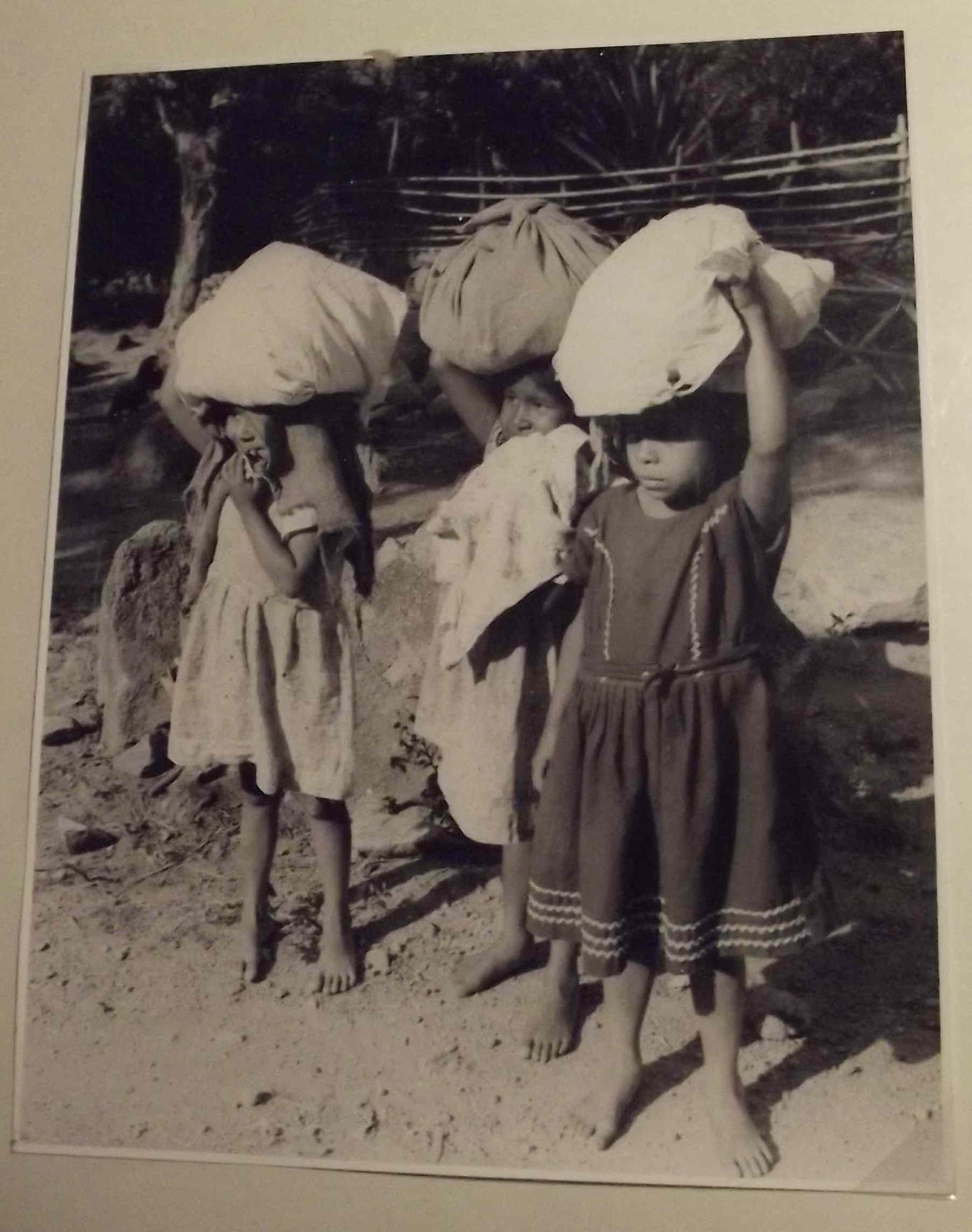
The exhibit also includes the documentary-style photos of Robert West, whose origin is not mentioned. Nearby are photos by anthropologist Gerardo Reichel-Dolmatoff, who left Austria for Colombia right before World War II. Reichel-Dolmatoff, who died in 1995, is remembered as the father of anthropology in Colombia. But recent research revealed that as a young man in Austria he had been a fervent Nazi and apparently assassinated rivals of Hitler. The library's exhibit doesn't mention this dark part of Reichel-Dolmatoff's past.


The Alsina, in which Casimiro Eiger and
other refugees fled Nazi Europe. 

Karl Buchholz in an interview. 

Photos by Anthropologist Gerardo Reichel-Dolmatoff.

Photos by Anthropologist Gerardo Reichel-Dolmatoff.

By Robert West.

Photos by Anthropologist Gerardo Reichel-Dolmatoff.


Photos by Anthropologist Gerardo Reichel-Dolmatoff.

Photos by Anthropologist Gerardo Reichel-Dolmatoff.


Art critic Marta Traba.


By Mike Ceaser, of Bogotá Bike Tours

Friday, April 15, 2011

Jackboots for Liberty!

All march in lockstep for freedom against fascism.
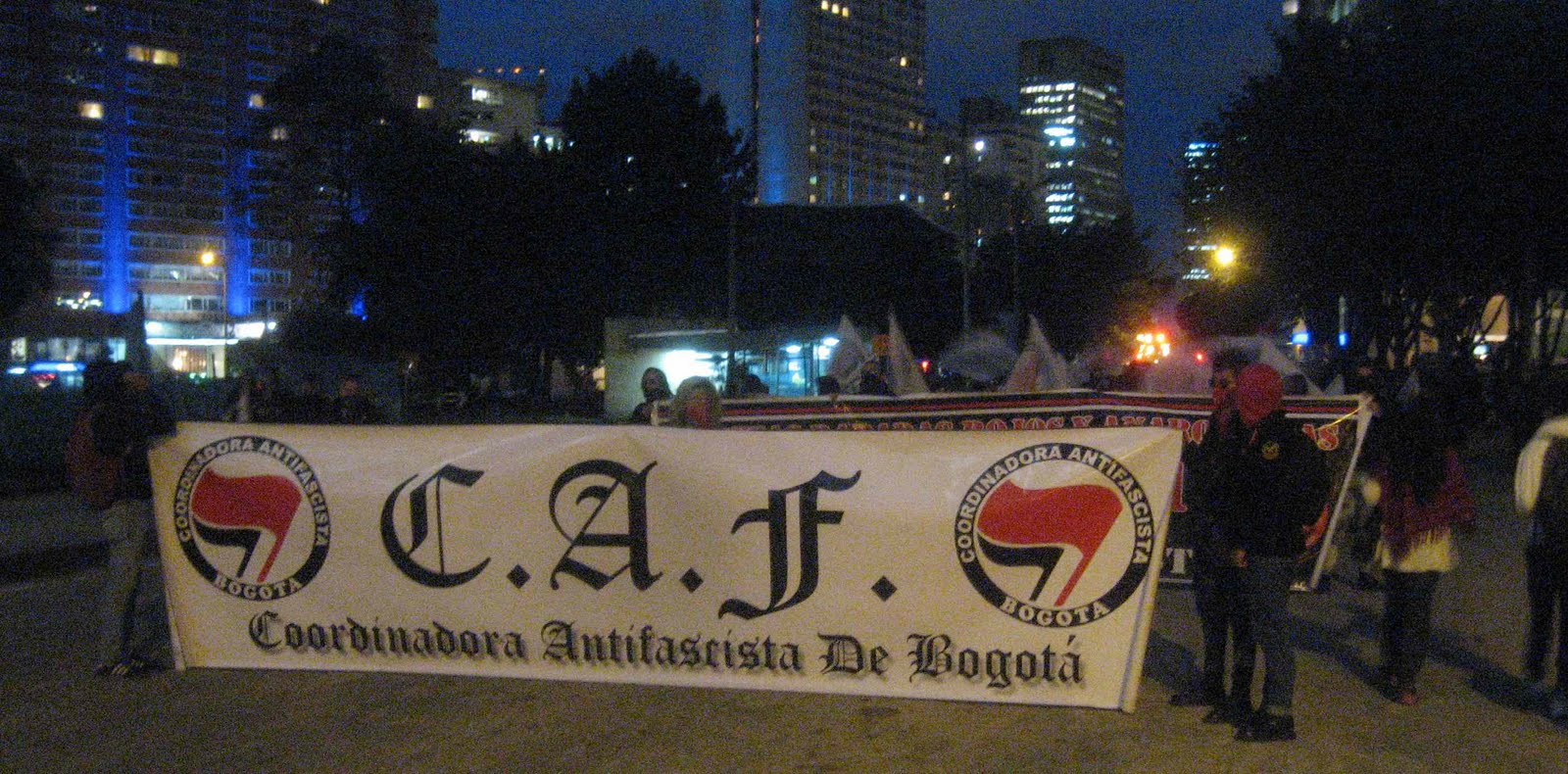
This evening I encountered this 'anti-fascist' march on Seventh Avenue. An army of muscular young mostly guys, masked, booted, uniformed and disciplined. They yelled in unison, waved their flags decorated with reverse swastikas and anarchy symbols, halted and charged forward in phalanxes. Thru the back of my mind ran newsreels of jackbooted Nazi Brownshirts.

"Down with the fascist government! Antifascists to power!"

When I snapped photos, they challenged me, several times.

"You can't take pictures of us. We have our own photographers."

"This is a public event in a public place," I said. "And this is a free country."

The guy didn't question my statement about it being a free country.

"In the past, people have made bad use of photographs," he told me. "I recommend that you don't take pictures."


Confronted with a bunch of masked, burly young men, I retreated and took photographs discretely from further away - a completely pointless exercise with my cheap little camera. But the guy's warning told me more about them than did their banners. What sort of a group believes it has the right to dictate how it is portrayed? That only its own version of reality counts? A fascist one.

The next time I approached the march and started snapping, the anti-fascists called another enforcer. By this time, tho, I'd thought about things and come up with an argument.

"Have you taken pictures?" he asked in the tone of someone used to being obeyed. "That's prohibited. Show me the photos in your camera."

"You know," I said, "you have a very fascist attitude."

I didn't put the camera down. I felt nervous. But perhaps the approach of the city's anti-riot police, employees of this supposedly fascist government, who were escorting these protesters down Bogotá's most important avenue at rush hour, gave me security.


Many people have observed that the political extremes often intersect in their own forms of totalitarianism, as in Hitler and Stalin, generally disastrous for their own peoples and nearby nations. For another example, look next door at Venezuela, where a supposedly leftist president has eliminated checks and balances, repressed the independent media and just said that he'll stay in power until 2019, at least. (He was first elected in 1999.)

I once had a discussion with a Colombian neo-Nazi. (Absurd on its face in a nation with very few people of Aryan descent and where most people are of mixed ethnic heritage.) They are of course explicitly racist, altho they deny hating anybody, and spout wild conspiracy theories about Barack Obama being a communist agent. Today's supposed anti-fascists seemed little different, besides the swastikas being flipped over. Despite their anti-racist rhetoric, I didn't see a singly non-white face in their ranks, which says something. And, ir they want to dictate who will photograph their march, can you imagine how they'd dictate the media if they ever reached power?

Colombia's government certainly has issues with freedom of speech and repression of dissidents. But the anti-fascists' own march, down Bogotá's principal avenue, puts the lie to their claims about the government and says something about their own ideological blinders.

One of the anti-fascist's flyers told more about them then their banners did. Alongside a drawing of a muscular man glaring at the reader and readying a punch, it said: 'In the neighborhood anti-Nazis rule.' It was written by the Kennedy Anti-Fascist Front, whose slogan is 'Commitment, Revolution and Liberty,' the words encircling the image of a muscular, growling dog readying a punch and flanked by the symbols of anarchy and communism. Confusing, since communism has almost always meant uniformity and obedience, while anarchy has never led to equality.


Kennedy is a huge, mostly poor area in South Bogotá, with lots of crime and violence. These 'anti-fascists' look to me like yet another urban tribe, a gang of kids who define themselves by their enemies and mistake hate and group cohesion for ideology.

By Mike Ceaser of Bogotá Bike Tours