Showing posts with label children. Show all posts

Sunday, March 18, 2018

Cheating Children of their Green Space


'We need green areas to breathe!'
'We want more recreation.' 'We want to breathe.'
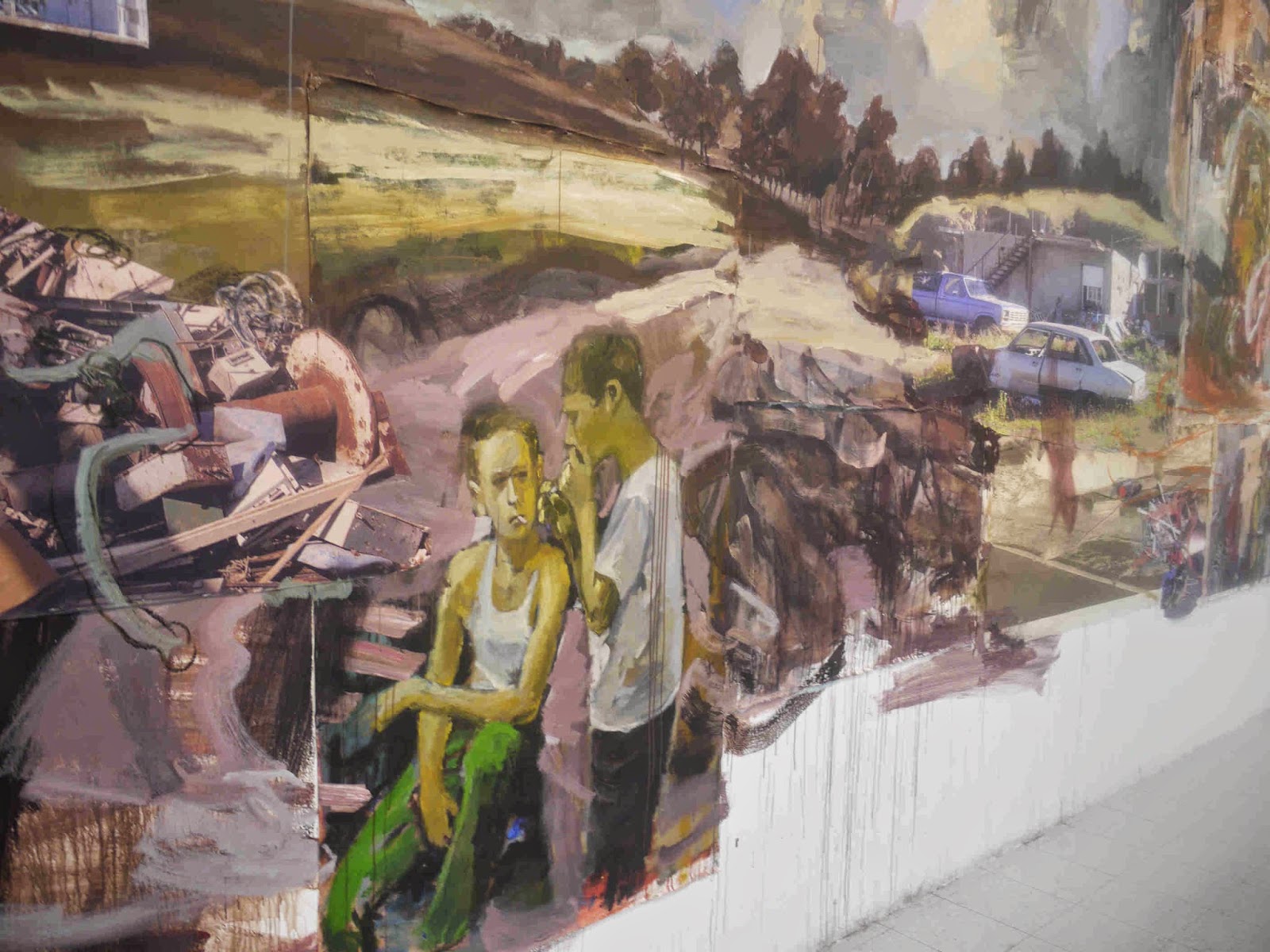
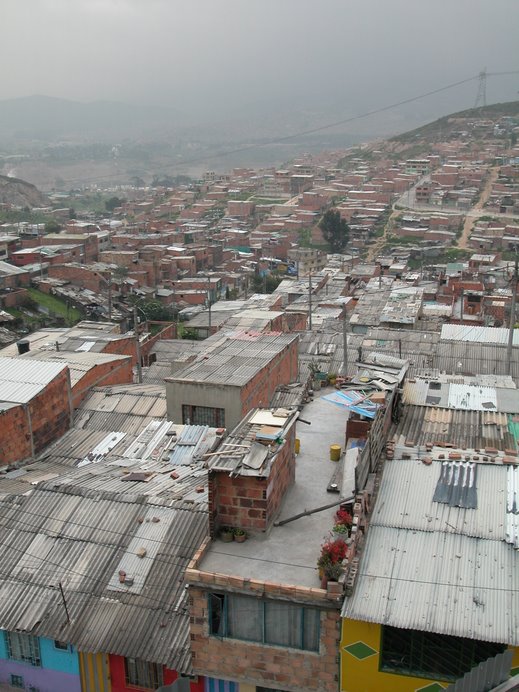
 Recently, schoolchildren marched thru the gritty Santa Fe neighborhood calling for more green areas and recreational spaces - which are in short supply in the poor, industrial area. The neighborhood also has some of Bogotá's poorest air quality.

Yet, ironically - and infuriatingly - just a few blocks away there ARE large green spaces - which are -incomprehensibly - fenced off from the neighbors' use.

A fenced off green space along Calle 26,
across from the INPEC.
When the city built the TransMilenio line along Calle 26 to the airport in 2011, for no apparent reason they demolished houses and businesses long both sides of the avenue. Since then, the land has sat empty and unused, fenced off with barbed wire and with dogs and guards to keep out anybody who dares to walk their dog or play ball on the grass.

When tourists ask me why this is, I just shake my shoulders and confess that city bureacrats, who are obviously much more intelligent than I am, must have very good reasons to spend our tax money  to deny Bogotanos access to public green space.

Jaime Garzon, the martyred comedian, scowls down at the off-limits green area.
Don't dare walk your dog in this green area along 26th Street.
Don't you dare walk on the grass!
No approaching this mural.

A grassy area, once part of the Central Cemetery, could be turned into a large park, rather than fenced off.


By Mike Ceaser, of Bogotá Bike Tours

Wednesday, February 7, 2018

What! Me Market Smoking to Kids?

Camel cigarette girls on the prowl today for young victims in La Candelaria.
I was cycling across the Plaza del Periodista this afternoon when we came upon this phenomenon: Four attractive young women dressed identically carrying marketing displays. But these weren't the cell phone or cable TV hawkers one often sees, but cigarette pushers offering Camel smokes.

Colombia signed the World Health Organization's global treaty on tobacco, which is supposed to end marketing to youth; and Camel manufacturer RJ Reynolds' own website boasts about its code supposedly safeguarding against marketing to people who are under 21, or utilizing models who are younger than 25.

So, why are these young women, whose very appearance associates smoking with youth, healthfulness, sex appeal and social success doing offering cigarettes, with their accompanying scourges of addiction, lung disease and heart attacks, in a neighborhood full of high school and university students?

Of course, the tobacco companies will swear that their marketing doesn't try to hook anybody, but only to make smokers switch brands. Who believes that?

Camel cigarette packs in a display case (which is NOT advertising)
beside candies on a Bogotá sidewalk.
By Mike Ceaser, of Bogotá Bike Tours

Friday, December 1, 2017

Sexual Violence as a Weapon in Colombia's Conflict

Sexual abuses have been in the news not only because of the endless parade of headline-making sex crimes, often targeting children, but also because of revelations of wholesale sexual attacks being used as a weapon of war by Colombia's various armed groups. 

A recent report by the Centro de Memoria titled 'The War Written on the Body' counted more than 15,000 sexual attacks amidst Colombia's armed conflict, committed by armed groups of all types, including the official military. That number, of course was surely a huge undercount, since most such crimes are never reported.

The report included testimonies by women and girls recounting attacks by armed groups, often as punishment for supposed disobedience. One woman, for example, had helped her children escape from being recruited as FARC fighters, for which misdeed the guerrillas gang raped her. Other women were targeted with attacks as warnings to or punishment against their husbands, for example for not paying protection money to the armed groups. 

One FARC leader, Raul Reyes, who was killed in 2008 by a Colombian military bombing of his camp in Ecuador, kept an escort of female guerrillas, some as young as 10 or 11, whom he sexually abused.

A graph shows numbers of reported cases of sexual abuse
related to Colombia's armed conflict. Cases
peaked in 2002 and 2014.
A young girl recruited by the guerrillas described in the Centro Memoria's report how the guerrillas arranged newly arrived girls up in two rows: the virgins on one side, the rest on the other. The virgins were given to the guerrilla commanders for their recreation, while lower-echelon guerrillas had to make do with the others.

Female guerrillas who became pregnant were usually forced to have abortions or had their newborns taken from them.

A conservative politician calls for
life sentences for child abusers.
Sex crimes are also in the news because some conservative politicians are advocating for capital punishment or life in prison for child rapists. That has many asking why the demobilized guerrillas - many of whom committed sex crimes, as well as murder, kidnapping and forced displacement - should get off with little more than a symbolic punishment, and even be allowed to hold political office.

And I also wonder why the wave of accusations (almost all of them certainly true) of sexual misbehavior against prominent men in the U.S. has not spread to other places, particularly Latin America. After all, in a nation like Colombia where many men feel entitled to make sexual comments to women on the street, and where machismo culture is strong, is it credible that much worse things don't happen in the privacy of offices and studios?

By Mike Ceaser, of Bogotá Bike Tours

Friday, May 5, 2017

What's Missing From These Lunches?

Children lunching in La Candelaria.
I noticed these schoolchildren eating lunch today outside the patrimony office in La Candelaria. But for me something was missing: They consumed soft drinks, pizza, but no fruits or vegetables. Or, how about a sandwich, with tomato and lettuce.

I don't know about you, but my school lunch always included an apple and an orange or other fruit. All of that sugary, processed and cholesterol-packed food won't do these kids' futures any good.


A few blocks away fruits and veggies for sale in La Concordia's market.
By Mike Ceaser, of Bogotá Bike Tours

Wednesday, March 25, 2015

'Childhood Without a Divine Treasure


Colombian artist Vicky Neumann has worked in the United States and Europe. But she came home to do the powerful exhibition about children, poverty and sexual exploitation on now in the National University's Art Museum, located near the Bogotá campus's Calle 45 entrance.

The exhibition, titled 'Childhood Without a Divine Treasure,' is scheduled to continue thru July 4.

The museum has a second exhibition, by Colombian artist Oscar Murillo, who lives in London, about capitalism and exploitation.


By Mike Ceaser, of Bogotá Bike Tours

Tuesday, October 21, 2014

To Catch a Thief?


This afternoon in the Teusaquillo neighborhood during a bike tour we came upon this scene, in which two tough-looking men were apprehending this kid, whom they accused of stealing, apparently a car's rear-view mirror.

Scenes like this one aren't rare in Bogotá, where residents frequently take the law into their own hands after crimes - or alleged crimes. In this case, thankfully, the two men didn't beat the kid up, altho that might have been because we witnesses were nearby with cameras, and someone called the police, who showed up quickly. I've seen other incidents in which people beat up an alleged criminal, with the justification that 'the police will just let him go.'

Why is the man in the striped shirt carrying a pistol? Does he really think that two big men need the help of a firearm to detain a small kid? Would he really use it against this kid for supposedly stealing a mirror? And, does he have a license to carry a firearm in the first place?

And, how about the kid? He looked like a homeless drug addict, and very desperate. Had he been kicked out of his home? Beaten or abused? Desperate to eat or more likely to buy bazuco, he tore off a mirror worth a few thousand pesos in El Bronx and started running. He didn't get far this time.

Perhaps he's in a children's home by now and will come out better for the experience. But more likely he's in a cell with other criminals, or back on the cold streets by now.


By Mike Ceaser, of Bogotá Bike Tours

Tuesday, May 20, 2014

A Bus Burns Up, but the System's Burnt


A bus carrying children from church in Magdalena Department turned into a flaming hell the other day, killing 31 kids and severely injuring about 20 others after its unlicensed driver poured gasoline onto the carburetor.

That driver is now in jail, as is the Presbetyrian minister who apparently hired the unlicensed driver along with the bus, whose registration and mechanical review documents were expired.

The minister, left, and bus driver, right, in police custody.
Of course, these two men should be prosecuted for this totally needless tragedy. But what about the authorities who allowed a disfunctional machine to stay on the road and continue transporting children? What about officials who turned a blind eye to this unlicensed driver, whose mechanical knowledge and ethics evidently left lots to be desired.

When a bus crashes, when a building collapses, when a discoteque burns, when a coal mine catches fire, fingers point at the final obvious villain: the careless driver, the construction company which used cheap materials, the mine owner who cut costs by leaving out safety measures.

But what about the officials who allowed the tragedies to happen by turning a blind eye to the legal violations - and will again, unless they are punished? How many other buses with expired papers and unlicensed drivers are carrying children around Colombia? I bet there are lots.

In rural regions, I suspect, the good old boys do each other favors by overlooking details such as drivers licenses and mechanical revision certificates. But nobody did these dead children or their families any favors.

Unless the underlying system changes, expect more tragedies - and more bus drivers taking the fall for a disfunctional system.

On a related note, I can't help commenting on the quote from one of the severely burned children, published in El Tiempo, saying that 'God loves me.' I feel for the victims and their families, I hope that God loves them and I'm happy that their faith gives them comfort at this terrible time. But, burning a child to the edge of death and killing his friends is a very strange way for a god to express his love. The faithful will say that the tragedy was the act of men (and probably women as well), and that God saved the survivors. But if God is everywhere, then where was He when the driver was about to pour the gasoline onto the carburetor, and why didn't God puncture the gasoline container? Where was God when police let this unlicensed driver stay on the road? How about when officials turned a blind eye to the delapidated old machine?

And, needless to say, if anybody should be under God's protective, watchful eye, it should be children on their way home from church.

By Mike Ceaser, of Bogotá Bike Tours

Tuesday, October 8, 2013

What do the Madres Comunitarias Want?

Madres Comunitarias protesting today on the steps of Congress on Plaza Bolivar. 
 The Madres Comunitarias, women who take care of neighborhood children in their homes, have been protesting for months. But, during the last several days, many have gone on strike, and today groups of madres occupied churches across the country.

Nationwide, there are almost 80,000 Madres Comunitarias, who are employees of the ICBF, the Colombian Institute for Famly Wellbeing. They turn their homes into neighborhood day cares, generally in poor areas. But they complain that their pay is poor, while their responsibilities are great, that their jobs are informal and that they do not receive pensions, even after decades of work.

Blowing the horn for Madres' rights.


Santander is pesent!


By Mike Ceaser, of Bogotá Bike Tours

Sunday, September 29, 2013

Adoption Dog Days in Bogotá


United States photographer Alec Soth was evidently enchanted by Bogotá while he lived here during the adoption process of his daughter a few years ago. And he recorded his impressions, many of them of dogs, and now has them on display in the Museo de Bogotá in La Candelaria.

I'm no judge of photography, but that has never stopped me from expressing opinions. I'm not exactly sure what gives these photos more artistic value than photos of dogs which most people could take. For a Bogotá resident, who sees these same sorts of dogs and bogotanos every day, the photos seem routine. But they might be interesting for someone who's never visited here, particularly if the only images of Colombia they've seen involve drugs, bombings and kidnappings.

But art is all subjective, and Colombian adoption is more interesting to talk about.

This happens to be the street I live on in La Candelaria.
The Santa painting has since disappeared.
Historically, Colombia seems to have been a fairly popular source for adoption, particularly for Scandinavian families - in any case, a good number of Scandinavian families with children, as well as Scandinavian young people who were adopted from here have come to do bike tours as a way to get to know their birth country. Not all adoptions have been completely aboveboard: One young woman who did the bike tour told me she'd tried locating her birth family only to discover that her adoption papers had been falsified.

But in recent years, following scandals, Colombia has made the adoption process longer and more demanding and given priority to Colombian families over foreign ones. In mid-2012, Colombia put a hold on new applications from foreigners for children under six years old who don't have either physical or mental problems.

Despite these new restrictions, as well as long waiting times, Colombia seems to be receiving lots of attention from adoption agencies because many other countries have restricted foreign adoptions even more.

Adoption can be a wonderful thing, and the adoptees from Colombia I've met have seemed generally healthy, happy and satisfied with their lives (altho those who were not probably wouldn't have come to visit in the first place). But adoption can go wrong, and adoptees are sometimes exploited. Read this jarring Reuters investigation about how U.S. families 're-home' adopted children they don't like using online networks.

And, disturbingly, I found at least one adoption site with this glib pitch which focuses on the adoptive families' convenience, not so differently from selling any sort of inanmate product.

Medical and psychological evaluations are provided with all referrals, providing a complete overview of the child a family is adopting. These wonderful children are often home in as little as six months. For families who want to provide a home to an older child, Colombia is a perfect adoption option....

Why Adopt From Colombia

Healthy, well-adjusted older children and sibling groups available

Sibling groups are available of all ages

One of the most affordable adoption programs available anywhere
Short waiting time


Previous divorce acceptable

It makes me wonder whether, pitching children this way, however positive the intentions may be, only sets families up for disappointment and rejection when parenting turns difficult.

 The best-known adoption of Colombia children in recent times was that of two young boys by a New York Times reporter who is gay. Predictably, conservatives tried to block the adoption. I haven't seen anything since about how the boys are doing. According to adoption websites, Colombia now frowns on gay couples and single men adopting from here.


By Mike Ceaser, of Bogotá Bike Tours