Showing posts with label climate change. Show all posts

Sunday, September 9, 2018

A Climate Protest Against...Peñalosa

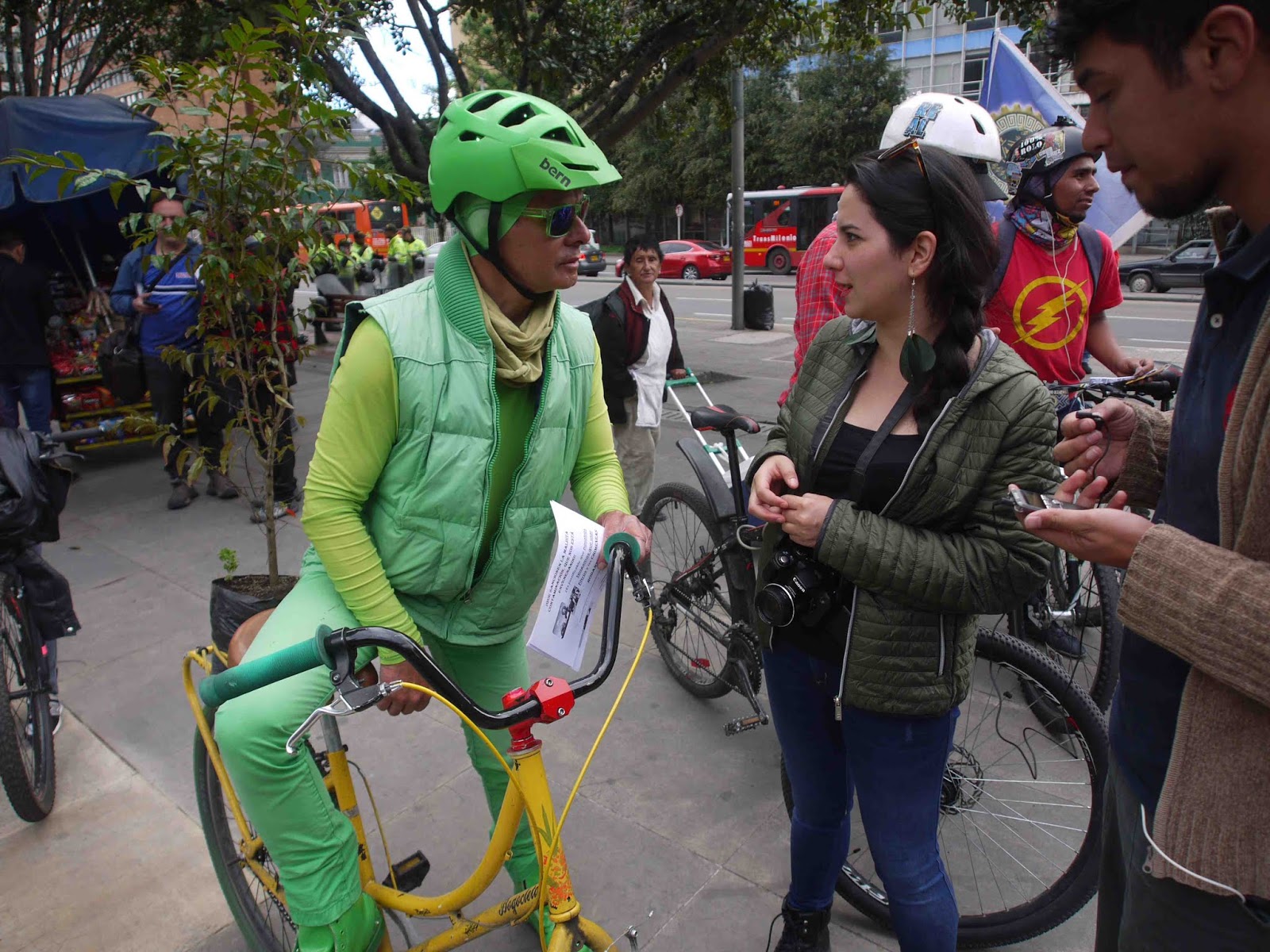
Rallying for the climate - kind of - in the Parque Nacional.
At a rally against climate change yesterday participants protested against...Mayor Peñalosa.

The gas masks say 'No TransMilenio.' Does this make sense
 if it means keeping the old 'rolling chimney' buses around?
Some of the issues seem reasonable, such as protesting the recent cutting of urban trees (the city says that some trees have become hazards). And defending the Van der Hamm protected area north of Bogotá, which the city wants to develop (the city says the protected area has already been damaged).

But the rally's primary emphasis seemed to be opposition to the expansion of the city's TransMilenio express bus system...the very same system which has won international awards for reducing climate change gases.

And, while it is a different, if related, issue, many TransMilenio buses are relatively clean burning, and the city promises that buses on the planned
'Bogotá free of fossil fuels.' We'll
expect that one tomorow.
Septima corridor will be electric or gas-powered zero emission vehicles. Meanwhile, many of the old buses running on the avenue are literal rolling chimneys. Is keeping those polluters on the road by opposing TransMilenio really pro-environment?

Even more absurd were the calls for a 'Bogotá free of fossil fuels.' If only! But such unrealistic fantasies only distract from achieving real changes.

And if these people were really against climate change, they'd oppose the private cars inundating the city by the tens of thousands every year, which generate much more greenhouse gas per-rider than buses do, as well as hogging space and clogging roads. But I didn't see a word against private cars.
Two old 'rolling chimneys' which passed the park where they were protesting against TransMilenio.


Protest these? New relatively clean TransMilenio buses on Carrera Septima.


Don't cut down trees!


Smoking away. No contradiction between protesting pollution and polluting.
Smoking away: These pollution protesters saw no reason not to pollute themselves.

Activist Greenman at the protest.

No TransMilenio on Carrera Septima - because we like those old rolling chimneys!


No TransMilenio on Ave. 68.

Protect the wetlands.
By Mike Ceaser, of Bogotá Bike Tours

Tuesday, May 8, 2018

Rushing to Burn Coal


Coal producers know that their dirty fuel's days are numbered. If concerns about global warming - burning coal pumps more carbon into the atmosphere per unit of energy generated than does either oil or natural gas - don't lead to coal's phaseout, then the rapidly dropping prices of solar and wind-generated electricity will make coal obsolete sooner or later.

Colombia's El Cerrejon coal mine,
near the Venezuelan border, owned 
by BHP Billiton, Anglo American 
and Glencore, also produces about 33 
million tons of coal annually. 
That's why coal producers, including Colombia's Drummond, face an economic reality. If they don't sell their coal soon, they might have to leave it in the ground.

So Drummond - and undoubtedly other producers - are planning to accelerate their coal mining, long term environmental impacts be damned.

Drummond produced about 33 million tons of Colombian coal last year, and plans to raise annual production to 35 million tons with hopes to one day reach 40 million tons. At that rate, perhaps, it can exhaust its Colombian reserves before before coal sunsets.

According to the great majority of the world's scientists - as well as basic common sense - pumping huge quantities of carbon dioxide and other gases into the atmosphere is altering the planet's climate in fundamental ways. However, Drummond doesn't seem concerned - I didn't see a mention of climate change on the company's website - and neither does the El Tiempo newspaper, despite all its protestations about  environmental problems, headlined its interview with Drummond's Colombian CEO 'That's how things are done' and didn't mention global warming. And neither does the Colombian government, which claims to aspire to sustainable development while overseeing unrestrained resource extraction.

By Mike Ceaser, of Bogotá Bike Tours

Wednesday, December 13, 2017

Doubling Down on Climate Change


The World Bank will stop financing oil and natural gas prospecting and drilling projects after 2019, but Colombia's oil industry vows that won't slow its exploitation of the dirtiest sorts of hydrocarbons.

So, even tho Colombia will be hard hit by climate change: it will lose biodiversity, coffee-growing regions will suffer, its glaciers will melt and the city of Cartagena may be left as an island - its oil sector sees no reason to reduce its contribution to that crisis.

That means investing some US $42 billion over the next two decades, say oil industry officials to drill
Colombia's non-conventional hydrocarbons
are in some of its most biodiverse regions.
some 7,000 new wells and perhaps double Colombia's new hydrocarbon production by increasing controversial methods such as fracking, which some experts warn threatens Colombia's water supply.

'Colombia doesn't have the luxury of leaving these resources in the ground,' the El Espectador newspaper writes, in what sounds like a quote from an oil executive.

Unfortunately, the cost of pumping out these resources, in lost biodiversity and natural areas, and particularly in destruction from climate change, may far outweigh its oil income. But nobody appears to be considering that side of the balance sheet.

Colombia can't stop climate change on its own - and it may in fact be way too late to stop it at all. But once it really gets going, Colombia will have nobody to blame but itself.

And many of the non-conventional resource blocks overlap indigenous territories.
By Mike Ceaser, of Bogotá Bike Tours

Tuesday, December 5, 2017

The Beginning of the End for Coffee?

Production in peril. Coffee may be on the way out.
Is this the beginning of the end of Colombian coffee? That's the suggestion of the Australia-based Climate Institute, which reports that Colombian coffee production will suffer greviously 2050, while the world's wild coffee could be extinct by 2080.

Sacks of Colombian coffee ready to be shipped. 
The Climate Institute is undoubtedly correct that the planet is warming and that will cause devastation in crops around the world, particularly in tropical regions such as Colombia - where coffee now grows best.

Coffee won't end, however. Researchers will develop new varieties, new growing techniques and plant the crop in new regions further north and south. In fact, they're alread planting coffee in southern California.


But those measures won't prevent huge dislocations: What will happen to the millions of small farmers and others who depend on coffee now? They will not be able to migrate to any new coffee-growing regions, because other people already live there. Moving uphill to cooler climes won't solve their problems, either, since mountains shrink towards their peaks. And, as coffee shifts to the north and south, that will mean huge environmental impacts as land is deforested for new plantations.

All these changes will mean a more expensive mug of Starbucks. But that will be the least of our
Colombian coffee employs more than a half-million families,
or 2.7 million people.
problems. Because, if a warming climate alters coffee cultivation, it will also change farming of other more critical food crops. And that could mean famine, migrations, epidemics and other human and natural catastrophes.

Coffee alone supports more than two million people in Colombia, and tens of millions across the globe.

The Climate Institute's advice to drinkers is to purchase carbon neutral or sustainably grown coffee. But that doesn't address the climate change gases generated by coffee's shipment across the world from tropical to wealthy nations. And the coffee economy's impact is only a drop in the barrel compared to the global economy's climate change change gases.

All of which means that to save coffee - as well as many other crops and innumerable wild species - we'll have to fundamentally change the world's economy - fast - and that's not likely to happen in time.

Colombia will suffer badly from global warming. The country is already losing its glaciers, and the city of Cartagena may be transformed into an island, among many other impacts. But none of that has slowed Colombia's own enthusiastic contribution to climate change: Colombians are buying cars and traveling by airplane at a frenzied pace; gasoline and other fuels receive huge subsidies; deforestation is charging along; and the government aims to pull all the oil, gas and coal it can out of the ground.

Colombia is a victim, but also perpetrator of its own suffering.
The climate institute predicts dire consequences for Colombia from global warming.
By Mike Ceaser, of Bogotá Bike Tours

Saturday, June 3, 2017

Colombia's Climate Contradictions

Congested cars on Calle 26 pump carbon dioxide into the air. Colombians buy more than 20,000 new cars per month.
Donald Trump has taken a wrecking ball to international cooperation, to the United States' image and to the planet's future by withdrawing the U.S. from the Paris climate accord.

However, judging by the climate policies of the rest of the world, including Colombia, which is supposedly sticking with the accord, the agreement is headed for failure, anyway.

Colombia seems like a good example of this:

The country signed the Paris agreement, but has proceeded to enthusiastically dig as many fossil fuels
Colombian oil production, in red, and consumption, in black.
(Chart: Wikipedia.)
out of the ground as possible. Colombia's production of coal, the dirtiest fossil fuel, is still growing fast, and oil production may level off only because they can't find more of it.

Ecopetrol's Reficar Cartagena refinery complex,
recently expanded.
The country also made a major long-term investment in the fossil fuels industry by modernizing Ecopetrol's Reficar refinery in Cartagena, a project which went $6 billion over budget, spurring corruption investigations.

Meanwhile, Colombian car ownership is booming, and deforestation rages on.

Still, Colombia is doing well compared to many other oil producers, particularly its neighbors Ecuador and Venezuela, both of which subsidize the price of gasoline and other energy forms, essentially paying people to waste energy. Venezuelan car owners pay only about one U.S. penny per liter to fill their tanks, but that hasn't stopped Caracas from signing the Paris agreement or lecturing developed countries about their environmental policies. Nor do other oil producers, such as Saudi Arabia, Kuwait and Iran, see any contradiction between signing the Paris agreement and producing oil and subsidizing its consumption.

Colombia also subsidizes its gasoline, though much less than does Venezuela.

Colombia is also said to be one of the world's most vulnerable nations to climate change.

World car sales are rising, and almost all of them burn fossil fuels.
(Chart: Andemos)
Needless to say, the world would be better off in many ways, besides in climate change terms, if it cut back on fossil fuel consumption: the air would be cleaner, cities would be quieter and more liveable, and people would likely get more exercise, from walking and bicycling. And fewer forests would be cleared.

Trump has squandered the U.S.'s leadership and moral standing as well as the planet's environmental future in return for a few votes and donations from fossil fuel producers. But at least give him credit for honesty. Trump withdrew from the climate agreement, instead of leaving the U.S. on the list while pursuing environmentally poisonous policies.

However, the danger now is that the rest of the world will use Trump as a convenient whipping boy, and an excuse not to act themselves.

Higher and higher: Colombian coal production. Coal is the dirtiest fossil fuel,
and Colobmia is producing more and more of it.
(Chart: Wikipedia)


By Mike Ceaser, of Bogotá Bike Tours

Wednesday, April 26, 2017

Mocoa - An Act of God or of Man?

The Mocoa tragedy was made worse by deforestation in the region and human-driven climate change.
When torrential rains pushed tons of mud over the town of Mocoa, in Putumayo Department, killing more than 300 people at the end of March, many condemned the 'natural disaster.'

Rescue workers in Mocoa this month.
However, the disaster's iimpact was made much worse by human actions which prepared the way. Colombia is suffering an accelerating deforestation. And the region surrounding Mocoa had been severely deforested during recent decades, reducing the soil's capacity to soak up rainwater. When rain falls onto deforested soil, it runs off quickly, carrying soil, trees and rocks with it. Forests can also serve as protective barriers. In fact, in El Carmen, the one Mocoa neighborhood which escaped destruction, residents had preserved their protective forest.

More broadly, The New York Times reports that more frequent natural disasters in places such as Colombia and Peru appear to be tied to human-driven global warming.

Before rushing to condemn the vagaries of nature, Colombians should also reflect upon their own actions.

By Mike Ceaser, of Bogotá Bike Tours

Saturday, September 19, 2015

Immobilizing for Climate Change

The banner behind the traffic jam says 'Great mobilization against climate change on Sept. 22nd.'
A single cyclist amidst a sea of cars.
You heard it hear first: On the 22nd of this month, Bogotá will 'mobilize against climate change,' and most private motor vehicles will be prohibited that day. Sadly, however, all the rest of the days the city seems to be mobilizing in favor of climate change and global warming.

Mayor Petro has made climate change one of the headline issues of his administration. However, he has overseen an historic boom in car ownership and accompanying boom in traffic jams. Petro entered office promising to create a congestion charge, but never pushed the issue, instead fiddling with the failed 'Pico y Placa' car restriction policy.

Bogotanos mobilizing - or immobilizing - for climate change.
Colombian officials recently promised to reduce the nation's global warming gas production by 20% by 2030. The goal looks admirable, but very impossible, in a nation where the number of cars is skyrocketing and which depends on agriculture, coal and oil exports and transportation. Colombian officials must know the goal is impossible, unless they expect the economy and population to start shrinking very soon.


By Mike Ceaser, of Bogotá Bike Tours

Thursday, May 28, 2015

Melting Away

Good-bye to the snows of Santa Marta. (El Tiempo)
For thousands of years, they crowned Colombian peaks: Anomalous white caps in the heart of the tropics. But, in a few decades, they will all be gone.

Colombia has about six remaining glaciers, depending on how you count them, the best known being in the Cocuy range and the Sierra Nevada de Santa Marta. In the mid-1800s, only a geological blink of an eye ago, it had about 17. Over the past 165 years, Colombia has lost almost 90% of its glacier-covered area. During the three decades between 1980 and 2010, 57% of the glaciers disappeared.

The disappearance of Colombia's glaciers, which is part of a trend also including Asia, Africa and the rest of tropical South America, does not have only environmental impacts: it is also eliminating important tourist attractions and cultural sites for indigenous peoples. For farmers, glaciers store water during the rainy season and release it slowly during dry months. Without glaciers, the rainwater rushes down quickly, carrying away topsoil and destroying the land.

The glaciers' demise is being caused by climate change. To deny that the climate is changing is to deny reality. And the overwhelming majority of scientists agree that human activity, by pumping greenhouse gases into the atmosphere, is changing the climate.

Loss of area by Colombian glaciers, between 1950 and 2010. (Graph: IDEAM)


By Mike Ceaser, of Bogotá Bike Tours

Thursday, April 9, 2015

Colombia, Climate Change Victim or Culprit?


'A dryer coast and rainier Andes mountains because of climate change.'
Yesterday's El Tiempo headlined a report about climate change's coming impact on Colombia: higher temperatures and droughts in some regions and flooding in others. Colombia can expect less predictable harvests and more natural disasters, such as landslides.

'Climate change, a different challenge for each region.'
El Tiempo's article also framed Colombia as a victim, pointing out that the country produces only 0.37% of the globe's CO2 production. That's true enough - but Colombia is also the planet's fifth-largest coal exporter and an important producer of petroleum, all of which is burned elsewhere and turned into carbon dioxide. Colombia is also suffering galloping deforestation, which turns forests into aerial carbon. And, a car driven a kilometer here, or a mile of plane flight here pumps as much carbon into the atmosphere as does the same car driven or a plane flown in the U.S., Europe or Japan.

Colombians are not climate victims, but POOR Colombians - like poor people all over the world - who don't drive cars, don't travel by plane and consume little - are the victims.

Climate change victims, or culprits?
What can Colombia do to deal with climate change? Construct water reservoirs, build dykes around Cartagena and Santa Marta and move peasant farmers to new lands. It will be expensive and traumatic.

The wealthy, whose high consumption ways are causing this mess, will likely weather it best in the end.

And the El Tiempo newspaper, naturally, falls into that category. Its reporting about climate change is squeezed in between advertisements for the cars and international travel which pump more CO2 into the atmosphere.

Colombia has climate change victims, but those complaining about it aren't among them.

By Mike Ceaser, of Bogotá Bike Tours

Saturday, October 25, 2014

Nicolas Maduro Turns Green


Pumping nearly-free Venezuelan gasoline. (Photo: Flickr)
Believe it or not: The leader of major oil exporter, who spends billions of dollars every year to pay people to burn gasoline, is denouncing oil production for destroying the planet.
Barbarous, savage and anti-human?
Preparing for a fracking job. (Photo; Wikipedia)

But Venezuelan Pres. Nicolas Maduro doesn't mean all kinds of oil production, of course. Maduro has denounced hydraulic fracturing, or 'fracking', which he calls "barbarous, savage and anti-human."

Fracking does have its special dangers, including causing small earthquakes, consuming lots of water and maybe polluting groundwater. But its greatest danger is that, like all hydrocarbon production, it pumps carbon into the atmosphere, driving global warming. According to data from The Guardian, in 2010 Venezuela produced 5.8 tons of carbon per person per year, compared to 1.6 for Colombians and 2.3 for Brazilians.

“What stands out is the squandering of petrol at the cheapest price in the world – two cents of a dollar per liter – which does not even cover production costs,” Juan Carlos Sánchez, a member of the Intergovernmental Panel on Climate Change (IPCC) told IPS News in 2012.

Since then, the price of gasoline in Venezuelan has plummeted as inflation there has soared, making the country even more wasteful.

Big, new, gas guzzlers in Venezuela. (Photo: Flickr)
Add to that galloping deforestation, and Venezuela manages to rival even some rich, developed nations, such as Switzerland, in its pollution.

But all this irresponsibility and selfishness hasn't stopped Venezuelan leaders from denouncing other nations behavior.

"We have no doubt that (failure of anti-climate change agreements) is due to the irresponsible attitude and lack of political will of the most powerful nations," late Venezuelan Pres. Hugo Chavez said at a climate conference in 2010. (Nor has their hypocrisy stopped leftists from non-judgmentally quoting Venezuela's leaders as they spout off.)

Chavez was right about other nations' irresponsibility, of course, but that doesn't change his own hypocrisy.

Maduro's real complaint is not the fracking is destroying the planet, but that it is destroying Venezuela's economy. Fracking has enabled the United States to become a huge petroleum producer, pushing world oil prices below the level at which Venezuela can meet its expenses - including the cost of giving away gasoline.

All of which reminds me of a time while I was living in Caracas when, as a journalist, I was covering some sort of chavista revolutionary conference held in a central Bogotá high-rise. As I was looking over the event's program, which included speeches denouncing genetically modified foods - which haven't harmed anybody, as far as I know - I looked out a window at hillside slums, where towers of black smoke showed where garbage was burning - pumping carcinogenic toxics into the air. But nobody cared.

By Mike Ceaser, of Bogotá Bike Tours

Sunday, September 21, 2014

Bogotá's March for the Climate


Anti-climate change marchers on the Ciclovia today.
Bogotanos participated in the global 'March for the Climate' today, supposed to combat global warming. Bogotá Mayor Gustavo Petro has made fighting climate change a centerpiece of his discourse - but not of his policies, unfortunately.

Petro has implemented some limited pro-cycling policies, but under his watch the number of private cars - and particularly motorcycles - has boomed. That's not exactly Petro's fault, but he has not advanced policies, such as a vehicle congestion charge or real solid waste reduction laws, which could reduce the city's global warming gas production.

'Help the planet? Don't eat meat!'
That said, Bogotá and Colombia in general still do produce relatively small amounts of global warming gases per capita. That's because Colombia's a developing nation in which car ownership is still lower than its neighbors and because almost all the country's electricity is generated by hydropower.

However, car ownership is growing fast, the country is losing it forests at a dramatic rate and it's a significant and growing exporter of hydrocarbons, particularly coal, the dirtiest fossil fuel. And Colombia recently approved the use of fracking, meaning it hopes to accelerate still more its fossil fuel production.

As in Colombia, climate change gases are booming across the developing world. According to a report released today, the planet set a new record in greenhouse gas emissions, driven particularly by China and the United States.

Consciousness-raising marches may be a good first step. But it'll take real lifestyle changes for the planet's wealthy if we want to halt climate change before it becomes too late.


Communist marchers denounce capitalism as the cause of environmental destruction. That's true enough, but communism, which can brought us Chernobyl and other disasters, didn't do any better.
Greenpeace - despite its idealism - or because of it - opposes nuclear energy, which is the only low-carbon energy source that can realistically replace fossil fuels in the medium term.
Factories 'Guilty of Causing Sicknesses.'


'Protect Our Wetlands.'


Soon after passing the climate change march, I spotted this pollution-belching bus, a half-block from the Ministry of the Environment.  
While global warming gases and traditional air pollution are different things, 'rolling chimneys' like this one are an indication of the government's lack of seriousness in environmental matters.


The city government has permitted projects like this one, a private university's massive parking garage being built on Bogotá's hills. 
Projects like this one contribute to climate change (and damage quality of life) in multiple ways, by promoting private car use and deforesting the hillside.

By Mike Ceaser, of Bogotá Bike Tours