Showing posts with label public transit. Show all posts

Tuesday, October 6, 2015

A Dusty Demolishing

Dust rising over the city center, seen from La Concordia.
Mount Vesuvius erupting in Bogotá? Not quite. This afternoon, the city demolished a building
Future or fantasy? The planned Estacion Central.
located in a delapidated area a few blocks west of the Colpatria Tower. The plan is to build a huge transit/office/housing/retail complex there named Estación Central.

Hopefully, the project will actually happen, and not fall victim to corruption, budget cuts or diverting of funds to the monumentally expensive subway fantasy.

Meanwhile, if only there were a way to knock down buildings without generating huge dust clouds, which must inject billions of tiny particles into the air.


By Mike Ceaser, of Bogotá Bike Tours

Thursday, May 14, 2015

Adiós to Those Old Buses?

A SITP bus and private buses on Carrera 10 in central Bogotá.
Once again, Bogotá's city government has promised to retire those old buses which do so much to pollute our air and turn the streets chaotic.

http://www.eltiempo.com/bogota/salida-de-empresas-de-buses-de-bogota/15743195
Can it be true? 'End of the hegemony of the old public transport companies.'
And let's hope that they actually fulfill their word this time, even tho they've been promising the end of these buses since the 1990s.

'¡Urgent, Petro Deceives!' A sign on a bus protests
the old buses' phase-out.
Unfortunately, however, lots of things could happen between now and then, including protests by the bus industry, which in the past have shut down the city; If they can't reverse the law, the bus owners might find a way around it, thru bribery or deception. According to a recent court ruling, during past campaigns in which owners were paid to junk the aged, highly-polluting buses, some bus owners managed to get paid for junking the same bus several times - sometimes without actually junking it at all. In other cases, bus owners have sent the bus's shell to the junkyard, while placing the old, polluting engine into another bus, where it continues belching smoke.

And, according to news reports, the city plans to integrate hundreds or thousands of those old buses into the SITP system, in which they will be repainted, undergo a name change and continue belching smoke.


A common sight: An old bus belches smoke on Calle 26.
By Mike Ceaser, of Bogotá Bike Tours

Thursday, March 12, 2015

An End for the Old Buses?

Soon to be gone? Ancient buses wait on Carrera 10.
Bogotá officials say - once again - that those old buses wheezing and groaning along our avenues squealing their brakes and belching smoke will be gone in a few months.

Of course, they've been promising this for years, and yet they're still here. And this latest promise has a huge 'but': It'll only happen if two of the near-bankrupt SITP subcontractors can get on their feet financially, which will require a miracle.

There are good reasons to get those old buses off of the streets: They pollute and contribute to a street-congesting surplus of public transport. But the buses are also profitable, and so their influential owners want to keep them rolling - and polluting.

A recent headline in El Tiempo announcing the elimination of the old buses...
And a similar story from 1996 announcing the disappearance of the old buses...
An old bus belches its way along Carrera 10.
But if reducing pollution is the city's goal, then they should get rid of the dirty buses, whatever their age. And that might mean shutting down TransMilenio....

A TransMilenio buses issues a cloud of smoke in La Candelaria, along the Eje Ambiental.
By Mike Ceaser, of Bogotá Bike Tours

Tuesday, October 14, 2014

Higher Train, Lower Price Tag

A ride with a view from Medellin's metro. Why pay more to bury a train line underground? (Photo: Colombia Travel)
Bogotá underworld is a crowded place: power lines, natural gas pipes, sewers, building foundations and lot and lots of loose earth, because Bogotá was built on top of a wetland.

That's a very, very inconvenient place to try to build a train line.

But above Bogotá, there's a lot of....empty space.

Urban trauma: Subway construction in Toronto, Canada.
(Photo: UrbanToronto.ca)
As many analysts have pointed out, the most expensive and slowest place to put a train line is exactly where Bogotá plans to: Underground. Ex-Mayor Enrique Peñalosa says so in a long essay in today's El Tiempo. And the other day an official from Medellin, whose own train line is partially underground, said it clearly: "It's not viable at all...Building an underground subway line is crazy."

An elevated train costs lots less to build and to maintain than does an underground line. (And a ground level train is even cheaper.) That's a fundamental factor for Bogotá, which can't figure out where it'll find the estimated $7.5 billion dollar price tag of the first underground subway line. (The cost is equivalent to the city's whole annual budget.)

A ride in an elevated train line is also lots more pleasant. I grew up mostly in the San Francisco,
Riding in the sun. A BART train pulls into a station. (Photo: NBC Bay Area)
California Bay Area, which has a regional train system called BART. Various BART segments run underground, on the surface and on elevated tracks, and I can tell you that when a train emerges from a tunnel it's like a breath of fresh air: Sunlight replaces fluorescent lights and views of the city and mountains replace gloomy black tunnel walls. Cellphone reception improves, too.

So, more people will ride an elevated train - and enjoy it a lot more.

And it's no secret that one of Bogota's big drivers for building a subway line is status. That's why city leaders keep repeating that Bogotá's the only big Latin American city without a metro, and one of only a couple of cities its size in the world without one. Peer pressure is a bad reason to do anything. But, if what Bogotá wants is status, then building a shiny, visible above-ground train line will do lots more for the city's image than would burying that train under ground.

By Mike Ceaser, of Bogotá Bike Tours

Monday, October 14, 2013

Good-Bye to Bogotá's Old Buses?

Passengers board disordered buses on 19th Street in Bogotá.
TransMilenio chief Fernando Sanclemente promised recently that Bogotá's old, chaotic, polluting buses would be removed from the city's streets by April of next year.

Believe it only when you see it. Bogotá's city governments have seldom stood up to the bus companies, and Gustavo Petro's administration seems even more timid than his predecessors'. After all, Petro has even discontinued the policy of junking the very oldest buses.

A woman races for a bus on Calle 19. 

Hopeffully, city officials will fulfill their word this time. And if they do, let's hope that those old, polluting buses aren't simply replaced by less-old polluting buses. Those blue SITP buses and TransMillenio are supposed to replace the old buses. But the SITPs rarely seem to carry passengers. And, increasingly, they pollute just as badly as the old, traditional buses.
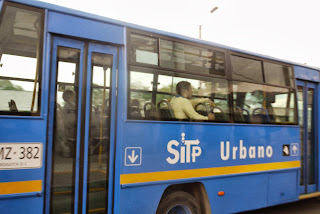
It's a lonely ride in a SITP bus.
An improvement? An SITP bus belches smoke near the Central Cemetery.

A clean, ordered, efficient bus system would be a huge step forward for Bogotá. And, in principle, the SITP makes a lot of sense. But, so far, that's not visible in the city's implementation.

By Mike Ceaser, of Bogotá Bike Tours

Thursday, May 23, 2013

When the 'Solution' Becomes the Problem


When the city introduced those blue SITP buses last year they were to be the solution to Bogotá's chaotic, inefficient and very polluting public bus system - and they may yet be. But so far they aren't showing it.

Most of the SITP buses travel empty, or nearly so. That was supposed to be a start-up problem - except that after months of operation, their ridership has approved little.
A SITP bus takes off with a blast.
But, at least, officialdom promised us, these new buses wouldn't ignore emissions laws, as the regular buses and TransMilenio buses so flagrantly do.
'Really, honestly, cross our hearts, we're actually enforce the environmental laws this time.'
Except that, as these photos show, they haven't.


Anybody in there?
I can see right thru you.

The motor's on, but nobody's home.

Bogotá's ancient, dirty and chaotic private bus fleet certainly needs replacing - but are more polluting buses - which are also usually empty - the solution?


Should we have expected anything different? After all, the TransMilenio system - an icon of Bogotá - belches out smoke pitilessly.
False advertising? A SITP flyer protrays the bus as clean (tho apparently empty).


By Mike Ceaser, of
Bogotá Bike Tours

Wednesday, November 14, 2012

The SITP's Empty Present...and Future?

Hello, is anybody in there?
I took these photos today of some of the first buses of Bogotá's much-vaunted and long-awaited Integrated System of Public Transit, or SITP. By having efficiently-designed routes and doing things like stopping only at official bus stops, the SITP is supposed to bring Bogotá clean, efficient and rational public transport by replacing the existing dirty, chaotic and inefficient private buses. (Unfortunately, however, I've observed that many of the SITP buses are also pretty polluting, despite still being new.)

But to accomplish those things, the SITPs will have to carry passengers. Every one I've seen has been empty, or nearly so. The main reason appears to be that the city has not retired the traditional buses which compete with the SITP's lines. (Altho that still begs the question of why so few passengers choose the SITP buses, which are presumably safer and more comfortable than the traditional ones.Also, you can always be sure of finding a seat!)

Is this yet another result of the bus companies' great influence over the city, which also appears to keep them invulnerable pollution and safety laws?

One good thing about the SITP - if it's actually implemented - will be the end of the murderous 'War for the Penny' in which those private buses race each other to pick up passengers for a few pesos. Just a few days ago a bus driver ran a red light, according to witnesses, and hit two children, killing one of them. Even tho the bus driver had millions of unpaid traffic fines and tried to flee the scene, police didn't jail him and he didn't lose his driver's license.

By Mike Ceaser, of Bogotá Bike Tours