Showing posts with label public space. Show all posts

Monday, May 14, 2018

A Piece of Paradise in South Bogotá

Tossing a frisbee amidst the trees. 
Entrance to a different reality:
El Parque Bosque San Carlos.
Uribe Uribe and Gustavo Restrepo are two of those nondescript working class enighborhoods of south Bogotá which are pleasant enough places to live, but have little more to recommend them. So, I was stunned when bicycling thru these neighborhoods today to come upon a forest - a real uban forest!

It's called the Parque Bosque San Carlos, and on a holiday afternoon like today it was full of neighbors walking their dogs, playing football, throwing frisbees and dancing. I didn't feel like I was in Bogotá at all - and much less the often grimy and monochronous southern side of the city.

San Carlos is smaller than the also treey Parque Simon Bolivar Park and Parque Nacional. But San Carlos is much more forested, and those other parks are located in the wealthier north Bogotá,whose residents have more opportunities to escape from the city. And San Carlos is a complete park, with jogging paths, futbol pitches, basketball courts, children's play areas and lots of green spaces.
Even flowers!

How did this happen? The park adjoins the Santa Clara Hospital, so the land must have once been part of the hospital's campus, which is why it wasn't built up with houses. I read that the trees, almost all of them eucalyptus, were planted around 1950, making them seventy years old. Some have gotten diseased, and in late 2016 the city closed the park for some six months and cut down more than 40 trees and planted 30 trees more adapted to the local climate.

 The success of San Carlos ought to set an example for the city to turn the unused lands around the San Juan de Dios Hospital and the Central Cemetery into parks as well.
A nice place to walk a dog - even backwards.


A sapling grows, presumably of a native tree.


The park has several children's play areas.

A birdhouse, and a glimpse of the working class neighborhood.

Parchita makes a friend.


Rolling away.


A great place to learn to ride a bike!

Enough room to play ball.


By Mike Ceaser, of Bogotá Bike Tours

Sunday, January 7, 2018

Who Owns the Sidewalks?

A cop watches as vendors gather up their goods on a side street off of Carrera 7.
One of Mayor Peñalosa's most prominent and polemical policies, clearing public spaces of illegal vendors, may have hit a roadblock.

Courts ruled recently that vendors who sell on a particular spot for a considerable time acquire rights
A car occupies a sidewalk in the Los Martires neighborhood.
If you park your car on a sidewalk long enough,
does that make you the sidewalk's owner?
of possession for that piece of pavement, something like eminent domain, and can't be driven off without a sort of due process. By the same token, the court ruled, by permitting vendors to use sidewalks as their retail space for years, it is implicitly saying that they have a right to be there, and authorities can't suddenly change the rules.

This is an age-old battle in Bogotá, and one which the city won't ever win. As long as there are poor people here and the sidewalks offer access to many potential customers, vendors will occupy them, even if they are forced to play hide-and-seek with the police.

A cop escorts a vendor off of Carrera 7.
It is true that many street vendors are a nuisance: They clutter and block sidewalks, compete with tax-paying formal businesses and contribute to an atmosphere of anarchy and disorder. But they also serve many functions, providing a livelihood to poor people and easy access to products for the rest of us. I've bought headphones, books, socks, fruit and shoes on the street (or sidewalk).

If only authorities could distinguish between 'good' vendors who don't block pedestrians and
don't compete with neighboring shops, and those who do do damage to urban living. Unfortunately, making such a distinction is nearly impossible, and therefore

By Mike Ceaser, of Bogotá Bike Tours

Saturday, June 3, 2017

The Tragedy Of Tagging

'Don't turn the other cheek!'
A few years ago, the city sponsored a street art festival in an alley off of Calle 13, on the way to the Paloquemao Market.
A sad street art alley.

The artists produced a bunch of colorful, interesting works, most famously the one above, sponsoring Rosie the Riveter of WWII fame, declaring 'Don't turn the other cheek!'

The phrase can be interpreted as a call for self assertion, for fighting back against gender violence, for not taking things lying down.
And here's the 'other cheek' wall today.

Unfortunately, over the years the art pieces were progressively
painted over. The cheek mural lasted the longest, making me think that perhaps the tagging gangs held it in a special esteem, and it became one of Bogotá's most iconic graffitis.

That wasn't quite true, I discovered a week ago passing thru the alley with a bike tour. Today, the wall looks like this:

All gone now.
Time for another graffiti festival!

On 26th St. as well, some of Bogotá's most famous street art pieces have been attacked.

Aren't there enough blank walls around for these guys to deface?

This anti-mining mural on 26th St. got mutilated.

This mural sponsored by the Centro de Memoria pays tribute to victims of Colombia's conflict, but not so much anymore.
By Mike Ceaser, of Bogotá Bike Tours

Wednesday, April 26, 2017

A Sound Sculpture?

The recently-installed 'sonic sculpture' at Calle 19 and Carrera 3.
Thanks to massive public outcry by readers of this blog, the city finally got its act together some months ago and installed this sound sculpture at the intersection of Calle 19 and Carrera 3, across from the Centro Colombo-Americano. Bogotá's first 'sonic sculpture,' by Oswaldo Maciá, a Cartagena native who lives in London, is supposed to broadcast the sounds of birds chirping across the traffic lanes onto the sidewalks. However, I haven't noticed anything.

The work is named 'Scene Under Construction,' and was selected from 72 entrants. I suspect that some of the other works would have contributed more to the traffic island.

The sculpture is beside newly-constructed student residences.


By Mike Ceaser, of Bogotá Bike Tours

Saturday, September 20, 2014

Wasted Space on Calle 26

Jaime Garzón, the martyred comedian, now behind barbed wire.
A handy dumpsite.
A few years ago, when the city began work on the TransMilenio line for the Calle 26, they demolished houses and businesses on both sides of the street. What did they need the space for? It wasn't clear.

But the answer's now obvious: They didn't need the space for anything.

Predictably, the empty lots the city left on both sides of Calle 26, just west of the Central Cemetery, became illegal dumping grounds, providing ugly foregrounds for the huge murals the city has sponsored there. In response, the city is now fencing the empty lots off with concrete posts and barbed-wire.

This sad jaguar and miner
will soon be fenced in.
My prediction: Within a few weeks, the barbed wire will get stolen and the dumpers will move in again.

Isn't there a better use for this land? How about green space? Lots of locals would find these areas useful for dog-walking or pick-up futbol games.

The folks who saw their homes and businesses needlessly demolished must be shaking their heads - and their fists.

A few days ago, these feet murals
were walking on trash piles.
Why did this happen in the first place? I can only speculate. Incompetence? Bad planning? Or did someone with influence own a demolition company?

Pulling barbed wire.

Stringing up barbed wire.

By Mike Ceaser, of Bogotá Bike Tours

Saturday, March 23, 2013

The Struggle for Public Space

Residents in El Parkway, in Teusaquillo,
designed by Austrian architect Karl Brunner. 
Creating and protecting public spaces has been a constant theme in Bogotá's history. City parks and plazas get sliced up by new avenues or invaded by poor homeless people or the cars of the wealthy. Buildings, legal and illegal, march up the city's supposedly protected Eastern Hills, and few protest.


Passers-by watch work on an expansion of
Parque de la Independencia. 
But Bogotá has also created new public spaces, altho almost always amidst controversy. Decades ago, Simon Bolivar Park, larger than New York's Central Park, was laid out in north Bogotá. About a decade ago, the city removed the tombs from the Children's Cemetery on Calle 26 and turned it into the little-used Parque el Renacimiento (Rebirth Park). A few years later, they bulldozed the violent Cartucho neighborhood in the heart of the city and replaced it with Parque Tercer Milenio, which does fill up with children, football players and dog walkers on weekends. Now, workers are bridging over Calle 26 to connect Parque de la Independencia to the Museum of Modern Art, in what is intended to return the park to something like its original shape.

Bogotá's public space has also been boosted over the last decade by the spaces created in conjuction with TransMilenio line construction. A law requiring all new buildings to devote 30 to 40 percent of their areas to public space has been irregularly enforced, according to El Tiempo.

Bogotá seen from its Eastern Hills. A very dense city, does Bogotá need more public space?
But other questions entirely are the condition and maintenance of existing public spaces. Some are invaded by street vendors or parked cars, or made unpleasant by trash and human waste.

In an industrial neighborhood in west-central Bogotá a
metal tree stands in for park space. 
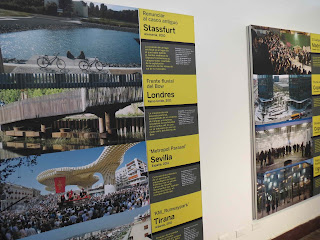
The Museo de Bogotá in La Candelaria now has an exhibition about award-winning examples of urban public spaces in Europe, which will continue thru mid-April. Creative use of public space played a part in the 'Most innovative city' award won recently by Medellin. In 2007, Bogotá was awarded the Leon de Oro during the Venice Arquitectural Festival.

Books about public space in the Museo de Bogotá.
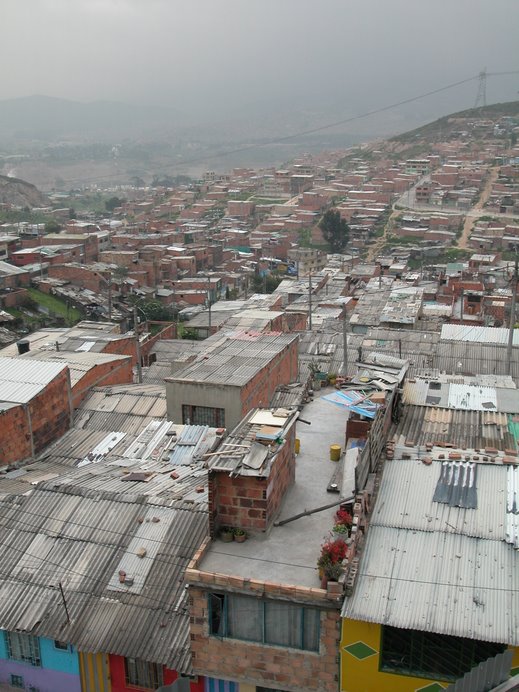
Despite Bogotá's efforts, El Tiempo reports that the city has less than 4 square meters of public space per resident, whereas international standards recommend 15 square meters per capita. Neighborhoods vary widely. Teusaquillo, for example, has 14.25 square meters of public space per inhabitant, while neighborhoods such as Ciudad Bolivar, which grew informally and chaotically, have little green space. There's also a huge gap between wealthy and poor neighborhoods: The city's wealthy north has much more public space than do poor neighborhoods in its south.

According to El Espectador, Teusaquillo (which has Simon Bolivar Park within its boundaries) leads the city with 21 square meters of public space per inhabitant. Chapinero has 7.4 square meters, Los Martires 3.3, Ciudad Bolivar 2.9, La Candelaria 2.2, Kennedy 1.4 and Suba only 0.6. The numbers were generated by MapCity.

The city official best known for creating and improving public spaces was Mayor Enrique Peñalosa, who created Tercer Milenio Park and recovered plazas which had been occupied by illegal vendors. Austrian architect Karl Brunner created the Parkway, a popular park which cuts diagonally thru the Teusaquillo neighborhood.

Men walk thru Parque Tercer Milenio, created after the El Cartucho neighborhood was bulldozed. Behind them are Bogotá's Eastern Hills, which are slowly being privatized. 
Young girls pedaling on La Ciclovia, which turns hundreds of kilometers of avenues into recreation space every Sunday.  
Cyclists on Bogotá's Sunday Ciclovia, which turns hundreds of kilometers of avenues into recreation space. 
Parque El Renacimiento was created on what was the Children's Cemetery. 

Privatization of public space by the wealthy: Cars parked on Plaza Santander. 

An overhead view of the expansion of Parque de la Independencia. 

Cyclists on Ave. Septima, which has been turned car-free during the day by Mayor Gustavo Petro. 

A missing monument along Calle 26. 

Examples of award-winning public spaces in Europe on display in the Museo de Bogotá. 


Public space created beside a TransMilenio station in central Bogotá. 

Soccer players in the evening in Parque Tercer Milenio. 
Factory workers play soccer in a street in an industrial neighborhood of Bogotá with almost no park space. 


Workers nap during their lunch hour in a pocket park in central Bogotá. 

Homeless people in the trashy Plaza España. 

A delapidated bridge in the Parque Nacional in Bogotá. 

A newly-built pedestrian bridge in central Bogotá. 


By Mike Ceaser, of Bogotá Bike Tours