Showing posts with label poverty. Show all posts

Wednesday, September 13, 2017

Let The Homeless Eat Cake - or Starve!

An anti-social act? Giving food to a
homeless old man in Bogotá.
(Photo: El Banquete del Bronx)
Chalk this one up on the list of brilliant contributions to the public good by our city government:

Food donations to the homeless must meet high hygenic standards - or the hungry don't eat!

According to one police official, the new Police Code sanctions the distribution of food that doesn't have a sanitary registration - whatever that is. Perhaps a five-star restaurant, or at least a Juan Valdez, for the homeless?

The police also claim that distributing food to the homeless can cause fights and even homicides. A strange idea, which only makes one wonder what will happen if these people DON'T get food: Will they simply starve to death silently?

Anyway, what sort of hygenic standards do the homeless people's meals comply with when they DON'T receive handouts from churches and other groups? Take a look:
A homeless man searches thru trash for things to eat or sell. 
Does the food he'll find here have a sanitation registry?
Damnit! This pizza I found is past its sell-by date.
And pity the charitable folks who want to help the homeless - but are afraid of getting punished for doing so!

This is yet another example of government officials' urge to control everything they can, and their lack of empathy for those actually living in the real world.

By Mike Ceaser, of Bogotá Bike Tours

Tuesday, May 2, 2017

How to Kill a Neighborhood


When the city slashed a four-lane avenue through the hardscrabble Egipto neighborhood above La Candelaria last year, it may have eased the commutes of some wealthy Bogotanos, but it cut the heart out of this already-troubled neighborhood.

A mother and daughter walk past a spot where small
businesses were demolished to widen the avenue.
Construction not only razed small businesses and homes along the avenue route, it also divided the neighborhood in two and has residents risking life and limb to cross what had been a narrow street.

Few residents of the impoverished and high-crime Egipto neighborhood own cars, but they suffer the expanded avenue's dangers, pollution and ugliness.

Planners seem to have forgotten about pedestrians: Street lights are far apart. Here, two women climb over the dividing rail. 
Pedestrians then must wait for a chance to cross the avenue.
The avenue benefits wealthier outsiders. Few Egipto residents own cars. 

By Mike Ceaser, of Bogotá Bike Tours

Thursday, October 6, 2016

Poverty and Peace

Impoverished Colombians are much more likely to have suffered from Colombia's conflict. So, why
did they vote against the peace accord - at least in Bogotá?

Take a look at Bogotá's voting results, as published in El Tiempo. While Usaquen, Chapinero and Teusaquillo all voted SI, while majorities in the poor neighborhoods of Bosa, USME and Ciudad Bolivar, voted NO. On the other hand, many other poor rural areas of the country, such as Chocó, Putumayo and La Guajira, voted heavily SI.
On the one hand, you might expect that victims of violence, such as the tens of thousands of displaced people living in these poor areas, would vote SI to end the conflict. El Tiempo, however, hypothesizes that impoverished Colombians object to the guerrillas, who may have victimized them, receiving government stipends and other support, as agreed to in the peace accord.

Poverty has undoubtedly fueled Colombia's conflict. It may also be blocking an agreement.

Update: Multiple news reports say that evangelical churches, which tend to be strongest in poor neighborhoods, came out strong for the No vote, which might explain both the No winning in poor neighborhoods and the higher turnout there. However, the connection between the peace deal and evangelical issues - mostly LGBT rights - is pretty tenuous.

By Mike Ceaser, of Bogotá Bike Tours

Friday, May 29, 2015

The Calibradores, a Job in Extinction?

Calibradora Blanca gives information to a bus driver.
You might have wondered what those people you see dashing thru traffic and having hurried conversations with bus drivers, notes in hand, are doing. They are calibradores, and earn a few coins by informing of how far ahead the preceding bus on the same route is running ahead of them. That enables drivers of those traditional private buses to time themselves to not follow too closely after another bus serving the same route.

It's unpleasant, dangerous work, dodging among vehicles, swallowing diesel fumes and being subjected to blaring horns. But the calibradores, many of them homeless people, have few skills or other work options. If they did, after all, they wouldn't likely be doing this in the first place.

But the calibradores may have only a few days work left, if Bogotá follows thru with its plan to integrate the traditional private buses into the publicly-run SITP bus system. Since the SITP buses run on coordinated, centrally-controlled routes, the calibradores reason for being will disappear.

Blanca on Carrera 10, her workplace.
Blanca, who was working Carrera 10 at its intersection with Avenida Jimenez, told me she'd been a calibrador for about four years, despite having university studies.

"I had to fight for this space," she said, against other calibradores, mostly homeless men, who also work the avenue.

Her profession "is an example of maldicia indigena," she said, using a term for native Colombian ingenuity.

She showed me the 200 peso coin which her last bus driver client gave her, and a sheet of paper where she noted the times when buses passed by. On a typical day she can earn about 20,000 pesos - less than U.S. $10.00, she said.

"I'm poor because I'm honest."

Blanca's notes of what times which
bus lines passed by at what times. 
The city's plan to convert the traditional private buses into SITP buses faces challenges, in particular changing the culture of buses stopping wherever they like - bus stop or no bus stop - to pick up and drop off passengers. Passengers will have to get used to paying by card rather than cash, as they do on the traditional private buses.

Blanca blames the change on 'capitalism,' and even manages to blame the United States. But the private buses are an example of unbridled, nearly unregulated capitalism. The SITP system is managed by City Hall.

And will the switch to SITP mean anything more than a change in colors? The city promoted the SITP system as a solution to, among other things, traffic congestion and pollution. But many of the SITP buses run nearly empty; and many SITP buses are themselves highly polluting.

Blanca, for her part, feels certain that the the change won't really happen. Perhaps that's wishful thinking.
A bus crier, another endangered proffesion.


By Mike Ceaser, of Bogotá Bike Tours

Tuesday, April 7, 2015

The Evolution of La Candelaria


Residents walk along a cobblestone street in La Candelaria.
 La Candelaria, Bogotá's oldest neighborhood and still the city's heart, has undergone multiple evolutions.

Poor people walk uphill toward the
Egipto neighborhood.
For centuries after the city's founding in 1538, La Candelaria was the home of the city's elite, its power brokers. The wealthy began moving out of the historic center during the 1920s, according to a report by the Universidad Nacional, and the 1948 Bogotazo devastated the city's center, pushign the wealthy north to newer neighborhoods such as Teusaquillo, Chapinero and Usaquen. Meanwhile, amid Colombia's chronic violence, the city's historic center became known for crime, poverty and decay.

However, since the early 2000s, thanks to Colombia's increased stability, lower crime rates and growing economy, La Candelaria has experienced something of a renaissance, with tourism, growing universities and rising property prices.

And now a study by Universidad Nacional students makes it official: La Candelaria is gentrifying.

Dying breed? A neighborhood shop.
According to the university report, monthly apartment rentals in the neighborhood are around a million pesos - a hefty sum in a city which defines an income of more than 200,000 pesos per month as being 'not poor' - and houses can be worth several billion pesos.

As a result, says the study, "the traditional low-income residents are beginning to migrate to other parts of Bogotá, such as the south, which can be noticed by the replacement of shoemakers and bakeries with expensive restaurants."

Today, La Candelaria still feels like a neighborhood. But, as rising rents force out traditional residents, it may lose that and turn into a district of old buildings, quaint cafes and museums.


Universities, such as the Catholic La Salle, have expanded, bringing more students and money to La Candelaria.
Increased police presence has made tourists and residents feel safer, altho crime remains a problem.
However, will La Candelaria ruin itself thru success?

Traffic jams have become chronic in the historical center. But instead of discouraging private car use, officials are allowing the Externado University to build a huge parking garage on the hillside.
A few years ago, someone built this faux-old house on Calle 9.
Whether because of corruption, lack of laws or lack of enforcement, the city keeps permitting constructions which conflict with the neighborhood's historic ambience.
Are those mushrooms behind these houses?
This multi-story apartment building going up on a cobblestone block of Carrera 3 doesn't look very colonial.
Some scenes of La Candelaria?

The Abadia Colonial Hotel was renovated by its Italian owner.
A beggar woman hawks flowers on a La Candelaria doorstep.
A delivery bike in front of a quaint store.
A view down Calle 10.
A theatre and the recently-renovated Muisca Hotel.

Tourists walk near La Plaza del Chorro.
Locals play their daily board game.

A used book store's doorway.

By Mike Ceaser, of Bogotá Bike Tours

Tuesday, October 21, 2014

To Catch a Thief?


This afternoon in the Teusaquillo neighborhood during a bike tour we came upon this scene, in which two tough-looking men were apprehending this kid, whom they accused of stealing, apparently a car's rear-view mirror.

Scenes like this one aren't rare in Bogotá, where residents frequently take the law into their own hands after crimes - or alleged crimes. In this case, thankfully, the two men didn't beat the kid up, altho that might have been because we witnesses were nearby with cameras, and someone called the police, who showed up quickly. I've seen other incidents in which people beat up an alleged criminal, with the justification that 'the police will just let him go.'

Why is the man in the striped shirt carrying a pistol? Does he really think that two big men need the help of a firearm to detain a small kid? Would he really use it against this kid for supposedly stealing a mirror? And, does he have a license to carry a firearm in the first place?

And, how about the kid? He looked like a homeless drug addict, and very desperate. Had he been kicked out of his home? Beaten or abused? Desperate to eat or more likely to buy bazuco, he tore off a mirror worth a few thousand pesos in El Bronx and started running. He didn't get far this time.

Perhaps he's in a children's home by now and will come out better for the experience. But more likely he's in a cell with other criminals, or back on the cold streets by now.


By Mike Ceaser, of Bogotá Bike Tours

Sunday, August 10, 2014

Poverty Amidst Plenty


Maria and two of her children.
The headlines roar it out: Colombia is one of the planet's economic stars, with a growth rate above 6% - perhaps the world's fourth-highest. Colombia recently overtook Argentina to become Latin America's third-largest economy.

But not all Colombians are celebrating those headlines. Throughout the countryside, in the Pacific Coast and in south Bogotá, Colombia remains an extremely poor nation, many of whose citizens feel little opportunity to rise. 34% of Colombians live below the poverty line, according to government statistics which seem overly positive to me. But in some regions, such as El Chocó, more than half of the people live below the poverty line. Colombia also has one of the world's most unequal wealth distributions, altho both poverty rates and inequality have improved in recent years.

For that matter, we pass by lots of severe poverty every day in central Bogotá.

Maria Bridget, who is 33, is one of those people. I don't remember how I first met her, but I've known her for years, during which time she's squatted at times beside a river and with her six children and grandchild in a tenement room in the sometimes violent Santa Fe neighborhood.

Maria is not poor because she doesn't want to work. She and her children glue posters to polls and walls and vends trinkets, often balloons, on the pedestrianized stretch of Ave. Septima. But even so, it's always a battle to pay the 15,000 peso daily rent on the room she shares with her extended family.

Because she can only manage to pay only a single night at a time, she pays far more for a run-down room than would someone who could pay their month's rent in advance. Besides that, there are clothing and food costs - even tho the children eat some of their meals at school or in free municipal soup kitchens. Recreation doesn't appear to be in Maria's budget, except perhaps for the glue I smelled on her breath.

A girl in a Bogotá slum.
(Photo: Corresponsales del Pueblo)
"We have to get the rent any way we can," she says. "If we don't pay 4 or 5 nights in a row, they'll kick us out."

The balloons she sells on Ave. Septima belong to another woman, who farms them out. Maria earns 1,500 pesos from each of the balloons she sells for four or five thousand pesos. But some days, especially when it rains or the police evict street vendors, she sells only a few balloons.

"If I don't sell, I don't earn anything," she says.

She can make from 10,000 to 30,000 sticking posters on walls, but that work is irregular.
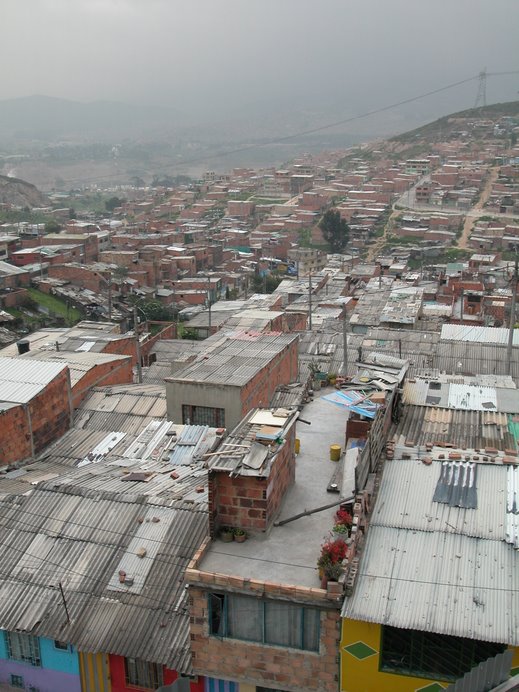
A Colombian hillside slum. (Photo: Wikipedia)

Maria and her own two siblings became orphans when she was ten after her father was shot to death and her
mother died of some disease she couldn't identify. She doesn't remember what her father did for a living or have any idea why he was killed.

It was drizzling when I spoke to Maria in a small fish restaurant in the Las Nieves neighborhood. The rain doesn't help balloon sales.

"Today I've only sold three balloons," she said, and headed back out to the street.

By Mike Ceaser, of Bogotá Bike Tours

Sunday, May 18, 2014

Skating and Biking in Barrio Egipto


 These young people were skateboarding and biking in this skate/bike park along La Circunvular, in between the hardscrabble Egipto, Belén and Los Laches neighborhoods. I wondered whether my camera was in danger, but the kids were friendly and most interested in talking about illegal drugs. They seemed impressed that I'd grown up in California, where marijuana is almost legal.

These are poor neighborhoods, troubled by crime, unemployment and gangs. And the area is suffering further insult, as the city widens the La Avenida Circunvalar, slashing the neighborhood in two.

A mural by a group of local youths called 'Emigrantes' defends embattled Mayor Gustavo Petro. 
Residents walk past an empty lot in Egipto. Homes and businesses were demolished to widen the avenue. 
By Mike Ceaser, of Bogotá Bike Tours