Showing posts with label car-free day. Show all posts

Wednesday, April 22, 2015

'Vehiculos' Self-Defeating Vision

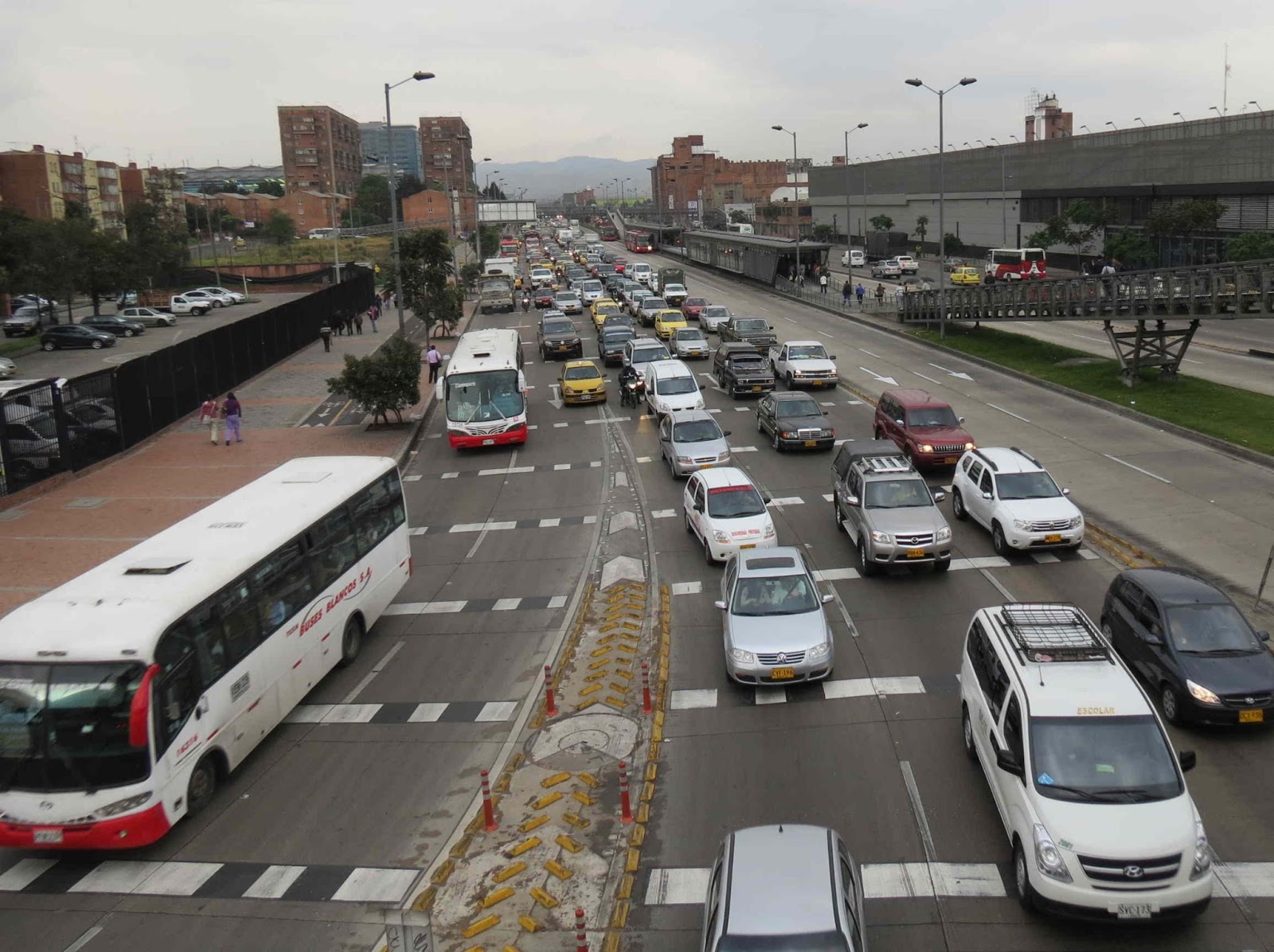
A good, gridlocked highway on the left, a bad, functioning roadway on the right, during Car-Free Day. 
In honor of its hated Car-Free Day, El Tiempo's car.-boosting Vehiculos section published this cover spread entitled 'Cars Are Winning The Battle Against Car-Free Day.'

If so, theirs is a bizarre kind of victory, judging from the photos. On the left, is Vehiculos' preferred vision: a gridlocked highway, and on the right, a mostly vacant roadway during Car-Free Day, on which traffic actually flows.

Be careful what you wish for, you Vehiculos editors, or else someone might notice that cars are killing this city.

By Mike Ceaser, of Bogotá Bike Tours

Car-Free Day: More Symbolism Than Substance?

NQS avenue this afternoon.
The same stretch of the NQS Avenue on a normal day.
Bogotá pioneered the annual Car-Free Day during the Peñalosa administration as a way to show car-dependent residents that there are other ways to get around.

Palo Quemao's Market's empty parking lot.
It's a great concept. But unfortunately, it may do just the opposite: Rather than going to school or work by bus, bicycle or foot, many car owners simply stay home on car-free days, reinforcing their own beliefs that the only way to get around is inside a huge, polluting machine.

That seemed to be the case today, during Mayor Petro's new, extra Car-Free Day, when much of the city seemed somewhat ghostly.

Don't get me wrong: I believe that cars are a scourge on cities and the planet, and I wish that every city was car-free every single day. However, Bogotá's car-free days seem mostly to generate resentment against such top-down sustainable transit measures, while changing the behavior of few people.

Petro has proposed creating monthly Car-Free Days. That will only add an additional day off or work-at-home day for many people. Better, but even less politically possible, would be to create a Car-Free Week, which would obligate drivers to find a more sustainable way to get around.

At this point, I can't help recalling an anecdote from the time car-choked Caracas, Venezuela
A normal, grid-locked day in La Candelaria.
involuntarily went car-free. In 2002, engineers and tanker captains working for the country's key petroleum industry went on strike in an effort to paralyze the country's economy and force Pres. Hugo Chavez out of office. They failed, but for weeks gasoline, normally abundant and nearly free, was unavailable. I interviewed people waiting in line - irrationally - for days at dry gas stations, even tho they could have long since gotten to their destinations by bus or bicycle.

I knew a woman there who normally drove alone in her car from the city's outskirts to her office job in central Caracas, a miserable three-hour ordeal off traffic jams. During the petroleum strike she could not get gasoline and was forced - god forbid - to take the bus - and three separate buses, in fact. But despite that multi-bus odyssey, with the roads clear, my acquaintance got to work faster by bus than she had driving her car.

I'm sure that many people had similar experiences. Nevertheless, once the oil started flowing again, the immense traffic jams returned.

Should Bogotá shut down its gas stations? It could be a good thing, but not likely. Better for the city to triple the price of gasoline, or do what Petro said he would upon being elected: Create a London-style congestion charge.

That could really reduce the driving habit.


According to El Tiempo, bicycle - or, bike parking lot - use rose 9.2%, SITP bus use rose 19% and pollution dropped 15%.

By Mike Ceaser, of Bogotá Bike Tours

Thursday, February 5, 2015

Car-Free Day: The Good, the Bad and the Futile

Jimenez Avenue in La Candelaria was crowded with pedestrians this afternoon. Bogotá's brilliant mayor suspended bus service on the avenue between 10 a.m. and 3 p.m.
Today's Car-Free Day saw a big turn-out of cyclists, a bit less pollution and proof that, yes, you really can travel across town without traveling alone in a huge, polluting, gas-guzzling machine.

Cyclists on Carrera Septima. Its bike lane was packed. Hopefully, a few of these people will pedal again tomorrow.
The day's most dramatic change was not the air quality, which reportedly improved by only 5%, or even the traffic which actually moved, but the boom in bicycling. Carrera Septima's bike lane was actually crowded, and even suffered momentary traffic jams. 

Hopefully, some of these folks will pedal again tomorrow. 

Bumper-to-bumper bicycles on Carrera Septima.
But, today, as every day, those vehicles called 'rolling chimneys' belched on, unconcerned about being sanctioned.

A bus leaves behind a river of smoke on Carrera 10.
A TransMilenio bus, the 'pride' of Bogotá, pours out smoke.
Traffic was light in La Candelaria, so it actually moved.
Here's a nearby stretch of Carrera 3 yesterday, experiencing its normal traffic jam.
The TransMilenio system carried 13% more passengers than on a normal day.
And the SITP system's passengers rose 23%, yet this bus was still mostly empty.
Great news on Car-Free Day! Last year set a record for new car sales, and this year's already outpacing it!
By Mike Ceaser, of Bogotá Bike Tours

Thursday, February 7, 2013

The Trouble With Cars

Carrera 30 near the National University flowed uncongested today. Often,  traffic just crawls along here. 
A traffic jam on a nearby stretch of Carrera 30 a few days ago. 

Bogotá's annual 'Car-Free Day', which happened today, is a beautiful dream. And here's why: Cars Kill Cities!

Private university students walk in the ritzy La Merced neighborhood. Today, the poor souls had to catch the bus or a taxi 


Nowhere to walk: Normally, the neighborhood looks like this, where the street and sidewalk are turned into a parking lot and pedestrians have to dodge cars.


On a normal day on the Avenida Circunvular cars park on the sidewalk, forcing pedestrians to walk in the road, amongst racing cars.

 On a normal day, a car tries to force its way onto Carrera 10, where buses crawl along. Private cars occupy about 80% of the space on Bogotá's streets, but transport only about 20% of people.

'Slowly or with space?'A poster advertising car-free day on an office building's bulletin board. The attorney  I met with in the building considered car-free day a terrible inconvenience. 
Cyclists ride down Calle 26, half of which was turned into a Ciclovia today.  The bicyclists' turnout was underwhelming. 

A graph from a recent OECD report on Colombia shows how traffic speed has dropped as the number of cars has climbed.
Cars wait in a minor traffic jam today. Some cars with special permits were allowed to drive around today. Radio commentators remarked on the great proliferation of 'Handicapped' signs in car windows today, which allowed them to use the roads. Even with only a few cars, they managed to generate congestion.

By Mike Ceaser, of Bogotá Bike Tours