Showing posts with label capitalism. Show all posts

Tuesday, November 25, 2014

Cartels: Then and Now

That was then: In 1993 Colombian hit men pose with the corpse of Pablo Escobar, leader of the Medellin Cartel.
Not long ago, there were the Cali and Medellin cartels, which brought a drug-fueled scourge of murder and bombings to Colombia. Then came the Norte de Valle and Oficina de Envigado cartels.
Face of the new criminal cartel?
Toilet paper for sale.

And now, the diaper and toilet paper cartels?

According to government regulatory agencies, companies in these industries have conspired to manipulate and raise prices, cheating consumers.

A few companies dominate
Colombia's toilet paper industry.
Investigators say they've found e-mails and other evidence to back their accusations. Allegedly, the companies met secretly overseas to set prices and quality. But, whatever the truth, just the fact that Colombia now has the time and resources to worry about the behavior of the diaper and toilet paper industries is a sign of how far the company has come from the time that it was near being a failed state.

A generation ago, Colombians worried that the Medellin Cartel would overthrow the government. Today, they worry that the diaper and toilet paper cartels will strain household budgets.

Capitalist greed is bad. But it's a relief compared to what Colombia's been thru.

Stealing from babies? Diapers may be the face of a dark conspiracy.
By Mike Ceaser, of Bogotá Bike Tours

Monday, December 23, 2013

Foreign Profits Win Out Over Colombian Lungs

Lobbying by U.S. truck makers means Bogotanos will suffer from smoke-spewing trucks for years to come, The Chicago Tribune reports.  
It's a story which should embarass all Colombians - and shame those of us from the United States.

This year, the Colombian Ministry of the Environment planned to require emission filters on all new
A Coca Cola truck contributes to Bogotá's air - and lungs.
Filters can remove 90% of particulate pollutants.
trucks - an environmental/health measure long required in developed countries.

But U.S. truck manufacturers, which dominate the Colombian market, cried out to heaven, the Chicago Tribune reports. The air quality measures gave unfair advantage to European manufacturers, they claimed (because the Europeans make cleaner vehicles, perhaps?). The truck makers and buyers also claimed that environmental measures were too expensive for Colombia - even tho the lack of such controls costs Colombians many billions of dollars every decade in health and other costs, according to Universidad de los Andes Dean of Engineering Eduardo Behrentz (as well as untold human suffering).

Bogotá's buses don't bother with filters, either. 
Conveniently, the malleable Colombian environmental authorities postponed the new filter requirement until early 2015, the Tribune reports (and we'll see what happens in 2015).

"The Colombian government is on the (industry) side, and it's allowing the import of technologies that are considered obsolete in the country where they were created," Behrentz told the Tribune.

The truck makers and buyers apparently also used free trade agreements Colombia has signed to argue that health and environmental measures impose unfair restrictions on capitalism, according to the Tribune piece.

But the immense health damage from air pollution, which causes thousands of premature deaths every year in Bogotá alone, means other kinds of restrictions on people's lives.

Of course, trucks aren't the only culprits contaminating our lungs. Spend a short time on a Bogotá street and you'll see that cars, buses, trucks and factories all share the responsibility - as do the authorities who turn a blind eye to the problem.

EcoPetrol recently invested huge sums to lower the sulphur levers in the country's diesel fuel to 50 parts per million - a respectable level for a developing nation. But Behrentz says that money's wasted as long as the country doesn't require emissions controls and allows decades-old vehicles to continue operating.
Even police vehicles flout environmental laws.

Behrentz, who helped write the law which was postponed, sounds embarrased about his own government.

"I don't praise my own government that chose (foreign companies') interest over the interest of the Colombian people," he told the Tribune.

Also check out my blog (in bad Spanish) specifically about air pollution:

www.airenuevobogota.wordpress.com
The result...smog blankets Bogotá.
By Mike Ceaser, of Bogotá Bike Tours

Wednesday, July 24, 2013

When is a corporate megafarm not a corporate megafarm?

When it's divided into many smaller plots - even tho they're all owned by the same big coporation.

That, at least, seems to be the message from U.S. agricultural giant Cargill corporation and Colombian sugar producer Riopaila Castilla SA.

A peasant farmer benefited by government land
redistribution plows a field. But did the land end up in
corporate hands? (Photo: El Espectador)
A 1994 law was intended to guarantee land for small campesino farmers. Many of those small farmers historically have lost their land to outlawed guerrilla and paramilitary groups - which have sometimes cooperated with corporations to steal those lands from peasants.

But the two big companies managed to amass huge spreads, anyway. In order to not violate the letter of the law, they purchased plots of land one by one from small farmers in Vichada and Meta departments and accumulated farms covering some 300 square miles. And, oddly, the companies bought the Colombian land thru other companies based in Spain and Luxembourg. Ironically, by working thru foreign-based corporations, the purchasers get the benefits of international investment promotion treaties. And, the purchases are also protected by international treaties - making them much harder to reverse.

The situation has been denounced by leftist senators including Wilson Arias of the Polo Democratico Party.
A farmer herds cattle in a photo from a Colombian
government website about land redistribution.
But did the farmer keep his land? (Photo; Incoder)

The scandal just brought down its first big name with the resignation this week of Carlos Urrutia, Colombia's ambassador in Washington. A friend of Pres. Santos, Urrutia had been a partner in the Brigard & Urrutia law firm, which helped the companies buy the land. A third big company which used the same scheme to buy lands was Grupo Aval, which also owns El Tiempo newspaper.

The law firm and companies involved insist the arrangements are legal - which they very well may be. And, according to news reports, the big agricultural companies probably won't be obliged to return the land to small farmers.

Perhaps the most troubling part of the affaire is its possible implications for the FARC-government peace negotations going on in Havana, Cuba. The FARC were born as a group of landless peasants and land redistribution has been one of their core values. If the guerrillas conclude that the government is insincere about land redistributing land, could that poison the talks?

By Mike Ceaser, of Bogotá Bike Tours

Thursday, November 22, 2012

How Carlos Slim Got So Rich


'Phrases from Homer...
Great idea boss!'
 If you have a Claro (until recently Comcel) cellphone, then you probably receive these annoying offers: 'Get Homer on your cell phone,' 'Get love and hearts on your cellphone'. It's hard for me to imagine any sane person over the age of 8 who'd actually want Homer squeaking out of their cellphone. I am over age 8 and despise the Simpsons (whom I've never watched on TV). But I installed Bart Simpson, even tho my cellphone is too primitive for these applications.

Why did I do it? Because when you press 'Okay' to make the annoying offer go away, you're uknowingly installing Homer. Sure, you can unsubscribe - but they've already charged you for a month's service.

'Love and hearts in your mobile'
Carlos Slim, who owns Claro, and with a $75 billion dollar fortune is the world's richest man, didn't make all of his money by tricking people into subscribing to Homer Simpson's inanities. And I hope that this isn't indicative of his business practices - but I do wonder.

After all, Claro - like other cellphone companies - has a policy of making whatever phone credit you don't use evaporate at month's end. Just imagine if your credit card took away all the money you didn't spend, or the grocer came and took away all the food you didn't eat by month's end. People would be out in the streets protesting.

But, for some reason, we seem to accept the cellphone companies' right to take away service we've paid for.

'Good choice' signing up,
even tho you didn't mean to.
Claro is also the company which Colombian government officials have complained is abusing its dominant market position. When the government suggested that Slim should be restricted from further expanding his dominance in the Colombian market, Slim called that unfair limitations on the free market.

Carlos Slim certainly deserves admiration for using brains and hard work to convert himself from a child of humble Lebanese immigrants into an extraordinary success story. And, I'm sure that his telecommunication, construction, mining and retail businesses have contributed to the world (altho not always so. His investments have also included tobacco companies).

Carlos Slim, bringing the Simpsons
to your cell phone!
Claro's questionable business practices coincide with another unfortunate phenomenon - the invasion of Bogotá by the Oxxo convenience store chain, which seems to sell mostly junk food and alcoholic beverages. Oxxo may displace traditional family-run stores, which do sell fruits and vegetables. If Oxxo drives those family businesses under, will we be left with U.S.-style nutritional deserts, where healthy foods aren't available? And the associated epidemics of obesity and diabetes?

Homer Simpson,
brought to you by Carlos Slim.
My goal isn't to demonize Mexico, which is a wonderful country with wonderful people. But I probably do have a bit of a grudge.

After all, when Colombians criticize capitalism and globalization, the United States is always the boogeyman. Many U.S. companies certainly deserve criticism. But give the gringos a break. We're not the only ones.


By Mike Ceaser, of Bogotá Bike Tours

Friday, October 12, 2012

Memorializing the Horrors of El Caucho

Chained indigenous rubber workers. 
Rubber king Arana.
A rubber industry workhouse. 
Colombia's indigenous people of the Amazon are commemorating the 100th anniversary of the horrific rubber boom at the beginning of the last century, when tens of thousands of indigenous people were enslaved and worked to death by a Peruvian company exporting its production to English industries in this early example of globalization.

Sir Roger Casemont, an Englishman
who investigated the rubber industry's
horrors.
Today, Pres. Santos sent the indigenous communities a message "asking for forgiveness for your dead, your orphans and your victims" sacrificed "for a supposed 'progress' which didn't understand the importance of safeguarding every person and every indigenous culture."

La Voragine, a classic novel
about the rubber industry's abuses.
(Some would argue that those words could also apply to the development 'locomotives' being promoted by Santos' government today, most of which consist of digging up and exporting the nation's natural resources, at great cost to its biodiversity and indigenous cultures.)

The horrors of the rubber, or caucho, exploitation were immortalized by Colombian writer José Eustasio Rivera in his 1924 novel El Voragine.

Almost all of the rubber production was done in the Putumayo region by a Peruvian company named La Casa Arana, which exported most of its rubber to England, altho the United States' automobile boom also drove the demand for rubber.

A sign today on Plaza Bolivar says that native
peoples have nothing to celebrate.
The English carried out several investigations, led by Irishman Sir. Roger Casemont, which reported the horrors of slavery, torture and mass murder in the rubber production. But the industry only declined after the English exported seeds and planted rubber in Africa and Malaysia, where production and transport were cheaper.

The story has a dramatic postscript. Casemont, who had also investigated atrocities by Belgium in the African Congo, went on to fight for Irish independence - by conspiring with Germany during World War I. However, he was captured by the British and hanged in 1916. Mario Vargas Llosa wrote Casemont's story in his recent historical novel  'The Dream of the Celt.'

An indigenous woman and child begging on a sidewalk in downtown Bogotá. Indigenous people from the Amazon have had a particularly difficult time integrating into western culture. 

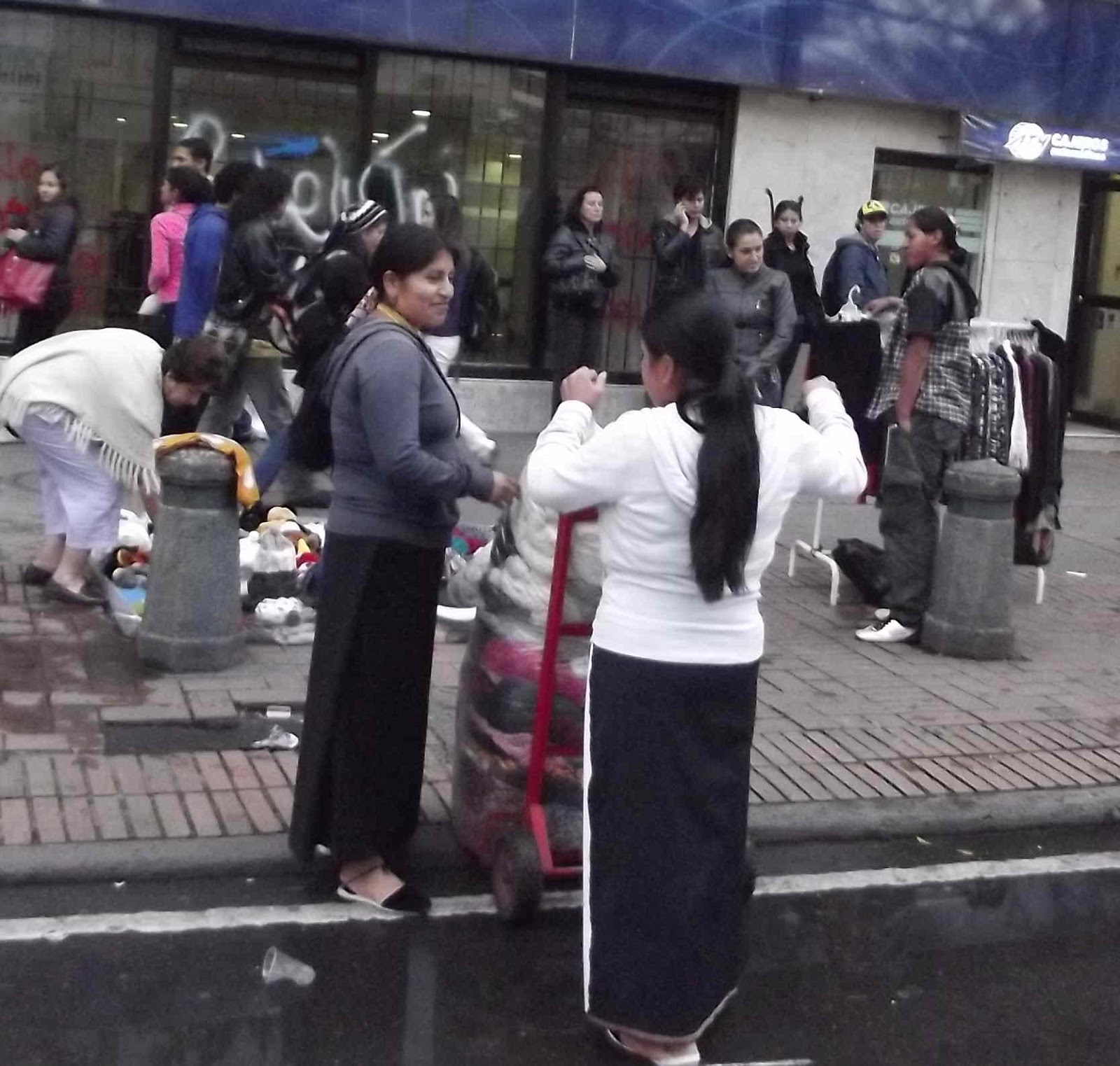
Indigenous women street merchants. Indigenous people from mountain and desert regions, particularly Quechua speakers from Ecuador, seem to succeed relatively well commercially. 

An indigenous woman wheels her wares past a street mural saying 'Mucho Indio.'


By Mike Ceaser, of Bogotá Bike Tours

Thursday, November 3, 2011

A Visit to the Leo Tolstoy Cultural Center


Tolstoy, the immortal Russian author,
who died 101 years ago this month. 
The Leon Tolstoy Cultural Center in the middle of La Candelaria sits like an institution out of time and of place. Like the nearby French and American cultural centers, the Tolstoy center teaches culture and language, in its case Russian. But unlike those other institutions, the Tolstoy center is small, neither shiny nor glitzy, evidently surviving on a shoestring budget and is filled with an atmosphere of nostalgia rather than contemporary events.

A look at the center's history explains why. The Centro Cultural Leon Tolstoi was founded in 1944 by the Soviet Union, just as the Allied victory over Nazi Germany and its allies was becoming inevitable, to promote communist ideology here. In conjunction with such cultural centers in Colombia and other nations, the Soviet Union gave scholarships to students from all over the world, who it hoped would return home infused with socialist idealism.

Detail of a mural by Fernando Oramas.
But after the Soviet Union collapsed in 1991 that support disappeared. The Russian state, no longer communist, continues collaborating with the center, but only with occasional visits and donations of books and other items. The Tolstoy cultural center now survives by providing translations and music lessons. Five of the center's officials have been awarded the Lenin Peace Prize, now renamed the Order of Druzhba, the center's cultural director told me.

Today's Russia has a corrupt form of crony capitalism, which has produced a crop of multi-billionares. It is ruled by a few strongmen thru a contolled democracy and intimidated media. But at the Tolstoy Center here in La Candelaria, one might think that the old Soviet Union continued. There are the traditional Russian robes, the heroic mural by the entrance, the busts of Lenin and famous cosmonaut Yuri Gagarin. A plaque on the center's front wall celebrates the Soviets' victory over Nazi fascism, forgetting that the Soviet Union then imposed its own form of fascism on half of Europe.
Lenin still presides here. 

I talked to the center's cultural director, who lamented that the Soviet Union's economic system was ruined by 'ambitious men.' I agreed. Ambition is what makes both communism and capitalism such lousy systems - with the difference that capitalism actually rewards and harnesses that ambition. And, when it works right, that ambition can benefit lots of people, as did the ambitions of American billionare Steve Jobs and Colombian billionare Julio Santo Domingo.
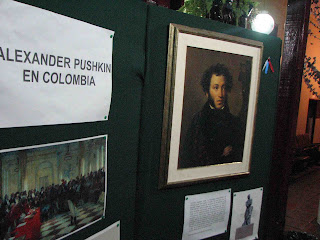
Right now, the center is commemorating
poet Pushkin, a giant of Russian literature.
The director also lamented Colombia's terribly unequal income distribution and its its emphasis on war. Those are two very real problems, but the second does ignore the fact that Colombia's armed conflict responds to violence against the Colombian people by armed guerrillas who espouse a Marxist ideology, altho they don't practice it. The cultural director expressed understandable disappointment with many of Colombia's leftist politicians - Bogotá's current mayor, Samuel Moreno, of the leftist Polo Democratico Party, is in prison on corruption allegations and the previous mayor, from the same party, recently allied himself with conservative ex-President Alvaro Uribe.

Traditional Russian robes. 
But Bogotá's Mayor-elect Gustavo Petro got his start as a leader of the M-19 guerrillas, and has maintained a principled leftist ideology. Perhaps his victory will give the lie to the guerrillas' strategy of armed rebellion. She didn't give me a clear response.

 Most likely, the Tolstoy Center in La Candelaria will maintain its ideology from another era, a sort of museum to a nation which espoused an idealism which failed - and got swept out of history.
The Leo Tolstoy Center is located on Calle 12c between Carreras 3 and 4. Besides teaching music and language, the center also holds cultural events including Russian movies and music events. Find them on Facebook under Centro Cultural Leo Tolstoi in La Candelaria.


Commemoration to the Soviet Union's victory over the Nazis. 

Russian matryoshka dolls. 


By Mike Ceaser, of Bogotá Bike Tours