|
| People walk thru the tree-filled Parkway in the Teusaquillo neighborhood. |
Urban trees block noise, soak up pollutants, provide shade and make a city feel more liveable - but they also generate controversy.
 |
Councilman Saenz points to a photograph of deforested
land in the Bosque Izquierdo neighborhood. |
That's happened in Bogotá, where the city plants trees - but also cuts them down. And the sometimes over-zealous efforts of tree cutting companies, as well as construction companies which deforest areas others many consider to be public patrimony.
City Councilman Roberto Saenz, who calls himself 'the environmentalist councillor' has held a series of public hearings about urban deforestation, focusing particularly on several cases of construction on or near Bogotá's iconic Eastern Hills, its
Cerros Orientales. These include apartment towers in north Bogotá and in the historic Bosque Izquierdo neighborhood, and two towers which the Universidad Externado is building above the La Candelaria neighborhood.
"I'm not impartial on this," Saenz said. "I'm for the trees."
Colombia's Consejo de Estado recently ruled that the hills' Forestry Reserve should be sacrosanct.
 |
A map shows the area where the Externado University
is building towers above La Candelaria. |
Strangely, however, construction on the hills continues unimpeded. Bogotá's Eastern Hills could be a great resource for the capital's residents, particularly for the poor, who can't afford to escape the city to find nature. But the hills' reputation for crime keeps many out, and if private interests manage to pave over the hills, their potential will be lost forever.
While there are questions about the these projects' documents and licenses, what is clear is that many contradict the city's declared philosophy of protecting public space and promoting sustainable transit not based on the private car.
"When all the evidence shows that we are going against nature, how can they tell us that all the (projects') documents are in order?" said Fernando Cortés, a leader in the Bosque Izquierdo neighborhood.
 |
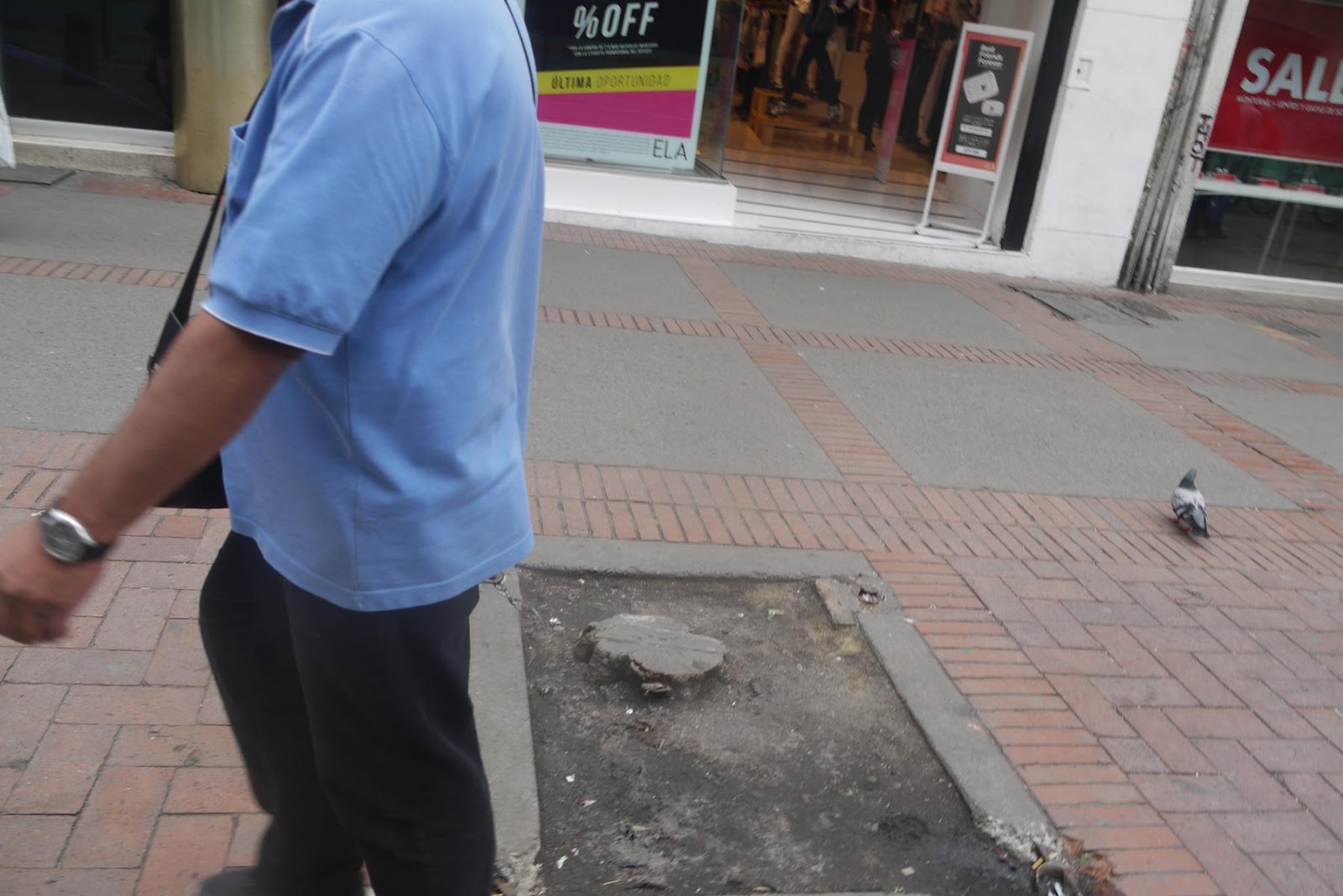
A woman walks past a sawed-off sidewalk
tree in Teusaquillo. |
"Externado University, as a law school, should be the first to conserve the forest," councilman Saenz said. "They should buy and protect the forest."
The Externado's project includes the removal of thousands of trees, altho some are supposedly being replanted elsewhere and the university is supposed to plant trees in other places. But that will still mean the loss of forest and green space for the people, many of them poor, who live in nearby neighborhoods. And, the university's project, which includes almost 500 parking spaces, will produce impacts including pollution and traffic jams along La Circuvular Avenue and in the historic center, La Candelaria.
Juan Melgare, a resident of the tree-filled Teusaquillo neighborhood and
urban tree advocate, attended a recent meeting to
 |
Nothing green here: A treeless street in the
Puente Aranda neighborhood. |
denounce city plans to cut hundreds of trees in the grey and polluted Puente Aranda neighborhood. I was surprised to hear that that industrial neighborhood, which is pure cement, even HAS that many trees.
"They want to cut down trees in one of the most polluted parts of Bogotá," Melgare said.
Melgare points out that there are huge economic incentives for deforestation. The companies hired to do the work can earn from hundreds of thousands to millions of pesos for for cutting down a tree. And the wood is sold to barbecue restaurants.
Melgare even defends non-native trees, such as pines, urapanes and eucalyptus. He recalled one promoter of native trees who wanted a huge eucalyptus tree cut down.
"I asked him his age," Melgare recalled. "He was 50. I told him 'That tree is 75 years old. It's got more citizenship than you do."
 |
| Juan Melgare stands under a tree in Teusaquillo. |
 |
| A metal tree on a sidewalk in Puente Aranda. |
 |
| A bus belching smoke passes a lonely and mutilated tree on a street in Puente Aranda. |
See also:
By Mike Ceaser, of
Bogotá Bike Tours




 Posts
Posts