Showing posts with label cold war. Show all posts

Wednesday, December 17, 2014

The Day the Cold War Ended


Headlines in today's El Tiempo announce the U.S.-Cuba detente and the FARC ceasefire announcement.

The quiet little island of Cuba rocked the region today with two announcements which may mean the end of the Cold War.

Cuba and the United States will normalize relations, meaning that Washington has accepted that hemisphere's only communist nation, and one of very few in the world, is no threat to democracy and capitalism.

And the FARC, the hemisphere's oldest and largest Marxist guerrilla group, announced in Cuba a unilateral, indefinite ceasefire in its war against the Colombian state.

Coincidence? Partly, perhaps. After all, not even Cuba's closest ally Venezuela seems to have known in advance about the Cuba-U.S. agreement. But both moves reflect a transformed world in which capitalism - if not liberal democracy - has triumphed and the communist vestiges are either futile or irrelevant.

The FARC have announced previous ceasefires, but never before an indefinite one. This one may not even last - the FARC leaders promised to call it off if the military attacks their forces. But it's yet another sign that the guerrillas are tired and weakened and really want to reach a peace deal in Havana.

The Economist points out that the guerrillas' move hands the Colombian government a difficult choice: if it ceases attacks on the guerrilla it will implicitly accept a bilateral ceasefire - an idea which Pres. Santos has repeatedly rejected. But, whatever happens, the guerrillas have clearly signaled that they want 'no mas.'

The ceasefire will be great news for Colombia if it means an end to kidnappings, attacks on infrastructure, car bombings, land mines and all the other horrors the guerrillas have inflicted on Colombia.

As for the Washington-Havana detente, it removes a source of tension between Colombia and its biggest trading partner, Washington, since Colombia has maintains normal relations with Cuba. And it further weakens Venezuela, already in an economic tailspin, which has long counted on Cuba as its closest ally and unwavering partner in denouncing Washington policies. Now, Venezuela becomes the hemisphere's prime target of U.S. criticism.

'Times in the Americas are changing,' says The Economist.

That's true. But if capitalism seems to be triumphing everywhere - including 'communist' China and inevitably in Cuba, one can't say the same about liberal democracy. Looking across the hemisphere, it's unclear whether liberal democracies, on the model of the U.S., Canada, Colombia, Brazil, Chile, Uruguay and others will prevail, or whether the region will become dominated by authoritarians disguised as democracies, on the model of Ecuador, Nicaragua and Venezuela.

By Mike Ceaser, of Bogotá Bike Tours

Wednesday, November 20, 2013

Kennedy and Colombia

Kennedy and Colombian Pres. Albeto Lleras inaugurate housing for the poor in south Bogotá.
The 50th anniversary of JFK's assassination is as good a time as any to take a look at the storied president's relationship to Colombia.

Kennedy visited Colombia once, in December 1961, only the second U.S. president to do so, following Franklin Delano Roosevelt.

JFK in Bogotá.
(Photo: JFK library.)
The purpose of Kennedy's visit was ostensibly to inaugurate a south Bogotá housing project funded by United States aid money. But the Kennedy administration's broader purpose was to line up regional governments behind U.S. Cold War policy - in particular, opposition to Fidel Castro's communist government in Cuba. Eight months before, the U.S. had launched the disastrous Bay of Pigs invasion, which Kennedy had inherited from his predecessor, the Eisenhower administration.

Kennedy had lots going for him in Latin America: he was young, handsome, charismatic, apparently vigorous (he in fact had severe medical problems), and, most of all, Catholic.

In March '61, his administration had created the Alliance for progress, supposed to help development of Latin America.

But the United States faced widespread distrust across Latin America, as expressed by Colombian an ingratiating letter a few months before Kennedy's visit. Lleras said that Colombia had "no doubts" about the U.S.'s commitment to send development aid to Latin America, but that many other countries thought that Washington's demands weren't balanced. Washington's aid pledge to the region "lacks precision," Lleras wrote, "while at the same time the United States requires from (Latin nations) in very precise form radical transformations that they cannot undertake without external aid from the United States."

In other words, if Latin American nations were to follow Washington's economic and ideological blueprints, they expected to be paid for it.

A cartoon shows Kennedy and Fidel
Castro confronting each other.
(JFK Library)
Pat M. Holt, a journalist, book author and staff member of the Senate Committee on Foreign Relations, also believed that Washington had more persuading to do: "Some - I am afraid many - Latin Americans are not yet convinced that the Soviet presence in Cuba is by intervention and not by invitation," he wrote, adding that, because of Castro's apparent popularity, "Latins are assailed by doubts that (Organization of American States (OAS)) to end Soviet intervention in Cuba would interfere with the right of the Cuban people to self determination. This argument may be silly, but that doesn't keep some people from believing it."

On the following page, Holt quoted a clause in the OAS charter stating that "No State or group of States has the right to intervene, directly or indirectly, for any reason whatever in the internal or external affairs of any other State."

For its part, Lleras assured Kennedy that Bogotá was on the same page as Washington in its "desire to sek proper solutions to the serious danges which have been created for the hemisphere by the imminence of the Soviet menace..."

A few days before Kennedy visited Bogotá, Colombia broke diplomatic relations with Cuba. In January 1962, the OAS expelled Cuba, which is still not a member.

In Nov. 1963 Kennedy was assassinated in Dallas, Texas. Some conspiracy theories hold that Castro was behind the killing. The south Bogotá neighborhood which Kennedy visited was renamed Barrio Kennedy.


By Mike Ceaser, of Bogotá Bike Tours

Sunday, October 28, 2012

The Cuban Missile Crisis and Colombia


Fidel Castro and Nikita Khruschev buddy up.
(Photo: Boston University)
A half-century ago, humanity came to the verge of armageddon when the United States discovered Soviet nuclear missiles in Cuba. After several tense weeks, John F. Kennedy and Nikita Khruschev reached an agreement and backed away from the abyss.

But, during those tense weeks Cuban dictator Fidel Castro asked the Soviets to shoot at U.S. spyplanes, which could likely have triggered nuclear war, as recounted in this story in the New York Times.


Castro, a revolutionary accustomed to dramatic acts and gestures, favored military action against the U.S. Castro, who was still angry about the attempted U.S. invasion of Cuba, also resented not being consulted by Moscow. Castro was motivated by anger and desire for vengeance. Cuba was an important country, he believed, and would not accept being treated as a non-factor. If proving Cuba's importance meant burning millions of people, including Cubans, to ashes, so be it. In contrast, both the U.S. and Soviet leaders were much more rational actors: they wanted to further their interests, but knew that nuclear war would be bad for everybody.

“This is insane; Fidel wants to drag us into the grave with him!” Khruschev reportedly told his advisors.


Fortunately for the world - and particularly for the millions of Cubans and Americans who would have surely been blown to bits or fried by nuclear storms - the Soviets removed their missiles, and in exchange the U.S. removed its own nuclear missiles from Turkey and also promised never again to invade the communist island.

(Reportedly, Colombia had offered its support for a U.S. invasion of the island to remove the missiles.)

Fidel Castro and bearded comrades celebrate the 
revolution's victory.
The world gave a sigh of relief. But the Soviets' support and the U.S. assurance that it would never again invade Cuba, as it had disastrously in 1961 at the Bay of Pigs, gave Castro cover to try to foment Communism across the hemisphere. In 1968, Che Guevara died in Bolivia trying to ignite a Cuban-style revolution there. Castro also financed and trained armed insurgencies across Central and South America, including Colombia's ELN guerrillas. In recent years, however, Cuba has assisted with as-yet-unsuccesful peace negotations between the Colombian government and the ELN and FARC guerrillas.

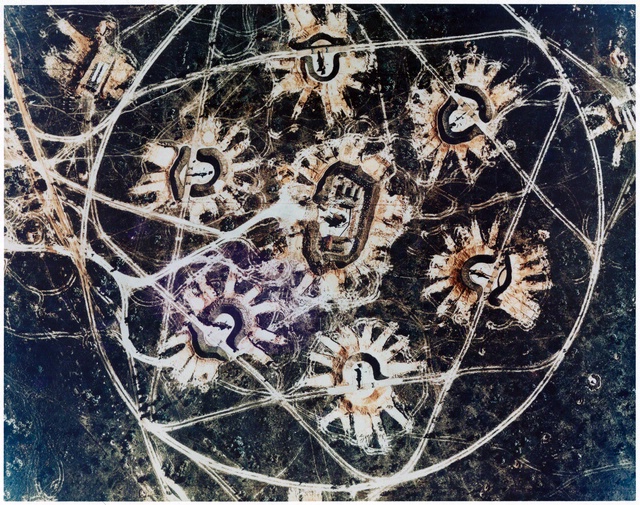
A U-2 spy plane photo shows Soviet missile silos in Cuba.
(Photo: Smithsonian Museum)
Meanwhile, the United States and now-geriatric revolutionary Cuba, only 90 miles apart, still maintain one of the world's last remaining Cold War hostilities.

Today, Latin America's only situation even distantly resembling the 1962 Cuba is Venezuela, a leftist nation hostile to the U.S. which has during recent years purchased billions of dollars of mostly Russian military weapons. But those are conventional weapons, and Venezuela presents no military threat to the U.S., altho its armamanets are potentially worrisome to its neighbors, Colombia and Guyana.

A bit like Cuba a half century ago, Venezuela is a source of tensions between Moscow and Washington, still vying for influence.

The Soviet missiles have ended up achieving their original goal: preserving the Communist revolution on the U.S.'s doorstep. But in the meantime their builders, the Soviet empire, has crumbled, leaving Cuba as a sort of museum piece for a failed system. However, in the guerrillas which still afflict Colombia, Colombia continues to feel the the missile crisis' consequences.

So, for Colombia, the missile Crisis leaves mixed messages. By preserving revolutionary Cuba, the missiles contributed to Colombia's ongoing troubles. However, the communist island could now contribute to peace in Colombia.

And, the crisis' greatest lesson for Colombia is that determined and cautious leaders can resolve the most difficult crisis without firing a shot.

But are Colombia's guerrillas rational actors? For that matter, is the government?


By Mike Ceaser, of Bogotá Bike Tours

Saturday, December 17, 2011

Kennedy in Colombia


Today is the 50th anniversary of U.S. Pres. John F. Kennedy's 1961 visit to Bogotá. Kennedy came ostensibly to promote the Alliance for Progress, a Washington-backed development effort. But his visit was more about the ongoing Cold War and Washington's desire to keep Bogotá firmly within its orbit.

The South Bogotá site where U.S. support would build the El Techo housing project.
At the time, Fidel Castro's Cuban revolution was seeking regional allies. Kennedy's speech to Liberal Colombian Pres. Alberto Lleras Camargo mixed Kennedy's characteristic idealism...

"Today we face our greatest challenge to the vitality of our American revolution. Millions of our people -- scattered across a vast and rich continent -- endure lives of misery. We must prove to them that free institutions can best answer their implacable demand for social justice, for food, more material welfare and above all, for a new hope - for themselves and for their children."
John F. Kennedy sets the first brick at El Techo. 

...with apologies....

"We in the United States have made many mistakes in our relations with Latin America. We have not always understood the magnitude of your problems or accepted our responsibility for the welfare of the hemisphere."

...a warning against communism....

"They promise free elections, and free speech and freedom of religion. But once power is achieved, elections are eliminated, speech is stifled and the worship of God is prohibited."

A cartoon makes fun of Pres. Alberto Lleras' closeness to Uncle Sam. 
...and one outright lie: "We deny the right of any nation to impose its will on any other."

Just eight months before, the Kennedy administration would back the failed invasion of Cuba at the Bay of Pigs.

That same day, Kennedy had visited a south Bogotá neighborhood where the U.S. was financing a housing project for the poor called 'El Techo.'

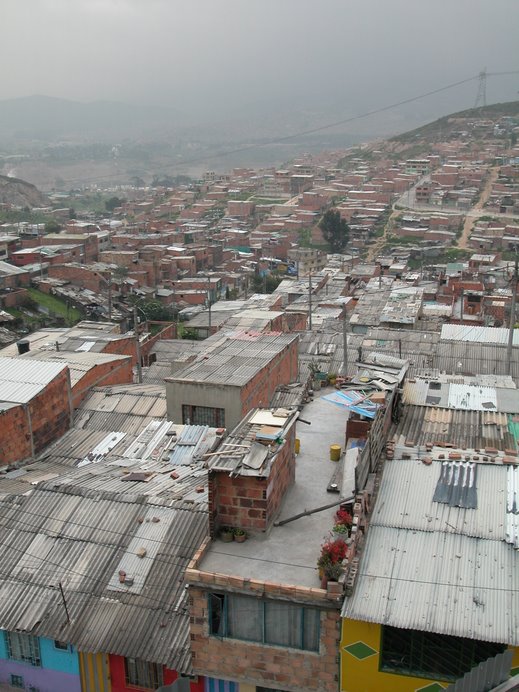
South Bogotá's Ciudad Kennedy today. (Photo: The Tall Gringo)
Kennedy was popular throughout much of Latin America, both for his idealism and for being the U.S.'s first Catholic president. (He was the second U.S. president to visit Colombia, after Franklin Delano Roosevelt in 1934.) But his goals, for all their good intentions, were not to be fulfilled.

Two years later, Kennedy would be assassinated in Dallas. Colombia named a south Bogotá neighborhood in his honor, but today it remains a poor and troubled part of the city.

With the presidency of Lyndon Johnson, the U.S. turned inward, preoccupied with Civil Rights and domestic poverty, and soon after became obsessed with the failing war in Vietnam.

Today, Latin America continues to be burdened by poverty and inequality. Cuba remains a thorn in Washington's side, and socialist rhetoric - if not reality - has received new life from a new generation of leftist leaders in Venezuela, Ecuador and Bolivia.

By Mike Ceaser, of Bogotá Bike Tours