Showing posts with label architecture. Show all posts

Friday, May 4, 2018

A New Life for Narco Properties

El Mexicano's old walled property near La Zona Rosa,will soon host the Chinese embassy.
During past decades, Bogotá was home to numerous properties which everybody knew belonged to narcos, altho few people were likely to say so out loud. Today, with the cocaine trade booming once again, Bogotá is likely newly awash in drug money, altho much less conspicuously.

Villa Adelaida, as seen from the street,
will soon house a restaurant.
Meanwhile, some of those narcoproperties of decades past are finding new lives. The 'Mexicano's' old high-walled estate located just north of the Zona Rosa was recently purchased by the Chinese government and is to be their new embassy site. The Mexicano's old wall could be useful for keeping out anybody inclined to protest against China's many human rights violations.

El Mexicano, whose birth name was José Gonzalo Rodríguez Gacha, was actually Colombian, but liked Mexican music and Mexican money, earning him the nickname. He started out as a hired assassin for emerald kingpins, but decided that drug trafficking was more profitable and became a member of the Medellin Cartel, along with Pablo Escobar. El Mexicano may have been even more brutal than Escobar, and eventually unleashed a brutal battle for control against his old friends in the emerald business. He was killed by Colombian police in 1989.

Not far away, on Calle 70 and Carrera 7a, La Quinta Villa Adelaida has stood rotting away for decades. Built in 1914 by Agustín Nieto Caballero, founder of the nearby Gimnasio Moderno, a high school for children of the traditional conservative elite, the huge house later became the Baron Club,  the site of expensive carousing. However, the club's owner, Manuel Abajo Abajo, a Spanish citizen, was arrested in 1987 for narcotrafficking and sentenced to nearly a decade in prison.
s.
Villa Adelaida in its glory days.
The house passed to control of the government, and has been under renovation the last several years. Plans for the property have included a hotel and shopping mall - but ran into opposition from neighbors, who feared more traffic jams. Next year, if all goes according to plan, an expensive restaurant will open in Villa Adelaida.

Do more narco properties remain in Bogotá? Undoubtedly, many do. However, today's narcos have learned to live less conspicuously to not make themselves targets of authorities and rival cartels. At the same time, the Mexican cartels have taken the most profitable retail trade away from the Colombians, and the Colombian drug traffickers which remain have shifted their centers of operations the big cities to rural areas near the coasts and borders.

By Mike Ceaser, of Bogotá Bike Tours

Thursday, February 1, 2018

Whose Patrimony is Worth Protecting?

An apartment tower under construction near the Castillo San Felipe, a colonial fort, in Cartagena.
An apartment tower - one of a planned five - for low-income people being built near a colonial fort in Cartagena is threatening the city's designation as a UNESCO world heritage site.

It's a difficult decision: The low-income families, many of whom have already paid for apartments in the towers, need comfortable, affordable housing near where they work. But five modern towers will detract from the castillo's character, and loss of world heritage status would surely damage Cartagena's tourist appeal.

Doesn't Cartagena have another location to build apartment towers?

The polemic over construction in Cartagena makes one wonder why nobody protests when architectural monstrosities appear in Bogotá's own supposedly colonial historical center.

The ugly, multistory, box-like apartment building on the rear, left, was recently completed on the south end of Carrera 3, one of La Candelaria's most picturesque and historic streets. 

This block of Carrera 3 WAS one of the nicest in the neighborhood, colorful single-story houses and cobblestones. Now it has an ugly multi-story apartment building.

The Externado University recently built these character-less buildings on the hillside above La Candelaria, deforesting part of the hillside and blocking residents' views of the rest.

Some years ago, neighbors protested the construction of this faux-colonial building on the corner of Calle 9 and Carrera 2.

Tourists pose in front of the centuries-old La Candelaria Church. But, sadly, modern ugliness is going up around it.

Pedestrians pass below buildings which remind me of mushrooms.

Anything attractive at all - much less colonial - about this building on Carrera 3 and Calle 11?

An Oxxo liquor/junk food store on Calle 11 just above the La Candelaria Church, one of about a half-dozen such stores which have appeared recently in La Candelaria. Do they contribute much besides feeding students' and tourists' addictions?

Or this one, on Carrera 4?
By Mike Ceaser, of Bogotá Bike Tours

Thursday, January 30, 2014

The Legacy of Leopoldo Rother


The National University's Fine Arts building is characteristic of the simple, block-style arhictecture employed by Rother.

German-Colombian architect Leopoldo Rother would turn 120 this August, and likely be disappointed at the sad state of many of his Colombian works. 

Born in 1894 in Breslau, Germany, now part of Poland, Rother designed governmental and athletic buildings in Germany. But the ascent of Hitler forced Rother and his family to flee because of their Jewish heritage. 

In 1936, Rother immigrated to Colombia, where he quickly obtained work designing public buildings and teaching at the National University. He designed the Edificio Nacional in Barranquilla and the Eduardo Santos Stadium in Santa Marta.

But Rother's best-known work is likely the Universidad Nacional's Bogotá campus. Rother designed the 121-hectare campus as an oval, with ring roads circling its periphery. The campus is so large that it is formally known as the University City. (The 'Nacho' was founded in 1867, but its buildings were scattered throughout Bogotá. The Ciudad Universitaria became Colombia's first university campus.) The buildings are block-shaped and unadorned, a style which he apparently adopted from a 1932 modern arquitecture exposition in New York's Museum of Modern Art. Today, the buildings can seem a bit boring and monotonous. And the government has allowed many to decay, a situation which has triggerred student protests. 

In his later years, Rother taught architecture at the Universidad Nacional and did designs for Colombia's public works department. In 1977, he was awarded the Cruz de Boyaca and died the following year in Bogotá.

On the National Univesity's campus, the architecture department's museum is named after Rother. The museum recently held an exhibition about his life and works.
A 1930s map of the National University's campus, showing its oval design. 
The National University's engineering building, designed by Rother and now under repair. 
A crumbling building on the National University campus.
The National University's Bogotá campus's newest building, which breaks the campus's block pattern, and has won recognition for its design. 
The Edificio Nacional in Barranquilla, designed by Rother. (Image: Wikipedia)

Eduardo Santos Stadium, in Santa Marta, designed by Leopoldo Rother (Image: Hoy Diario de Magdalena)

By Mike Ceaser, of Bogotá Bike Tours

Sunday, May 19, 2013

The Legacy of Rogelio Salmona


The entrance to the Archivo Nacional, just south of La Candelaria, one of Rogelio Salmona's many works in Bogotá.
Pedestrians walk along Jimenez Ave., the Eje Ambiental,
designed by Rogelio Salmona but never completed
and now sadly neglected. 
Rogelio Salmona is unquestionably Colombia's most famous architect of recent times. Born in 1929 in Paris, the son of French and Spanish Jewish parents, Salmona's family moved to Bogotá in 1934. He grew up in the Teusaquillo neighborhood, and after the Bogotazo violence returned to France to work for years with famed architect Le Corbusier.

Returning to Colombia in 1957, Salmona taught in the Universidad de los Andes and designed many buildings and other structures which have become landmarks, mostly in Bogotá, but also scattered across Colombia.

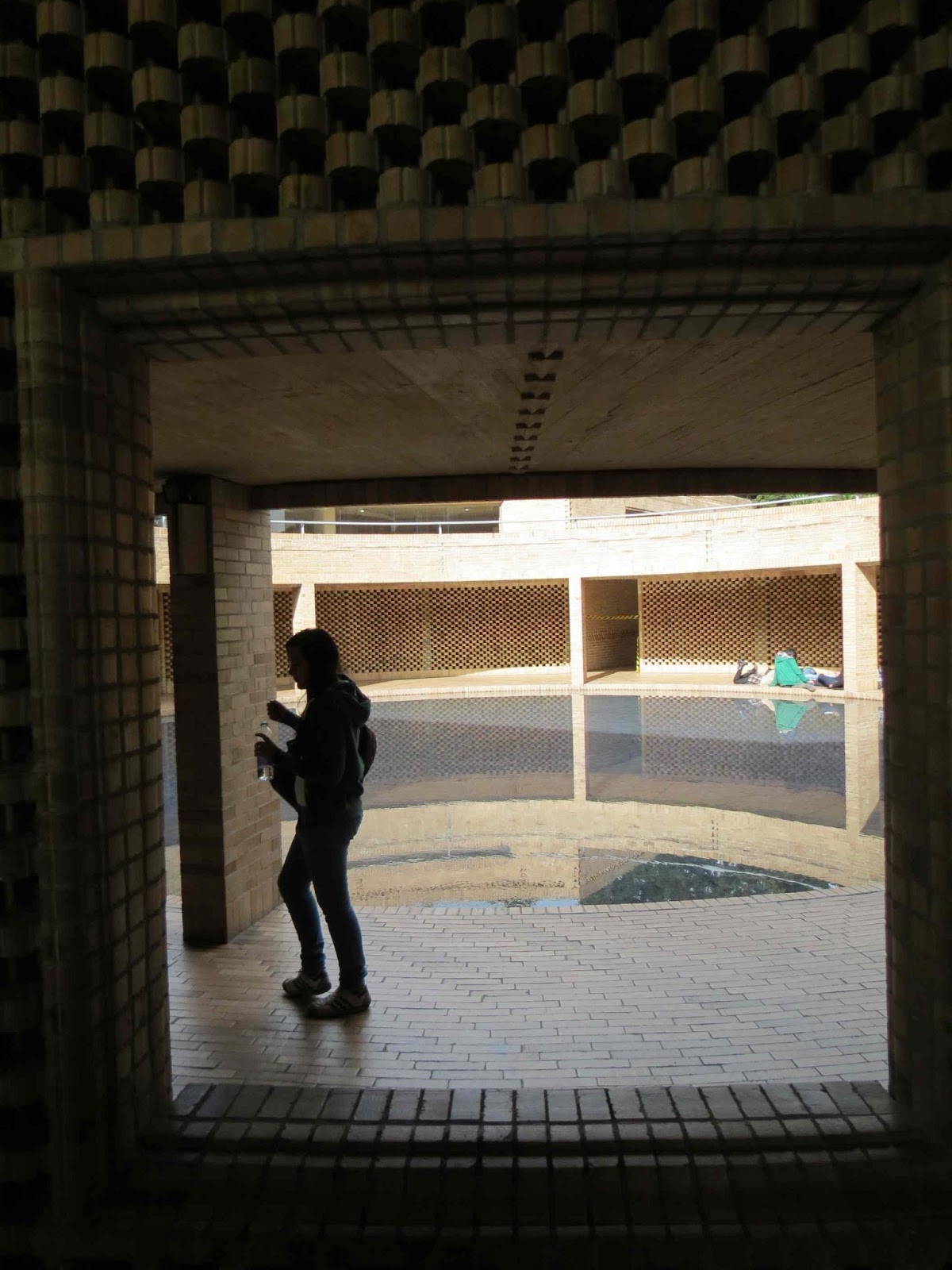
Salmona's works are known for their brickwork, their curves and for being open to and integrated into their surrounding environments. With their quiet pools and interior patios, they seem to bring the outdoors inside. Those characteristics also show the deep influence of Arab/Moslem architecture in Salmona's style.
The Gabriel Garcia Marquez Cultural Center in La Candelaria. The building was designed by Salmona and built by the Mexican government in honor of the Nobel-Prize winning novelist, but contains nothing about the writer. 


Las Torres del Parque, behind Bogotá's bullfighting stadium. The complex curvers around the stadium, and was supposed to house people of all classes, but now seems to be inhabited by the wealthy. Salmona lived in one of the towers during his final decades. 
The Jorge Eliecer Gaitan house-museum, which has never been completed. 

A view of the Biblioteca Pública Virgilio Barco and its contiguous park, which forms part of the Parque Simon Bolivar. 

Visitors cross bridges in the Biblioteca Pública Virgilio Barco.

A pathway to the Biblioteca Pública Virgilio Barco.

Pools and pathways in the Biblioteca Pública Virgilio Barco.

Pools of water at the entrance to the Biblioteca Pública Virgilio Barco.

Pools and bridges at the Biblioteca Pública Virgilio Barco.

Entrance to the Postgraduate Social Sciences Building on the National University's Bogotá campus. 

Brickwork on the Postgraduate Social Sciences Building on the National University's Bogotá campus


A pool in the Postgraduate Social Sciences Building on the National University's Bogotá campus


Students relax in the Postgraduate Social Sciences Building on the National University's Bogotá campus
By Mike Ceaser, of Bogotá Bike Tours

Sunday, December 2, 2012

Immigrant Architecture


The famous El Espectador newspaper building on Jimenez Ave., formally named the Ed. Monserrate, was designed by Spanish arquitect Germán Tejero de la Torre, who immigranted to Colombia in 1939 fleeing Spain's civil war.
The Museo de Bogotá, on Carrera 4 and Calle 10 in La Candelariahas an exhibition on now about the contributions of immigrant architects, coinciding with another exhibit about immigrants in the nearby Biblioteca Luis Angel Arango.

The Ed. Monserrate resembles the Ed. Carrion in Madrid.

Spaniard Alfredo Rodriguez Ordaz, who immigrated to Colombia in 1939, designed both the Banco de la Republica and the fachade of Bogotá's Cathedral (added in the 1940s).
The fachade of the Cathedral of Bogotá and the Banco de la Republica.

The apartment building on the right on 11th St. in La Candelaria was designed by Victor Schmidt, who immigrated from Switzerland in 1939. His work combined colonial features and Swiss styles, according to the museum.
The building on the left was designed by Swiss immigrant Schmidt. Beside it is a concrete building lacking any character, in my eyes.

The Palacio San Francisco, designed by Gastón Lelarge, who immigrated from France in 1897, was the provincial capital building, but has sat vacant for years. It's supposed to be converted into a cultural center.

The Universidad de La Salle's building in La Candelaria was designed by Herbert Rauprich Jung, who fled Germany and immigrated to Colombia in 1936. The building may be handsome. But I've always thot that it clashes with the La Candelaria neighborhood's historical atmosphere.


Some notable buildings in central Bogotá:
The Calle del Sol apartments on Carrera 3. The building was first a cathedral and in the 1950s the secret police headquarters.

The Museo de Bogotá in La Candelaria. The building was the residence of the Virrey, the Spanish king's representative.
This building being renovated on Calle 10 is to be the new location of the Museo de Bogotá.
Check out these mushroom-like apartments on Carrera 4 in La Candelaria. I was told that they are the reason why the neighborhood did not receive UNESCO world heritage designation.

The Teatro Faenza, which is being restored by the Universidad Central. It's modeled after a theatre in Italy.

Las Torres del Parque behind the Plaza de Toros, designed by Rogelio Salmona.

Character-less buildings across from the Instituto de Desarrollo Urbano.

By Mike Ceaser, of Bogotá Bike Tours