Thursday, June 27, 2013

Barbara and Her Recycling Family


Barbara, her daughter and granddaughter were picking thru an office building's trash on Calle 99 this afternoon, selecting material they could sell - a few of Bogotá's thousands of 'recicladores,' Barbara, a single mother, told me she's been doing this work her whole life. But hopefully her daughters will find more opportunity - all four of them are in school, Barbara said.

In recent years, some of Bogotá's recyclers have become organized and their work formalized, thanks to the work of organizer Nohra Padilla, who recently won the Goldman Environmental Prize. This city is paying them for each kilogram of material they remove from the streets, as well as social benefits. But Barbara hasn't signed up, altho she'd like to.

"There's so much red tape and paperwork," she complained.

Barbara lives in Bosa and comes to this building three times each week to scavenge. Altho this is one of the city's most expensive neighborhood, she said the building employees have been kind to her, even watching over her scavenged material while she works 100th St. A truck arrives after midnight, pays her and takes it away. She earns about 30,000 pesos per day, she said.

After that, she goes back to Bosa - if she can. "When there's no bus, I just sleep on the street," she explained.

But hopefully not in the rain, and not with the little girls.


By Mike Ceaser, of Bogotá Bike Tours

Wednesday, June 26, 2013

When is a Narcotrafficker Not a Narcotrafficker?


Horacio Cortes celebrates.
The man is flooding Colombia and other nations with an illegal, addictive drug. He's been accused by the Brazilian government and investigated by the United States government for trafficking. In a rational world, you'd expect him to be behind bars. Instead, Horacio Cartes will soon take office as president of Paraguay.

As president, Cortes, who's also one of Paraguay's richest men, will undoubtedly be accorded all the honors due to the leader of a friendly nation whenever he visits Colombia or other countries. He's already met with the president of Spain and the head of the European Commission.

A street vendor's stand in San Victorino, which sells
cigarettes alongside candies.  The 'Gold Seal' cigarettes
must be smuggled in and cost a third the price
of legal cigarettes.  

If Cortes' deadly, addictive product - cigarettes manufactured in a plant in Eastern Paraguay and then smuggled into Brazil and around the world - just happened to be on the other side of the legal wall, then he'd be likely to be on the run like Pablo Escobar (who was elected to Congress himself), rather than soon running his country.

A man on San Victorino Plaza lights up a single 'loosie' cigarette,
which he's just purchased illegaly. 
More than two billion of Cortes' cheap Ibiza, Marine y Rumba brand cigarrettes smuggled into Colombia make up 14 percent of Colombia's cigarette market, according to El Tiempo.

Colombian media reports have focused on the massive smuggling's economic impacts, particularly the lost taxes and lost jobs in Colombian manufacturing and farming.

That's all true. But much more importantly, cheap smuggled cigarettes encourage more smoking and lure kids to start smoking - and become lifelong addicts. A vendor in the San Victorino market area was selling cigarettes by the stick (which is itself illegal) including the Gold Seal brand (which is not made by Cortes) which cost only 100 pesos per stick, one third or one fourth the price of legal cigarettes.

The vendor, whose young daughter was standing nearby, assured me that she "almost never" sells cigarettes to children, but that some other vendors do. The police, she said, don't bother to enforce either the anti-loosie or the prohibition on selling to children.

It's also ironic that Coltabaco and Protabaco, which split Colombia's tobacco market between them, have led the complaints about the smuggling. They are owned, respectively, by tobacco giants Philip Morris International and British American Tobacco. But, Just a few years ago, those same tobacco giants cooperated with cigarette smugglers to flood Colombia with cheap smokes, according to journalist investigations and internal company documents. (They even worked with the same Mansur family on the island of Aruba, who now allegedly smuggle in the Paraguayan smokes.)

The multinationals' tune has since changed, because they now own Colombian tobacco companies and smuggling competes with their own businesses. They continue to argue that tobacco taxes encourage smuggling. But it's a bit hard to take them seriously when they were making the same argument a few years ago while facilitating the smuggling themselves.

Colombia's organization of departments sued the big international tobacco companies over the smuggling, but ended up settling for a paltry sum and some promised policy changes. Now, according to El Tiempo, the governors are considering suing Cortes's company. But don't hold your breath.

When Cortes assumes the presidency we can expect any lingering obstacles to cigarette trafficking to evaporate.

When Cortes visits Colombia, will he be treated like a honored guest or a smuggler poisoning Colombia's children?

By Mike Ceaser, of Bogotá Bike Tours

Tuesday, June 25, 2013

A Visit to The Hub

Camilo Russi and Diego Rodriguez in front of the Hub Bogotá.
Networking, collaboration and alliances seem to have become key elements for all progressive causes - and those are the ingredients which The Hub - a kind of leftist beehive in Bogotá's Zona G - tries to harness and promote.


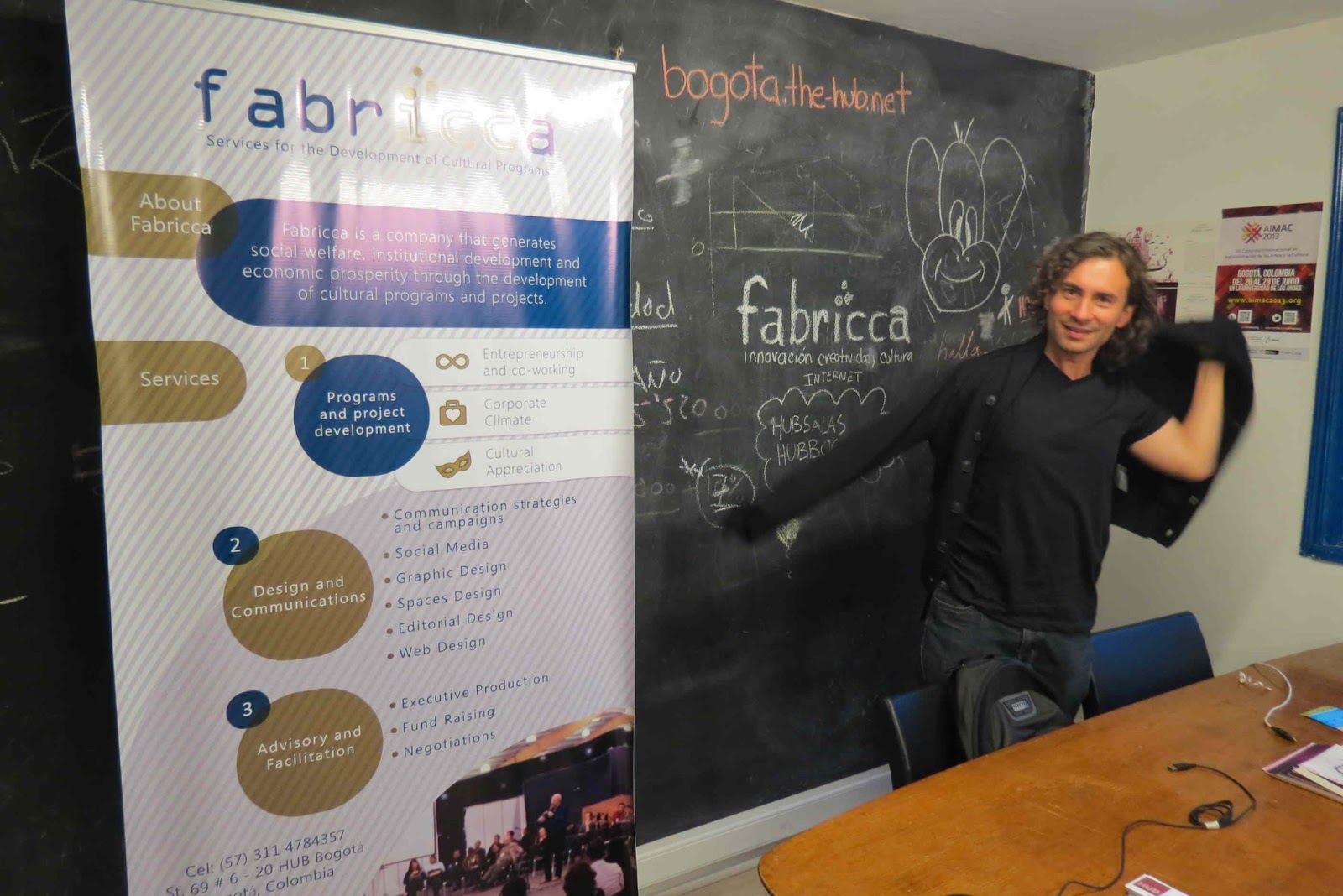
Carlos Barrero of fabricca, a cultural promoter. 

One of The Hub's many meeting rooms. 
From outside, The Hub's wooden building located a block and a half east of Ave. Septima, doesn't appear too impressive. But its interior is efficiently divided into many common areas and meeting rooms, where dozens of institutions, promoting everything from arts, to recycling to sustainable urban growth, work. Some organizations rent permanent private offices, while others have work stations in the common areas. Some are long term, others come and go. Altogether, after only one year in existence, Bogotá's Hub has 75 members. It's one of the youngest of close to 100 Hubs scattered around the world.


The Hub's members include large organizations, such as Bamboo Finance, which says it manages $250 million dollars in investment funds for progressive causes and has offices on four continents, and LGT Venture Philanthropy, which says it works on six continents. But most seem be small local organizations, such as fabricca, a three-year-old promoter of cultural activities which was one of The Hub's first members - but which I couldn't even find with Google.
The Hub, Bogotá.

"It's a space for sharing," Carlos Barrero, one of fabricca's founders, said of The Hub, "combining social, environmental and cultural projects."

Near fabricca we walked past Mono Films and a recycling organization called Cempre. On the first floor are the Green Pages and in a small upper floor office is Acumen, an anti-poverty organization.

Despite its philanthropical philosophy, The Hub's members include for-profit organizations with a
conscience and The Hub itself is intended to turn a profit on its services. But The Hub doesn't appear to have concrete guidelines for which organizations it accepts as members. I asked Hub employee Diego Rodriguez, who guided me around, how they'd respond if, say, a casino, a tobacco company or some other profit-only driven business asked to join.

"We'd try to change their thinking," Rodriguez explained, adding that such businesses usually realize that The Hub's not for them.

I was surprised - and a bit disappointed - by a few aspects of The Hub. Its entry hall contained the usual pamphlets about promoting culture, recycling and bicycling - but their parking lot was filled with cars, and their small bike rack was empty. I also asked why they're located in the exclusive, high-estrato Zona G, near five star hotels and gourmet restaurants. Rodriguez explained that one of The Hub's goals is to show that 'you don't have to make great sacrifices in order to do development work.' True enough. But La Candelaria and southern Teusaquillo aren't slums, and cheaper offices there could free up money for doing more good. And I can imagine that the Zona G's ritzy atmosphere could intimidate some of the low-income people the Hub aims to help.
One of The Hub's shared workspaces.

That said, The Hub's a healthy initiative for Bogotá, a city in dire need of more activism, particularly of the grassroots variety. If The Hub, by creating alliances and networks amongst differing organizations, can promote that, it'll make a real contribution to this city.


By Mike Ceaser, of Bogotá Bike Tours

Monday, June 24, 2013

A Nation Kidnapped

FARC kidnappees held behind barbed wire in a jungle prison.
No other crime, perhaps, has scarred Colombia's recent history and psychology as deeply as has kidnapping.

Unlike massacres and assassinations - which at least end quickly - kidnappings stretch on for months, years or more than a decade, creating long, painful dramas.

And kidnapping even created its own culture in Colombia - as it's now doing in Mexico - with novels and non-fiction books and even radio programs for kidnapping victims.

Now, two human rights organizations have attempted to place numbers on this scourge. And their report, altho terrible enough, is almost surely a huge underestimate.

The report, A truth Kidnapped (Kidnapping from 1970-2010), is the result of five years' research by Cifras and Conceptos and the Center for Historical Memory, counted more than 39,000 kidnappings over the past four decades. Of those crimes, they said, only some 7,800 kidnappers have been arrested, meaning a 92 percent rate of impunity.

Over these past decades, kidnapping has become a source of chronic anguish in Colombia. For years, foreign journalists made sure to note how wealthy Colombians kept anti-kidnapping hot lines at their fingertips, lived behind barbed wire and traveled with bodyguardss. Colombia's fabled plastic surgery industry got its start from reconstruction for wealthy kidnap victims of the Pablo Escobar era, whose ears and fingertips had been sliced off to horrify family members. And then there was the literature - from Gabriel Garcia Marquez's News of a Kidnapping, to the recent slew of books by Ingrid Betancourt, the American contractors and others rescued from the FARC after years of jungle captivity. Kidnapping even gave birth to what must be one of the world's most unique media forms: Radio stations which transmit messages from anguished family members who hope that their captive loved ones in the jungles or mountains have access to a transistor radio.

But as terrible as the kidnapping study's numbers are, they are surely a gross underestimation. Most kidnappings - 75%, according to the anti-kidnapping NGO Pais Libre - are not reported at all. That may be because the victims are too scared or unsophisticated, unimportant or remote, or because they prefer to reach 'a friendly agreement' by paying the kidnappers instead of involving authorities.

During my journalistic days I interviewed many kidnapping victims, including one famous one: Clara Rojas. She was presidential candidate Ingrid Betancourt's running mate, who while in captivity had a baby with a guerrilla. I also spoke to a young woman who'd been kidnapped by the FARC guerrillas when she was 15 and held in the jungle for three years along with her father, until her family finally scraped together enough money for their ransom. The guerrillas didn't physically abuse their victims, but the woman recalled the terrible boredom of spending her teenage years captive in a jungle tent with no idea of if or when she'd be free.

I also talked to a man who'd administered a ranch near the Venezuelan border. Guerrillas kidnapped him mistakenly believing that he was the ranch's owner, and therefore a valuable prize. They subjected him to a kind of torture by forcing him to endlessly tread water in a river until they became convinced he was only an employee and released him.

I met a man from a rural town who repaired radios and electrical equipment. Guerrillas kidnapped him and forced him to repair their communications equipment. After this happened several times, the man and his family fled to Ecuador, where they were refugees.

Also in Ecuador I talked to a woman who had owned a small town restaurant in a Colombian border area. A group of strangers came and ate for several days without paying. When she finally presented them with the bill, the men informed her they were FARC guerrillas: 'We're not paying,' they said. 'And we're also taking away your business and your sons,' whom they turned into unwilling rebel fighters and permanent kidnap victims.

Stories like those often never make it into the statistics.

Then there have been the guerrillas' spectacular mass kidnappings, including the ELN's 1999 kidnapping of 285 parishioners from a Cali church and the 46 passengers and crew of an Avianca flight the same year. In 2002, the FARC invaded the regional Assembly building in Cali and kidnapped 12 regional deputies, whoom they held for five years before murdering 11 of them.

The most recent high profile kidnapping was of a Spanish couple in La Guajira, apparently by common criminals. Police rescued them last week.

Kidnapping peaked between about 1996 and 2005 and has since declined steeply. This year, officials recorded an average of 5.8 kidnappings per week in Colombia, down from 8 per week last year, according to Pais Libre. That's still a lot, reflecting weak rule of law and the continued activty of outlaw organizations throughout the country.

The FARC guerrillas have said they've given up kidnapping, and hopefully they'll hold to their word. If the ongoing peace negotiations succeed, Colombia's kidnapping nightmare will finally conclude, if not end completely.

By Mike Ceaser, of Bogotá Bike Tours

Saturday, June 22, 2013

Writing Down the Rules for War - and Peace

Almost a decade ago, human rights organizations criticized the government of Pres. Alvaro Uribe because its demobilization agreement with right-wing paramilitaries seemingly let those guilty of grevious human rights offenses off with light punishments.

Victims of a 1997 paramilitary massacre.
Now, a new Human Rights Watch report asserts that the 'Framework for Peace' created for the negotiations with the FARC guerrillas could bring the same result.

The Framework for Peace is intended to facilitate reaching a peace agreement with the FARC guerrillas, who are negotiating peace with the government in Havana - but at a price: light punishments for those guilty of severe human rights abuses. In a response to questions from Colombia's Constitutional Court, Human Rights Watch said that the Framework "flagrantly contravenes the legal obligations assumed by Colombia according to international law."

Even such mechanisms as a post-conflict truth commission wouldn't address this injustice, says HRW.

Investigators dig victims of false positive
killings from a mass grave.
Still, with all of its failings, the paramilitary demobilization seems to have succeeded. Altho some paramilitaries have continued committing atrocities and in other areas they have been replaced by criminal groups called bacrims, Violence levels have fallen in many parts of Colombia. The horrific massacres of whole towns haven't been repeated.

Colombia may find that paying the same price of injustice for peace with the FARC is worth it.

A few years ago, Colombia was shaken by one of its most horrific human rights scandals when it wasFalse Positives.' Now, military jurisdiction legislation approved by Congress this week could let those killers off easy, say human rights advocates.
discovered that military units were kidnapping and murdering young men and disguising them as guerrillas in order to earn bonuses or time off. They were called '

Posters portray the Fuero Penal Militar law as
permitting the targeting of civilians.
Rights group, including HRW and others, have assailed the military jurisdiction law (ley de fuero militar) approved by Congress this week. The law is supposed to protect soldiers by making clear when they can and cannot use force. But rights defenders suggest it could legalize attacking civilians, and that cases of plain murder, such as the false positives, could end up in military court - where sympathetic judges are likely to treat soldiers lightly. Military officials promise that this won't happen - at least with past cases.

The legislation also attempts to create rules for hostilities with the new violent groups, called Bacrims, which have sprung up after the paramilitaries demobilized. But battling these groups, which may not wear uniforms and are hard to distinguish from common criminals, also carries dangers of attacks against civilians.

Colombia may win from these two laws - but the cause of justice, and the armed conflicts' many victims - look likely to lose.


By Mike Ceaser, of Bogotá Bike Tours

Friday, June 21, 2013

Scenes from World Skateboarding Day in Bogotá

Skateboard power on Plaza Bolívar.

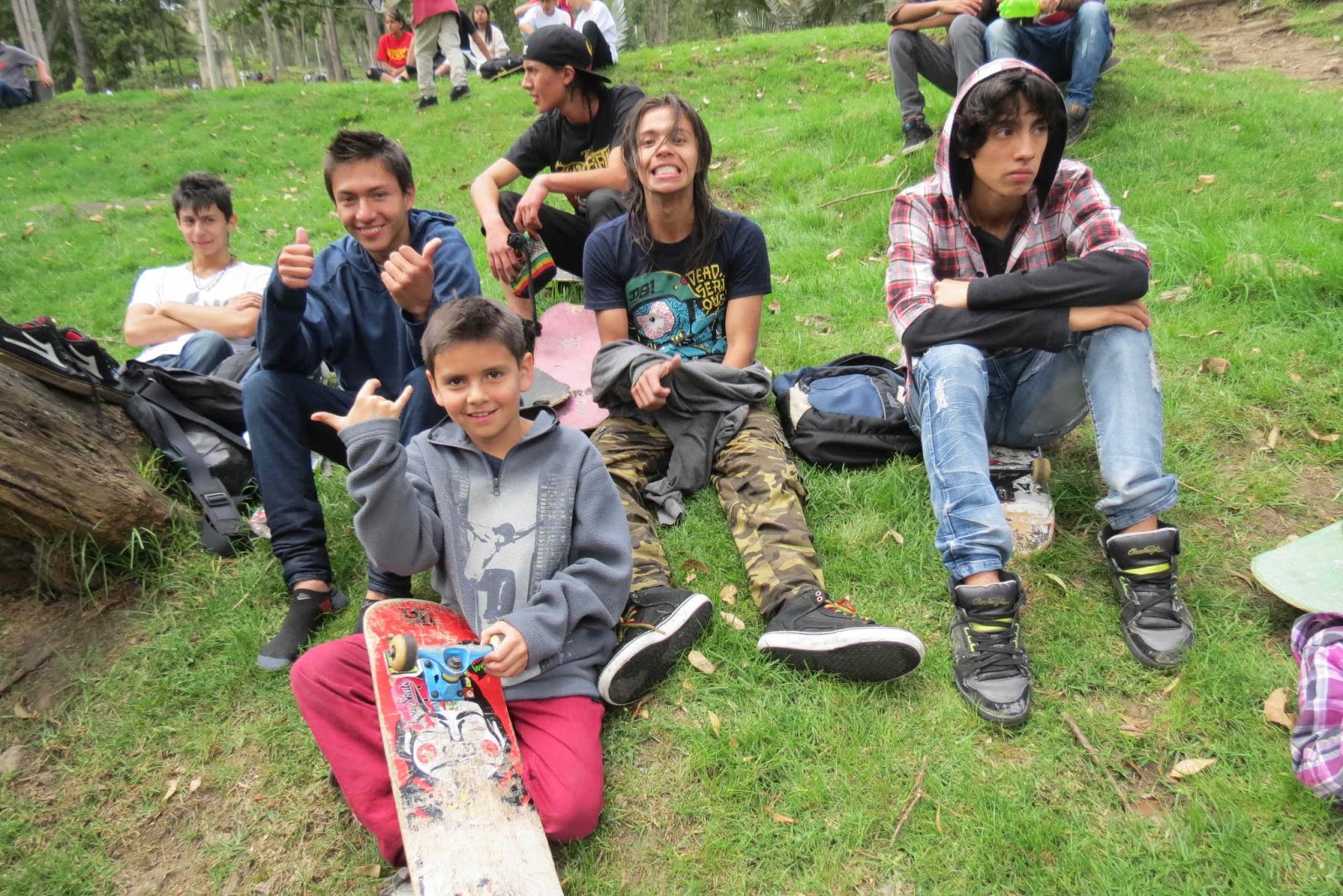
Today skateboarders celebrated their annual World Skateboarders Day with a show of power in numbers. They gathered on Plaza Bolívar and skated north to the the Parque Nacional, filling Ave. Septima with an estimated 5,000 'boarders, stopping other traffic. A skateboarders' Critical Mass - something bicyclists have never accomplished here.

Raise that skateboard high!

Rolling downhill in the Parque Nacional.

Cruising north on Ave. Septima.

Skateboard power!


A skateboard family.


Observers on the sidewalk. Notice the tie vendor taking pictures.

Leaping for it in the Parque Nacional.

Oooops!
Skateboard anarchist.


Super cool skateboarders.


Only a small minority of boarders are female, but this girl was going for it on the downhill in the Parque Nacional in Bogotá.

Go Skate Day.

Skateboard love.

By Mike Ceaser, of Bogotá Bike Tours

Thursday, June 20, 2013

A Billboard for Debate

'Gustavo Petro governs Bogotá' 'Timochenko wants to govern Colombia.'
'No Impunity!' No more ex-members of terrorist groups with the right to govern us.' Rafael Guarin.


This billboard is to go up along the road between Bogotá and Soacha, south of the capital.

The billboard makes two harsh statements for its makers, who are evidently uribistas fearful that the radical left is taking over their country: Bogotá is ruled by an ex-guerrilla, and soon Colombia may be as well. It's signed by Rafael Guarin, a conservative ex-viceminister of defense.

But, while Bogotá Mayor Gustavo Petro was a leader of the M-19 guerrillas during the 1980s, that was decades ago, and he's clearly integrated himself into the democratic system. In fact, his administration's mishandling of garbage policy and struggles with transit and land use policies (which have him facing a recall referendum) are indications not of authoritarianism, but the difficulties of working within a system of checks and balances.

The idea of leaders of the FARC guerrillas, now in peace talks with the government in Havana, going into Congress, is more troubling. The group continues committing severe human rights violations and haven't shown respect for free speech or democratic decisionmaking. The FARC's most recent ten-point plan outlines a wholesale remaking of Colombia's government, including a Assembly to remake the nation's Constitution.

The FARC's ideas are unlikely to become reality. Yet, things probably didn't look so different back in 1991, when Colombia's previous Constitutional Assembly drafted the current Constitution. Demobilized M-19 guerrilla leaders played a prominent role in that assembly, even while the Justice Palace - which they'd attacked just six years earlier - was still in ruins.

The M-19 deserve a lot of the credit (or the blame, depending on one's political perspective) for Colombia's progressive Constitution and legal system. And the demobilized M-19 leaders' political participation in Congress, provincial and municipal government can only be considered a story of succesful integration by an armed group, on the lines of Northern Ireland and South Africa.

In fact, the one time M-19 leaders' participation in government provides the strongest response around against the guerrillas outdated fantasies about armed revolution.

And, to the ex-M-19ers' credit, they have criticized the FARC.

Could the FARC repeat the M-19's story? I'm dubious. The M-19 were young, sophisticated and had a strong idealism, little of which can be said of today's FARC. Could a group whose modus operandi has come to include the recruitment of children, displacement of peasants and drug trafficking possibly participate in a system based on rule of law and respect for human rights?

Still, if the current negotiations achieve a peace treaty, the FARC probably will get their chance to make politics. But does that mean that Timonchenko will govern Colombia? Not likely. If FARC leaders ever do enter Congress, they'll likely only end up isolated and irrelevent in their leftist echo chamber.

Guarin, the billboard's author, said he wants to generate debate on the FARC's future role.

A City Hall official called the planned billboard 'dirty propaganda,' but expressed support for open debate. That's healthy.

By Mike Ceaser, of Bogotá Bike Tours