Saturday, October 25, 2014

Well, Some of It's Art


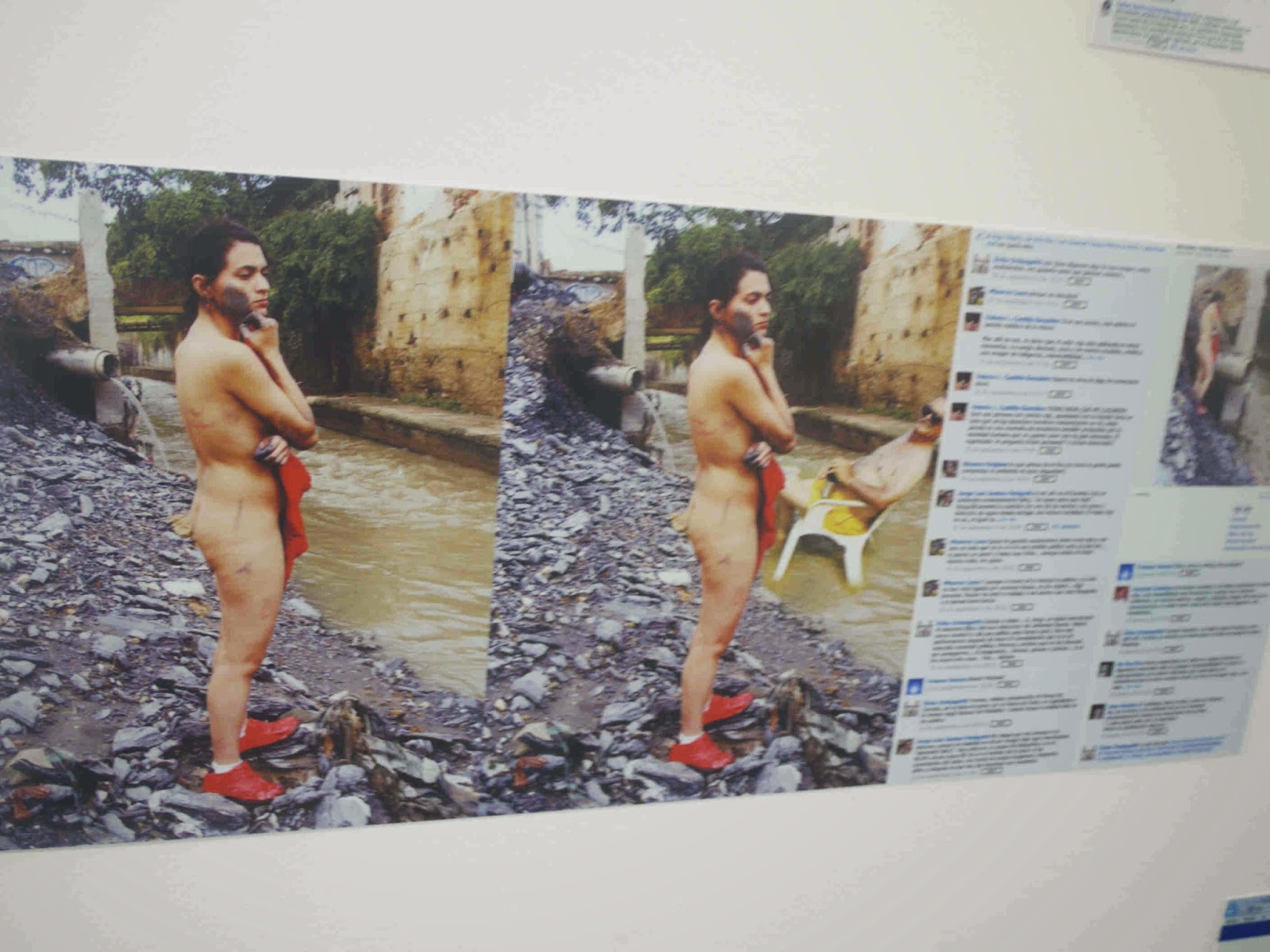
In conjunction with the ArtBo exposition going on in the Corferias convention center, various galleries in La Candelaria are putting on their own shows. This is from the Misol gallery on the corner of Carrera 3 and Calle 12D.

Is it art? Some of it. Other's just plain obscenity, it seems to me. But the gallery's worth a walk thru, and while you're at it you can also visit several other local galleries. You'll have a much lower-key art experience than in Corferias.

A match by any other name.
Why is this horse in the living room?
Suburban nude.
Why am I standing here naked?
Two ladies in a kitchen. Transcendental!
An artist gave a lecture this afternoon about the nature of consciousness.
Artsy types.
A study in copulation.


By Mike Ceaser, of Bogotá Bike Tours

Thursday, October 23, 2014

Evening in Los Martires


The Los Martires neighborhood, located a few blocks west of La Candelaria, is a run-down, hardscrabble area, but retains a sort of weathered charm. Once, perhaps close to a century ago, the residents were rich, and their stately homes remain, now converted into grain shops, hardware stores and welding shops.

The area should be a historical monument. On its plaza, the Spanish colonialists executed Colombian patriots. But today that same plaza is roamed by drug addicts from the nearby alley known as El Bronx.

A salesman on a bike pedals down an unpaved street.
A house, once grand, now a hardware store.

Pedicabs delivering passengers.

The Iglesia del Voto Nacional, built after the Thousand Days War in gratitude for a peace which did not last.

Bar games for sale on a sidewalk. The silver objects are disks for playing tejo.

A homeless man searches thru a corner garbage pile. Such is Bogotá recycling.


Soldiers stand guard by the obelisk memorializing Colombia's martyrs.
By the plaza, a spontaneous flea market appears every day, offering products scrounged from the garbage or perhaps stolen. 
Tools on the sidewalk.


By Mike Ceaser, of Bogotá Bike Tours

Wednesday, October 22, 2014

'A Place for Nobody': The Closing of the Plaza de Toros


When Gustavo Petro became mayor three years ago, he vowed to end bullfighting and convert the historic Plaza de Toros Santamaria into a center for arts and culture, as well as a tourist attraction.

The Plaza de Toros would be transformed into a Plaza de Todos, a 'stadium for everyone.'
A threat? Bullfighters staging a sit-in in front of the plaza.

For a while, Petro seemed to keep his word. He allowed no more bullfights after Feb. 2012 and for a while the plaza was used for sports events, concerts and even, most memorably, ice skating.

However, about a year ago, the sports and cultural events stopped. The only activities which continued there were morning bullfighting practices and visits by tourists, including Bogotá Bike Tours. We'd visited the stadium for years, thousands of time, and never experienced a single problem. Foreign and Colombian tourists enjoyed exploring the handsome old Moorish-style building and learning about la fiesta brava, as well as the building's dramatic political history.

About three months ago, a group of young bullfighters began a (pseudo) hunger strike in front of the stadium, and their morning practices inside ended.

Tourists by a statue of famed Colombian bullfighter Cesar Rincon.
Then, about three weeks ago, the District Institute for Sports and Recreation (IDRD), which administers the city-owned building, changed the building's administrator. The new administrator shut the historical monument to visitors. When I talked to her, she cited the hunger strikers camped out in front of the building.

"When the tension subsides, we'll reconsider," she said.

We had never noticed any tension, with the bullfighters, who are quiet and friendly - or anybody else. Days passed, and the imaginary tension didn't disappear. The stadium remained shut.
Tourists on the plaza's arena.

We sent a letter and called the IDRD. An IDRD official also mentioned the hunger strikers to justify the closure. I pointed out that the strikers are very friendly people, and, in any case, are on the sidewalk outside the stadium - so what possible relevance do they have to what goes on inside the stadium? No reply.

The IDRD did, however, reply to our letter., They justified the closure on the "ongoing process of structural reinforcement for the stadium." Mayor Petro has argued that the old building needs repair work. Many suspect that's an excuse he invented to not allow bullfights. But, whatever the truth, the fact is that no work of any kind has started there - and may never. The handsome old building sits empty and used by nobody.

The Petro administration, rather than turning the old plaza into 'a place for everyone,' has transformed it into 'a place for nobody.' A brilliant move for a city which aspires to make itself into a tourist destination

It's really absurd that one of Bogotá's historical monuments is closed to the public - and even the bureaucrats who made the decision don't seem to know why.

The Moorish-style building was designed by a Spanish architect.
Ride that bull!

The stadium's backside.
By Mike Ceaser, of Bogotá Bike Tours

Tuesday, October 21, 2014

To Catch a Thief?


This afternoon in the Teusaquillo neighborhood during a bike tour we came upon this scene, in which two tough-looking men were apprehending this kid, whom they accused of stealing, apparently a car's rear-view mirror.

Scenes like this one aren't rare in Bogotá, where residents frequently take the law into their own hands after crimes - or alleged crimes. In this case, thankfully, the two men didn't beat the kid up, altho that might have been because we witnesses were nearby with cameras, and someone called the police, who showed up quickly. I've seen other incidents in which people beat up an alleged criminal, with the justification that 'the police will just let him go.'

Why is the man in the striped shirt carrying a pistol? Does he really think that two big men need the help of a firearm to detain a small kid? Would he really use it against this kid for supposedly stealing a mirror? And, does he have a license to carry a firearm in the first place?

And, how about the kid? He looked like a homeless drug addict, and very desperate. Had he been kicked out of his home? Beaten or abused? Desperate to eat or more likely to buy bazuco, he tore off a mirror worth a few thousand pesos in El Bronx and started running. He didn't get far this time.

Perhaps he's in a children's home by now and will come out better for the experience. But more likely he's in a cell with other criminals, or back on the cold streets by now.


By Mike Ceaser, of Bogotá Bike Tours

Monday, October 20, 2014

Battle Over the Buses

Bus-free day? Calle 26, usually busy with private buses.
Thousands of private buses stayed home today in what could be the beginning of a battle over the future of the city's public transportation.

Calle 26 this afternoon near the Central Cemetery.
Mayor Petro wants to replace the city's old, chaotic, polluting private buses with the Integrated Public Transit System, or SITP. But the SITP has been poorly implemented. Few people ride the buses, pushing some of the system's private operators toward bankruptcy. And, many of the blue SITP buses belch as much smog as do the traditional private buses, altho Petro's 'Humane Bogotá' doesn't seem to care about that.

Petro's solution was draconian: Expanding the city's failed Pico y Placa anti-traffic congestion rule from private cars to the private buses, banning them from the streets two days each week depending on the last digit of their license plates. The law has been on the books for years, named the 'Environmental Pico y Placa.' Since 'clean air' is not in this mayor's vocabulary, the law had been forgotten - until Petro needed a weapon in his battle with the private bus companies. Now Petro decided to enforce it, but evidently with no environmental criteria.
Calle 26 on a normal afternoon.

The move does make some sense, since transit specialists agree that Bogotá has an excess of buses, many of which are old and polluting. But the law's real, thinly-disguised motivation was to force passengers onto the SITP buses. Inconveniently, however, many pointed out that many outlying neighborhoods lack SITP lines.

The strike dramatically reduced traffic in central Bogotá. But that was probably also because many people just stayed home today. As for the SITP buses, while they appeared to carry more passengers than usual, I saw many that were nearly empty or carried few passengers, despite the strike.

Will the bus companies persist in their strike? Can Petro take the political cost? Tune in in a few days.
A lone bus on Carrera 10, which is usually back-to-back buses.
A line of SITP buses in Teusaquillo.
A SITP bus with an impressive number of passengers. (The man on the bench is displaying his solidarity with the bus strike.)

Despite the strike, this SITP bus was nearly empty.
Green is not clean. A (private) bus belches smoke today.
By Mike Ceaser, of Bogotá Bike Tours