Wednesday, January 14, 2015

Je Suis Charlie?

Take a flyer. A Bogotá city employee hands out flyers supporting the French satirical magazine Charlie Hebdo.
The satirical French magazine Charlie Hebdo may be ugly, offensive, repugnant and blasphemous. But in a free society, one has a right to be ugly, offensive, repugnant and blasphemous. Nobody is obligated to read the publication.

Today, Bogotá's City Hall joined the chorus in support of free speech in the wake of the horrific massacre of Charlie Hebdo staff in Paris.

Colombia has no similarly scathing publication. But if it did, I'd be interested in seeing how Mayor Petro would respond to being satirized in such a vicious way.


Even the communist paper 'Voz' came out in favor of Charlie Hebdo - and included an irrelevant criticism of capitalist media monopolies. 
Charlie Hebdo's latest, post-massacre cover.
By Mike Ceaser, of Bogotá Bike Tours

Tuesday, January 13, 2015

Colombia's Favorite Meteorite


What's left of the meteorite of Santa Rosa on display in the Museo Nacional in Bogotá.
A midget on the meteorite.
In April 1810, a meteorite fell from the sky near the town of Santa Rosa, in Boyaca, Colombia. The metallic rock's voyage didn't end there, however. Today, the meteorite's pieces are distributed throughout museums and universities in Colombia, United States and England.

It was a young girl, Cecilia Corredor, who discovered the meteorite, called an aerolito, while chasing a bird. Villagers dragged the 750 kilogram rock into town, where for years it found use as a blacksmith's anvil. Later, the town built a pedestal and placed the rock in a position of honor in the town's plaza.

There it sat for almost a century until American meteorite collector Henry A. Ward got wind of the huge rock. He traveled to Santa Rosa, where he made a deal with the governor: In exchange for the rock, he'd give the town a bust of Pres. Rafael Reyes. The deal was sealed, and Ward's men proceeded to haul the rock off of its pedestal.

Ward poses by the stone,
while still on its pedestal.
But exporting a huge rock isn't easy - physically or politically. Colombia was still smarting from the loss of Panama, which had been sliced off and made independent by U.S. Pres. Theodore Roosevelt. Should a gringo be able to carry off a national heirloom?

"That meteorite is mine, by all rights human and divine," Ward wrote to a U.S. friend.

After an exchange of letters - in which U.S. officials spelled Colombia 'Columbia' - Ward received permission to cut off 100 kgs from the meteorite. He instead sliced off 300.

That material is now distributed throughout universities and museums in the U.S. and England. But the largest piece of the stone, weighing 411 kgs, is in the Museo Nacional in Bogotá, where an exhibition illustrates the rock's wanderings.

Want to learn more about the famous meteorite? Visit the museum, or read all about it here.
Ward's men haul off the rock.
The meteorite being cut, a 14-day process.
The remaining meteorite in the Museo Nacional.
By Mike Ceaser, of Bogotá Bike Tours

Sunday, January 11, 2015

Fresh Air...For a Few More Days


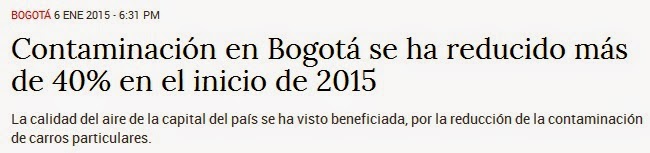
Environmental authorities recently reported that Bogotá's air pollution is down 40% - despite the best efforts of Bogotás innumerable 'rolling chimneys.' But just wait a few days: When the vacationers return to town, so will the smog! 


A recent view of Bogotá's Eastern Hills, usually blurred by a gray haze.

Does this bus have diarrhea?
A blue SITP bus, supposed to be the solution to the pollution problem, issues a stream of smoke.
A view of La Candelaria and central Bogotá,
Add caption


By Mike Ceaser, of Bogotá Bike Tours

Saturday, January 10, 2015

Egipto's Three Kings Festival 2015


An old man named Reginald and a little girl dance for coins at Egipto's Three Kings Festival.
A few scenes from the Egipto neighborhood's annual Three Kings Festival, which kicked off today and continues thru Monday. Altho the event is nominally Catholic, it's basically gluttony, alcohol and loud music. Egipto is a rough neighborhood located above La Candelaria. The festival is being held on La Circunvular Avenue.

This year's was the festival's 100th anniversary, reports El Tiempo.


A couple dances in the street at the Three Kings Festival.
The chicha queen at the Three Kings Festival.
Dancing in the street!

The view down hill thru La Candelaria to the city center.


Cops frisk young men as they enter the festival.

Don't look for health food.


Pouring chicha, which is made from fermented corn.

The city skyline seen from the Circunvular in Egipto.
By Mike Ceaser, of Bogotá Bike Tours

Friday, January 9, 2015

Colombia's Self-Defeating Battle Against Uber

Which is an Uber car? The government order to 'immobilize' Uber vehicles is impossible to enforce.
It was probably inevitable that the arrival in Colombia of the taxi-type smartphone application Uber would generate protests - principally from traditional taxi drivers, who feel their business getting cut into.

The government responded to the taxi lobby the other day by authorizing police to 'immobilize' Uber
By putting more cars onto clogged roads,
Uber can worsen traffic congestion.
cars - an absurdity unless cops are psychic, since Uber vehicles carry no outside markings.

The cabbies' concerns are understandable, but their fight against technology is futile. If not Uber, then another vehicle sharing system will appear...and then another.

On the other hand, government concerns about vehicle safety, tax payments and driver training, are more legitimate. But distinguishing between Internet-based car-sharing and plain old car pooling will be difficult.

Speaking of car pooling, despite Bogotá's worsening traffic congestion, the city has never seriously promoted ride sharing, either by setting up a peer-to-peer ride-sharing program or by creating car pool lanes for vehicles with multiple passengers.

Bogotá policies to promote car-sharing have accomplished
nothing. But car-sharing apps could be a solution. 
The appearance of ride-sharing applications such as Uber is a great chance for Bogotá and other cities to reduce use of the single-passenger vehicle, which is the least efficient way to use road space.

Uber can worsen traffic congestion by luring more cars onto limited road space and drawing passengers from more efficient public transport. But it can also be positive, by reducing pressure to buy private cars.

By working with Uber-type applications rather than trying futilely to ban them, Colombia might have a chance to reduce traffic congestion.

But it can't do that by blocking change.
The owner of this 'public service vehicle' has a sticker announcing that he's not Uber to avoid police hassles.
By Mike Ceaser, of Bogotá Bike Tours

Early Return of the Traffic Jams


One of the daily traffic jams in La Candelaria.
Millions of Bogotanos are still far away, on their Christmas vacations, but the city's traffic jams already back.

Waiting and waiting,,. 
And things will only get worse. Last year, Colombians bought a record 326,000 new cars, about hoalf of which will clog Bogotá's streets...unless the government takes real measures - which doesn't mean more twiddling with the failed Pico y Placa law. Instead, drivers should pay for their impacts on the city, in noise, congestion, space used and pollution, thru a London-style congestion charge, charging for parking and raising the price of gasoline.

'Fear of the dollar provokes record car sales,' reports El Tiempo.
By Mike Ceaser, of Bogotá Bike Tours

Thursday, January 8, 2015

Colombia's Own Charlie Hebdo Moment


On the morning of Aug. 13, 1999, journalist and satirist Jaime Garzón was driving to work when gunmen murdered him. Right-wing paramilitaries are believed to have been behind the assassination, which is still under investigation 16 years later.

Today's newspapers reported the Paris massacre. El Tiempo
printed its front page in black and white.
Whoever was behind it, Garzón's murder shook Colombia, which had become tragically accustomed to the killing of politicians, but not to that of popular commentators. And, inevitably, Garzón's killing, like that of many Colombian journalists before and after him, inevitably sent fear thru every Colombian journalist and commentator, who wondered whether his or her next observation would bring a bullet.

Sound familiar?

Today, journalists the world over have become very aware how just a few armed fanatics can destroy lives and a newspaper.

I'm not defending Charlie Hebdo, which I've never read and wouldn't understand if I did. A Financial Times columnist called Charlie Hebdo's ridiculing of Islam "stupid," altho the commentary has since been revised. And it sounds as tho the magazine was very offensive not only to Islam, but to many groups and religions. But it was a group of Islamist extremists trapped in a medieval mentality who apparently stormed the newspaper's office yesterday and massacred 12 people.

'We are all Charlie.' El Espectador published a
French-language cartoon on its front page..
Today, journalists all over the world, including Colombia, feel a bit more scared about what they
right and where they go. Journalists, more than other professionals, are vulnerable because they must constantly venture out into unfamiliar places, amongst strangers, to get the story. Probably there'll be less of that now, which will mean a loss for society. It will also mean suffering for Muslims and other immigrants across Europe, since right-wing, xenophobic protests like those last week in Germany will undoubtedly intensify.

Those offended by Charlie Hebdo, like those who hated satirist Garzón, had lots of reasonable alternatives, including filing a lawsuit, marching in protest or just closing the magazine and tossing it into the trash.

The Committee to Protect Journalists lists 45 Colombian journalists murdered since 1992. Those murders have inevitably had a muting effect on media investigation and reporting. Freedom House ranks Colombia's press as only 'partly free.'

During recent years, Colombia has had many scandals, including the parapolitica, government spying and the horrific falsos positivos murders. We can only speculate about how much wrongdoing would have been reduced or even prevented had Colombia had a more vigorous press.

By Mike Ceaser, of Bogotá Bike Tours