Sunday, March 15, 2015

The 'Miracle' Metro

A jammed Bogotá road. Is a subway the solution?
It will reduce commute times, traffic congestion, pollution - and even crime and health problems, while saving Bogotá millions of dollars.

Those are some of the claims made by backers of a 15 trillion peso Bogotá subway line in a recent study by the company Teknidata, hired by the city's Urban Development Institute, the IDU.
A Bogotá bus belches smoke. Has anybody
thot of enforcing emissions laws?

But many of those claims look dubious from a glance at Latin American capitals such as Mexico City, Santiago, Chile and Caracas, Venezuela, all of which have much more extensive subway systems than Bogotá could have for decades - and still suffer from horrific pollution and traffic jams.

The reason is simple: Induced traffic demand. Opening up road space, by either building more roads or taking cars off of the roads using mass transit, will reduce traffic jams....for a while. But new drivers, seeing that wonderful open asphalt, will decide to make more trips. So, traffic ends up just as bad, or even worse.

This is not to say that a subway's a bad thing. In fact, it's an excellent thing for the many thousands of people who use it every day to get where they're going quickly underneath the traffic jams.

Will Bogotá's metro look this good?
But the question for a cash-strapped city isn't whether a metro would be a good thing (a space port, after all, would also be a good thing), but whether it's the most cost-efficient way to accomplish the city's goals. And a subway looks rather like the most expensive way to maybe achieve its goals:

Reduce traffic congestion? Rather than spending trillions of pesos digging up the city for a subway, Bogotá could reduce congestion AND make money by creating a London-style congestion charge. Such a charge would raise the cost of and thus disincentivize driving. More people car-pool, take buses, ride bikes or simply don't make that unnecessary trip, and traffic jams are reduced (and so is pollution).

Reduce pollution? This one's almost too obvious to be worth explaining. Bogotá has a bad air pollution problem. Bogotá also doesn't bother to enforce emission laws. Wouldn't enforcing the law be a good first step toward reducing pollution, rather than pretending a subway will do it a decade from now - by which time the city will be inundated with many thousands more polluting vehicles?

As for reducing crime, the newspaper article doesn't bother to explain this, and I won't try.

Bogotá's leadership is fixated on building not only any metro but the most expensive kind; a subway. And not because it's the best transit option, but - it seems to me - because other big cities have subways, and Bogotá wants to feel important. Incidentally, subway construction will also mean huge, juicy contracts for infrastructure companies.

By Mike Ceaser, of Bogotá Bike Tours

Saturday, March 14, 2015

Good-bye Land Mines?

A campesino who lost his right leg to a land mine.
(Photo: Campaña Colombiana Contra Minas)
The other morning, Edilberto and Marlon Alexis González Mina, ages 9 and 10, were walking to school near the village of Tandil Alto Mira in Nariño Department, when they stepped on a land mine.

The explosion killed the two boys, making them the latest of the 11,000 people injured and killed by mines since 1990 in Colombia, the only nation in the Western Hemisphere where land mines are still being planted. Colombia is the world's third-most mined nation, behind only Afghanistan and Cambodia.

Colombia's guerrillas plant home-made land mines to protect themselves from pursuing soldiers and to guard coca leaf fields. But they don't return to remove the devices, so the mines remain waiting silently to kill or maim the unfortunate person (or animal) who steps on them.

So it was positive news ten days ago that the military and FARC guerrilla negotiators agreed to work together to find and remove the thousands of land mines after they sign a peace treaty.
A mural on an abandoned Bogotá building
memorializes land mine victims.

More than a few 'ifs' and 'buts' remain, however. The peace agreement looks likely, but is no sure thing. And neither is the obedience of the many guerrilla units to directives from their leaders. Meanwhile, the ELN guerrillas, who are not in the peace negotiations, presumably continue planting land mines. And, in any case, the guerrillas can't possibly know the locations of all of their mines, which a government official estimates are distributed across 688 municipalities.

The guerrillas fashion their mines using explosives sometimes laced with screws and feces in order to maximize the injuries and infection. These artesanal mines can wait underground for 50 years for someone to tragically step on the wrong spot.

Colombia may finally free itself of the nightmare of land-mines, but not for a while yet.

By Mike Ceaser, of Bogotá Bike Tours

Thursday, March 12, 2015

An End for the Old Buses?

Soon to be gone? Ancient buses wait on Carrera 10.
Bogotá officials say - once again - that those old buses wheezing and groaning along our avenues squealing their brakes and belching smoke will be gone in a few months.

Of course, they've been promising this for years, and yet they're still here. And this latest promise has a huge 'but': It'll only happen if two of the near-bankrupt SITP subcontractors can get on their feet financially, which will require a miracle.

There are good reasons to get those old buses off of the streets: They pollute and contribute to a street-congesting surplus of public transport. But the buses are also profitable, and so their influential owners want to keep them rolling - and polluting.

A recent headline in El Tiempo announcing the elimination of the old buses...
And a similar story from 1996 announcing the disappearance of the old buses...
An old bus belches its way along Carrera 10.
But if reducing pollution is the city's goal, then they should get rid of the dirty buses, whatever their age. And that might mean shutting down TransMilenio....

A TransMilenio buses issues a cloud of smoke in La Candelaria, along the Eje Ambiental.
By Mike Ceaser, of Bogotá Bike Tours

Wednesday, March 11, 2015

A Venezuelan Threat to Whom?

Nicolas Maduro: Hapless leader
or threat to Washington?
“I, BARACK OBAMA, President of the United States of America, find that the situation in Venezuela....constitutes an unusual and extraordinary threat to the national security and foreign policy of the United States, and I hereby declare a national emergency to deal with that threat." 

Give us a break. Venezuela is near being a failed state. It's economy's going down the tubes, its government's turning increasingly corrupt, authoritarian and repressive, and Venezuelans' lives are becoming tougher and tougher.

Venezuela is a threat...to Venezuelans and probably to Colombians and other neighbors. But an 'extraordinary threat' to the U.S.'s national security and foreign policy?

Venezuela was perhaps once a threat to U.S. foreign policy - back when Chavez was alive and admired, and when high oil prices gave Caracas a full wallet to buy and influence foreign heads of state. But today Venezuela is widely seen as the basket case it is and has been reduced to begging support from its few allies. Caracas is in no position to rally anybody against the U.S. Even Venezuela's long-time ally Cuba has pivoted toward Washington.

Venezuela's worst-case - and increasingly likely - scenario is a larger scale repeat of its its 1989 Caracazo social explosion, when riots led to thousands of deaths. The difference is that today the economy is even more distorted and the country even harder up than back then, so things might be even worse, and Venezuela could emerge from the crisis as a full-fledged dictatorship.

But that dictatorship scenario is a threat to Venezuelans rather than to the U.S. As many will recall, Washington got along just fine with dictators and strongmen in Brazil, Argentina, Chile and Peru - not to mention China and Washington's blooming friendship with communist Cuba. Or maybe I missed Washington's crack-down on Saudi Arabia for being a dictatorship, not permitting free speech or religious practice, and furiously repressing women, dissidents and religious minorities.

And, the Washington officials who denounce Venezuela should keep in mind that they are financing the behavior of Caracas, which still sells most of its oil to the U.S.

The Caracas Chronicles blog speculates that Venezuela could emerge as a base for Islamic terrorism - which is an absurd, wild-eyed scenario for a highly-Catholic nation still dependent on U.S. Or turn into a narco-state. But the U.S. has long co-existed with state-tolerated drug trafficking, and will continue losing the War on Drugs until it abandons failed prohibitionist policies.

On the other hand, Obama's declaration plays right into Venezuelan Pres. Nicolas Maduro's rantings about the U.S. conspiring to invade and overthrow him. After all, declaring a nation an 'extraordinary threat' sounds like a great justification for invasion.

Venezuelan Pres. Maduro didn't hesitate to exploit the new diplomatic crisis, which he called "the most aggressive, unjust and harmful blow against Venezuela." Maduro announced that he would introduce an enabling law into the National Assembly giving himself additional powers to deal with the situation. Those familiar with Venezuelan politics tknow that means more quasi-dictatorial powers for Maduro.

Disturbingly, Venezuela's Ambassador to the Organization of American States said during a television interview that a sharpshooter's bullet makes a different noise when passing thru the skull of a government opponent, because "the sound is much less, like a crack, because the cranium is hollow and the bullet passes thru rapidly."

A comforting comment for opponents in a supposedly democratic nation.


By Mike Ceaser, of Bogotá Bike Tours

Tuesday, March 10, 2015

A Warning Shake

Office workers on an unscheduled break today along Ave. Jimenez.
Bogotá's office workers received an unscheduled break this afternoon when an earthquake centered on Santander, near the Venezuelan border, was felt in Bogotá. There were no reports of injuries or serious damage in Bogotá, altho some towns in Santander reported widespread structural damage.

The mild quake served notice that, altho earthquakes are rare here, they do happen, and can be powerful. Bogotá is built on a wetland, and the next powerful quake which hits here will inform us about the structural integrity of its high-rises.

By Mike Ceaser, of Bogotá Bike Tours

Monday, March 9, 2015

Friends in High Places

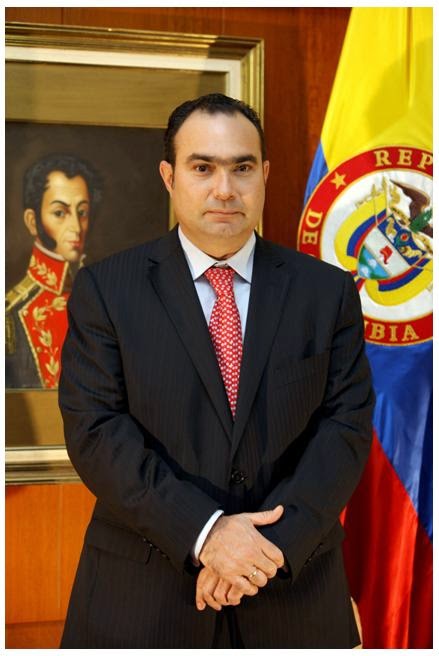
Judge Pretelt: In the middle of the storm.
When El Tiempo columnist Maria Isabel Rueda recently interviewed Constitutional Court Pres. Jorge Pretelt, she was impressed that Pretelt brought along the court's ex-president, Rodrigo Escobar Gil.

Because magistrate Pretelt is embroiled in allegations that he demanded a 500 million peso bribe in order to reverse a ruling against the Fiduciaria Petrolera S.A. oil company, Rueda asked Escobar Gil whether he was working for that company, known as Fidupetrol.

Escobar told her he was not.

But a few days later, Rueda writes, she learned that Escobar Gil had in fact signed a contract to help Fidupetrol in its battle to reverse a 22 billion peso ruling by the Supreme Court against the company. Fidupetrol's case was in Escobar Gil's old stomping ground, the Constitutional Court.

The episode is in the news because Pretelt, the Constitutional Court's current president, stands accused of asking for a 500,000,000 peso bribe in order to produce a court ruling favoring Fidupetrol. As it turned out, the court ruled against the company. Its attorney Víctor Pacheco then accused Pretelt of demanding a bribe to ensure that Fidupetrol's tutela succeeded and then failing to fulfill his promise. Pretelt denies the bribery accusation, but acknowledges that Pacheco visited him at home. Pretelt has taken a leave of absence.

Victor Pacheco, the man who started it all.
Update: El Tiempo reports that Pacheco, apparently contradicting himself, told prosecutors that Pretelt had in fact instructed Pacheco to give money to another court judge, Mauricio Gonzalez. Pacheco later informed Gonzalez, who made the affair public.

El Tiempo examined Pretelt's finances and found that he has acquired a large amount of property over recent years. Pretelt denied any wrongdoing and pointed out that he comes from a wealthy family.

Whatever the truth about the alleged bribe, the mere fact of an ex-court president representing a company with a case before the court calls the high court's version of 'justice' into question.

'La Ley Para Los de Ruana' - A common saying meaning
that only the poor have to obey the law.
After all, who can doubt that a an ex-court high court magistrate - much less its president - still has powerful influences on the court, whose inner workings he knows intimately and on which he must still have friends and political allies?

In this case, Fidupetrol's machinations failed them. But how many powerful people and companies have bent courts to their interests thru bribery and undue influence? And if that's the case on Colombia's top courts, how much corruption is happening in local courts? I now that I've heard multiple stories about people slipping judges money to get convicted relatives off with light sentences. And, the repeated spectacle of drunken drivers responsible for fatal accidents receiving home detention also undermines faith in the courts.

To rebuild respect for its courts, Colombia needs to take a few basic steps, including requiring more transparency about court officials' property and income and prohibiting retired judges and other court officials from working on cases before the institutions they recently belonged to.


By Mike Ceaser, of Bogotá Bike Tours

Saturday, March 7, 2015

Seven From The Same Mold?

All from the same mold? Candidates for rector of the National University.
The Universidad Nacional, Colombia's largest university and one of its most respected ones, is in the process of selecting its next rector, to serve from 2015 - 18. The new rector is to be chosen from seven candidates by the High University Council, which has only one student among its nine members.

As always, the selection process is generating opposition - unsurprisingly on the far-left campus. Student activists want to have vote and voice on the selection. The students will proceed to hold a vote and choose a far-left candidate - and be ignored by the university administration.

I have a suggestion for the university. Take a look at the slate of candidates: They all appear suspiciously white, male and middle-aged. Why not encourage women and minority candidates to participate (there and also on the council), and perhaps the student activists will be more willing to believing that the administration is open to new ideas.

Colombia's largest public university has serious issues of infrastructure, tuition and access to education. Perhaps by bringing in people of different backgrounds, the university can find novel answers to its troubles.

Wall art on the National University campus calls for electing leftist, one-time sociology Prof. Miguel Angel Beltran as rector. Accused of being a FARC guerrilla agent on campus, Beltran was imprisoned for two years, released and recently stripped of his title as professor. 
Encapuchados, or hooded activists, express their position about the rector selection on the Plaza del Che.
A banner by the university entrance about the rector selection. 
By Mike Ceaser, of Bogotá Bike Tours