Thursday, May 18, 2017

The Wrong-Way Drug War

Erradicating Colombian coca bushes. Less supply increases prices, triggering more plantations elsewhere.
During the Santos-Trump meeting in Washington today, undoubtedly at the top of the agenda was the huge increase in cocaine acreage in Colombia over the last several years.

Colombia's coca leaf crop has more than doubled, reaching record levels.

Conservative politicians and commentators, such as Florida Governor Rick Scott, ex-U.S. ambassador to the OEA Roger Noriega, and a certain right-wing Wall Street Journal columnist, want Colombia to accelerate coca leaf erradication, and in particular restart aerial fumigation with glyphosate.

Coca leaf acreage has spiked in recent years.
(Graphic from Semana magazine.)
Colombia suspended aerial fumigation in mid-2015 following a report which said that glyphosate might cause cancer. Many suspected that the government's real motive was to ingratiate itself with the FARC guerrillas, who late signed a peace deal with the government. Aerial spraying is also controversial because of its impacts on the environment and on food crops. And some analysts say it doesn't produce lasting impact on coca crops, since farmers have found ways to protect their plants, and can quickly replant them, compounding the environmental impact.

But even in the best of scenarios, attacking drug crops is a losing strategy. According to analysts, coca leaf farmers receive barely more than 1% of drug trafficking's profits, meaning that destroying those crops produces little economic impact on the drug economy. Even more importantly, by reducing supply, drug crop erradication raises prices and increases the economic incentive to plant coca. As a result, when they erradicate one farmer's crop, he or another farmer will likely respond by planting someplace else.

Also, drug traffickers' profits rise. Narcos say: 'Thank you Donald Trump!
Florida state Governor Rick Scott send Trump
a letter criticizing Colombian for failing to
erradicate its coca leaf crop.

On the other hand, reducing demand, for example by treating addicts, lowers prices and reduces the economic incentive to plant coca. Yet, Trump has proposed cutting the budget of the Office of National Drug Control Policy by 95%.

Naturally, decriminalizing drugs would reduce many of their negative impacts, but that's not on Washington's policy radar screen.

Afterthought: Santos and Trump also likely agreed to condemn the Venezuelan government for its increasing authoritarianism and many human rights violations. Good enough. So, how does Trump square that with his friendship with Turkish Pres. Erdogan, who is becoming increasingly authoritarian and violates human rights?


By Mike Ceaser, of Bogotá Bike Tours

Wednesday, May 17, 2017

The Gunadules' Art from the Universe

A  mola with modern influences.

One of Colombia's least-known indigenous peoples, the Gunadules, also known as the Kunas, Cunas o Tules, lived in pre-Columbian times in northern parts of Colombia and the Darien peninsula, but were driven into what is now Panama by conflicts with the Spanish and other indigenous groups. Only a few thousand still live in present-day Colombia.

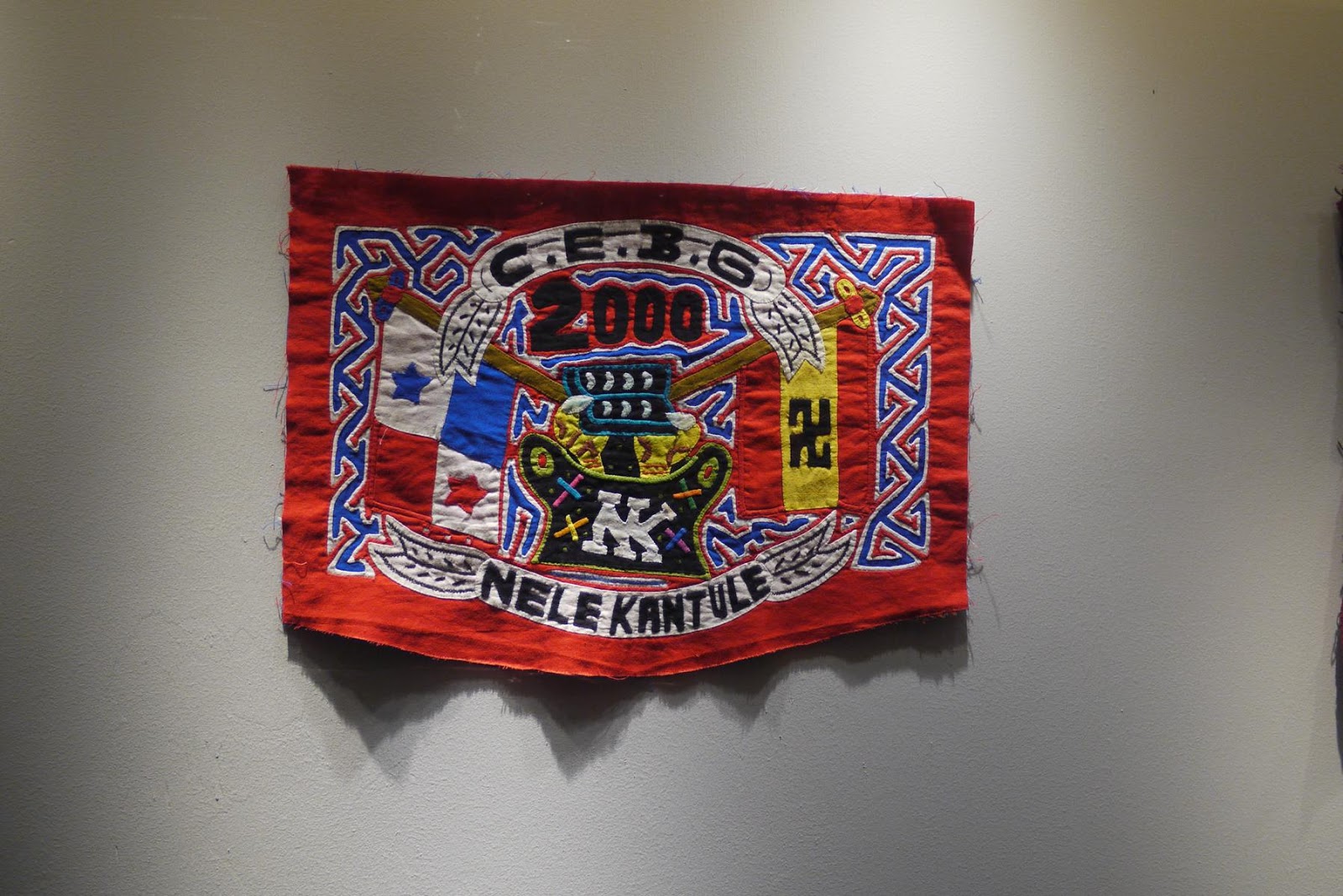
In 1925, the Kunas rebelled against the Panamanian government and achieved a measure of cultural autonomy - and also adopted a flag with a swastika, which they still use.
Most Gunadules now live in Panama.

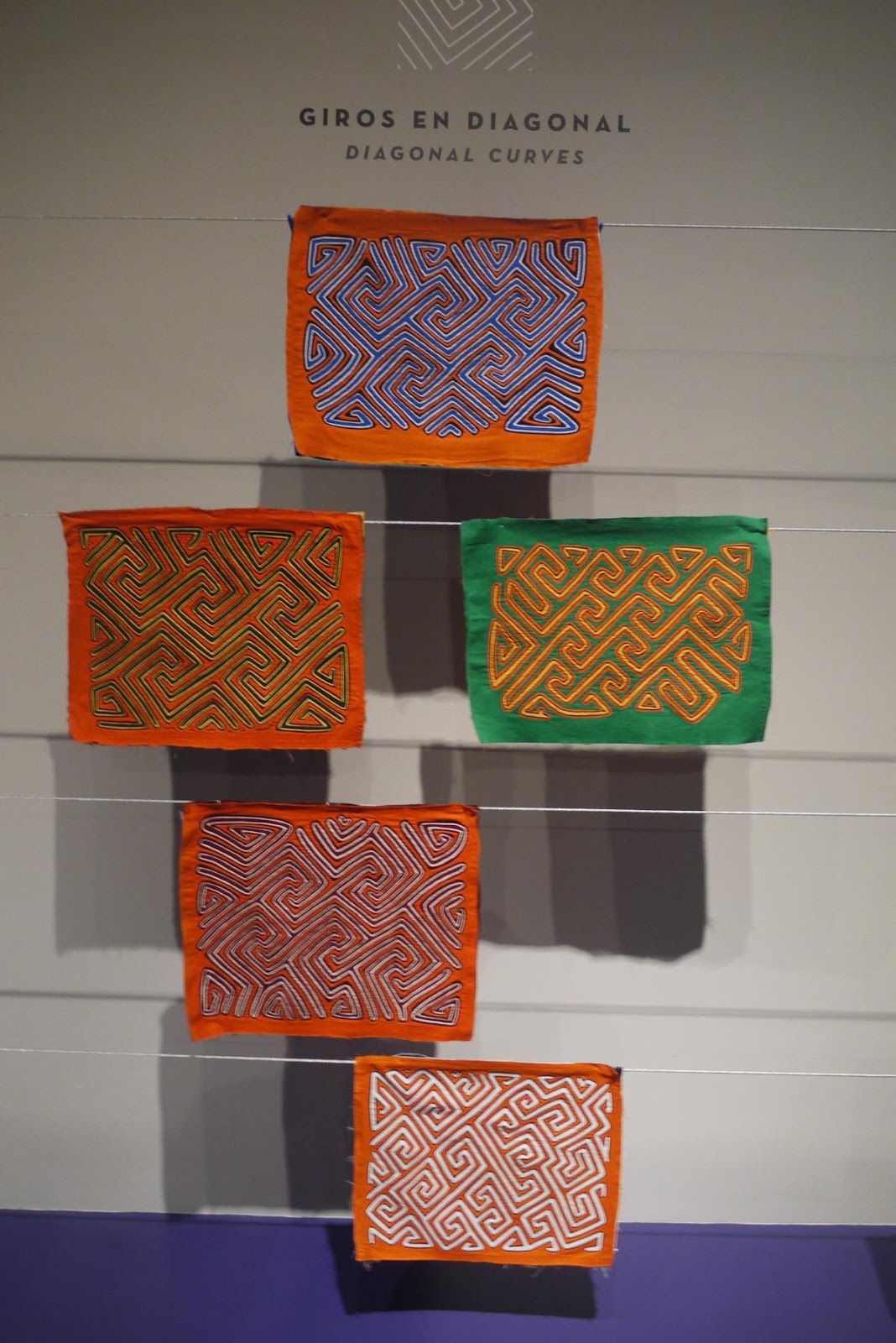
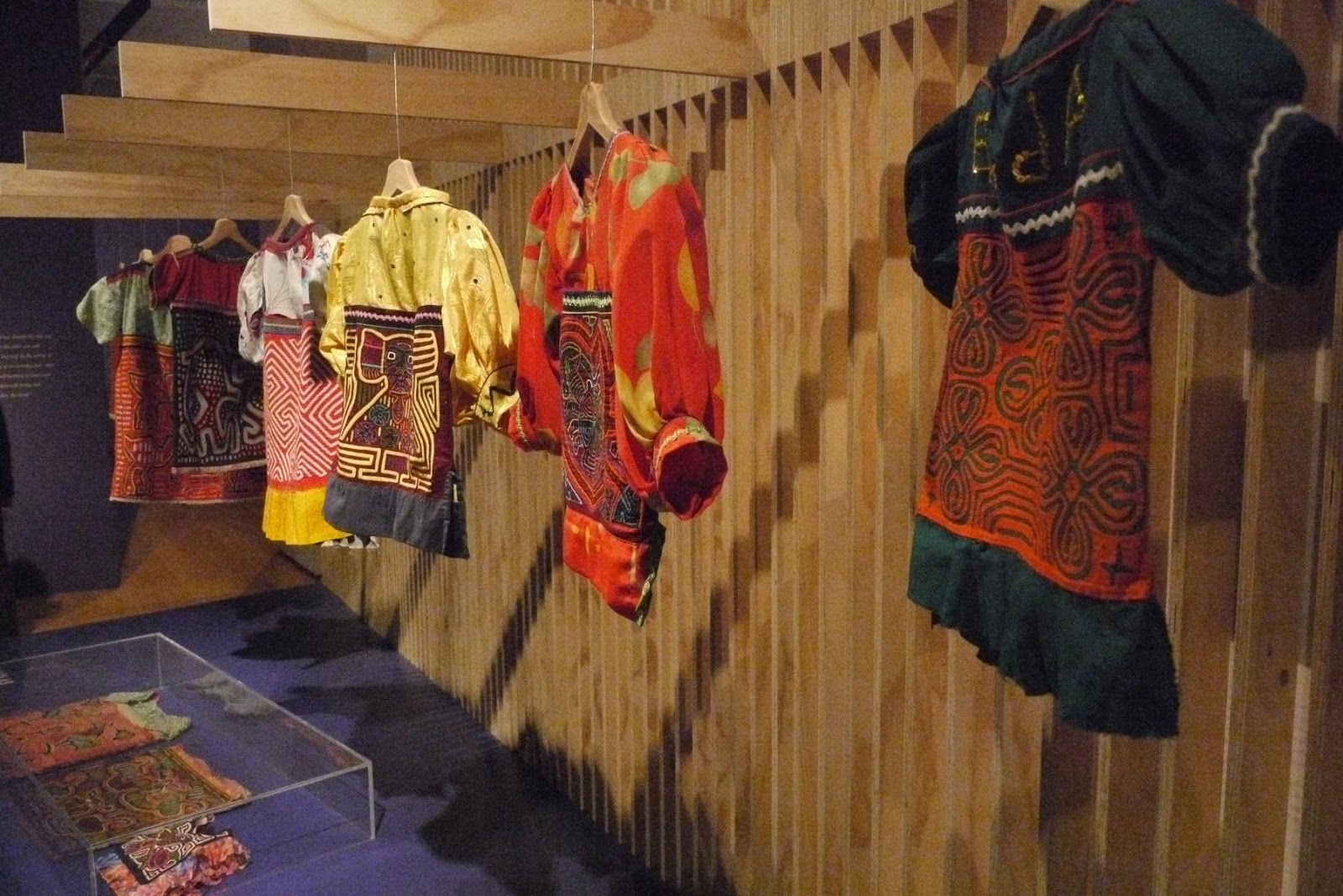
The Gunadule women are famous for sewing molas, which have a spiritual and artistic significance. According to Gunadule mythology, a woman traveled through the universe, which is divided into layers or capas, to bring back the secret of the molas.

An exhibition of molas, and other Gunadule artwork, is on now in the Museo de Oro in Bogotá.


When a figure cracks, it loses its spiritual value.


A bird.


Molas come in all colors.

Gunadule indigenous people.

Their flag includes a swastika.


Cultural influences: Old Milwaukee.


By Mike Ceaser, of Bogotá Bike Tours

Tuesday, May 16, 2017

A Frenchman's View of Old Colombia


A riverboat at a coffee plantation.
Bourgarel on horseback.
A lifelong diplomat, Ernest Bourgarel was France's consul general and chief minister in Colombia at the end of the 19th and in the early 20th century. Between 1890 and 1902, Bourgarel traveled widely across Colombia, particularly along the Magdalena River, documenting in his notebooks and with his camera a nation which was growing economically and developing its coffee industry - but also suffering from repeated civil wars.

Bourgarel's are some of the earliest documentary photographs of Colombia.

A selection of Bourgarel's photos and notes are on display this month in the Museum of Bogotá, in its new building on Calle 10 between carreras 3 and 4.

A cargo train.

La Candelaria Church in Medellin.

Working on the Panama Canal.

A steam train crosses a bridge.


Mules and men cross a wood plank bridge.
Bolivar street in Medellin.
The exhibition in the Museo de Bogota.
An old map of the Magdalena River.
Interior patio of the Museo de Bogotá.
Ernest Bourgarel, a self-portrait.
By Mike Ceaser, of Bogotá Bike Tours

Marching Off, Stage Left


For reasons we could debate, Latin American teachers' unions appear to often be wildly, inordinately far-left. Perhaps it's the mixture of a truly proletarian labor force with a level of intellectualism not often found among mine or factory workers.

One of the most surreal incidents I've experienced in my years in Latin America was an interview with a teachers' union official in La Paz, Bolivia. The woman had just returned from a union conference, and described to me the debates there: It was the Trotskyites vs. the Stalinists. (She was one of the Trotskyites.)

I left the interview wondering which decade I was in.

I felt the same way today when I passed these red communist flags carried by striking teachers. The teachers' demands are pretty standard: higher wages and benefits. Those won't require a revolution, which isn't likely to occur anytime soon, in any case.

'Let's go UPN.' The Union Patriotica Nacional is a far

The teachers' march on Carrera Septima.

By Mike Ceaser, of Bogotá Bike Tours

Monday, May 15, 2017

Santos: Worst President Ever?

Economic growth is slowing, drug production is growing, and the Colombian government is handing the nation over to communist guerrillas.

Colombia is in multiple crisis due to the misgovernance of Pres. Santos - if you believe right-wing Wall Street Journal columnist Mary Anastasia O’Grady.

It does sound pretty bad - unless you look at thing in context.

Pres. Juan Manuel Santos
Yes, Colombia's economic growth has slowed, but that's the fault of weak prices for raw materials, which Colombia can't control, as well as Colombia's lack of economic diversification - a problem the nation had since long before Santos.

In fact, just months ago Colombia had one of the world's fastest-growing economies, and one which had grown year after year under both presidents Uribe and Santos.

Santos has also pursued exactly the sort of capitalist free trade policies which the Journal usually praises.

It's also true that Colombia's cocaine production has boomed in recent years, and part of the reason is undoubtedly the government's prohibition against aerial herbicide spraying. That decision, based on supposed health concerns, was certainly questionable. But the more fundamental reason for the drug crop's growth is the booming cocaine market in the U.S. - and that is not Colombia's fault. Prohibitionist policies have never worked, and those failed policies are imposed by Washington, not -Bogotá.

O'Grady is also correct that the government gave the FARC guerrillas a sweetheart deal in the peace talks, and that Santos simply ignored the national referendum which voted narrowly against the pact. But I'd like to see anybody, including Uribe, get the guerrillas to sign a better deal - particularly one which would send them to prison for their numerous crimes.

O'Grady is correct that Colombia has troubles, but they're mostly not the fault of Pres. Santos.

O'Grady doesn't want the U.S. government to continue sending foreign aid to Colombia. However, Colombia's transformation from a near failed state to a stable democracy with a growing economy is one of Washington's biggest foreign policy successes.

By Mike Ceaser, of Bogotá Bike Tours

Religion, Terror and Luxury: La Calle del Sol

The Calle del Sol building on Carrera 3 in La Candelaria. A seminary, monastery, secret police headquarters, and now apartments.
An old-style lamp on
the building's corner.
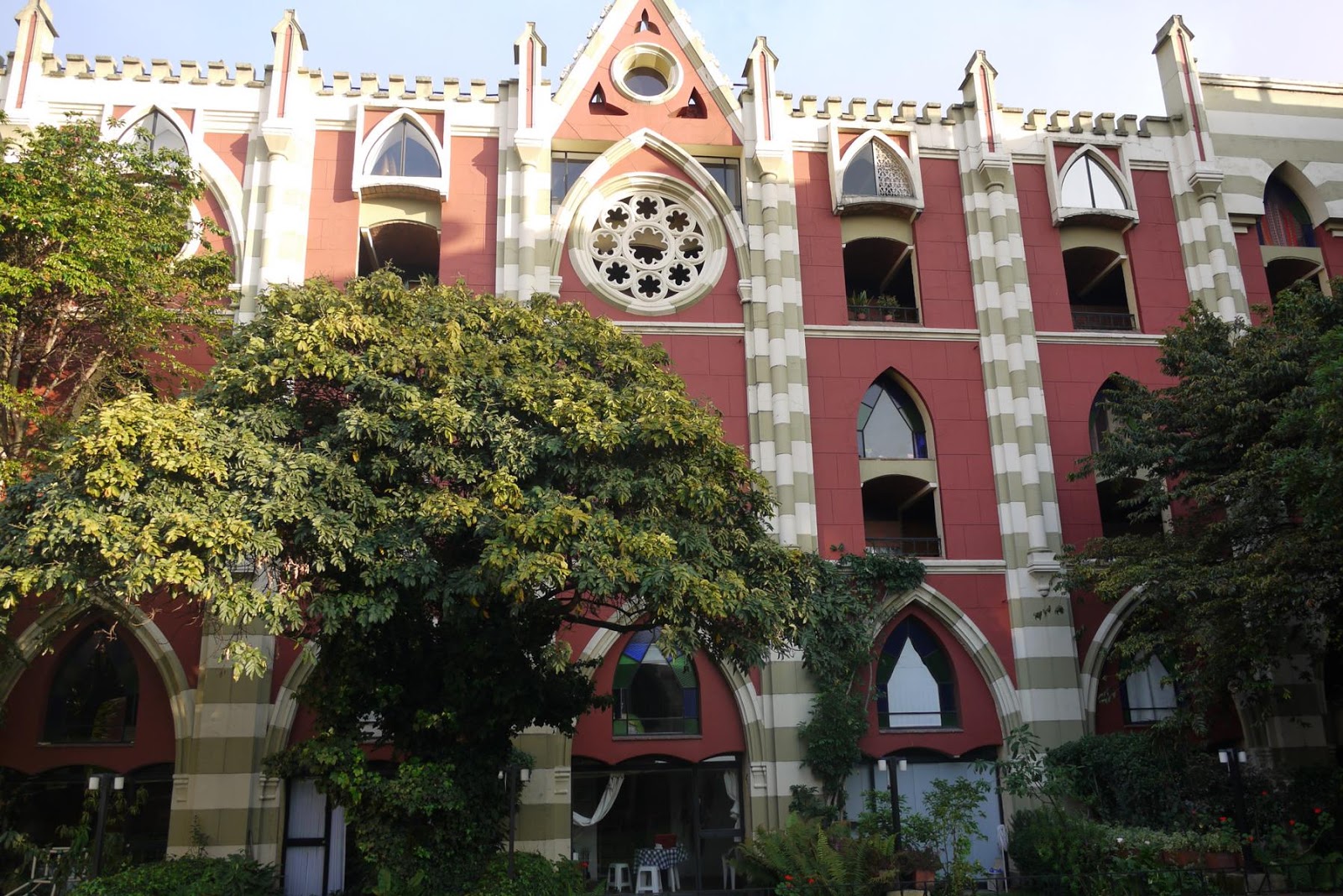
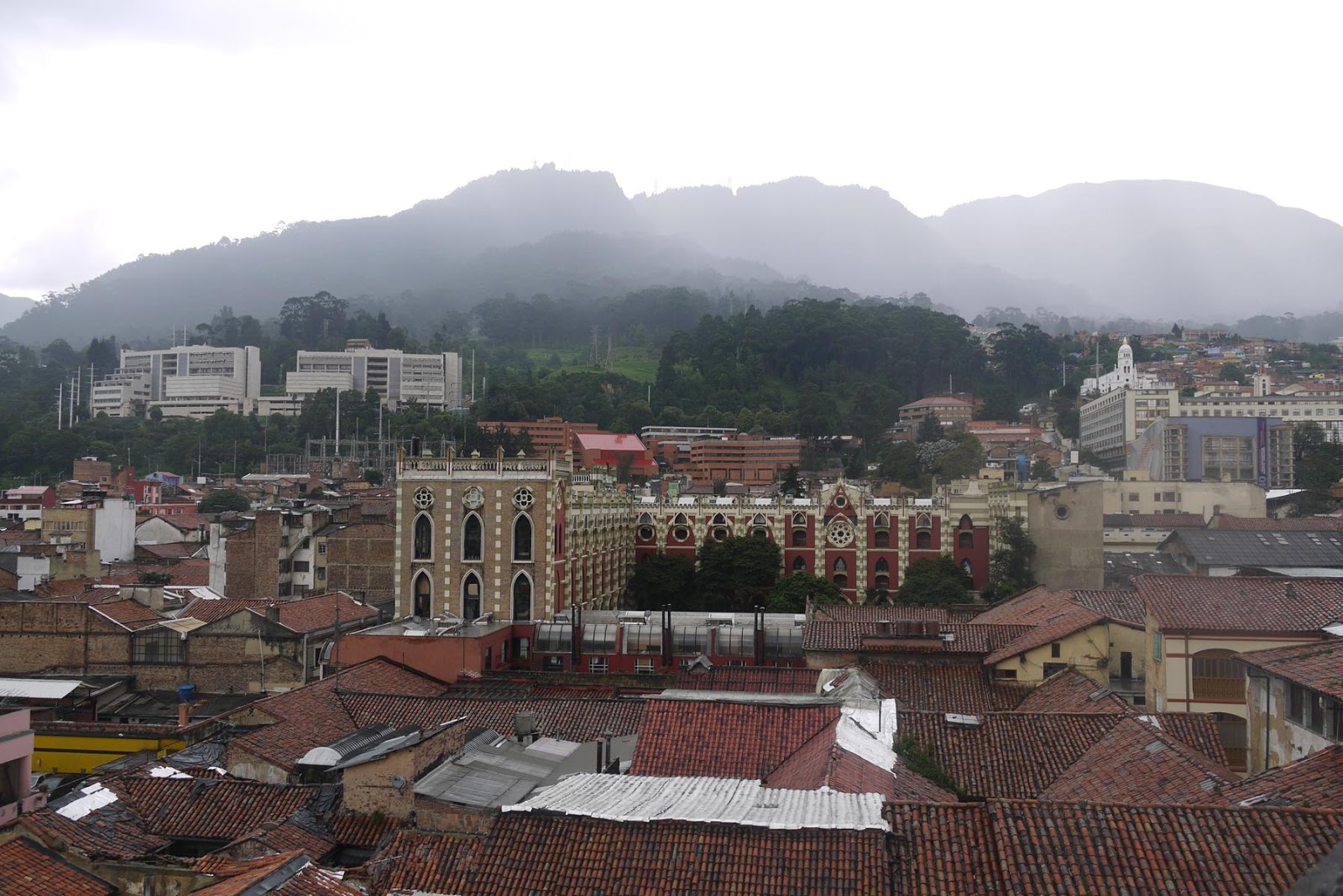
The Calle del Sol apartments are perhaps the most majestic and sought after residences in La Candelaria. Located on Carrera 3 between 11th and 12th streets, the building's neogothic arches make it look look like a monastery - which in fact it was in the early 1900s.

Built around 1917 to be a Catholic seminary, the Calle de Sol was later a monastery and then, in the '50s, '60s and '70s, headquarters for the feared DAS - Colombia's secret police. During the mid-1950s, Colombia was ruled by dictator Rojas Pinilla, who allegedly had communists and union members tortured and killed in the building's dungeon. One of those allegedly murdered there was the original Manuel Marulanda Vélez, a union leader from whom the legendary FARC guerrilla leader took his nom de guerre. Even today, residents and security guards sometimes report hearing ghostly wails of those unfortunates.

Today, on the building's 12th Street side, in the DAS's old prison, is a classy restaurant named La
The Calle del Sol's
entranceway.
Bruja, or the witch. Supposedly, a woman who believed that her son was being held prisoner in the DAS's dungeon, implored the guards to allow her to visit him. They refused. So she prepared delicious dishes for the guards, 'bewitching' them with her coooking and, decades later, giving the restaurant its name.

After the secret police departed, the building was neglected for years, until a group of Colombian and foreign investors purchased, expanded and renovated the old monastery and turned it into apartments, which opened around the year 2000. Today, Calle del Sol contains some 74 apartments of different sizes, surrounding an inner lawn.

View from an internal window.

A hallway.

The building has a marvelous internal lawn: a piece of tranquility in the midst of central Bogotá.


A great view from the Calle del Sol's roof.


The new BD Bacata skyscraper seen from the Calle del Sol.


A skyline at sunset.


A view of the Calle del Sol and Bogotá's Eastern Hills from the BLAA library.
By Mike Ceaser, of Bogotá Bike Tours