Tuesday, February 22, 2011

Ex-Kidnappee Lit

Caged hostages of the FARC guerrillas
Last week, in an effort to get some positive publicity and remind the world that they still exist, the FARC guerrillas released six of the people they've kidnapped and held hostage (even while kidnapping other people). Wasn't that wonderful of them?

In any case, some of these freed hostages may now write books, adding to one of the world's grimmest and most unique literary genres: the 'My-Years-as-a-Guerrilla-Hostage' book. I know of more than a half dozen of these books, the most famous of them likely being those by one-time presidential candidate Ingrid Betancourt and one by three U.S. contract workers with Northrop Grumman whom the FARC kidnapped after their small plane crashed while hunting for drug crops in 2003.

I've read three of these, written by very different people.

One, Secuestrada (Kidnapped) by Leszli Kalli, a young woman who was traveling with her father when the ELN (National Liberation Army) guerrillas hijacked their plane in 1999 and forced it down in the jungle with 46 people on board. Kalli and her father spent 373 days in jungle captivity before the guerrillas released them. That was a different era, when the Colombian government was trying to reach a peace deal with the guerrilla movements, and so carried out less military action against them.

The book is touching because of Kalli's efforts to come to grips with her life and reconcile relations with her father, as well as her please for a more just Colombia. But the book also became monotonous and repetitive as the captivity dragged on and we learned more about Kalli's health troubles and other details. Still, reading the book, I couldn't help thinking about The Diary of Anne Frank, both because of the Kalli's partially-Jewish roots (she was on the first leg of a trip to Israel when the plane was hijacked) and because the book contained lots of elements of coming of age and adolescent introspection.

Fernando Araujo, ex-minister of development, was jogging in Cartagena in 2000 when the FARC guerrillas grabbed him and spirited him off to the jungle, where they held him for six years. I read his book, El Trapecista, a few years ago, and recall being impressed by the man's great discipline and determination to keep himself sane in captivity - qualities which surely helped him to escape when the opportunity arose. I didn't find this book very insightful, but it did have the exciting element of his escape, after the military bombed the guerrillas' encampment. After Araujo's escape, Pres. Uribe made him minister of foreign relations.

Another escapee, whose book I have not read, is that by police officer Jhon Pinchao, who was held by the FARC for almost nine years until he managed to escape and make an epic trek thru the jungle. (Other ex-kidnappees said that after Pinchao's escape, the FARC tightened security measures, including chaining hostages by the neck to trees.) I'd like to read his book, Mi Fuga Hacia la Libertad (My Flight to Freedom), as anybody who fights off resignation for nine years, must be an exceptional person.

The two best-known ex-kidnappee books must be 'Out of Captivity', by the three kidnapped Americans and 'Cartas a mamá desde el infierno,' (Letters to Mom from Hell) by one-time presidential candidate Ingrid Betancourt. I've read the Americans' book, but not Betancourt's. Both received lots of attention, both because of the authors' high public profiles and because of the Americans' negative portrayal of Betancourt. The four of them, together will 11 others, were freed by the Colombian military's July 2008 Operacion Jaque, in which the military tricked a guerrilla leader into handing over the group of hostages in the belief that they were to be taken to the top FARC leader.

What struck me most about the Americans' experience, as with the other accounts, was the sheer inhumanity of their captivity. The FARC kept them in cages or chained by the neck and often prohibited them from speaking to each other. The three generally complied with their captors' rules, but used small gestures of resistance to maintain their self respect and hope for freedom thru their years in the jungle.

An aspect of this book I enjoyed were the descriptions of the Americans' various guerrilla captors, most of whom were uneducated and some of whom wanted out of the guerrilla and expressed sympathy for the hostages. In my own personal talks with ex-guerrillas, I've found that few joined for ideological motives.

Caged FARC hostages
Also, as a critic myself of U.S. anti-drug policy, I was struck by the three Americans' failure to question the effectiveness of that policy. After all, after many years, deaths and billions of dollars invested, the illegal drug trade goes on and nefarious organizations like the FARC and paramilitaries continue profiting from it, precisely because it's illegal. Of course, it's perfectly human and understandable that men who had been so dedicated to a policy, and who made such a huge sacrifice because of it, would be unlikely to question it. Certainly, their ex-employer, Northrop Grumman, isn't likely to question a policy which brings it millions of dollars of government funding.

Once also feels grudgingly impressed by the FARC's persistence. The three Americans describe their jailers in general as an often rag-tag bunch including many maladjusted types. Yet, this group has been able to hang on for decades against the Colombian government backed by the world's richest and most militarily powerful country. Of course, if the FARC cannot be completely stamped out, it is also completely obvious that they'll never overthrow the Colombian state - so, why do they continue fighting and inflicting such suffering on their countrymen and women?

Betancourt during her bad times in captivity.
The Americans' book made headlines mostly because of its sometimes-sordid portrayal of Betancourt's alleged selfishness and collusion with their guerrilla captors.

From a purely mechanical aspect, I found the Americans' book's organization a bit confusing. The three Americans take turns recounting parts of their experience, each piece of the account lasting one or a few pages. While each section was headed by the writer's name, I generally quickly forgot whose viewpoint I was reading, altho the accounts were still interesting.

Kidnapping is a chronic nightmare for Colombia. In recent years, as the military has pushed the guerrillas into remote regions, the number of high-profile political kidnappings has dropped. But, apparently many ranchers still live in fear of the purerly economic kidnappings for ransom. The anti-kidnapping organization Pais Libre even reported recently that the number of kidnappings rose last year.

And, as long as the guerrillas continue earning millions from drug sales, they'll likely have the resources to continue kidnapping Colombians. So, unfortunately, the kidnappee literary genre is likely to keep growing.

By Mike Ceaser, of Bogotá Bike Tours

Sunday, February 20, 2011

The Guinea Pig Races are Back!


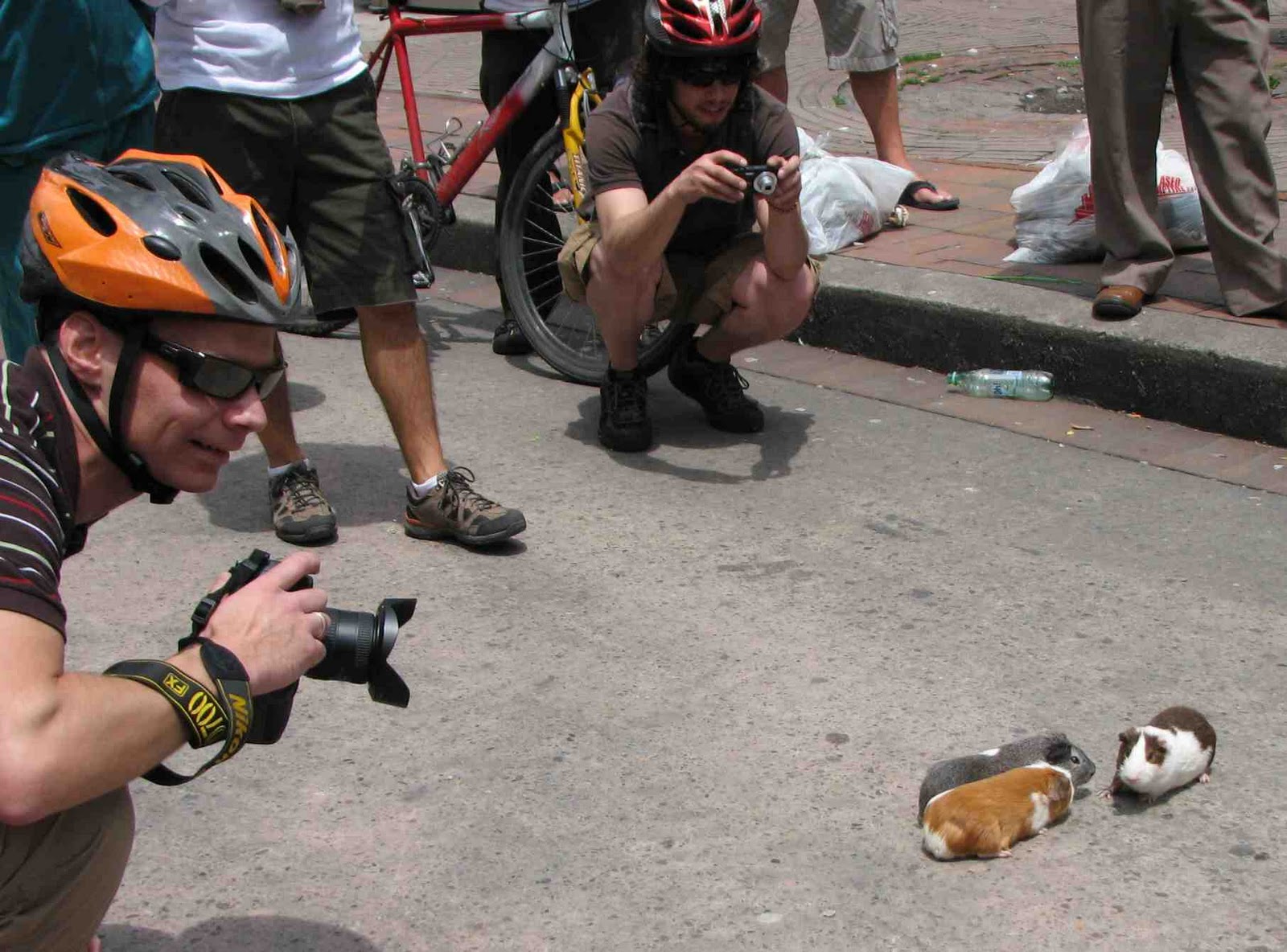
The guinea pig races, once common on Avenida Jimenez, disappeared for a while. Perhaps the guy who puts them on - and there can't be many people with guinea pigs and the skills to train them - had taken his rodents on the road for a while. We encountered the races during today's bike tour.

Recently, he's returned, with his crazy, exciting athletes.

"These aren't rats!" he says. Throughout the Andean region, the critters are called cuys, and make a popular food. You can order up cuy in Colombia's Nariño province.

Line 'em up!
The rules governing guinea pig races can vary. The guinea pigs line up facing a dozen or so numbered upturned plastic bowls, each with an entryway cut into its side. Spectators place coins on a bowl. Sometimes, the winner is the first pig to enter a bowl, sometimes the second, sometimes the last one. Or, sometimes the guy sends off just one guinea pig. If the piggy enters your bowl, you're the lucky winner and double your 200 pesos or something. It's hard to get rich through the guinea pig races - unless you own the guinea pigs.


This girl is all attention.
Ladies and gents, place your bets!
These guys won't pose!
And he's off!
There he goes, eye on the goal. 
Almost home, looks like we've got a winner!
By Mike Ceaser, of Bogotá Bike Tours

Saturday, February 19, 2011

Carlos Pizarro, Colombian Guerrilla and Martyr


If one man's whose life story could represent Colombia's historical tension between politics and violence, he might be Carlos Pizarro, an armed guerrilla leader, presidential candidate and, finally, leftist martyr. The National Museum (official site) has an exhibition about Pizarro through March 27.

Pizarro, born in 1951, studied at the Javeriana and National universities in Bogotá, where he became a committed communist and joined the Communist Youth Party. In 1958 he entered the FARC guerrillas, but left in 1963, convinced that their violent tactics were not the route for changing Colombia. In abandoning the FARC, Pizarro left a note saying 'Ya vuelvo' or 'I'll be back soon,' which has become probably his best known quote.

Pizarro and others then founded the M-19, or April 19 Movement, guerrilla group, named after the April 1970 presidential election, which populist military general and one-time dictator Gustavo Rojas Pinilla narrowly lost amid allegations of fraud.

The M-19 began as an unarmed organization with knack for dramatic gestures, such as stealing revolutionary hero Simón Bolívar's sword. But it turned into a violent, armed guerrilla movement.

Justice Palace in flames
Jose Raquel Mercado, killed
by the M-19
In 1976, the M-19 kidnapped and then killed union leader José Raquel Mercado. In 1980, the group took over the Dominican Republic's embassy during a party, eventually negotiating the release of the dignitaries and being allowed to travel to Cuba. Thousands of people cheered the M-19 members as they paraded through Bogotá to the airport. But in 1985 the M-19's attack on the Palace of Justice in Bogotá went disastrously wrong. The government refused to negotiate, counterattacked the palace and about 100 people were killed, including 11 of the 12 justices and many civilians.

M-19 leaders during 1985 peace negotiations
Three years later the M-19 turned in their weapons and became a purely political movement. Pizarro ran for president as the group's candidate in the 1990 election. However, he was assassinated by an assassin hired by right-wing parliamentaries. Pizarro was one of three candidates assassinated during the 1990 campaign.

Pizarro's martyrdom, however, created a legacy. The M-19's replacement candidate did well in the elections and the group played an important role in the 1991 rewriting of Colombia's Constitution. That progressive Constitution has permitted court decisions in favor of gay rights, abortion rights and the right to possess a personal dose of drugs, which was reversed by the legislature in 1999.


The exhibit looks like the work of a Pizarro admirer, with lots of emphasis on the man's ideals and his lofty statements about democracy, but less about the M-19's violence and killings. One military official has been convicted for killings committed during the Justice Palace episode, and others are scheduled to be tried.

But the M-19, who started it all, have gotten off scott-free. The M-19 very likely sincerely desired to use the attack to bring social justice to Colombia and open the country's political system to more participants. However, there's lots of evidence that in the attack the M-19 collaborated with and accepted money from cocaine king Pablo Escobar, who certainly was no idealist and whose motives were not altruistic.

Nor do I remember even a mention in the exhibit of the kidnapping and murder of union leader Mercado, whom the M-19 killed on April 19, as a grisly celebration of the anniversary of their founding.


Several ex-M-19 leaders are still active in politics, now in the leftist Democratic Pole Party. The best known is Gustavo Petro, who has run for president.
Pizarro's tomb in Bogotá's Central Cemetery

A plaque by Pizarro's tombe: 'They will not kill our happiness.
We are still smiling'

By Mike Ceaser, of Bogotá Bike Tours

Thursday, February 17, 2011

Civil Rights for Suspects?

Don't mouth off kid!
During a bike tour the other day, we encountered this scene near Jorge Tadeo University in the Las Nieves neighborhood. Two kids had just committed a mugging - or, at least, the security guards and bystanders were convinced they'd done it.

The security guards grabbed the kids, one of whom looked to be about 15 years old, and the other one perhaps 12, and proceeded to hit them and sic dogs on them while they hustled them to the nearby police station.

Hey, that hurts!
The kids apparently got caught red-handed, but they certainly hadn't been tried or convicted of anything. And they were kids. But passerbys displayed no sympathy at all, instead yelling "Ratas! Ratas!", slang for thieves. The kids looked back angrily.

One can certainly empathise with the bystanders, many of whom most likely have been mugged themselves and seen the kids run off scot-free. It's happened to me twice, and I've witnessed several other muggings.

In this case, the guards weren't shy about continuing their violence amidst onlookers and with me and others snapping photos.

And these kids aren't usually mugging to buy food for their families. They steal to buy drugs, party, impress girls with their fancy cellphones. So, the public naturally has built up resentment. And, police complain that in the rare cases that juveniles get arrested, they often go free the next day.  So, I've seen occasions when neighbors caught a thief, beat him up and then let him go, feeling certain that vigilante law was much more effective than anything the courts would do.

Take that, kid!
Incidentally, all of the muggings I've either seen or been the victim of in Colombia have been committed by 'white' people, which has given me the reverse of the usual stereotype. If I'm walking at night and notice a group of young men behind me, I might get nervous. But if I notice that they're Afro-Colombians, I relax. 


For their part, the police here routinely stop young men on the street and pat them down, with no need for probable cause. Women are almost never suspected.
What have you kids got in your pockets?
By Mike Ceaser, of Bogota Bike Tours

Wednesday, February 16, 2011

Ivory Coast's Sweet Gift to Colombia

Colombian cocoa beans
The small west-African nation of Ivory Coast happens to be a big player in cocoa exports - it provides 40% of the world's supply. Ivory Coast's terrible political crisis, in which the sitting president refuses to hand over power to the apparent election winner has brought about a cocoa export ban meant to cripple the economy and force a power handover.

Ivory Coast's crisis has pushed up world cocoa prices and boosted other cocoa exporters, including Colombia.

Cocoa beans are the main ingredient for chocolate, which is loved by Colombians. Even though Colombia is South America's third-largest cocoa producer, it imports the beans from Peru to feed its own chocolate habit.

Let's all hope that Ivory Coast resolves its terrible dispute fast and gets back onto the democratic track.

Cocoa shouldn't be confused with coca, the base ingredient for cocaine. Still, the fact that cocoa and coffee flourish in Asia, Africa and South America, makes one wonder why coca leaf is planted only in South America. 


Chocolate for sale at Chocolates Andino


By Mike Ceaser, of Bogotá Bike Tours

Tuesday, February 15, 2011

Shoah Remembrance in Bogotá

Holocaust survivors, still strong and eloquent.
It was probably best for my ability to sleep that I arrived late at a talk today by five Colombian survivors of the Holocaust.

By the time I entered the standing-room-only event at the Bogotá Museum of Modern Art , the accounts of horrific experiences had passed and the survivors were describing the war's end, their migrations to Colombia and whether they could ever forgive, a point they disagreed on.

Faces of many who did not survive.
The four women and one man, speaking still imperfect Spanish with European accents, displayed vigor, spirit and strong memories, a testament to their vitality despite what they suffered: discriminatory laws, being driven from their homes, from their countries, packed in rail cars and seeing friends and relatives taken away to be  slaughtered by a civilized nation converted into a machine of mass murderer. 


The museum's Shoa exhibition, which fills some three levels, is sophisticated and detailed, with personal experiences, photos, recordings and examinations of Spain's mixed role in the Holocaust (a fascist nation friendly to Hitler, some Spanish diplomats individually risked their lives to save Jews and others). The exhibition also looks at  South America's involvement in World War II and Jewish refugees' efforts to flee to Latin America. The information is powerful and moving, as the account of history's most terrible and calculated slaughter must be.


A rally of Nazi fanatics in Barranquilla during WWII
What's missing, however, is the story of Colombia's own relationship to World War II and the Holocaust. An ally of the United States, Colombia cooperated militarily with the U.S., and, after Japan's Pearl Harbor attack, Colombia broke its diplomatic relations with Germany. In 1943, German U-boats sank Colombian ships, prompting Colombia to tardily declare war on Germany. Pro-Nazi conspiracies evidently existed in Colombia, a strategic nation thanks to its nearness to the Panama Canal. In a policy similar to the U.S.'s interment of Japanese immigrants and their children, Colombia rounded up and expelled German citizens and nationalized their property, even though most of them were likely inoffensive residents.

Some other Latin American nations, or their officials, did play either tragic or heroic roles during the war. Cuba notoriously turned the S.S. St. Louis, a ship packed with Jewish refugees, back to Europe, where many were murdered by the Nazis. In contrast, the Dominican Republic agreed to accept 100,000 Jewish refugees, although escaping Europe became so difficult that only 645 people actually made it. George Mantello, an El Salvadoran diplomat stationed in Switzerland distributed El Salvadoran citizenship papers, which saved the lives of thousands of Eastern European Jews and later helped pressure Hungary to resist the Nazis' deportations of Jews to Auschwitz.

After the war, many Jewish survivors, German refugees and Nazi persecutors took refuge in South America, but relatively few came to Colombia, which at the time was suffering a period known as 'La Violencia,' a politically-driven fratricide which at times rivalled Naziism in barbarity.

Five of those Jews who did come to Colombia, mostly because they had relatives already here, spoke on Tuesday at the Modern Art Museum. Now octogenarians, they heard with difficulty, but spoke strongly, with no lack of passion or strong beliefs. A woman whose family managed to send her to England to wait out the war recalled how after Germany's surrender the refugee children received lists of the dead from the Red Cross - "where they found their parents' names."


Max Kirschberg shows the number tattooed on
his arm in Auschwitz.
After telling their stories, the octogenarians reflected on how to prevent another genocide.

"Memory is the best shield so that it doesn't happen again," said one woman. Others spoke out against neonaziism, or the importance of living one's own life in a good way.

The survivors have handled their experiences differently. One decided to forgive. Another said she could not, until she had the permission of "my aunts, uncles, cousins and other relatives" slaughtered by naziism. A woman from Holland has vowed never to step on German soil.

Yet, despite the world's collective memory, genocide has happen multiple times since World War II, in Africa, Serbia, Cambodia, and likely other places - while the rest of the world did little.

Still, the Colombian survivors managed to draw positiveness from tragedy. "There is one God for all of us," said one survivor, to a strong applause from the packed room.

Inge Chaskel hasn't let her WWII experiences ruin her life. 
The Holocaust revertebrates particularly strongly in Colombia, because some of the crimes by the country's lefitst guerrilla groups and right-wing paramilitaries almost rival the Nazis' crimes for cruelty and barbarity, although certainly not in scale.


Sadly, at least one Israeli is accused by Colombia of helping train Colombian paramilitaries to commit such crimes.

Like many nations, Colombia also has its own skinheads and neo-Nazis - a bizarre phenomenon in a nation where the great majority of people are of Spanish, Indian or African descent, or of mixed background.

On the other hand, having lived throughout South America, I've seen and heard less racism, anti-Semitism and homophobia here than in other Latin American nations.

There have been at least two famous Jewish Colombians: Actress Fanny Mikey, who organized theatre festivals and founded the National Theatre, and Leo Siegfried Kopp, who founded the Bavaria Beer Company and who has become a kind of saint in Bogotá's Central Cemetery.

The Shoa exhibition ends March 31. The museum is also showing films about the Holocaust.

By Mike Ceaser, of Bogotá Bike Tours

Cesar Gaviria's Quixotic Campaign

Cesar Gaviria

Colombian ex-President Cesar Gaviria has been carrying on something of a speaking campaign against drug prohibition. The other week, he, Mexican author Carlos Fuentes and others argued in favor of drug depenalization at El Tiempo's symposium celebrating its 100 years of existence. (Will newspapers see another century? Another half century?)

Carlos Fuentes
With guys like these, as well as ex-presidents of Brazil and Mexico, who should know something about drug problems, broaching the subject, one might hope that some major world political figure would grab the idea and run with it. After all, gay marriage, abortion rights, environmentalism, tobacco control laws and other causes which seemed fantastical a few years or decades ago are now public policy in many nations and firmly in the public debate in many others.

Bogotá DAS HQ bombed by Escobar
If anybody's seen the damage from the drug trade it's Gaviria, Colombia's president from 1990 to '94, when drug cartels terrorized Colombia and cocaine made Pablo Escobar one of the world's richest and most violent men. Escobar killed Liberal presidential candidate Luis Carlos Galan and, when Gaviria succeeded him as the Liberal candidate, tried to kill Gaviria as well by bombing a passenger airplane. Under Gaviria's watch, U.S. and Colombian police hunted down and killed Escobar in 1993.

So, you'd hope that at least one major figure, such as a European president or prime minister, or at least a health minister, would seize the flage of drug decriminalization and wave it. But if it's happened, I haven't heard about it (besides Holland and Portugal, which don't make much noise.) Prohibitionism has patently failed, and the alternative is out there, just waiting to be grabbed.

Apparently, many leaders, like Gaviria, wait until they're out of office to come out of the closet as supporters of decriminalization.

What really frustrates me is my belief that many national leaders, probably including U.S. Pres. Obama, ex-U.K. P.M. Tony Blair and others must certainly recognize that the War on Drugs has failed, but won't say so. They are war leaders, after all, and admitting defeat in any war, even a lost one, just doesn't look good.

The U.S. just announced that it's cutting Plan Colombia aid. That's sensible. But it doesn't likely mean a reassesment of its goals here.

Update: Ex-President Ernesto Samper has also called for drug decriminalization.

By Mike Ceaser, of Bogotá Bike Tours