Friday, July 20, 2012

20 de Julio on the Plaza del Chorro

Try some chicha!
They celebrated the 20 de Julio, Colombia's independence day, all over the country, including the Plaza del Chorro in La Candelaria (where Bogotá was founded).


A children's theatre group. 


The crowded Callejon del Embudo, or Funnel Avenue.


Try out cake.


Lots of mural work going on, including this one in the Callejon del Embudo. 

Dressed for the occasion. 


Young stiltwalkers. 


By Mike Ceaser, of Bogotá Bike Tours

The Centro Memoria

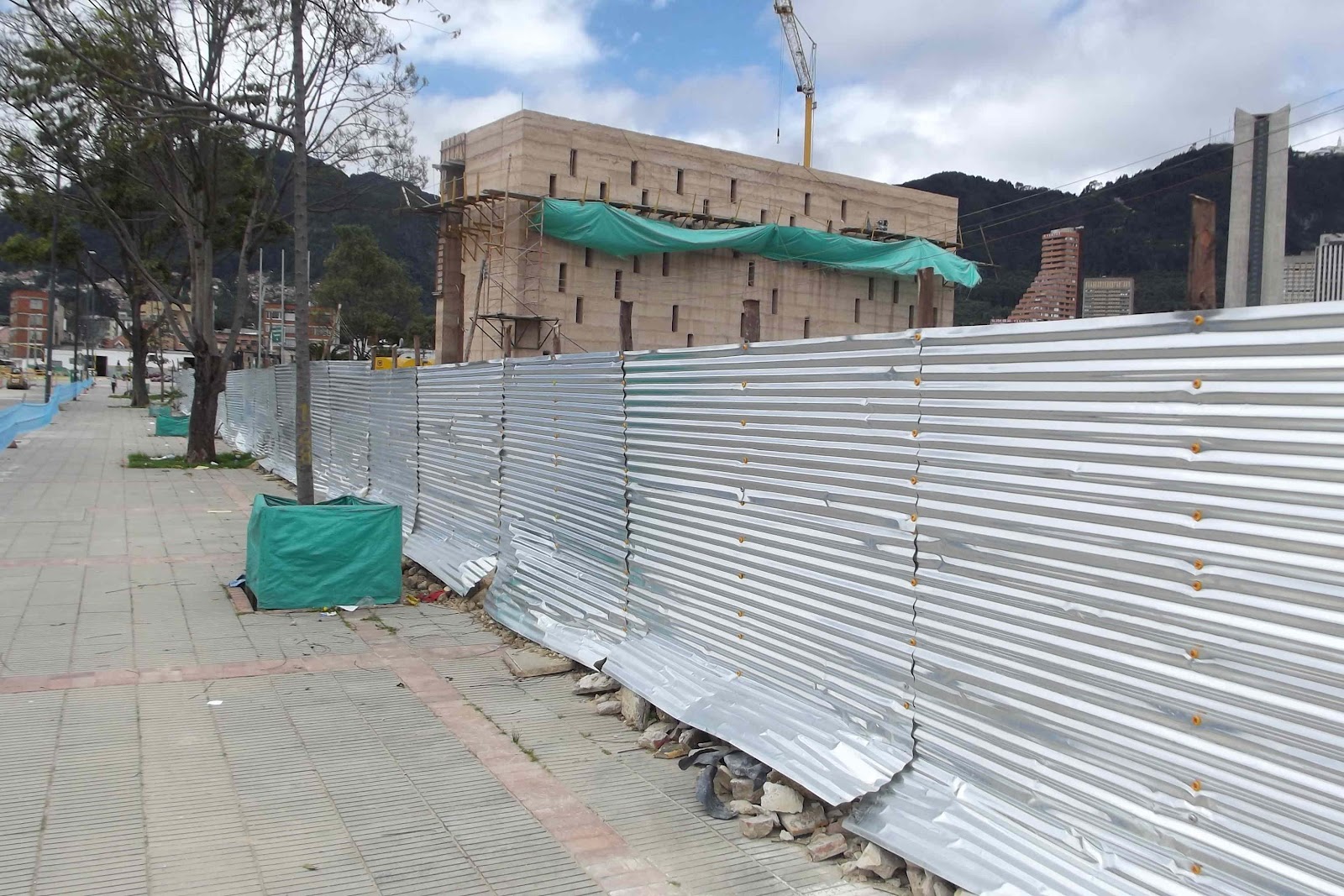
A worker said the Centro Memoria will be
completed in another two months, but I doubt it. 
The new Centro Memoria seen behind mausoleum pillars.
Perhaps you've noticed the oddly-shaped structure going up off of El Dorado Ave. near the Central Cemetery. With its narrow slit windows, it reminds me of a fort.

It is to be the Centro Memoria, or Memorial Central, which I am told will contain exhibitions about Colombia's sadly violent history.

The Centro will fill a void, since Bogotá's many museums contain little about Colombia's troubled and tragic history of civil wars, narco cartels and guerrilla insurgencies. But I don't know the details of this new museum, and I wonder whether its exhibits will end with La Violencia or Pablo Escobar, or something like that.

The building is in an appropriate spot, a block north of the Central Cemetery in an area where victims of El Bogotazo were likely buried in mass graves. The block contains huge mausoleums, now empty. People working on the site say the structures will probably be demolished, perhaps to make way for football pitches - which would be an excellent addition for youths from the troubled Santa Fe neighborhood just to the south. But it will be a pity to lose the mausoleums, particularly since artists decorated them with thousands of images of people carrying stretchers, representing victims of Colombia's violence.

The center already has a website: http://www.centromemoria.gov.co/

Related posts:

Bogotá's History of Assassinations

Remembering Jorge Eliecer Gaitan

Artists decorated the empty mausoleums with thousands of images of people carrying bodies with stretchers. 

'Life is Sacred.'

The wide sidewalk has become a living space for homeless people. 


By Mike Ceaser, of Bogotá Bike Tours

Thursday, July 19, 2012

Scenes From Today's Health Law Protest


Looking sick!
Crowds marched down Ave. Septima today in protest against the Law 100, which would reform Colombia's health system. Critics say the legislation would transform health care from a right to a privilege. I don't know the details, but suspect that this law, just like the proposed justice system and public university reforms, is dead on arrival.
One thing about Colombia's troubled public health care system - it's more than the United States has got!
I can't help wishing that Colombia would take some more preventative measures, such as controlling air pollution and taxing junk food, which is causing an obesity boom.


This banner blames the law on ex-Pres. Uribe. 


A police line on Plaza Bolivar. 


'Health, a Right!'


By Mike Ceaser, of Bogotá Bike Tours

Wednesday, July 18, 2012

The Disabled Protest

'We are not invisible.'
'For the fullfillment of the transportation subsidy.'
An organization of disabled people held a protest by City Hall this morning, charging that their

benefits are being cut. If true, this is suprising for the administration of Mayor Gustavo Petro, a leftist who you'd expect to give the poor and disabled top priority. 

The demonstration also produced the surprising spectacle of a line of armored riot police protecting City Hall from a small group of disabled people. 

A protester raises a line in front of a row of riot police. 

The 'Semillas del Futuro' (Seeds of the Future) Foundation.


Disabled people are separated from City Hall by a police line. 


By Mike Ceaser, of Bogotá Bike Tours

Tuesday, July 17, 2012

Wayback Machine in the National Park

Men in 1940s dress in the Parque Nacional in Bogotá.
You could be forgiven for feeling that you'd stepped back in time today in Bogotá's Parque Nacional, as well as some other spots across the city, where a film about the assassination of populist leader Jorge Eliecer Gaitan and the ensuing Bogotazo riots is being made


A 1940s car parked beside a wall decorated with 1940s movie posters. They're beside Las Nieves Church. 


A make-up artist at work. 

Death notices dated a few days before Gaitan's assassination. 
Not far away, are the real landmarks to Gaitan's life and death:

Gaitan's tomb, near his home, which is now a museum. He was buried standing up. 

Gaitan's home on the right. On the left, an old streetcar. During the Bogotazo riots, the streetcars were pushed over and set on fire.
Gaitan's home in Teusaquillo, now a musuem. 


By Mike Ceaser, of Bogotá Bike Tours