Friday, February 14, 2014

Fighting for the Trees

People walk thru the tree-filled Parkway in the Teusaquillo neighborhood.
Urban trees block noise, soak up pollutants, provide shade and make a city feel more liveable - but they also generate controversy.

Councilman Saenz points to a photograph of deforested
land in the Bosque Izquierdo neighborhood.
That's happened in Bogotá, where the city plants trees - but also cuts them down. And the sometimes over-zealous efforts of tree  cutting companies, as well as construction companies which deforest areas others many consider to be public patrimony.

City Councilman Roberto Saenz, who calls himself 'the environmentalist councillor' has held a series of public hearings about urban deforestation, focusing particularly on several cases of construction on or near Bogotá's iconic Eastern Hills, its Cerros Orientales. These include apartment towers in north Bogotá and in the historic Bosque Izquierdo neighborhood, and two towers which the Universidad Externado is building above the La Candelaria neighborhood.

"I'm not impartial on this," Saenz said. "I'm for the trees."

Colombia's Consejo de Estado recently ruled that the hills' Forestry Reserve should be sacrosanct.
A map shows the area where the Externado University
is building towers above La Candelaria. 
Strangely, however, construction on the hills continues unimpeded. Bogotá's Eastern Hills could be a great resource for the capital's residents, particularly for the poor, who can't afford to escape the city to find nature. But the hills' reputation for crime keeps many out, and if private interests manage to pave over the hills, their potential will be lost forever.

While there are questions about the these projects' documents and licenses, what is clear is that many contradict the city's declared philosophy of protecting public space and promoting sustainable transit not based on the private car.

"When all the evidence shows that we are going against nature, how can they tell us that all the (projects') documents are in order?" said Fernando Cortés, a leader in the Bosque Izquierdo neighborhood.

A woman walks past a sawed-off sidewalk
tree in Teusaquillo. 
"Externado University, as a law school, should be the first to conserve the forest," councilman Saenz said. "They should buy and protect the forest."

The Externado's project includes the removal of thousands of trees, altho some are supposedly being replanted elsewhere and the university is supposed to plant trees in other places. But that will still mean the loss of forest and green space for the people, many of them poor, who live in nearby neighborhoods. And, the university's project, which includes almost 500 parking spaces, will produce impacts including pollution and traffic jams along La Circuvular Avenue and in the historic center, La Candelaria.

Juan Melgare, a resident of the tree-filled Teusaquillo neighborhood and urban tree advocate, attended a recent meeting to
Nothing green here: A treeless street in the
Puente Aranda neighborhood.
denounce city plans to cut hundreds of trees in the grey and polluted Puente Aranda neighborhood. I was surprised to hear that that industrial neighborhood, which is pure cement, even HAS that many trees.

"They want to cut down trees in one of the most polluted parts of Bogotá," Melgare said.

Melgare points out that there are huge economic incentives for deforestation. The companies hired to do the work can earn from hundreds of thousands to millions of pesos for for cutting down a tree. And the wood is sold to barbecue restaurants.

Melgare even defends non-native trees, such as pines, urapanes and eucalyptus. He recalled one promoter of native trees who wanted a huge eucalyptus tree cut down.

"I asked him his age," Melgare recalled. "He was 50. I told him 'That tree is 75 years old. It's got more citizenship than you do."

Juan Melgare stands under a tree in Teusaquillo.
A metal tree on a sidewalk in Puente Aranda.

A bus belching smoke passes a lonely and mutilated tree on a street in Puente Aranda.
See also:

Another Bite Out of Bogotá's Hills


By Mike Ceaser, of Bogotá Bike Tours

Wednesday, February 12, 2014

Another Doomed Traffic Scheme


Wasted time. Cars stuck in a traffic jam in La Candelaria. 
The mayor's latest doomed scheme to unsnarl traffic in central Bogotá is to apply the Pico y Placa scheme based on the number of occupants in a vehicle.

The principle is a good one: Encourage visitors to downtown not to do so in space-hogging single-passenger vehicles. Instead, three people are supposed to share a car.

In a city in which only a small minority use private cars, but private cars monopolize 80% of road space, the logic is obvious.

Is anybody paying attention? A banner near the
Hotel Tequendama announces
the upcoming restriction. 
Bizzarely, too, some downtown businesses are protesting the measure, which is supposed to kick in March 4, claiming that they or their customers won't be able to come downtown. Forget that there are lots of other ways to come downtown besides in private cars, including buses, TransMilenio, bicycling and walking.

These cars waiting near the Hotel Tequendama appeared
to contain only one or two passengers.
Their opposition is bizarre and irrational because this measure is actually a relaxation of the despised and failed Pico y Placa law. Cars otherwise prohibited from driving would be able to do so as long as they had three or more occupants, including the driver. (The area affected would extend from the Ave. Comuneros in the south to Calle 26 in the north, and the Ave. Circunvular to the east to Carrera 27 in the west.

However strong its logic, this rule won't be enforceable. Fatigued police transit officers aren't going to take the trouble to count passengers and consider Pico y Placa rules and then write tickets. And, what about all those cars with tinted windows? Those cars tend to belong to the rich, powerful and self-important, who won't likely roll down their windows to let a cop to peek inside.

Altho it would not be easy to implement, Bogotá should also prohibit the unjust, destructive and discriminatory practice of providing free parking to customers, students and employees. Free parking generates huge costs, subsidizes the wealthy at the expense of the poor and promotes wasteful, polluting driving.

The best - and perhaps only - real solution to Bogotá's trarffic congestion is a London-style congestion charge. The Petro administration has talked a lot about this, but not moved ahead on it.

Everybody suffers from too many cars. Here, cars block a TransMilenio bus from advancing. (Someone please tell me why police don't ticket vehicles which stop inside intersections.)

By Mike Ceaser, of Bogotá Bike Tours

Tuesday, February 11, 2014

Colombian Journalism - A Lot Less Deadly

A newsstand in central Bogota 
Conditions are improving for journalists in Colombia - in contrast to much of the rest of the region.

In its annual report isued today, The Federation for Press Freedom, or FLIP, reported 123 'agressions' against Colombian journalists during 2013 and two killings, of a radio reporter and an informal journalist. Many of the attacks took place against reporters covering last year's massive anti-government protests.

Still, as disturbing as those events are, Colombian journalists had it much worse in years past, when often more than 10 journalists were murdered annually. Many of those past killings, the FLIP points out, remain unsolved.
José Dario Arenas

The FLIP made a specific report about the violence-wrought Bajo Cauca region, where radio stations have abandonded news reporting in favor of sports and music to avoid angering the wrong people.

One of the journalists killed was a young man in the town of Caicedonia, near Armenia, who had Extra Quindio to support his wife and children. Soon, he started phoning in information about the local prison and police incidents to the newspaper. Apparently, he reported on the wrong person. One day, two men bought a newspaper from him, opened it, looked at an article about Caicedonia's prison and then shot Arenas dead.
practiced the trade informally, and for only six months. Jobless, José Dario Arenas, 32, had started selling the

Both Arenas's mother and a journalist who investigated Arenas's murder received death threats. The journalist later quit his job at the newspaper, which is no longer sold in Caicedonia. The killers won.

On the positive side according to the FLIP was the passage this year of legislation broadening access to government documents - altho it still requires the president's signature to go into effect.

But across Latin America, many media are under siege from their own governments - in many cases,
El Tiempo reports the demise of Venezuelan newspapers.
ironically, leftist governments whose leaders suffered decades ago under repressive right-wing dictators.

In Ecuador, Argentina and Venezuela, governments have used new laws, slander charges and economic weapons to intimidate and disable critical journalists. In Venezuela, probably the most critical case, broadcast media have lost their licenses and newspapers find themselves unable to import newsprint. Venezuela's leftist leaders have repeatedly accused the media of causing the nation's soaring crime.

In much of the region, it seems, the violence once used to repress the press has been replaced by intimidation, economic and legal tactics.

During this week's protests in Venezuela, the Venezuelan government banned Colombian TV station NTN24 from cable networks and the government-owned phone company even blocked Twitter photos.

By Mike Ceaser, of Bogotá Bike Tours

Saturday, February 8, 2014

Colombia's NSA

The military had set up a secret office in west Bogotá disguised as a video game retailer and hackers' hang-out, apparently to eavesdrop on Colombia's guerrillas. But the listeners allegedly went beyond their mandate and also listened in on the government's negotiators in Havana, Cuba.

Pres. Santos seemed to suggest that behind these actions was someone who wanted to sabotage the negotiations with the FARC guerrillas. That would make sense, since a peace treaty would reduce the military's influence and importance in Colombian society - as well as its budget.

But the broader danger which this episode, first reported by Semana magazine, illustrates is the way that surveillance programs, without proper oversight, tend to expand beyond with little control.

This isn't the first time this has happened in Colombia. The most notorious previous case was the DAS scandal of Alvaro Uribe's administration, when the government intelligence agency spied on all manner of people suspected of hostility to Uribe, including journalists, Supreme Court judges. The episode led to the DAS's liquidation.

Last year El Tiempo reported that the police planned to spy on social networks such as Twitter and Facebook and to do so were considering hiring an Israeli-American espionage company with a dubious background.

The United States' National Security Agency has, controversialy, monitored phone calls, e-mails and all sorts of other communications. That seems to have gone far beyond a reasonable, focused kind of surveilliance.

Lots more will come out about the military's eavesdropping program, which has already gotten four officers suspended. But, if they were spying on government negotiators, it's a fair bet that the espionage didn't stop there.

Espionage is a legitimate tool for governments - and its use is inevitable, in any case. But, particularly in a nation like Colombia, surveilllance requires a effective and transparent oversight. Otherwise, here comes 1984.

By Mike Ceaser, of Bogotá Bike Tours

Thursday, February 6, 2014

What a Difference a (Car-Free) Day Makes!

Left, Carrera 30, near the Universidad Nacional, on a normal day,
and, right, today on Car-Free Day.
You can take a lot of conclusions out of these pairs of photos of Bogotá avenues on 'normal' days, left, and today's Car-Free Day, on the right. (I didn't necessarily take the photos at the same time of day, but the scenes are typical.) One thing is clear, however, on those 'normal' days traffic often barely moves. Today, there was room to move.

Left, Calle 26 on a normal day, and, right,
today on Car-Free Day.
While the streets were clearer, the air wasn't necessarily cleaner - underlining the city's lack of control on vehicle emissions. El Tiempo editor Ernesto Cortés wrote a scathing column about air pollution today.

I saw many more bicyclists than on an ordinary day.
These are riding on the bike lane on Ave. Septima.
Environmental officials reported that ozone and nitrogen dioxide levels dropped compared to normal day. But concentrations of tiny particles suspended in the air actually increased in the morning, before leveling off to 'normal.'

Buses moved considerably faster and both TransMilenio and SITP buses carried more passengers.

Liberal Party political campaigners pedal
down Ave. Septima. 
Environmental officials set up 9 air pollution measurement stations, where they measured the emissions of almost 600 vehicles - about 100 of which failed. As far as I can tell, Car Free Day is the only time when officials actually measure vehicle pollution in the streets (whether those vehicles are actually punished is another issue). By their probably non-too-strict standards almost 1 out of 5 vehicles failed. If they would only do such measurements on a regular basis and actually remove these vehicles from our streets, Bogotá's air quality, health and quality of life would rise notably.

Bogotá environmental officials reported that the number of cyclists sextupled today. I'd take that statistic with a grain of salt, but numbers did rise.


The city created a temporary bike lane along the length of Ave. Septima - it should be there every day. These costumed bicyclists found the new lane useful. 
TransMilenio buses were packed. 
But SITP buses were, as always, almost empty. 
Not just cyclists - skateboarders also used the bike lanes.
By Mike Ceaser, of Bogotá Bike Tours

Wednesday, February 5, 2014

What - Me Advertise?

Not advertising? A young boy mans a sidewalk sales stand offering candies and cigarettes, which are featured in a slick display ad.
Why did this street vendor open these cigarette cartons?
How else could she sell smokes by the stick?
The Marlboro Men are dying off, many killed by the cigarettes they marketed; Michael Schumacher's days of being a tobacco billboard are over; and even Colombia has banned tobacco advertising and the practice of selling cigarettes by the stick - which makes it easy for kids to start smoking.

So, with today's headlines reporting that the world's cancer deaths will double - and many of those from tobacco in developing nations like Colombia - why doesn't Colombia bother to enforce its own tobacco control laws?

Yesterday's El Tiempo:
 'World cancer cases to double in 20 years.'
Colombia's tobacco control law prohibited tobacco advertising - but included a loophole large enough to drive a display ad thru. The law excepted displays for cigarettes and for the tobacco merchants, the line between display and advertisement is evidently an easy one to cross over.

The law also prohibited the sale of cigarettes 'by the stick,' or as 'loosies.' That part has simply been ignored, by both street vendors and the police. For proof, just take a look at any street vendor, whose open cigarette boxes are next to candies - convenient for teenagers who have only a few hundred pesos in their pockets.

What, me advertise?
Police could easily combat this practice with sting operations - have kids try to buy cigarettes, and confisticate the cigarettes from any vendor who sells to them. But the police just don't bother.

Today, someone observed to me, borrowing from Noam Chomsky, that tobacco kills far more people and is far more addictive than is cocaine. But, while the US finances coca leaf erradication in Colombia, it has, at least in the past, helped the tobacco industry. For that matter, many Colombian cigarettes are made and marketed by U.S. companies.

A vendor advertises cigarettes and sells loosies near the entrance to the Universidad del Rosario, in La Candelaria.
A street vendor in central Bogotá sells cigarettes by the stick. 
Sensual smoking in Shakira's latest video. The singer has a foundation for poor kids, but perhaps their health isn't so important. 
By Mike Ceaser, of Bogotá Bike Tours

Tuesday, February 4, 2014

Natural Beauties?

Traditional scenes? Models get sexy on the beach near Tayrona Park.
A few years ago, a controversy arose over a plan to build a luxury hotel in Tayrona Natural Park, because, presumably, it would defile the already less-than-pristine park. The hotel was never built.

Bats played an important role in
Tayrona culture. A Museo
 Nacional guide said the animals
 were believed to protect young
 girls from incest. 
So, why isn't anybody objecting to the Aviatur and Viva Colombia's new calendar featuring babes in bathing suits posing on Tayrona's beaches? (And forget about anybody protesting against marketing Colombia by showing off its sexy women - even as the government campaigns against human trafficking.)

The Tayrona Park region is known for its beaches and jungles and particularly the trek up to the Lost City, built by indigenous people beginning around 650 a.d. and abandoned during the century after the Spanish reached South America, as Europeans diseases devastated native peoples. The 'Lost City' was rediscovered in the 1970s by Colombian archeologists, altho local people surely had always known about it.

The so-called Lost City is actually only one of many towns in the region, which is now inhabited by three indigenous peoples, the Wiwas, Koguis and Arhuacas - none of whom walk around in bikinis.

Altho Tayrona does have a nude beach, the area's culture has lots more to offer than scantily-clad women. Here are some pictures from an exhibition in the Museo Nacional in Bogotá.

A meeting of mamo in Ciudad Perdida.

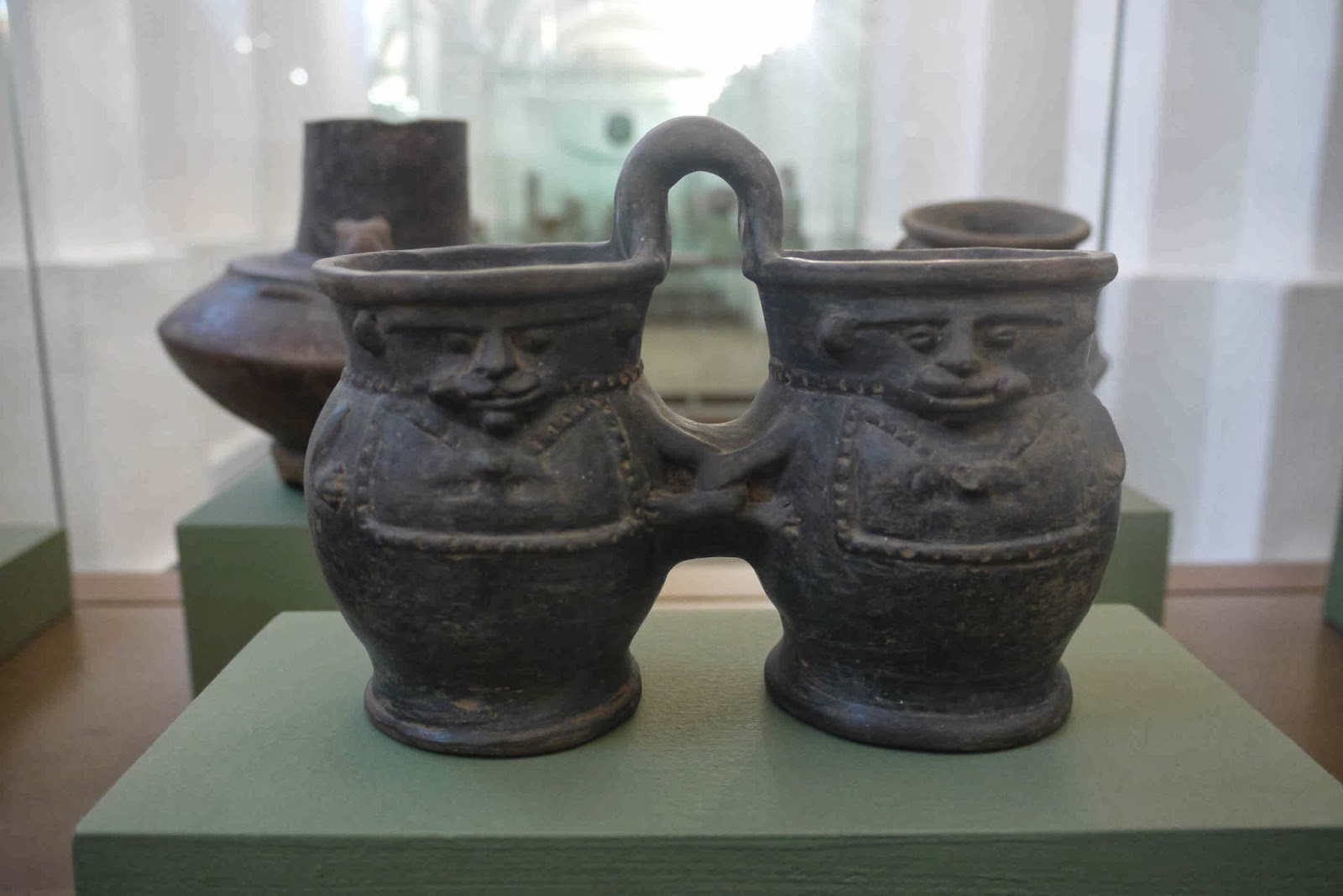
Tayrona pots. 
Foundations of Tayrona homes near Ciudad Perdida.
A Tayrona house. 


By Mike Ceaser, of Bogotá Bike Tours